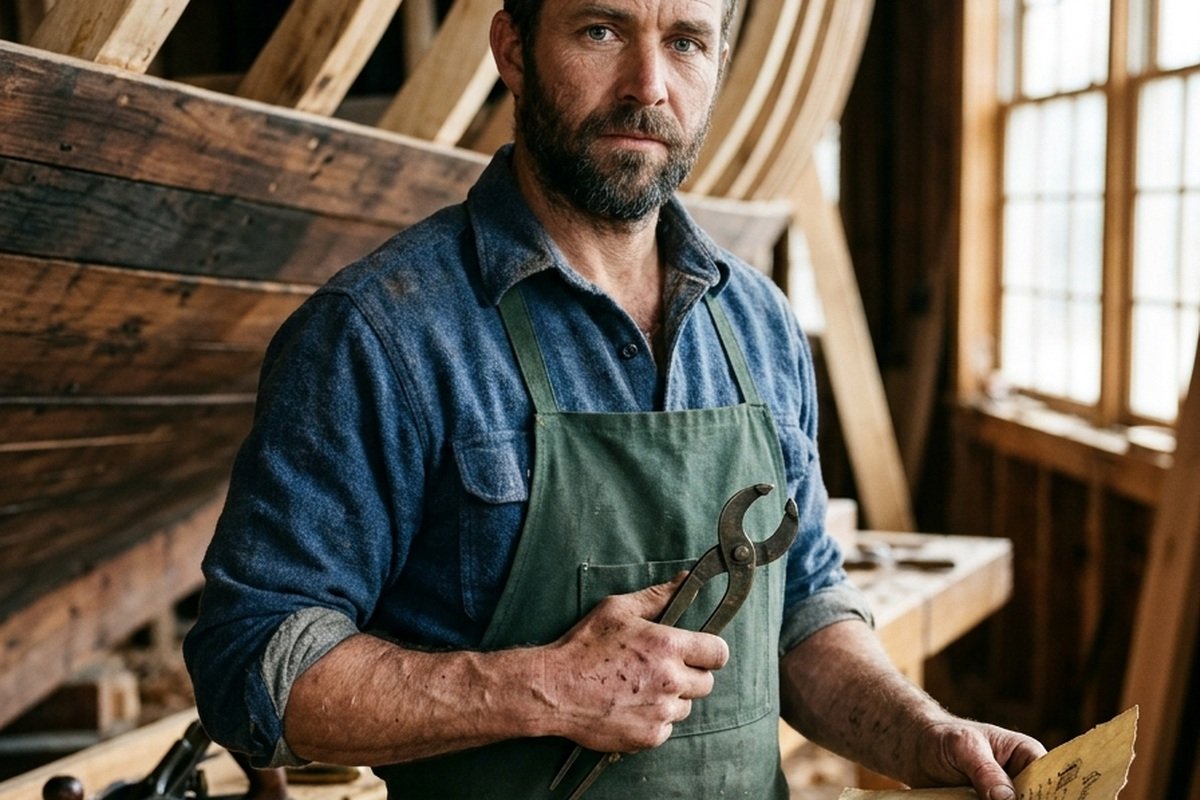
Along the rocky, fog-shrouded coast of Brooklin, Maine, wooden boatbuilding is not merely a trade; it is a sacred covenant forged between northern white oak, salt water, and human honor. My grandfather, Captain Silas Vance, established Vance & Sons Shipyard in 1939 on the sheltered tidal waters of Center Harbor, hand-hewing massive spruce timber pilings and building a sanctuary for traditional wooden maritime craftsmanship. For eighty-five years, our shipyard was revered across the North Atlantic for crafting museum-quality lobster sloops, timber-framed schooners, and coastal yawls. Master mariners knew Silas as the 'Poet of White Oak'—a man who could look at the natural curved grain of a standing timber in the Maine woods and know precisely which rib of a ship's hull it was born to support.
When both of my parents were lost at sea during a catastrophic winter gale off the Grand Banks when I was just fourteen years old, Grandpa Silas took me into his timber boatshop, wrapped his calloused, cedar-scented arms around me, and gave me a life. Over the next sixteen years, he mentored me through a grueling, traditional master guild shipwright apprenticeship. He taught me the complex mathematics of naval lofting on the chalked timber shop floor, the ancient craft of steam-bending two-inch white oak planks where temperature and timing determine whether wood bends like supple leather or shatters under hydraulic pressure, the tactile art of hand-planing Atlantic white cedar strakes to a tolerance of three-thousandths of an inch, and the traditional caulking of carvel seams with boiled pine tar, oakum, and spun cotton. Silas drilled into my mind that every hull built in this shop would carry human lives across freezing oceans, and that a shipwright who cuts a single corner in the joinery is guilty of betraying both God and the sea. He taught me to respect the grain, to honor the forest that provided the timber, and to pour my soul into every copper rivet. I worked beside him seventy-five hours a week, waking at 4:30 AM every morning to check the tidal moorings and fire the cedar-shaving steam boxes.
While my childhood peers left Maine for corporate finance careers in Boston or real estate firms in Portland, I chose to dedicate my life to preserving Silas's generational heritage. In 2018, when Silas turned eighty, we formalized our sacred partnership at our kitchen table before the Hancock County Maritime Guild. Silas placed his scarred, weathered hands over the shipyard's original 1939 brass-bound harbor registry and looked into my eyes with tearful gravity: 'Owen, my boy, this boatyard is not real estate dirt. It is living maritime soul. Your uncle Donald turned his back on the sea thirty years ago to chase predatory corporate buyout schemes in Manhattan. Under our registered master operating agreement, you own forty-nine percent operational equity today, and the day God calls me to the deep, the boatyard, the tidal ways, the timber inventory, and our designs pass to you as sole managing trustee.'
Trusting my grandfather's word as an unshakeable moral bedrock, I invested my entire life savings into modernizing the historic yard. Over seven years, I poured two hundred and forty thousand dollars of my own earnings into reinforcing the granite stone seawall, replacing the underwater marine railway cradle timbers, and restoring the boatshop's heart—an authentic 1890 steam-bending kiln and sixty-foot solid white oak keel-bending bed that Silas's own father had salvaged from a Bath ironworks shipyard.
Meanwhile, Silas's elder son—my estranged uncle Donald Vance—lived a life of ruthless corporate predation. Donald was a fifty-six-year-old Manhattan venture capitalist and asset liquidator who had made millions gutting regional maritime manufacturing plants, laying off third-generation craftsmen, and selling coastal waterfront properties to private equity luxury marina syndicates. Donald despised our wooden boatyard, openly sneering that Silas was a 'stubborn old fool who hoards four million dollars of prime yacht club deep-water frontage to build wooden canoes for tourists.' For over fifteen years, Donald had refused to step foot in Brooklin, never visiting on holidays, ignoring Silas's birthdays, and never once calling to ask about his father's failing health.
The nightmare struck on a freezing Tuesday morning in early November. Grandpa Silas and I were working on the final planking of a bespoke thirty-four-foot wooden daysailer commissioned by a historical maritime preservation trust. As Silas lifted a heavy bronze fastener drift to secure an oak garboard strake, he suddenly gasped, clutched his chest, and collapsed heavily against the timber hull. I caught his frail body before he hit the cedar-shavings floor, dialing emergency services with trembling hands while performing mouth-to-mouth resuscitation on the cold dock.
The emergency medical helicopter transported Silas to the cardiac and stroke trauma unit at Eastern Maine Medical Center in Bangor. The chief neurovascular surgeon delivered a crushing prognosis: Silas had suffered a severe basilar artery thrombotic stroke resulting in extensive cerebral ischemia. To stabilize his failing neurological vitals, the surgical team placed him on a mechanical ventilator and induced a medical coma. 'Owen,' the doctor whispered in the fluorescent hallway, 'the next seventy-two hours are critical. His neurological recovery is uncertain, and he is completely medically incapacitated.'
I spent the night in a vinyl chair in the ICU waiting room, praying over Silas's still form, holding his cold hand. At 7:00 AM the following morning, exhausted and emotionally shattered, I drove the two hours back to Brooklin to secure our marine railway winches and check on the shipyard's vintage shop cat. But as my truck rounded the coastal cove road overlooking Center Harbor, the sight that greeted me turned my blood to absolute ice.
The heavy cedar-log entrance gates of the 85-year-old shipyard had been wrapped in thick hardened-steel industrial tow chains secured by oversized yellow commercial padlocks. Standing along the perimeter fence were four private armed security guards wearing tactical black uniforms and carrying sidearms. Parked on the gravel courtyard was a sleek black luxury SUV bearing New York corporate executive plates, alongside a white commercial flatbed truck loaded with hydraulic demolition jacks and heavy structural core-drilling rigs.
I slammed on my brakes, jumped out of the truck, and ran toward the iron gates, shouting for the guards to step back. Out of the boatshop's heavy sliding timber barn doors stepped Uncle Donald. He was impeccably groomed in a five-thousand-dollar tailored vicuña overcoat, Italian leather driving gloves, and designer sunglasses, holding a steaming espresso paper cup in one hand and an embossed red-backed legal portfolio in the other. Beside him stood a slick, arrogant Manhattan real estate attorney carrying a leather briefcase. Donald looked at me with cold, amused condescension, as though I were an annoying stray gull hovering over his private dock.
'Owen,' Donald drawled smoothly, taking a slow sip of his coffee. 'I was wondering when the little boat carpenter would show up. Save your breath and turn around. You are officially trespassing on private commercial waterfront real estate owned by Vance Harbor Developments LLC.'
'Donald, what on earth are you doing?' I roared, my hands gripping the frozen steel chains of the gate. 'Grandpa is lying in an induced coma on a mechanical ventilator in the Bangor ICU fighting for his life! This yard is our family's living heritage, and under our operating agreement, I am forty-nine percent owner and master operating shipwright!'
Donald barked a harsh, mocking laugh that echoed across the quiet harbor waters. 'Master shipwright? Let us be practical adults, Owen. My father is eighty-six years old with a flatlined brain and a failing heart. He will never leave that hospital bed alive, and even if by some miracle his eyes open, he is legally incapacitated.' Donald's lawyer, Harrison Croft, stepped forward and slid an unsealed court document between the wooden pickets. 'Mr. Vance,' Croft stated with icy corporate precision, 'we have filed an emergency probate petition in the Hancock County Probate Court based upon Silas Vance's executed Last Will and Testament dated August 14, 2003, naming Donald Vance as sole executor and primary universal heir.'
I looked down at the 2003 will. It was an ancient, obsolete instrument Silas had drafted over twenty years prior, before Donald had defrauded our family business of one hundred and fifty thousand dollars to cover Wall Street margin calls and abandoned the state of Maine forever. Donald smiled with sickening, predatory triumph: 'You see, Owen, my father was too careless to update his legal paperwork. While you were wasting your youth cutting wooden boards and smelling fish like an uneducated peasant, this four-acre deep-water harbor frontage appreciated to astronomical levels. Yesterday afternoon, while you were crying in the Bangor ICU waiting room, I executed a binding four-million-two-hundred-thousand-dollar contract with an international marina syndicate to demolish these drafty timber sheds and construct a sixty-slip luxury mega-yacht facility.'
Donald pulled a certified bank draft from his breast pocket and tossed it casually through the gate into the gravel. 'There is a five-thousand-dollar relocation gratuity. You have two hours to pack your personal clothes from the loft. Everything else—the antique hand-carved half-models, the shipwright tools, the white oak timber reserves, the steam kilns—is commercial salvage. The heavy bulldozers arrive on Monday morning. If you step across this boundary line again, my armed guards will have you arrested for felony criminal trespass.'
The cold, calculating arrogance in his voice was sickening. He genuinely believed that money and corporate ruthlessness could erase eighty-five years of maritime blood, sweat, and devotion. I looked at the five-thousand-dollar check lying in the gravel, looked straight into Donald's dead eyes, and said: 'Donald, you don't know this harbor, you don't know Silas, and you certainly don't know me. You will not touch a single timber of this shipyard.' Donald smirked, signaled his tactical guards, and turned his back, disappearing inside our sacred workshop.
Shaking with grief and incandescent fury, I immediately drove to downtown Ellsworth to the law offices of Margaret Holloway. Margaret was a revered seventy-year-old maritime admiralty and trust litigator who had represented three generations of Maine boatbuilders and fishermen's cooperatives. Margaret had known Silas for over forty years and had personally attended our schooner launchings. When I recounted Donald's armed takeover of the shipyard and presented the 2003 will, Margaret's weathered face hardened into cold flint.
'Owen, listen to me very carefully,' Margaret said, leaning across her oak conference table. 'Donald is banking on that 2003 will because it was the last instrument formally indexed in the public county probate registry. But in September of 2021, when Silas underwent cardiac stent surgery, he came to this very office. Silas was brilliant, meticulous, and fiercely protective of your future. He knew exactly what kind of vulture Donald was.'
Margaret opened an encrypted digital case file on her computer. 'On September 22, 2021, Silas executed the Silas Vance Master Maritime Living Trust—a fully comprehensive, irrevocable generational trust. Under its terms, Silas transferred one hundred percent ownership of the shipyard, the tidal water rights, the shoreline docks, the machinery, and all vessel designs directly into the trust, designating you as the sole irrevocable successor trustee with immediate, non-revocable vesting upon Silas's medical incapacitation or death.'
I felt an immense weight lift from my chest, but Margaret raised a hand to caution me. 'There is a critical legal challenge, Owen. Under Maine trust law, to quash Donald's probate petition and obtain an immediate emergency injunction halting the demolition contract, we must present the certified, wet-ink original master trust deed bearing Silas's notarized signature and the official State of Maine embossed notary seal. Silas insisted on keeping the original deed in his own possession. Do you know where he secured it?'
My mind raced through Silas's habits. Silas distrusted commercial bank vaults; he believed banks could be manipulated by corporate freezes. Then, like a flare cutting through thick sea fog, a memory from three years ago illuminated my thoughts. One freezing winter evening, while we were shaping the massive forty-foot white oak keel timber for a coastal schooner on the 1890 bending bed, Silas had tapped the center keelson mortise with his bronze chisel and whispered with a knowing smile: *'Owen, remember this: the only timber that never rots and never betrays a sailor is the keel. What holds the ship together in a storm will hold your life together when the scavengers circle.'*
At 2:00 AM that night, under a starless coastal sky, I executed our silent counter-strike. Accompanied by my childhood friend Caleb, a commercial lobster boat captain who knew every rock and tide in Center Harbor, we bypassed Donald's perimeter guards by approaching from the seaward side. We cut the engine of Caleb's skiff, muffled our oars with canvas, and glided beneath the shipyard's low-tide marine railway pilings. Slipping through the tidal slipway trapdoor, we entered the dark boatshop basement.
Using a specialized mechanic's endoscope and a brass hex-key driver, I removed the false mahogany plug concealing the deep center keelson mortise inside the sixty-foot 1890 white oak steam-bending timber. Tucked deep within the dry, seasoned heartwood was a heavy, waterproof brass maritime chronometer casing. I unscrewed the threaded brass lid with trembling fingers. Inside lay Silas's certified, wet-ink 2021 Irrevocable Maritime Living Trust deed, accompanied by the registered warranty deed conveying the shipyard real estate, complete with blue silk ribbons and the Great Seal of the State of Maine.
Seven hours later, on Monday morning at 8:30 AM, the courtyard of the Vance & Sons Shipyard was staged for a spectacle of corporate arrogance. Donald had arranged a grand public 'Demolition & Groundbreaking Launch' for his luxury marina development. Over seventy people were present: local coastal reporters, commercial yacht brokers from Boston, representatives from the international private equity syndicate, and two massive hydraulic excavators with demolition claws idling loudly by the timber sheds.
Donald stood behind a raised podium draped in architectural renderings of 'The Vance Harbor Luxury Yacht Club & Marina.' He was smiling broadly, holding a ceremonial chrome-plated sledgehammer, basking in the flashing cameras of local business journals. 'Ladies and gentlemen,' Donald announced into the microphone, his voice dripping with triumphant vanity, 'today we close the book on an obsolete, decaying wooden relic of the past and usher in a modern four-million-dollar future for Center Harbor.'
As Donald raised the chrome sledgehammer toward the historic timber boatshop doors, a blaring police siren cut through the morning air. Two marked cruisers from the Hancock County Sheriff's Department pulled sharply into the courtyard, followed by Margaret Holloway's car and my pickup truck. Sheriff Wayne Billings, a veteran lawman who had known Silas Vance for fifty years, stepped out of his cruiser accompanied by Senior Assistant District Attorney Marcus Albright.
I stepped out of my truck, dressed in my clean work denim, carrying the certified blue-backed 2021 Master Living Trust portfolio in my hands. Margaret Holloway walked directly to the podium, flanked by Sheriff Billings. 'Shut down those excavator engines immediately!' Sheriff Billings commanded through his cruiser's megaphone. The roaring diesels sputtered into silence. The courtyard froze in stunned disbelief.
Donald's face flushed with fury as he gripped the microphone: 'Sheriff, arrest this trespasser immediately! I am the court-appointed executor of this estate, and this boy is disrupting an authorized commercial demolition!'
Margaret Holloway stepped up to the podium, her resonant voice cutting through the silent harbor and directly into the media microphones: 'For the record and for the assembled press: Mr. Donald Vance holds zero legal authority over this property. Two hours ago, Judge Arthur Sterling of the Maine Superior Court, Probate Division, entered an emergency emergency injunction and restraining order against Donald Vance, Vance Harbor Developments LLC, and their subcontracted demolition firms.'
Margaret held up the certified court order and displayed the high-resolution deed scans on the media monitors: 'On September 22, 2021, Silas Vance executed a valid, irrevocable living trust that transferred one hundred percent ownership of this shipyard, its shoreline, its machinery, and its archives into the Silas Vance Maritime Trust. Under the express statutory terms of that trust, Owen Vance became the sole, absolute managing trustee the moment Silas was hospitalized. Donald's 2003 will is legally null and void, completely superseded by operation of Maine trust law.'
The development syndicate executives looked at the certified court order, gasped in horror, and immediately confronted Donald's lawyer. 'You guaranteed clear and undisputed title!' the lead developer shouted, visibly sweating. 'Our earnest deposit is one hundred thousand dollars!' In front of five television news cameras, the developers tossed their contracts onto the gravel, turned on their heels, and fled the courtyard in disgust.
Donald stood frozen behind the podium, his arrogant smirk replaced by a mask of sheer, unadulterated panic. His hands shook violently as he dropped the ceremonial sledgehammer onto the gravel with a hollow clatter. 'This is an ambush!' Donald stammered, his voice cracking. 'That trust is a fraudulent forgery concocted by an uneducated boat carpenter!'
Senior Assistant District Attorney Marcus Albright stepped forward, unbuttoning his overcoat and pulling a thick criminal indictment dossier from his briefcase. 'Mr. Vance,' Albright announced, his voice cutting through the frozen courtyard, 'we have spent the last forty-eight hours reviewing the emergency probate petition you filed in Hancock County on Friday. Our forensic document examination laboratory has verified that the signature addendum attached to your 2003 will was a forged instrument generated using an autopen plotter.'
Sheriff Billings stepped decisively behind Donald, twisting the arrogant liquidator's arms behind his back and snapping heavy steel handcuffs around his wrists with a cold, metallic click that echoed across the water. 'Donald Vance, you are under arrest on charges of felony forgery, filing fraudulent public documents, attempted grand larceny in excess of one million dollars, and commercial extortion.' As the cameras flashed and recorded every second of his public humiliation, Donald was escorted into the back of the sheriff's cruiser, his designer vicuña overcoat stained with road slush.
The legal and financial destruction of Donald Vance was swift, total, and irreversible. Within forty-eight hours, the international development syndicate filed a four-million-dollar civil fraud lawsuit against him, securing an immediate emergency freeze on his personal bank accounts and corporate assets to recoup their forfeited investments. Facing overwhelming forensic evidence and facing up to seven years in state prison, Donald was forced to enter into a binding, court-supervised plea agreement: five years of supervised criminal probation, five hundred hours of mandatory community service cleaning coastal public docks, a permanent lifetime criminal restraining order barring him from approaching within one thousand yards of Owen or the boatyard, and a court-ordered restitution payment of one hundred and sixty thousand dollars to reimburse the legal fees incurred by the shipyard.
Furthermore, the Maine Department of Marine Resources permanently revoked all commercial licenses associated with Vance Harbor Developments LLC, barring Donald from acting as a corporate fiduciary or waterfront developer in the state of Maine for life. Stripped of his reputation, abandoned by his corporate partners, and facing financial ruin, Donald fled back to Manhattan in total disgrace, his name permanently blackened in the maritime and commercial development communities.
Ten days after the public reckoning in the courtyard, a true miracle occurred. In the quiet, sun-drenched recovery wing of Eastern Maine Medical Center, Grandpa Silas's vitals stabilized. His eyes fluttered open, his cardiac and neurological function rallied through sheer resilient grit, and his first whispered words to me as I held his calloused hands were: 'Owen… did you find the brass case in the keel?' Tears of joy poured down my cheeks as I pressed his weathered hands against my forehead and replied: 'Yes, Grandpa. The truth was right where you left it. The shipyard is safe forever.'
By spring, Silas was discharged from the hospital, walking back into the timber boatshop with the aid of a hand-carved white oak cane. Together, we celebrated the shipyard's eighty-fifth anniversary not with commercial developers, but with over three hundred local fishermen, master boatbuilders, naval historians, and coastal neighbors who gathered along our tidal slipway for an open community feast.
Silas formally stepped down as master shipwright, transferring the master guild adze and lofting tools to me in an emotional ceremony before the assembled crowd. I restructured the boatyard into a permanent non-profit educational and preservation trust, establishing the Silas Vance Maritime Apprenticeship Program. Using the restitution funds recovered from Donald, we fully funded four annual full-tuition apprenticeships for young, aspiring shipwrights from working-class coastal families across Maine, ensuring that the sacred art of wooden boatbuilding will thrive for another century.
Today, the aroma of steamed white oak, pine tar, and cedar shavings fills the air of our historic timber shop. The tide gently laps against the granite seawall as our 1890 steam bending kiln hums with gentle, radiant warmth. Grandpa Silas sits in his favorite cedar armchair near the sunny slipway doors, sipping hot black coffee, watching four eager young apprentices learn the sacred art of hand-planing a boat's strakes.
True heritage cannot be demolished by greed, seized by armed guards, or forged by selfish vanity. It is forged in the fire of honest labor, preserved by unbreakable family covenants, and passed from loving hands to faithful hearts. As long as the Atlantic tides rise and fall along the coast of Maine, the wooden ships of Vance & Sons will sail unbroken, seaworthy, and proud.