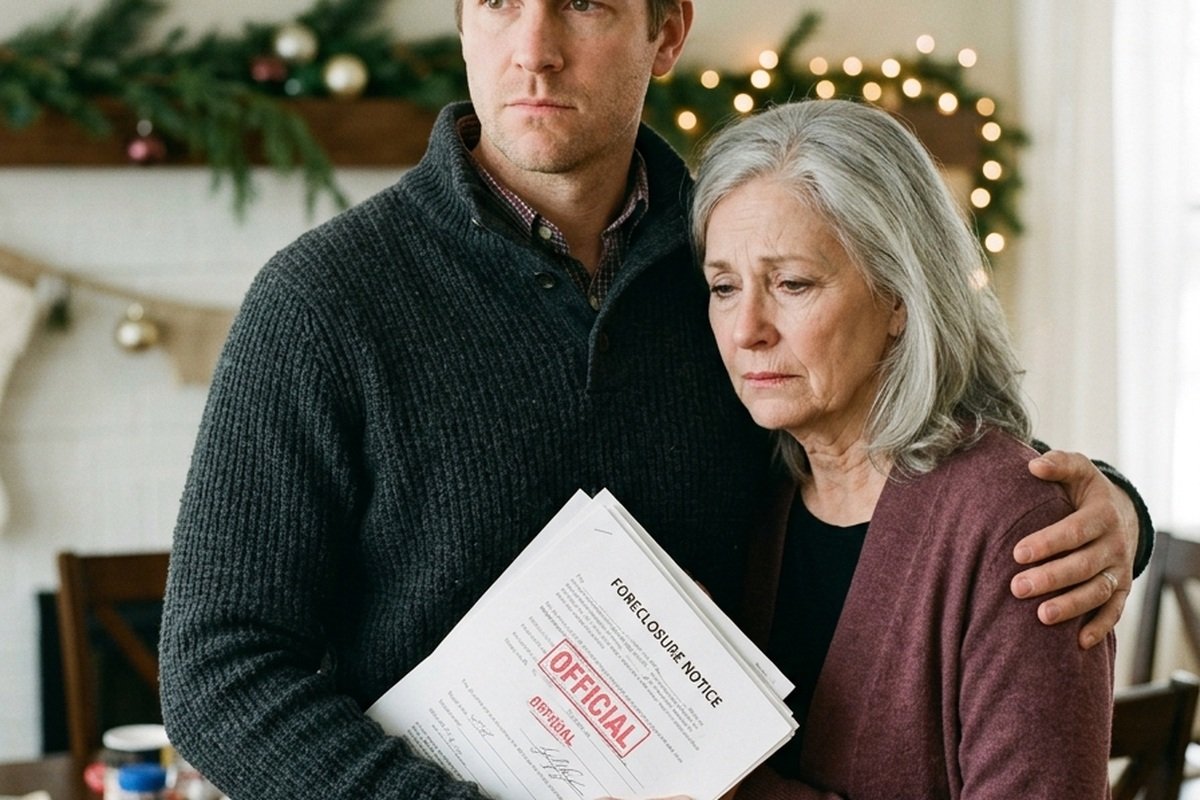
The collection notice said I owed $1,840 for a storage unit I had never seen.
It arrived on a Tuesday between a water bill and a grocery coupon, addressed to Nina Cole, co-lessee, Unit 418. The last line warned that the contents could be sold if the balance was not resolved within thirty days.
I assumed it was a mistake until I called the number and the facility manager asked whether my sister Kara was still authorized to speak for me.
“She has never been authorized to speak for me,” I said.
Mister Bell went quiet. Then he read back an email address I had stopped using two years earlier and the last four digits of my driver’s license.
Kara had both. I had sent her a license copy when we rented a moving truck after our mother died.
Mister Bell would not discuss the unit by phone, but he agreed to meet me that afternoon. I drove across town with the collection notice on the passenger seat and a growing pressure behind my eyes. Kara and I had argued about money before. She borrowed late and repaid later. She rounded down what she owed. She had never attached my legal name to a contract.
The facility sat behind a row of auto shops. Mister Bell led me into a small office and placed the unit contract under a clear plastic shield. Kara was listed as primary renter. I was listed as co-lessee and alternate payer.
The signature beside my name was a digital scribble. Under identification, the file contained the same license copy I had sent for the truck.
“Did anyone speak to me?” I asked.
He opened the access log. Kara had signed in every time. My name appeared only on the contract and three automatic notices sent to the dead email address.
Mister Bell said the unit had been current for six months, then unpaid for three. Kara had told the office I was handling the balance because she was traveling.
“She works four blocks from here.”
He did not defend her. He gave me a fraud-dispute form, froze the sale process for ten business days, and said I could view the unit only if Kara came or provided written permission. As he turned the screen toward me, I noticed the inventory description: household textiles, books, personal papers.
Kara had told the family she rented the unit for leftover supplies from her event business.
I called her from the parking lot.
She answered on the fourth ring and said, “I was going to fix it Friday.”
“What is in Unit 418?”
“Business things.”
“The contract says household textiles and personal papers.”
Her breathing changed. She asked where I was. When I told her, she said she could be there in twenty minutes.
Kara arrived with our brother Marcus. That frightened me more than if she had come alone. Marcus carried the expression he used when he had already heard one version of a family crisis and expected the rest of us to cooperate with it.
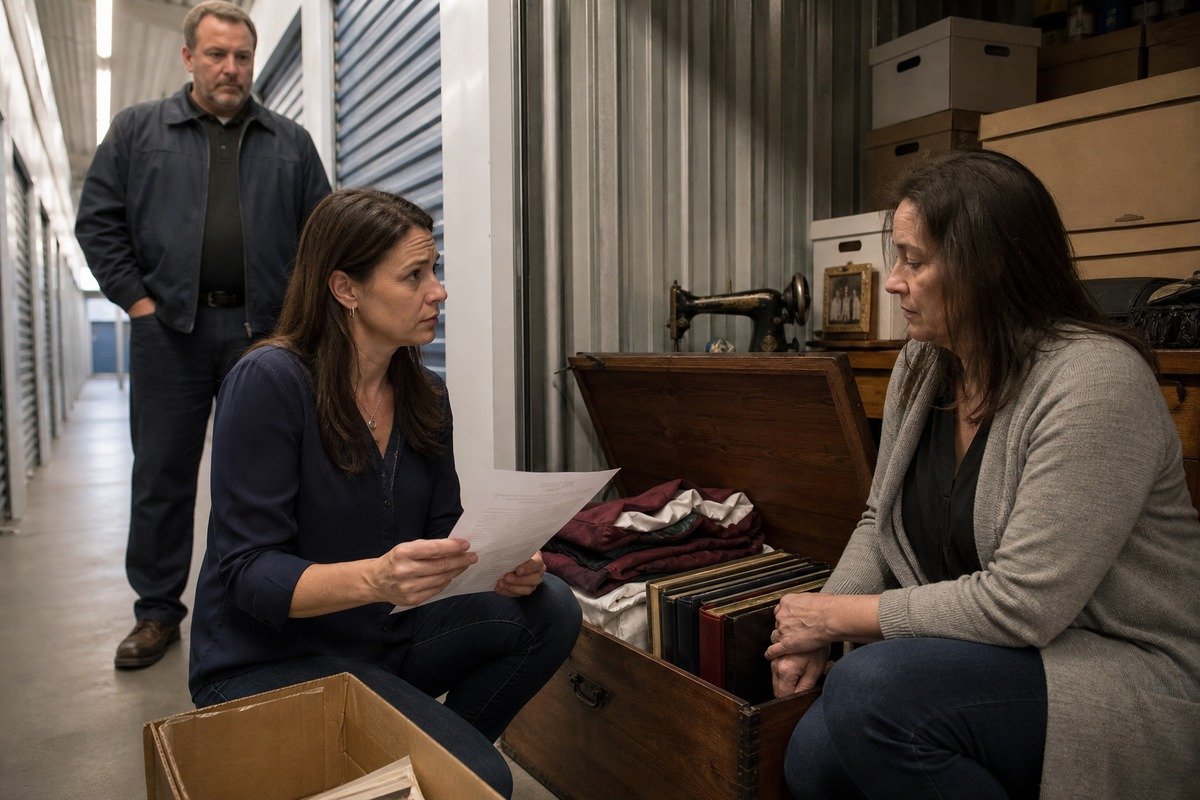
Kara signed the access form. Mister Bell walked us down a concrete corridor and lifted the metal door.
There were no table linens from her business. The first rack held garment bags labeled with our mother’s church name. Inside were her choir robes. Behind them stood twelve boxes of photo albums, recipe cards, tax folders, and letters. Her blue sewing machine sat beneath a folded quilt. A cedar chest that our aunt Celia had been asking about for months was pushed against the back wall.
After Mom’s funeral, we had agreed to sort those things together. Kara told us water had leaked into her basement and ruined most of them before we could meet.
Marcus pulled a photo album from a box. The pages were dry.
“You said these were gone,” he said.
Kara sat on the cedar chest and covered her face.
The storage unit had started as a hiding place, not a financial scheme. She could not bear our plan to divide Mom’s belongings. Aunt Celia wanted the choir robes donated to the church archive. Marcus wanted the sewing machine for his daughter. I wanted the letters scanned so everyone could keep copies. Kara heard every suggestion as another piece of Mom leaving.
She rented the unit nine months ago and moved everything before telling us the basement story. She added my name because the facility required an alternate contact. When her event work slowed, she stopped paying. She believed using my old email would buy her time without actually costing me anything.
“A debt in my name is a cost,” I said. “A lie about Mom’s things is a cost.”
Kara said she planned to catch up after a corporate event paid. The event was canceled. Then each missed month made confession harder.
Mister Bell reminded us the fraud freeze did not erase the balance. The contract had to be corrected, the debt assigned, and the contents either moved or paid for. He would document that I had never used the unit, but Kara needed to sign a statement acknowledging that she submitted my information without consent.
She flinched at the word fraud.
I flinched at the idea that protecting her from an accurate word might become my next unpaid obligation.
We did not solve it in the corridor. We closed the door and met that evening at Marcus’s house with Aunt Celia on video. Kara tried to begin with grief. Marcus told her grief explained the boxes but not my name on the unit contract.
Aunt Celia asked to see the choir robes. When Marcus held one to the camera, she cried. She had spent nine months believing the robes were destroyed. Her crying stripped away Kara’s claim that hiding the objects had preserved them for the family. Kara had preserved control over them.
I placed the collection notice, the access log, and the contract on the table. We separated three decisions.
First, I would file the identity dispute. Kara would sign the facility’s statement and provide the original payment records. My name and license copy had to be removed from every account field.
Second, the $1,840 belonged to Kara. Marcus helped her build a repayment plan using the deposit from her next two confirmed events. I would not lend the money or guarantee the plan.
Third, Mom’s belongings would not remain leverage for the debt. We scheduled a family inventory day for Saturday. Nothing would be divided, donated, or discarded until every box was photographed and listed.
Kara accused us of turning mourning into administration.
“You turned it into a secret lease,” Marcus said. “A list is how we get it back into the family.”
Saturday became the most difficult useful day we had spent together since the funeral. At the facility, we opened every box on folding tables. Aunt Celia came in person and identified the choir robes by year. Marcus’s daughter tested the sewing machine. I scanned letters while Kara read Mom’s notes in the margins of church programs.
The inventory exposed another truth: Kara had not hoarded everything equally. She had packed the objects from Mom’s last healthy years near the door and buried the hospital folders at the back. She was not only avoiding division. She was editing the version of grief she could tolerate.
That realization softened me, but it did not change the paperwork.
On Monday, Kara signed the correction. Mister Bell removed me as co-lessee and sent written confirmation that the account was disputed as unauthorized. The facility accepted Kara’s repayment plan and waived the sale fee, but not the rent. She paid the first installment herself.
Before we left, I asked him to compare the corrected record with the original screen while Kara and I watched. The alternate-payer field was blank. My old email and license digits no longer appeared in the customer profile. Kara's current address, not mine, received the repayment notices. He printed the account history and stamped the correction date on both copies. Kara asked whether that much documentation was necessary. I said it was the first consequence that did not depend on either sister remembering the day in the same way. She folded her copy into her bag instead of arguing.
We closed the unit twenty-one days later. The choir robes went to the church archive with Aunt Celia’s approval. Marcus took the sewing machine after Kara photographed its serial number and tucked Mom’s instruction card inside. Each sibling received digital copies of the letters and photo albums. Kara kept the cedar chest and three boxes of kitchen things, under a written list everyone had seen.
The access log and corrected unit contract stayed in my files. So did the repayment plan, not because I intended to police her payments, but because our family had spent too long treating documentation as an insult to love.
Kara and I did not return to normal immediately. For several weeks, our calls were practical and brief. She sent me each facility receipt without being asked. I answered without praising her for paying a debt that was hers.
Two months later, she invited me to help label the scanned photographs. Before opening the first folder, she said, “I thought keeping all of it together meant I was keeping us together.”
I told her the opposite had happened. She had made the rest of us mourn objects that still existed and made me responsible for a bill I never owed.
Then we labeled the photographs anyway.
Repair did not require pretending the storage unit was a misunderstanding. Because secrecy had assigned me both the debt and the rescue, repair required Kara to carry the financial consequence, the family to reclaim the truth, and me to stop confusing rescue with forgiveness.