The first email called me “the chef behind three hundred plates.”
I was not a chef. I ran a neighborhood cooking class twice a month and had agreed to make dinner for forty volunteers at the library’s annual book drive.
The committee turned that dinner into a ticketed fundraiser without asking me.
Committee chair Paula sent the promotional email on a Thursday morning. It featured my photograph from last year’s class, a menu I had mentioned casually, and a promise of three courses prepared by “local culinary educator Mina Shah.” Tickets cost seventy-five dollars. Two hundred eighty-four had already sold through an early-access list.
I called Paula before finishing the email.
She said demand surprised everyone. The library needed twelve thousand dollars to replace damaged children’s books, and my lentil dumplings had been popular at a volunteer lunch. The venue ballroom held three hundred, so the committee expanded the event.
My cooking-class kitchen held six burners.
I had no catering license, commercial insurance, staff, refrigeration plan, or supplier contracts for three hundred meals. The menu included yogurt and sesame, both requiring careful allergen and temperature controls.
Paula said the hotel would provide a kitchen.
The hotel contract included only room rental, tables, and dishwashing. It specifically excluded food production by unlicensed outside vendors.
“We will find helpers,” she said.
Helpers did not turn a volunteer promise into a compliant catering operation.
I asked her to stop ticket sales and remove my name. She said refunds would destroy the fundraiser and make the library look disorganized. She wanted me to wait until the committee met that evening.
By noon, all three hundred tickets were sold.
My phone filled with messages from former students asking whether I needed volunteers, whether the menu could accommodate allergies, and whether the ticket included wine. I could not answer because none of those decisions existed. Paula had created an event detailed enough to collect money and vague enough to leave every operational risk with the person whose name appeared beside the food.
One buyer wrote that she had chosen the dinner for her mother's birthday because my class had been careful about sesame allergies. The advertised menu included sesame without a registration process, ingredient list, or separate preparation area. That message turned a capacity problem into a safety problem. Three hundred people were not simply forty multiplied by volunteers. They required procurement, cold storage, trained service, allergen controls, waste handling, and a licensed entity responsible when something went wrong.
The event page now said SOLD OUT beneath my photograph.
I saved screenshots, the original volunteer email, and my message agreeing to cook for forty. Then I called library director Helen, who had not attended the committee’s planning calls. She believed the food would be donated by a licensed restaurant. Paula’s budget listed “Mina’s Kitchen—community partner” with a zero-dollar fee.
Mina’s Kitchen was the name of my class newsletter, not a registered business.
The committee had converted a newsletter header into a vendor.
Helen opened the budget file and found a vendor code created for Mina's Kitchen. It used the library's address, my public newsletter email, and Paula's phone number. No tax form, insurance certificate, or contract was attached. The finance system allowed the entry because a zero-dollar vendor did not trigger the same review as a paid caterer.
That shortcut mattered beyond the website language. If the event proceeded, deliveries and incident reports would carry a name that looked like my business but led to Paula's phone. Guests would reasonably believe I had accepted professional responsibility. I asked Helen to deactivate the vendor record and preserve an export for the board. Removing my photograph from promotion would not be enough while internal systems still described an organization I had never formed.
At the emergency meeting, treasurer Joel presented the numbers. Ticket revenue totaled twenty-two thousand five hundred dollars. After hotel, printing, payment fees, and entertainment, the projected donation was thirteen thousand eight hundred.
The food budget was nine hundred dollars.
That was three dollars per guest for three courses.
Paula expected grocery stores to donate ingredients once they saw the event’s reach. None had committed. She had used my menu and reputation to sell the capacity first, assuming resources would follow.
Two committee members said they thought I had approved the expansion. Paula had written in the minutes that “Mina is excited to scale with volunteer support.”
I had never seen the minutes.
I told the committee I would not cook for three hundred, lend my name to the event, or supervise unlicensed volunteers in an unfamiliar kitchen.
Paula asked whether I could at least appear and let the hotel produce the menu.
The hotel’s events manager joined by phone. Its kitchen was operated by an exclusive caterer. The caterer could provide a three-course dinner for fifty-eight dollars per person, not including service. Hiring them would consume more than the ticket revenue.
The event was financially impossible as advertised.
The hotel manager walked us through the service requirements. Outside food needed a licensed producer, proof of insurance, temperature logs, and staff approved by the exclusive caterer. The ballroom had no direct path from the teaching kitchen for three hundred hot plates. Renting warmers, linens, and service labor would add costs even if ingredients were donated. Paula's nine-hundred-dollar line did not omit one expense. It omitted the production system.
Joel recalculated the fundraiser in front of us. At the hotel's quoted price, food and service exceeded ticket revenue before entertainment or payment fees. Raising the price was impossible after sale, and calling the difference a donation would misrepresent what buyers purchased. The committee had treated my unpaid labor as the flexible number that made every other contract balance. Once that assumption was removed, there was no hidden bargain to negotiate. The dinner as promised could not be delivered legally or honestly.
Helen paused spending and contacted the library board. We had four options: cancel and refund, convert tickets to donations, redesign the event without dinner, or find a licensed sponsor willing to absorb most of the food cost.
Paula favored calling restaurants and describing the event as a publicity opportunity. I objected to transferring the same unsupported promise to another kitchen.
The next morning, the library sent ticket holders an accurate notice. It said the dinner capacity and culinary arrangement had been announced without confirmed production resources. Buyers could receive a full refund immediately or wait forty-eight hours for a revised event proposal. My name and photograph were removed.
Helen insisted the subject line say EVENT CORRECTION, not exciting update. The first paragraph named the unconfirmed meal and my lack of approval. The refund button appeared before any request to wait. Paula wanted to add that the committee acted with good intentions, but the board removed it because buyers needed facts before context.
We built a response log for questions the notice exposed. Several purchasers had dietary needs entered in a comment box that nobody monitored. One had arranged accessible transport around the advertised dinner time. Another bought six tickets for clients and needed separate receipts if the purchase became a donation. Those messages demonstrated why redesign could not be a simple announcement. Every buyer had made a different decision based on the original promise, and each needed a clear option rather than pressure to protect the library from embarrassment.
Seventy-six people requested refunds on the first day. Online comments called the fundraiser deceptive. One local blog asked whether I had withdrawn at the last minute.
I gave the reporter the original forty-person email and declined further comment. The published correction stated that I had never agreed to cater the ticketed event.
That record mattered because Paula’s version made my boundary look like unreliability.
The turning point came from the children’s librarian, Ava. She asked why the fundraiser needed to imitate a gala. The book drive served families who might never buy a seventy-five-dollar dinner ticket. A public reading marathon with food trucks, used-book sales, and sponsor-matched donations could use the same ballroom and require no single kitchen to feed everyone.
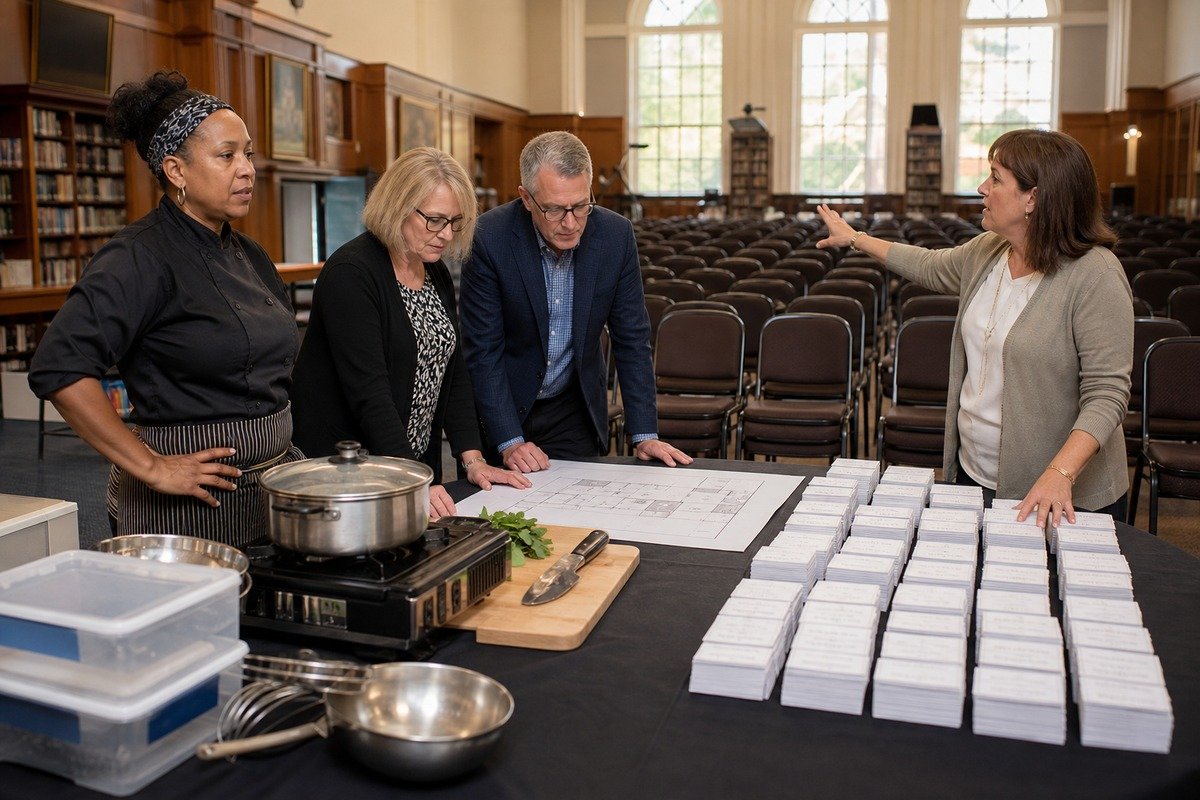
Ava covered the conference table with the library's actual strengths: volunteer readers, repair staff, donated books, family programs, and relationships with licensed food trucks. None required pretending the library had become a restaurant. She sketched a floor plan with a public stage, reading corners, and a small teaching room. The proposal made the cause visible instead of using a dinner to make fundraising feel prestigious.
We tested the idea against each existing contract. The ballroom could remain. The entertainer could shorten the set. Printing could be revised. Payment processing supported partial refunds and donation receipts. Food trucks needed permits but accepted their own payments and liabilities. The redesign did not rescue every dollar or expectation. It converted a set of unsupported obligations into components with named owners, costs, capacities, and exit terms. That was why it could proceed without requiring another person to say yes under pressure.
The hotel allowed the contract to change because the room and date stayed the same. Four licensed food trucks agreed to serve outside, with guests buying directly. The committee replaced assigned dinner tables with reading areas, book-repair demonstrations, and a stage.
Ticket holders received three choices: full refund, convert the ticket into a tax-receipted donation with free event admission, or apply the payment toward a sponsor bundle of children’s books. Nobody was told that refunds would harm the library.
Of the remaining 224 purchasers, 131 converted to donations, 58 chose book bundles, and 35 took refunds. The revised event started with less guaranteed revenue than Paula’s projection but no fictional meal obligation.
I agreed to lead one forty-person dumpling demonstration in the hotel’s licensed teaching room. That was the commitment I had originally made in a different setting, now defined by capacity, equipment, ingredients, and allergen registration.
The committee hired two assistants from my regular program and paid them. Participants watched and sampled one portion; they were not promised dinner.
Paula stepped down as chair before the event. The board found she had altered minutes, used an unregistered vendor name, and continued sales after I told her to stop. She remained a donor but lost authority over contracts and communications.
Joel also accepted responsibility. He had approved a budget with a nine-hundred-dollar food line because he assumed Paula had secured donations. The board adopted a rule that in-kind contributions required written confirmation and fair-market value before appearing in a public event budget.
Before approving the revised event, the board ran a capacity drill in the ballroom. Fire-code seating, accessible routes, food-truck queues, and the teaching-room limit were marked with removable tape. Three hundred people could attend only if arrivals were distributed and the central aisle stayed clear. The committee reduced the stage schedule and issued timed admission windows. For once, capacity was a measured fact rather than a hopeful adjective.
Paula attended the drill as an observer. She apologized to me privately and said she had believed a sold-out event would force sponsors to help. I told her scarcity can pressure vendors just as effectively as it pressures volunteers: once three hundred customers expect dinner, any restaurant that refuses can be cast as the cause of disappointment. She included that point in her written response to the board instead of asking me to keep the conversation private.
She said she feared a modest fundraiser would be ignored. The board recorded that fear as context, not permission.
Paula believed urgency was the reason people donated because spectacle made them notice. She wanted the library protected and feared an ordinary appeal would fail, but that motive still could not authorize promises made with another person's labor.
Joel reconciled every refund against the payment processor. Two purchasers had received duplicate automated receipts, and one book-bundle selection lacked a mailing address. The discrepancies were corrected before the event. Publishing the reconciliation delayed the final fundraising total by four days, but it gave the library a number that did not depend on unclaimed charges or optimistic assumptions.
The reading marathon raised eleven thousand four hundred dollars after refunds and costs. That was less than the original projection and enough to replace most of the damaged books. A sponsor later covered the remainder after seeing the event attendance report.
No one received a three-course dinner. Families read on cushions, children repaired torn practice books, and food trucks sold their own meals under their own permits. My forty participants learned to fold lentil dumplings at four tables.
Before the session, each participant received the ingredient list and allergen notice. The assistants checked registrations at the door and kept prepared filling below the required temperature until the demonstration began. We used color-coded utensils for the sesame-free table and recorded the batch times. Those practices were ordinary in a properly scoped class and impossible in Paula's plan to recruit unspecified helpers for three hundred dinners.
I started by explaining that the session capacity was forty because the room, equipment, assistants, and lesson design supported forty. I did not mention the committee dispute. The number did not need a dramatic defense once the operating facts were visible. Participants worked in groups of ten, tasted one cooked portion, and left with the written recipe. The workshop fulfilled the promise I chose to make without becoming evidence that I could have catered the gala if I had been more generous. Every portion served matched a registered seat and a documented batch.
During cleanup, Helen showed me the final ledger. My demonstration appeared as “capacity 40, licensed room, two paid assistants, written scope attached.” The detail looked excessive only if compared with the sentence Paula had used to create three hundred obligations from one yes.
The forty-person session had its own consequence. Six ticket holders arrived with friends who assumed they could stand at the back. Ava checked the registration list and offered them seats at the public reading instead. Nobody squeezed into the teaching room, and I did not make emergency portions. The boundary disappointed six people for ten minutes and protected forty participants for the full hour. That tradeoff was the operating principle the original gala had ignored.
Three months later, the library formed a new events committee. Volunteers could propose ideas, but no person’s name, photograph, menu, labor, or organization could appear in promotion without a signed scope. Sales could not open until venue, capacity, vendor, insurance, and refund terms were verified.
I continued teaching at the library. My newsletter kept the name Mina’s Kitchen, but the footer now states that it is an educational program, not a catering company. That clarification should not have been necessary. It became useful evidence anyway.
The original sold-out email remains in the board archive beside the revised event plan. One shows what enthusiasm can sell before reality arrives. The other shows what a community can still build after it gives every volunteer the right to define the size of a promise.