The second kitchen was drawn where my reading porch was supposed to be.
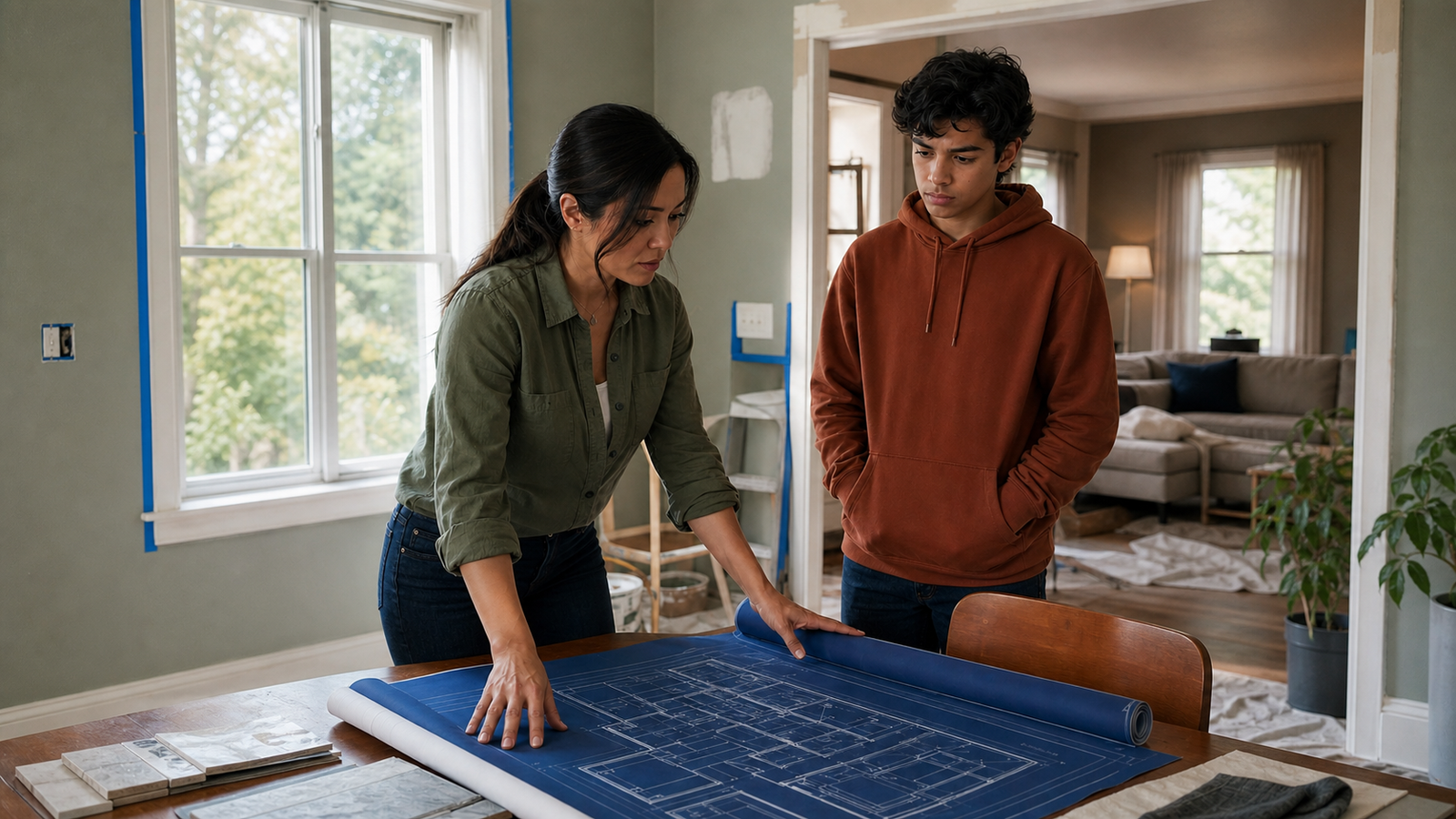
I unrolled the renovation plans across our dining table and stared at two neat rectangles labeled RANGE and SINK. Beyond them was a small bedroom, a wide bathroom, and a separate entrance from the driveway. Someone had designed an apartment inside the home my husband and I had spent three years saving to repair.
Theo had never mentioned an apartment.
His seventeen-year-old son, Julian, stood at the counter eating cereal from a mixing bowl. When he saw the plans, the spoon stopped halfway to his mouth.
That was the first moment I knew the drawings were not a contractor's mistake.
“Where did these come from?” I asked.
Julian set down the bowl. “Dad's office, I think.”
The answer was too fast. The plans had arrived in a plain cardboard tube with our address and no return label. My name was nowhere on them. In the title block, beneath PROJECT RIVERA HOME, someone had typed ACCESSIBLE FAMILY SUITE.
Theo's first wife, Alina, died when Julian was nine. Her mother, Celia, still lived forty minutes away and remained an important part of his life. I respected that. I drove him to her house twice a month, saved her seat at school events, and never asked him to call me Mom.
But Celia had recently learned that her apartment lease would not continue after winter. Theo and I had discussed helping her look for a new place. We had not discussed moving her into ours.
I assumed my husband had made a promise to his former mother-in-law and planned to present it as a finished decision.
That assumption found every old bruise in our blended family. The holiday when Theo changed our travel plans because Celia was lonely. The school ceremony where a photographer asked whether I was “the new mother” and everyone went silent. The afternoons when Julian and Theo spoke about Alina with such easy shorthand that I felt like a guest inside their grief.
I rolled the plans tight, called Theo, and told him to come home before meeting the contractor.
“What contractor?” he asked.
His confusion sounded genuine. I distrusted it anyway.
When Theo arrived, he examined the plans for less than a minute before looking at Julian. “Did you use my project account?”
Julian's face answered before he did.
Theo worked for a building-supply company. Employees could create planning folders for estimates, and Julian had used his father's home login to submit measurements. He had asked a student mentor in his vocational design class to help draw the suite. He had also scheduled a site survey for Monday and paid the reservation deposit from the savings account Alina left for his education.
The amount was six hundred dollars.
Theo became angry about the account and the money. I became angry about the rooms. Julian heard only one accusation: that wanting Celia nearby was a threat to our marriage.
“You said we had space,” he told me.
“I said we could help her find space.”
“You always turn family into a calendar appointment.”
The sentence landed because it contained enough truth to hurt and enough unfairness to make me defensive. I reminded him of every ride, dinner, and school event I had arranged. He said logistics were not belonging.
Theo told both of us to stop. Then he made Julian open the entire project folder.
The drawings included more than a kitchen. The counters were lower. The doorway widths were marked. A tiny desk sat beside a window facing the backyard. Julian had labeled it CELIA'S SEWING PLACE in an earlier version, then deleted her name from the final plan.
There were three cost estimates. None used our renovation savings. Julian had divided his education account into columns and calculated how much he could spend while still covering two years at community college. He planned to work evenings for the rest.
“You cannot spend your future fixing an adult problem,” Theo said.
Julian looked at him with an anger I had never seen. “Which adult is going to fix it?”
Theo had been postponing the conversation with Celia because he feared offering too little. I had been discussing rental listings as though efficiency could remove humiliation. Celia had been telling Julian not to worry while giving away furniture she thought would not fit wherever she went next.
Julian decided that if adults could hide their fear behind polite delays, he could hide a solution inside blueprints.
The reveal did not make his choices acceptable. He had used Theo's account, spent protected money, invited a stranger to survey our property, and designed a permanent change to our home without asking me. Love explained the plan. It did not authorize it.
I told him that plainly.
He pushed away from the table. “So it is no.”
“It is no to this plan,” I said. “That is not the same as no to your grandmother.”
I called Celia before any of us could create another secret on her behalf. Julian tried to stop me, afraid she would feel like a burden. That fear was exactly why she needed to be part of the decision.
Celia arrived carrying a tape measure and the expression of a person prepared to reject charity. She studied the plans longer than Theo had. Then she asked Julian why the sewing desk faced west when afternoon light made it hard for her to see dark thread.
He laughed, then cried. The rest of us followed in less orderly ways.
Celia did not want to live inside our main house. She wanted privacy, a bus route, and enough room for her sewing machine. She also did not want Julian using his education savings. What she had not told us was that she could afford part of a smaller apartment if the family helped with the deposit and moving costs.
The five-room suite was never built.
We canceled the survey. The company returned most of Julian's deposit, and he repaid the small nonrefundable portion by working Saturdays with Theo. That consequence mattered. So did what happened next.
We turned the plans over and made three columns: CELIA DECIDES, HOUSEHOLD DECIDES, and JULIAN MAY OFFER. Celia chose neighborhoods and rent limits. Theo and I chose what support our household could sustain. Julian offered moving help, weekly dinners, and the design of a compact sewing table that would fit beside an apartment window.
My reading porch stayed in the renovation. I changed one part of it myself. Instead of a built-in wall, we installed folding glass doors and a wide path to the driveway. The porch can host Celia's sewing group, Julian's projects, or an evening when I want the room alone. Flexibility felt more honest than a secret apartment assigned to one person forever.
Months later, Julian presented a revised housing project at his school showcase. The model was not our house. It was a small apartment arranged around a tenant's actual choices. Celia sat in the front row. Theo stood behind her. I arrived late from work and found Julian had saved me a chair beside them.
He introduced me as Maya, his stepmother, and the person who taught him that a generous plan could still violate a boundary.
I told him later that he had taught me something too. I had treated his connection to Celia as an obligation to schedule around, not a relationship with its own claim on his future. I could honor that claim without giving it every room in our home.
The original blueprints remain rolled in the back of Julian's closet. We did not frame them as proof of his devotion or destroy them as proof of his deception. They are unfinished work.
So are we.
In a blended family, belonging is not measured by who gets the second kitchen. It is measured by whether every person can enter the hard conversation before someone else draws the walls.