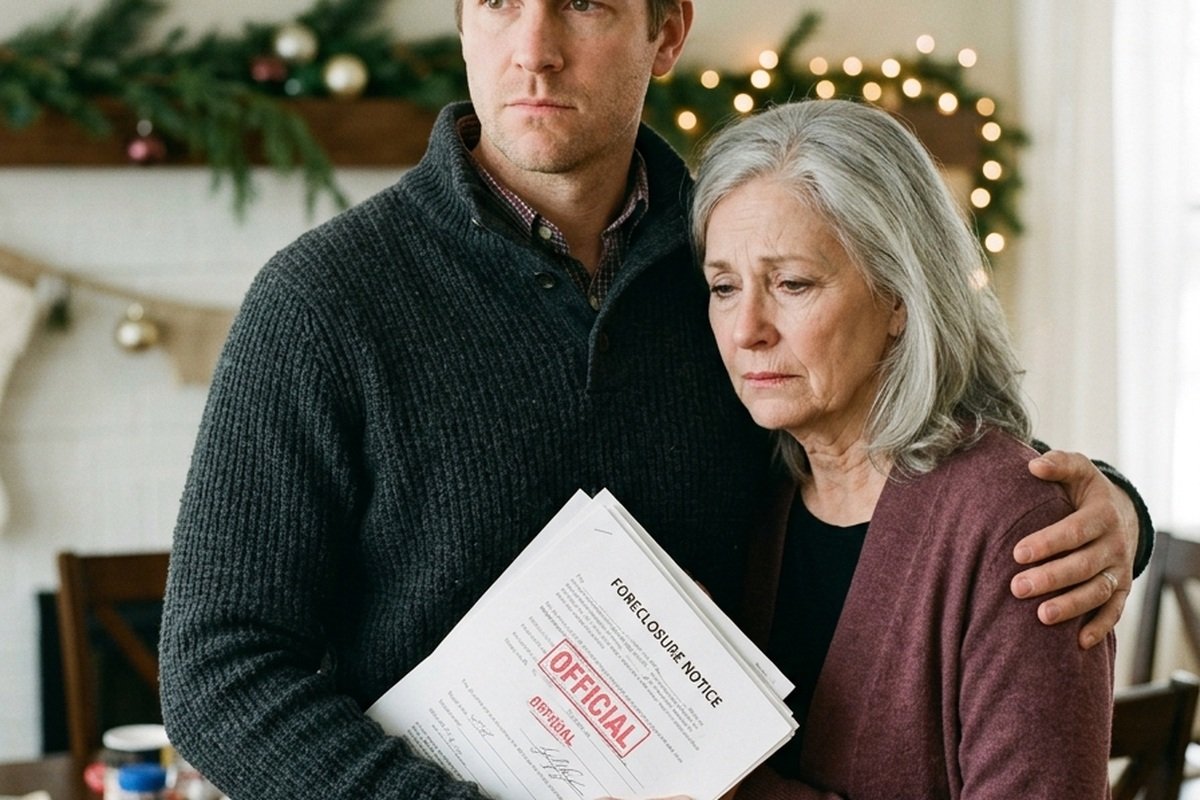
Our mortgage officer called to ask why the down-payment account was missing sixty-four thousand dollars.
I thought she had opened the wrong file.
My husband, Adrian, and I had saved for seven years. We were eight days from closing on a two-bedroom house with a small yard. The lender required a final source-of-funds statement before releasing documents.
Our closing folder contained seven years of deposits. We had saved tax refunds, skipped vacations, and sent part of every paycheck to the account. My grandmother's inheritance appeared as one documented transfer, followed by the letter the lender required to prove its source. Adrian and I had reviewed those pages together because unexplained money could delay underwriting. He understood that the account was not merely a balance. It was a chain of verified promises tied to a date.
We had already chosen paint samples and measured the small yard for a table. The sellers had repaired a railing after inspection, and our movers held a Friday slot. None of those details made the house ours yet. They showed how many people and decisions depended on the funds remaining where we said they were. Adrian later described his transfer as borrowing money for three weeks. The closing file showed he had also borrowed certainty from every arrangement built around it.
The savings account showed one outgoing transfer labeled BRIDGE LOAN—NORTH TABLE.
North Table was Adrian’s brother Mateo’s restaurant.
Adrian was sitting across from me when the officer called. He did not look surprised.
He said Mateo needed money for a replacement walk-in freezer and payroll after a burst pipe closed the dining room. Insurance reimbursement was expected within three weeks. Adrian believed the transfer would return before closing.
He had sent it four days earlier.
Our bank required both signatures to close the account, but either owner could transfer funds online. We had never treated that access as permission to spend the deposit alone.
“You loaned our house to your brother,” I said.
Adrian insisted he had protected both. Without the freezer, the restaurant might fail. Without the restaurant, Mateo’s twelve employees might miss wages. The house closing could move by a few days.
The mortgage officer corrected that assumption. Moving the closing required seller approval, a new bank-statement cycle, and documentation of every returned dollar. A large family transfer days before closing could also change underwriting.
The sellers had a backup offer.
I asked Adrian for the loan agreement.
He showed me a one-page note signed only by Mateo. It promised repayment “upon insurance settlement” and no fixed date. There was no collateral, interest, or approval from Mateo’s business partner.
The note listed Adrian alone as lender, even though more than half the account came from my income and an inheritance from my grandmother.
I matched the transfer against our deposit history while Adrian sat beside me. The amount exceeded all the money he had individually contributed during the previous two years. There was no honest accounting method that could describe it as his portion. He had used a jointly accessible system to make a unilateral loan, then written the document so only his relationship to Mateo appeared.
The note did not identify North Table's legal entity or bank account. It did not require proof of the insurance claim. It had no default terms and no statement that Mateo could bind the restaurant. Adrian said formal conditions would have insulted his brother during an emergency. I told him the absence of conditions did not make the money more generous; it made every other person who depended on it absorb risks they had not seen. That included me, Elise, the lender, and the sellers.
We drove to North Table that afternoon. The dining room floor was open in two places, and fans pushed damp air toward the kitchen. The broken freezer stood empty. Employees were cleaning chairs while Mateo argued with an insurance adjuster on speakerphone.
The emergency was real.
The expected reimbursement was not.
The adjuster separated the claim into categories on a yellow pad. Direct pipe repair was likely covered after the cause was confirmed. Damaged flooring required estimates. Spoiled food depended on maintenance records. Payroll and old taxes were not insurance losses at all. Mateo had compressed those distinctions into one sentence about a check arriving in three weeks, and Adrian had treated the sentence as a repayment schedule.
Elise asked Mateo to show every payment made from the transfer. The freezer vendor received twenty thousand. The tax agency received twenty-seven. Two food suppliers split twelve. The remainder covered payroll fees and an overdue utility bill. No single refund could reverse the transactions. The restaurant had used the house money to survive several obligations, only one of which came from the burst pipe. Seeing the ledger prevented us from solving the story Adrian thought he had entered instead of the business condition that actually existed.
The adjuster said the policy covered water damage but might exclude spoilage caused by delayed maintenance on the pipe. Review could take sixty days. Mateo had received no promise of payment in three weeks.
Adrian had heard the shorter estimate from Mateo before the adjuster inspected.
Then Mateo’s business partner, Elise, arrived. She knew Adrian offered help but believed the loan was twenty thousand dollars. Mateo had used forty-four thousand to cover overdue sales tax and vendor balances unrelated to the pipe.
The reveal changed every possible solution. The money could not be returned by selling the new freezer, because most of it was already dispersed.
Elise opened the restaurant books. North Table had been struggling for eight months. Mateo hid the tax arrears from her and described the transfer as a personal family loan outside company finances. Adrian did not ask for statements because demanding proof felt disloyal during a crisis.
Loyalty had removed the questions that might have protected all of us.
I called the mortgage officer from the closed dining room. The lender could not proceed without restored verified funds. The sellers granted forty-eight hours to show a credible recovery plan, not because they owed us time, but because their movers were already booked.
Mateo offered to borrow against the restaurant equipment. Elise said the equipment already secured a bank line. Adrian proposed using retirement funds. A withdrawal would create taxes and still require underwriting.
I refused to build a second risky transaction to hide the first.
We met a lawyer the next morning. She converted the vague note into a proposed debt acknowledgment, but Elise would not let the company sign until the books were reconciled. Mateo could sign personally, yet his available assets would not restore the deposit in forty-eight hours.
We lost the house.
The mortgage officer called at 4:10, after the sellers' agent rejected another extension. She explained the financing denial in procedural language: verified funds unavailable, repayment source uncertain, underwriting period insufficient. I wrote each phrase down because Adrian kept saying we should explain that the money belonged to family and would return. Family was not a source category the lender could verify.
We drove to the house once more to collect a measuring tape left with the inspector. The sellers' moving truck was in the driveway. Their agent gave us the tape at the gate and did not let us enter because the backup buyer's inspection had begun. Adrian apologized to her, and she said the sellers could not risk losing both transactions. Her answer was not cruel. It placed our emergency inside other people's deadlines. The house became unavailable at a particular hour, not at the vague future moment when Mateo might repay us.
The sellers accepted the backup offer after our deadline. We received our earnest money back because financing failed under the contingency, but we lost the inspection fee, appraisal fee, and the house we had measured for furniture.
Adrian called that consequence unfair because the money was not gone forever.
I told him closing dates exist in the present.
For a week, I stayed with my sister. I did not leave to punish him. I needed distance from the apartment walls covered with packing labels and from every sentence beginning with “when Mateo pays us back.”
Elise and the accountant completed the restaurant review. North Table could survive only by closing lunch service, laying off three employees, and entering a tax-payment plan. Insurance eventually covered part of the pipe repair but none of the old debts.
Mateo signed a five-year personal repayment agreement secured by his share of the business. Elise signed only an acknowledgment that the company had received funds, not a promise that company assets would repay them.
The first payment was four hundred dollars.
Adrian and I began marriage counseling before I returned home. Counselor Diane asked him why he did not tell me after the transfer, when secrecy could no longer help Mateo.
He admitted he planned to replace the money before the final statement and let me believe closing happened normally. If repayment arrived, he wanted to reveal the rescue later as evidence that he could protect both families without causing fear.
The loan was not only a desperate choice. It was also an attempt to avoid my right to object.
Diane asked us to reconstruct what Adrian predicted I would say. He expected me to request the restaurant books, limit the amount, protect closing funds, and possibly refuse. Those were not irrational obstacles produced by panic. They were exactly the controls that would have revealed the tax debt and the uncertain insurance claim. Avoiding my answer was part of how the transfer reached sixty-four thousand dollars.
He also admitted that presenting a successful rescue afterward appealed to him. He imagined Mateo repaying the account, the house closing, and me eventually praising the risk because nobody had been harmed. That imagined ending allowed him to treat secrecy as temporary. Counseling forced him to account for the version in which repayment failed, a version borne entirely by a spouse who had not been allowed to choose. The new financial rules therefore addressed disclosure timing, not just transfer limits. Telling me after money returned would never count as shared decision-making.
Adrian’s father had lost a small grocery store when the brothers were teenagers. Their relatives blamed him for not asking the family for money sooner. Adrian carried a rule from that collapse: if a family business calls, hesitation becomes betrayal.
Diane asked what rule governed promises already made to a spouse.
He did not have one.
We wrote financial controls before combining savings again. Any transfer above two thousand dollars required two approvals. Family loans required financial records, a written repayment date, and a separate account funded only after shared goals were protected. The house fund moved into an account requiring dual authorization.
Adrian sold a motorcycle and put the proceeds toward rebuilding the deposit. I did not count that as repaying Mateo’s debt; it was Adrian accepting part of the loss created by his choice. Mateo’s monthly payments went into the same account but remained tracked separately.
The first monthly statement exposed another disagreement. Adrian wanted to round Mateo's four-hundred-dollar payment up in our budget so the recovery timeline looked shorter. I asked us to record only what arrived. In counseling, Diane made us reconstruct the failed closing from bank statements instead of memory. The exercise showed four moments when Adrian could have told me: before the transfer, after it cleared, when the lender requested verification, and when I ordered moving boxes. Secrecy had been renewed at each moment; it was not one panicked click.
We canceled the storage unit we had rented for the move and sold furniture bought for rooms we no longer had. The dining table lost value because its custom size fit the old house. Adrian handled the listings and transfers, then placed the proceeds in the dual-approval account. Those chores did not equal the lost home. They made the consequence part of his calendar instead of something I managed while he focused on Mateo.
Elise created a monthly dashboard for North Table's tax plan, payroll, and secured debt. I received it because the repayment agreement depended on the business, but I had no authority to direct restaurant decisions. The boundary mattered: documentation let us evaluate repayment without turning me into an unpaid manager of the company Adrian had chosen to rescue.
North Table stayed open in a smaller form. Three employees lost jobs despite the loan. That consequence dismantled Adrian’s belief that spending our deposit had saved everyone. It bought time for a restructuring that should have begun months earlier.
One year later, we had not bought another house. Prices increased, and our budget purchased less than before. We attended open houses but made no offer until the account returned to the minimum our lender required.
The delay changed the kind of home we could consider. The original neighborhood moved beyond our approved range, and interest rates increased. We built a new comparison sheet that recorded not only listing price but the cost of waiting: higher monthly payments, another year of rent, and the fees lost at the first closing. Mateo's debt statement sat beside it, so family repayment could not be discussed as if returning principal erased the timing loss.
Adrian attended every lender call and sent me the bank statements before I asked. When a year-end bonus arrived, we decided together how much entered the house fund and how much remained for emergencies. The routine was deliberately uneventful. Trust did not return through one dramatic repayment. It returned through transactions that were visible before they occurred, including small choices where secrecy would have been easy and produced no immediate discovery.
Mateo paid consistently for twelve months, then missed one payment during a slow season. Under the agreement, he notified us before the due date and added the amount across the next three months. Documentation did not guarantee easy repayment, but it stopped emergency language from rewriting the debt.
Eighteen months after the failed closing, Adrian and I bought a smaller townhouse. At signing, the mortgage officer asked whether the down-payment funds had changed during underwriting.
We both said no.
After closing, Adrian gave me the only key at the title office and waited while the locksmith made the second. It was a small ritual, but he understood why I did not want another shared asset to begin with one person quietly deciding what belonged to someone else. We placed the repayment agreement in the townhouse safe. Mateo still owed most of the balance; a new home did not convert the debt into a sentimental family story.
The old house sometimes appears in online listings when I check neighborhood prices. Someone else planted herbs in the yard. I no longer imagine that the house belonged to us. It belonged to the agreement we were prepared to keep until Adrian made another promise with the same money.
Helping Mateo was not inherently wrong. Treating our shared future as his private emergency fund was.