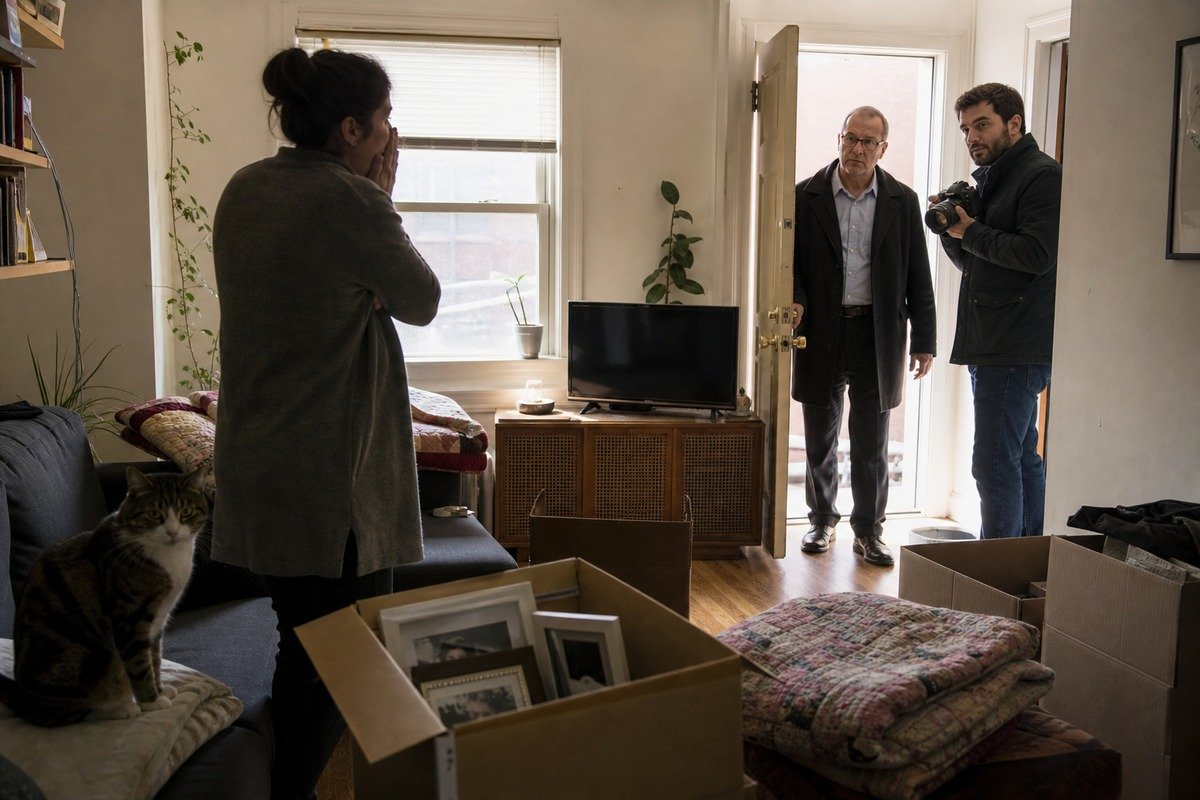
I knew strangers had been inside my apartment because my grandmother’s quilt was folded at the foot of the bed.
I never folded it that way.
The kitchen counter was empty. My medication organizer had been moved into a drawer. Three framed photographs were gone from the living room, and the cat’s water bowl sat inside the laundry closet.
Then I found a glossy card under the sofa: UNIT 3B—STAGED MODEL, TUESDAY PREVIEW.
Tuesday was that day.
My landlord, Warren, had told tenants the building might be refinanced. He had not said it was for sale or that buyers would tour occupied apartments. My lease required twenty-four hours’ written notice for entry except emergencies.
I searched my email and tenant portal. There was no notice.
I began an inventory before touching anything else. The quilt, towels, books, medicine, photographs, cat supplies, mail, and desk equipment went into a list with their original and found locations. The staging crew had not simply tidied. It had decided which parts of my life made the apartment attractive and which parts should disappear. My grandmother's quilt could remain because it looked warm. Her letters became clutter. My dishes were decorative; my prescription information was not.
Juniper's behavior made the entry feel current rather than abstract. She flinched when the hallway elevator opened and crawled behind the refrigerator again when Warren's voice came through the phone. I photographed her full water bowl in the laundry closet because someone would otherwise call it a harmless mistake. A pet shut away from water during three rounds of visitors was part of what unannounced access meant. The lease violation was measured in hours, but the disturbance remained after the key left.
My cat, Juniper, came out from behind the refrigerator and would not eat. Her carrier had been moved from the closet to the balcony. Someone had arranged my books by color and replaced my bath towels with white ones.
I called Warren. He said the real-estate team had used 3B because my apartment received the best afternoon light. He believed the property manager notified me.
The property manager, Lorna, said Warren told her I had agreed in exchange for a rent credit.
No such conversation happened.
Warren arrived with a key and entered after I opened the door. He walked through the apartment praising how good it looked. He said the staging company packed personal items carefully and would return them after photographs were complete.
“Where are the photographs?” I asked.
He pointed to two boxes in the hall utility closet, a common area I could not lock.
Inside were family photographs, prescription paperwork, my laptop dock, tax mail, the cat’s food, and a small wooden box containing my grandmother’s letters. The staging crew had labeled the box PERSONAL CLUTTER.
Warren called that wording unfortunate.
I called it evidence.
The next morning, tenant advocate Simone met me before work. We photographed every moved object, the glossy card, the utility boxes, and the lock log. The electronic entry system showed Warren’s master key at 9:12, 11:48, and 3:06. The building camera showed eleven people entering 3B across those times.
Simone aligned the camera times with the electronic lock and the listing photographer's metadata. The staging crew entered at 9:12 and stayed ninety-four minutes. The photographer arrived at 11:48. The buyer group entered at 3:06 and left at 3:41. Warren's key opened the door for each group, contradicting his first suggestion that a property manager made one mistaken entry.
The lobby log listed the visitors as vendor, media, and inspection. None said buyers. The broker had therefore passed the front desk under a purpose that would not alert an occupied-unit tenant even if I saw the log later. Simone asked the manager to preserve the raw access export before its thirty-day retention period ended. That step mattered because a neat visitor list prepared after a complaint could omit the difference between the stated purpose and the people who actually walked through my bedroom.
The first group was the staging crew. The second included a photographer. The third included six prospective buyers and two brokers.
My home had not been staged only for photographs. It had been shown.
Simone asked whether anyone photographed private documents. I did not know. A listing page already displayed twenty-four images of my apartment. My grandmother’s quilt, furniture, dishes, and bedroom appeared online as features of the property. One close photograph of the desk showed part of an envelope with my full name.
We saved the page before Warren removed it.
The listing appeared on six syndication sites within an hour. Simone captured the page source, image addresses, upload times, and the broker identifier attached to each copy. Cropping differed across sites; one version enlarged the desk enough to make more of the envelope legible. Removing the main listing would not automatically remove those derivatives.
I changed the password on every account whose mail had been in the utility box and called the pharmacy about the prescription sheet. No medication was missing, but the page showed my name, dosage, and refill number. The pharmacy canceled the number and documented why. Warren later argued that nobody had proved a visitor read the paper. The point of the response was that I could not prove they had not. He had created uncertainty around information that should never have left my control, and safe remediation had to respond to the exposure rather than wait for fraud.
The sales broker, Anita, agreed to meet that afternoon. She produced a property-access form signed by Warren. It described Unit 3B as “owner-controlled model unit, currently unoccupied for presentation purposes.”
Warren had represented my occupied home as empty.
Anita said she would never have brought buyers through an occupied unit without notice and consent. Her agency suspended the listing and contacted everyone who attended. Buyers were instructed to delete photographs and notes containing personal information.
One buyer had taken his own video. He had uploaded a short clip to a private investment group. The broker requested deletion, but the group administrator could not confirm whether members downloaded it.
That uncertainty changed the problem. Returning my possessions would not return control over who had seen the rooms, documents, and routines of my home.
I filed a police information report for unauthorized entry and a housing complaint. I did not claim burglary because nothing was missing yet. The record named the entry dates, people, and exposed documents.
Warren offered two months of free rent if I signed a confidentiality agreement and allowed the listing photographs to remain after my name was blurred.
The offer assumed the harm was bad publicity rather than entry without consent.
I declined.
Other tenants learned about 3B through the listing suspension notice. Four checked their apartments. Unit 1A had been photographed from the doorway after notice for a smoke-detector inspection. Unit 4C’s balcony had appeared in a brochure. Neither tenant knew their homes were marketing material.
We formed a tenant group and reviewed entry logs together. The pattern was not eleven secret tours in every unit. It was a broader habit of treating maintenance access as permission to collect sales images.
At a mediation session two weeks later, Warren admitted he selected my apartment because I kept it orderly and worked predictable daytime hours. He believed the sale would benefit tenants by bringing an owner who could afford repairs.
Simone asked why that benefit required saying the unit was unoccupied.
Warren answered that buyers were uncomfortable touring someone’s home.
That was the clearest statement of the choice. Instead of respecting the discomfort as a reason to obtain consent, he removed the tenant from the story.
The mediation produced an enforceable agreement. Warren paid relocation costs if I chose to leave, replaced my lock, funded credit monitoring because documents had been exposed, and provided the full visitor list. The listing agency deleted its photographs and certified removal from its syndication partners.
The building adopted a written entry protocol while Warren remained owner: purpose-specific notice, no photography beyond the stated maintenance need, no personal-item movement, and a tenant-selected witness for sales access. Sales tours could use vacant units only unless an occupant signed a separate agreement.
The protocol received its first test before I moved. A plumber needed access to trace a leak between my bathroom and 2B. The notice named the repair, the plumber, and a two-hour window. Warren's assistant asked whether a broker could measure the bedroom during the same visit because I would already be home. Simone replied that combined convenience did not combine permissions. The broker scheduled a separate measurement, and I declined it. The repair still happened on time.
Anita's agency completed its own review. The photographer had uploaded the original files to a vendor portal that automatically created low-resolution previews for syndication partners. Removing the public listing had not deleted that archive. Anita obtained deletion certificates from the photographer and portal, then sent copies to each affected tenant. One backup remained under a thirty-day disaster-recovery retention policy and could not be selectively erased. The agency documented its expiration date and confirmed deletion afterward. That was the first answer that acknowledged where the images had actually traveled.
The buyer video took longer. The investment-group administrator identified nine members who could access the post. Eight signed deletion confirmations. The ninth had left the group and did not respond. My lawyer advised that we could demand preservation and pursue him, but we could not truthfully claim the clip no longer existed. The settlement therefore recorded one unresolved recipient. Precision was less comforting than a broad promise, but it kept the evidence honest.
My lawyer and I built the protection plan around that uncertainty. The broker preserved the request sent to the ninth recipient and agreed to notify us if the account reappeared. Credit monitoring lasted two years, not because the video clearly showed financial data, but because the still images and utility box established a plausible exposure path. The settlement prohibited anyone from describing deletion as complete while that recipient remained unresolved.
I also asked for the visitor names to be retained under restricted access. I did not want them published to shame prospective buyers who had relied on Warren's empty-unit representation. I needed a record if a later misuse traced back to the tour. The agreement balanced both needs: Simone, the broker's compliance officer, and my lawyer held the list; Warren could not use confidentiality to erase it. Accountability required identifying the path without turning every visitor into the original wrongdoer.
Warren also paid a statutory penalty to each tenant whose unit had been photographed outside notice. The amounts were not enormous. They turned a practice he called efficient into a cost the sale spreadsheet could recognize.
I decided to move. Staying would have required treating every shifted object as a new warning. The agreement covered movers, the difference in deposit, and one month at my new apartment.
Apartment searches had changed after the entry. I asked each landlord how notice was delivered, whether master keys were logged, and when occupied units could be photographed. Two leasing agents treated the questions as suspicious. The cooperative manager answered with a written policy and showed me the resident access log before I applied. That transparency mattered more than a larger kitchen.
The settlement allowed sixty days, so I did not have to accept the first available unit. Simone reviewed the new lease with me and made sure relocation money arrived before movers were booked. Warren wanted to pay after I surrendered the keys. I refused to finance a move caused by his conduct and hope he reimbursed it later. The final schedule funded the deposit and movers first, documented the inventory second, and exchanged keys last. It gave me control over the sequence he had taken from me during the staging.
Before leaving, I held an inventory day with Simone. We opened the utility boxes and compared every item against photographs. Nothing was missing. My grandmother’s letters smelled faintly of the staging company’s floral spray, so I aired them on the table.
I also changed the exposed account numbers, froze my credit, and moved prescriptions to paperless delivery. Warren reimbursed each documented fee. The hours spent on those tasks were not repairable in the same way, so the agreement included a fixed privacy-impact payment. Naming that cost prevented the case from ending with a claim that nothing was stolen.
The following Sunday, the tenant group held a witness training in Unit 1A. Simone gave each person a blank access log and staged a practice request. When she asked what a witness should do if a worker raised a camera, Mrs. Alvarez answered, “Ask which repair requires the photograph, then stop the visit until the purpose is written.” We practiced recording arrival and departure without obstructing legitimate work. The exercise turned a settlement clause into something tenants could use when an owner was not expecting an advocate in the room.
We created a one-page form for actual visits. It named the notice, worker, purpose, permitted images, rooms entered, arrival, departure, and any unexpected request. Tenants kept the original; management received a copy. The form did not require residents to obstruct repairs or debate a technician's every movement. It gave both sides a shared account of what permission covered.
During the first month, the forms revealed two broad maintenance habits unrelated to sales. Workers sometimes photographed an entire room to document one cracked fixture, and assistants occasionally entered a second unit while waiting for a tenant to answer. Management corrected both practices before another formal complaint. The protocol became more than a response to my apartment because it made ordinary shortcuts visible. Warren had defended staging as one exceptional sales decision. The logs showed why purpose-specific consent had to govern routine work too.
Two weeks later, Warren requested a final insurance inspection of 4C. The tenant selected me as witness. The inspector photographed a cracked window frame only after showing us the claim number, then deleted a wider room image that included a family altar. Warren looked irritated but did not challenge the deletion. A rule mattered most when it constrained the same person after the meeting ended.
Juniper moved with me to a smaller building owned by a cooperative. The first time maintenance requested entry, the notice included the worker’s name, purpose, and two time options. I chose one and stayed home. It should not have felt extraordinary.
Three months after the move, the cooperative asked residents to review its photography policy before refinancing. I proposed the purpose-specific language from the settlement. The board adopted it for appraisals as well as repairs, so occupied rooms could not become generic promotional stock after an assessor left.
The old building eventually sold. The buyer kept the entry protocol as part of the settlement disclosure. Warren’s glossy model photos were not used. The listing showed the lobby, roof, vacant basement unit, and floor plans.
My quilt does not appear in the new advertisement. It lies unfolded across my bed, exactly where I leave it.
A landlord owns walls, pipes, and the legal interest in a building. That ownership does not make a tenant’s life into staging inventory whenever afternoon light is convenient.