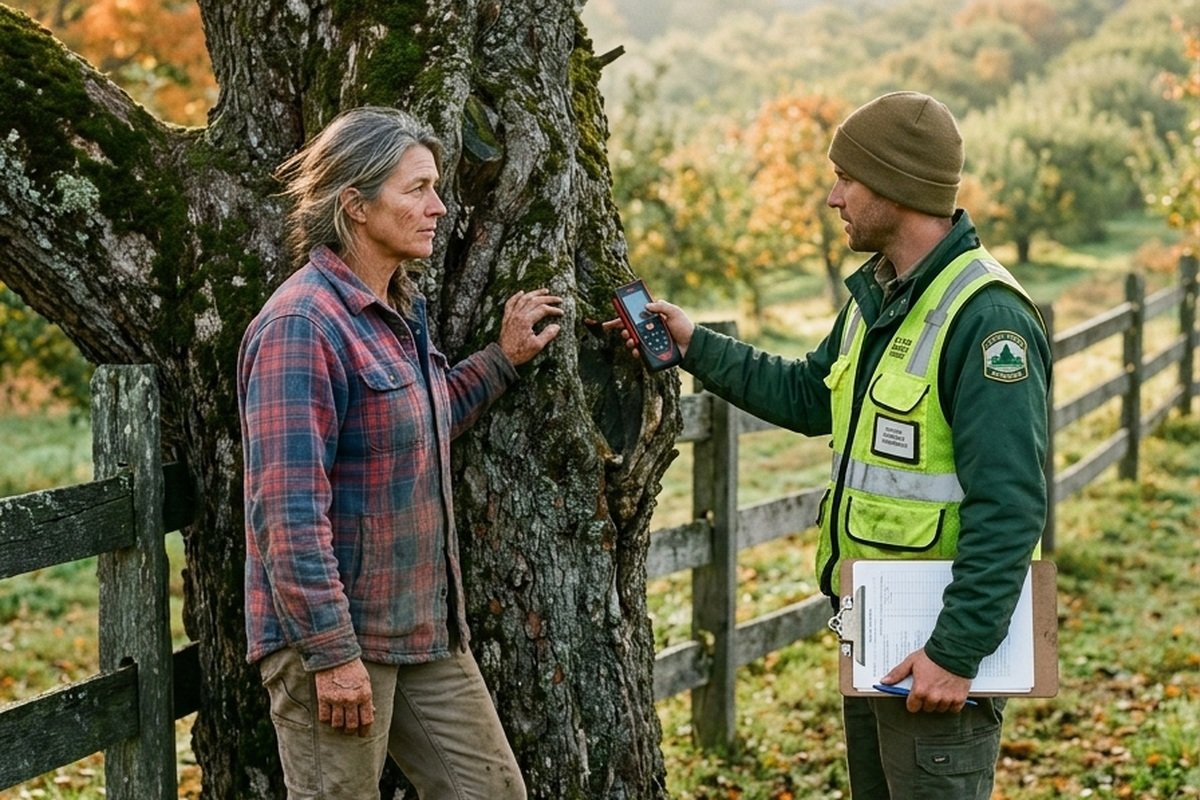
For seventy-four years, the Blackwood Apple Orchard had stood against the eastern ridge of our valley, four hundred acres of Honeycrisp, Gala, and antique heirloom trees planted by my great-grandfather with two working mules and a surveyor’s chain.
My hands had pruned those branches every winter since I was twelve years old, working alongside my father, Henry Blackwood, who believed that sweat was the only currency that truly honored family soil.
“A man doesn’t really own a piece of land like this, Liam,” my father used to tell me, wiping sap from his heavy canvas work gloves as the autumn mist gathered over the lower cider mill.
“He just holds the deed in trust for the next pair of boots that’s willing to wake up before dawn and keep it breathing.”
When my mother succumbed to pancreatic cancer seven years ago, the orchard became my father’s entire world, an anchor holding him steady against a grief that would have broken lesser men.
Then, four years ago, Brenda entered his life.
She was fifty-two at the time, polished, sharp-featured, and perpetually perfumed with expensive department-store lavender that felt completely alien among the smells of damp peat, cider barrels, and diesel fuel.
She had worked as an executive administrative officer for a regional commercial real estate development syndicate in the state capital, a fact she dropped into conversations with quiet pride.
Within eight months of their chance meeting at a county charity gala, Brenda had moved her sleek leather luggage into our family’s cedar-shingle farmhouse.
Three months after that, they had an intimate courthouse wedding that my father announced to me almost apologetically over a cup of black coffee at four in the morning.
“She brings life back into the house, Liam,” he whispered, looking down at his scarred knuckles. “It’s too quiet here at night without your mother. You understand, don’t you?”
I told him I understood, because I loved him and wanted him to be happy in his twilight years.
But from the very first month, Brenda made no secret of her disdain for the dirt, the seasonal labor, and the endless financial uncertainty of fruit farming.
To her, four hundred acres of prime hillside with riparian water rights was not a family legacy; it was forty-eight suburban residential parcels waiting to be bulldozed, paved, and monetized.
“Do you have any idea what developers would pay for this frontage along Highway 9?” she said one Sunday dinner, waving her silver dessert fork toward the orchard rows through the dining room picture window.
“Twelve million dollars minimum. You two work eighty hours a week like sharecroppers when you could be wintering in Palm Springs on annuities.”
My father set his fork down with deliberate care. “The Blackwood Orchard is not for sale, Brenda. Not now, and not after I’m in the family cemetery on the ridge. Liam will take over when my time comes.”
Brenda smiled—a tight, porcelain smile that never reached her cold hazel eyes. “Of course, darling. I’m just speaking practically.”
That was the first time I saw the look in her eye, the calculated patience of a predator who knows that time is on its side.
Ten months ago, my father’s health began a steep, inexplicable decline.
The man who had hauled sixty-pound apple crates without pausing for breath began experiencing severe fatigue, sudden memory lapses, and debilitating joint tremors that the county clinic attributed to rapid-onset neurological degeneration.
As his condition deteriorated, Brenda systematically closed the perimeter around him.
First, she replaced our longtime family doctor with a private concierge geriatrician based out of the city, citing ‘specialized palliative care.’
Next, she changed the security codes on the front gate and the Wi-Fi router, claiming that outside callers and noise agitated my father’s nervous system.
When I would come up from the packing barns in the evening to visit him, Brenda would meet me at the kitchen threshold with a tray of herbal tea and a hushed, tragic whisper.
“He’s just fallen asleep, Liam. The new sedatives take a lot out of him. Don’t wake him—stress could trigger another episode.”
Whenever I did manage to sit beside his bed, my father seemed strangely subdued, his gaze wandering toward the bedside table where Brenda had placed a small white medication organizer.
“Liam,” he whispered one rainy Tuesday afternoon while Brenda was at the pharmacy, his voice raspy and dry. “Where’s my old ledger? The leather one with the brass clasp from the desk?”
“I don’t know, Dad,” I replied, holding his frail hand. “Did Brenda move your paperwork into the filing room?”
His fingers squeezed mine with surprising, desperate strength. “Arthur Vance. Go see Arthur Vance at the courthouse square. Don’t mention it to her.”
Before I could ask him what he meant, the front door clicked open, and Brenda’s quick heels tapped across the hardwood floor.
Her smile was instant, but her eyes scanned my father’s hands and my face with surgical precision. “Visiting hours need to wrap up, Liam. The doctor was very clear about prolonged cognitive stimulation.”
That was the last private sentence my father ever spoke to me.
Six days later, he suffered a catastrophic cardiopulmonary arrest in the master bedroom.
By the time the rural volunteer ambulance navigated the private driveway, Henry Blackwood was gone at the age of sixty-eight.
The funeral was a blur of black coats, cider-mill workers with tears in their eyes, and Brenda draped in an immaculate designer veil, weeping softly into a monogrammed handkerchief.
Not even seventy-two hours after the cemetery shovel touched the earth, Brenda summoned me to the farmhouse office.
She was not wearing black anymore. She wore a tailored camel-hair blazer, diamond stud earrings, and had a neat stack of legal-sized documents arranged before her.
Beside her stood a man in a sharp navy suit whom I recognized immediately: Greg Mercer, the senior acquisitions vice president for Vantage Point Properties, the most aggressive residential land developer in the state.
“Liam, have a seat,” Brenda said, her voice silky smooth and stripped of any trace of mourning.
“We need to discuss the operational future of the property.”
“What is Vantage Point doing in my father’s living room before his headstone is even set?” I demanded, remaining standing.
Greg Mercer cleared his throat and smiled deferentially. “Mr. Blackwood, we’ve had a preliminary letter of intent under review for several months. We’re simply finalizing the phase-one soil study timeline.”
“My father would never sign a letter of intent with developers,” I snapped.
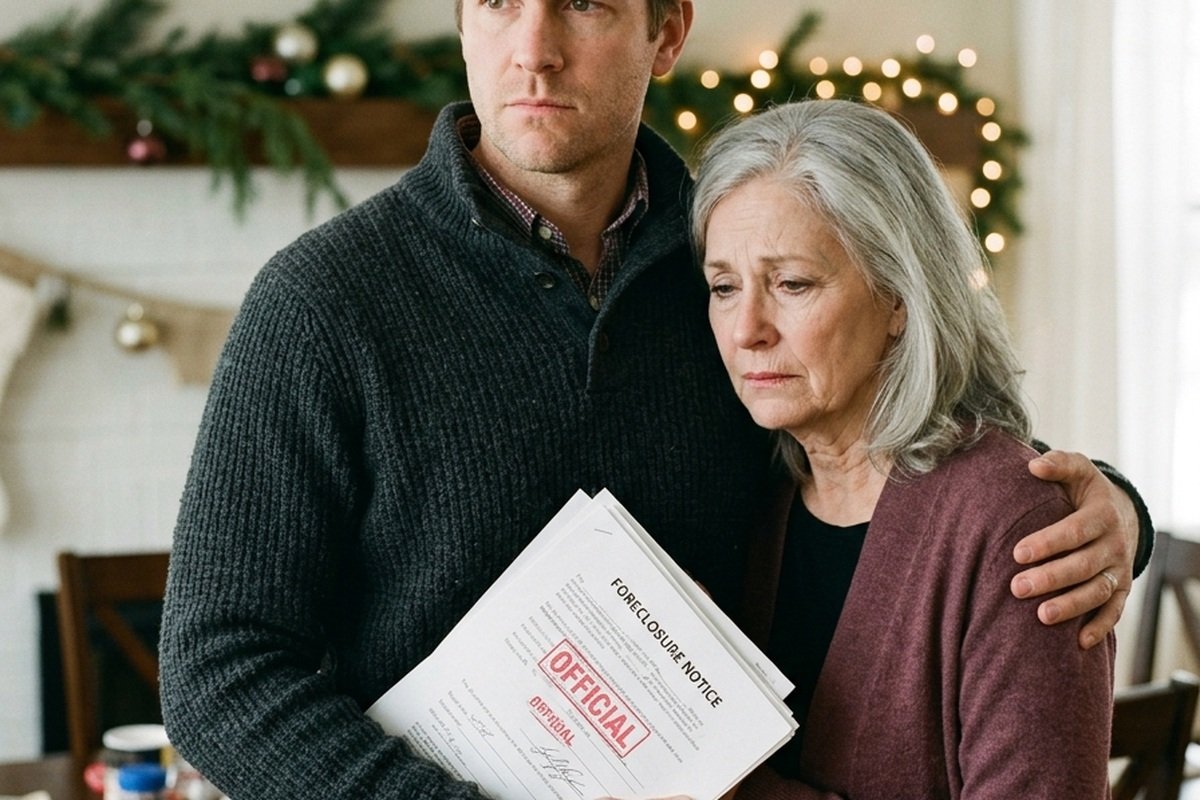
“Your father realized that his medical expenses and the capital debt on the cold storage units made independent farming untenable,” Brenda said calmly.
From a manila folder, she drew out a single sheet of yellow legal paper covered in shaky blue ink, along with a notarized affidavit stamped by a mobile notary public.
“Two weeks before Henry passed, he realized that your vision for the orchard was financially irresponsible,” Brenda said, sliding the paper across the desk toward me.
My eyes raced across the handwriting. It was my father’s slanted script, but erratic, trembling, and disjointed.
“I, Henry Blackwood, being of sound mind, hereby revoke all prior testaments and leave the entirety of the Blackwood Orchard real estate, water rights, and farm equipment to my beloved wife, Brenda Blackwood, for her to manage, liquidate, or sell at her sole discretion…”
“This is a holographic codicil,” Brenda explained with cold satisfaction. “Drafted, signed, and witnessed under state probate code. Greg and his partners have offered fourteen point five million dollars cash.”
“You have thirty days to clear your personal tools out of the repair shop, Liam. Out of respect for Henry, I’ve instructed the title escrow to gift you fifty thousand dollars from the initial closing funds.”
Fifty thousand dollars. For twelve years of eighteen-hour days, for four generations of family blood, sweat, and heritage.
“This is a forgery, Brenda,” I said, my voice dead calm despite the roaring fire in my veins. “My father would have burned this orchard to the ground before signing it away to a subdivision.”
“The notary was state-certified, Liam,” Brenda replied, leaning back in my father’s leather swivel chair. “The signature matches his driver’s license. If you attempt to challenge probate, the legal fees will bankrupt you in six months.”
“Accept the fifty thousand, buy yourself a landscaping truck in the city, and move on.”
I turned on my heel and walked out of the house into the cool October breeze.
I didn’t yell. I didn’t smash anything. Instead, my father’s dying words echoed through my skull with the clarity of a church bell:
“Arthur Vance. Go see Arthur Vance at the courthouse square. Don’t mention it to her.”
Arthur Vance was seventy-one years old, a legendary regional estate litigator who had served as my father’s legal counsel since 1984.
His office was situated on the second floor of a red-brick Victorian building overlooking the county courthouse, smelling of aged bond paper, leather law books, and pipe tobacco.
When I walked into his office twenty minutes later and told him about Brenda’s handwritten will and Vantage Point Properties, Arthur Vance didn’t flinch.
He took off his gold-rimmed reading glasses, folded them methodically, and leaned back against his high-backed green wing chair.
“Did Brenda present you with a handwritten holographic codicil dated September 28th?” Vance asked quietly.
“Yes,” I answered, startled. “How did you know the date?”
Vance smiled—a slow, grandfatherly smile filled with razor-sharp legal venom.
“Because on September 25th, your father walked up these back stairs without Brenda’s knowledge, assisted by our longtime packing manager, Tom Ruiz.”
“Henry knew Brenda was intercepting his mail, monitoring his calls, and pressuring him to sign legal papers under the pretext of medical insurance authorization.”
Vance stood up, walked over to a heavy fireproof steel floor safe in the corner, turned the combination dial with deliberate clicks, and pulled out an accordion folder tied with red ribbon.
“Your father was a farmer, Liam, but he was also an extraordinarily prudent businessman who loved you more than his own life.”
“He knew what Brenda was planning the moment she brought that real estate broker to the county fair last summer.”
“What is in that folder, Mr. Vance?” I asked, my heart pounding in my throat.
“The Blackwood Family Irrevocable Agricultural Heritage Trust,” Vance said, tapping the thick document with his fountain pen.
“Executed and registered three days before his death. With two independent medical evaluators certifying his absolute testamentary capacity, and a forensic video recording that renders Brenda’s little yellow napkin completely and totally void under state law.”
“I have already notified Brenda’s legal counsel that the formal estate reading will take place tomorrow morning at ten o’clock sharp in my conference room.”
“Go home, Liam. Wash the orchard mud off your boots, put on a clean suit, and let me handle Mrs. Blackwood.”
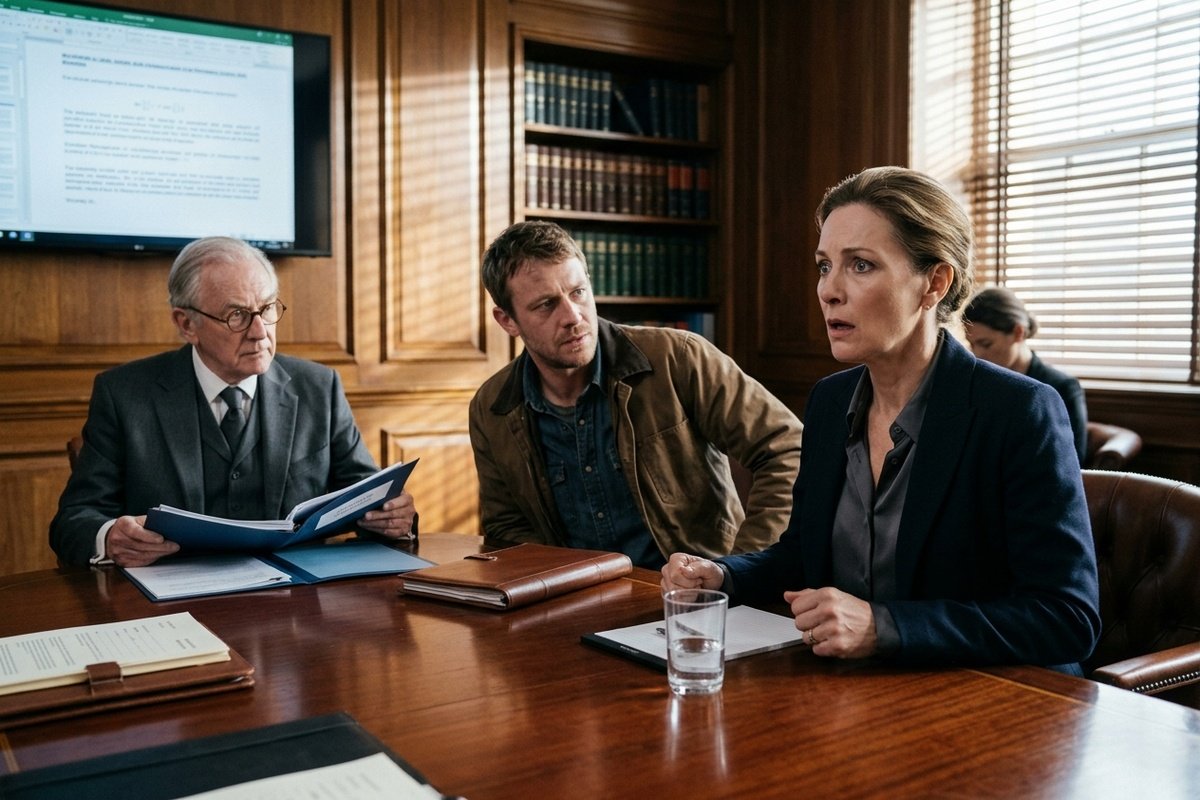
The next morning at ten o’clock, the mahogany conference table at Vance & Associates was the stage for an unforgettable confrontation.
Brenda arrived in high triumph, accompanied by her personal probate attorney, an arrogant junior partner named Bradley Finch, and Greg Mercer from Vantage Point Properties.
Brenda wore a fresh black silk dress with pearls, carrying a leather Louis Vuitton briefcase containing her handwritten codicil and the preliminary purchase contract.
She didn’t even look at me as she took her seat across the table. Her posture radiated absolute, unassailable victory.
“Mr. Vance,” Bradley Finch began smoothly, opening his folder. “We can keep this brief. We have already filed the holographic codicil of September 28th with the probate registrar.”
“My client, as the surviving spouse and sole named beneficiary of the real estate, has executed an enforceable purchase agreement with Vantage Point Properties.”
“We are prepared to offer Mr. Liam Blackwood a modest courtesy settlement of seventy-five thousand dollars—an increase from our initial figure—provided he signs a full waiver of claims by noon today.”
Brenda leaned forward, smiling with mock sympathy. “Take the offer, Liam. It’s more than fair for someone who doesn’t even hold equity.”
Arthur Vance did not open Finch’s folder. He didn’t even touch it.
Instead, he rested his hands on the mahogany table and looked directly at Brenda.
“Mrs. Blackwood, before we discuss your purported codicil, there is a mandatory procedural exhibit that must be entered into the record under Probate Code Section 613.”
Vance turned toward the wall-mounted flat-screen television and picked up a black remote control.
Brenda frowned slightly, her smug smile wavering for a fraction of a second. “What is this?”
“This,” Vance said softly, “is Henry Blackwood’s final recorded testament, filmed in this very room on September 29th at four o’clock in the afternoon, accompanied by Dr. Robert Sterling, Chief of Neurology at St. Jude’s Hospital, and Dr. Marcus Hayes, board-certified psychiatrist.”
Vance pressed play.
The screen flickered to life in sharp high-definition.
There was my father. He was sitting in the very chair I was currently occupying.
He was dressed in his favorite gray wool sweater. He looked thin, and his hands rested quietly on the table, but his eyes were piercing, lucid, and filled with unwavering dignity.
“My name is Henry Thomas Blackwood,” my father began, his deep, familiar baritone filling the silent conference room.
“Today is September 29th. I am making this recording in the presence of my attorney, Arthur Vance, and two independent medical physicians whom I have privately retained.”
Across the table, Brenda’s face drained of color so fast it looked as if she had been slapped.
Beside her, Bradley Finch froze, his fountain pen hovering in midair.
“If you are watching this recording,” my father continued calmly on screen, “it means that my heart has finally given out, and it also means that Brenda has produced the handwritten paper she forced me to trace when she withheld my medication on the evening of September 27th.”
A collective gasp seemed to suck all the air out of the room.
Greg Mercer, the developer, suddenly shifted uncomfortably in his chair, looking toward the exit.
“Brenda,” my father’s voice rang out from the television, looking directly into the camera lens with absolute authority.
“You thought I didn’t notice the documents your brother Greg Mercer was preparing. You thought that because my body was failing, my mind had surrendered.”
“For the record: that handwritten document was obtained under extreme physical coercion and duress while my cellular phone was locked in the kitchen safe.”
“Effective forty-eight hours ago, the entirety of the Blackwood Orchard—all four hundred acres, the packing plants, the cold storage, and all commercial trademarks—have been permanently deeded into the Blackwood Irrevocable Agricultural Trust.”
“The sole trustee, with absolute, unappealable authority over the property, is my son, Liam Blackwood.”
My father looked toward the spot where I was sitting, and his expression softened with profound, enduring love.
“Liam, you gave me your youth, your strength, and your loyalty. The orchard is yours. Keep the trees alive, son. Don’t let them pour concrete over our grandfather’s dream.”
My father paused, turned his gaze back to the camera, and delivered the final blow:
“As for Brenda: under our prenuptial agreement of October 2022, which remains fully valid, any attempt to contest this trust or initiate bad-faith probate litigation triggers Section 9—the complete forfeiture of all discretionary spousal allowances.”
“Mr. Vance has instructions to hand the security camera footage of September 27th from my study directly to the County District Attorney’s Elder Protection Task Force.”
“Good luck with your real estate developments, Brenda. You won’t be building them here.”
The screen clicked to black.
The silence in the conference room was deafening. You could hear the faint ticking of the grandfather clock in the hallway.
Brenda’s porcelain facade had shattered into a mask of pure, unadulterated terror.
Her jaw hung slack. Her hands trembled violently against her designer handbag.
“This… this is an ambush!” Bradley Finch stammered, his face bright red as he slammed his legal pad shut. “This video was taken without our knowledge! It violates disclosure rules!”
“It violates nothing, counselor,” Arthur Vance said, his voice cold as arctic ice.
“The trust deed was officially recorded with the County Recorder of Deeds on September 30th at nine o’clock in the morning. Title has already transferred.”
“Furthermore, Detective Miller from the county sheriff’s office is currently waiting in my outer reception lobby with a subpoena for your mobile notary’s logbooks and Mrs. Blackwood’s phone records.”
Greg Mercer stood up so fast his leather chair rolled back against the wall.
“Vantage Point is terminating all negotiations immediately,” Mercer said sharply, glaring at Brenda with disgust. “You assured us this title was uncontested. Do not contact our offices again.”
Mercer grabbed his coat and hurried out the door without looking back.
Brenda sat completely alone across from us.
The smug stepmother who had tried to steal four generations of family history was suddenly reduced to a trembling woman facing felony fraud charges.
“Liam…” she whispered, tears of panic finally breaking through her heavy makeup. “Liam, please. Your father wasn’t well. He misunderstood. We can talk about this like family…”
I stood up, fastened the button of my jacket, and looked down at her.
“You have twenty-four hours to pack your clothes and vacate my father’s farmhouse, Brenda,”
“If you leave so much as a shoebox behind, I’ll have the sheriff’s deputies deposit it at the county dump.”
She didn’t say another word.
She gathered her papers with shaking hands, rushed past Detective Miller in the lobby, and disappeared into the autumn morning.
Within forty-eight hours, Brenda had fled the county to stay with relatives in another state.
Her attorney quietly withdrew the fraudulent holographic codicil from probate court to avoid immediate criminal indictment.
The Blackwood Irrevocable Agricultural Heritage Trust is now officially active and bonded.
Yesterday afternoon, I stood on the high ridge beside my parents’ resting place, overlooking the four hundred acres of blossoming orchard trees.
The wind carried the crisp, sweet scent of ripening apples, and for the first time in months, I felt completely at peace.
Brenda’s lawyer recently sent a letter asking if I would consider granting her a twenty-thousand-dollar relocation allowance from my father’s personal bank accounts so she can settle her credit card debts.
Some of our distant relatives say I should show Christian mercy and give her the money to close the chapter peacefully.
Others tell me that anyone who would withhold medication from a dying man deserves nothing but the full weight of the law.
So I ask you: Did I take it too far by cutting her off completely and threatening criminal prosecution, or was I 100% justified in defending my father’s legacy?