On Monday morning, I walked down the front steps of my brick bungalow on Elm Street at eight o’clock, enjoying the quiet autumn air while collecting the morning newspaper from the porch railing.
The morning was cool and overcast, with fallen maple leaves scattering across our front lawn as school buses made their rounds through our quiet suburban development.
I was in my second week of recovery following a sensitive private surgical procedure that I had disclosed only to my physician, my employer, and my husband Thomas.
I had taken an eight-week medical leave of absence from my role as volunteer coordinator of our suburban neighborhood community garden, quietly passing my duties to a deputy coordinator without fanfare.
As a retired high school biology teacher, I had founded the community garden four years ago to bring neighbors together around heirloom vegetables and native pollinator beds.
I valued the garden deeply, but I had always maintained a clear division between my volunteer civic work and my private family life.
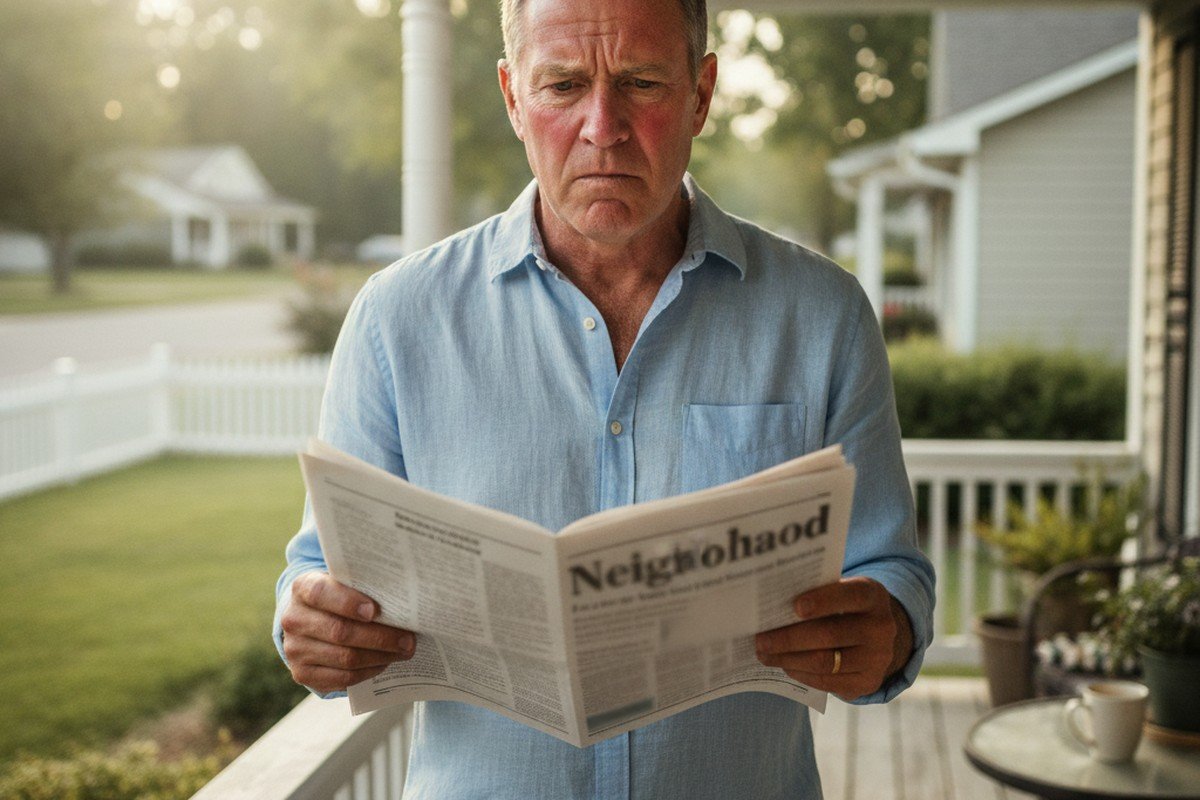
Beside the newspaper on the cedar porch bench lay the freshly delivered monthly printed edition of the Shady Oaks Community Newsletter, which was distributed to all two hundred homes in our subdivision.
I picked up the four-page newsletter, expecting to see updates about the autumn leaf collection schedule and the neighborhood park cleanup day.
Instead, across the top of page one in bold black letters was a prominent feature article titled: “Community Prayers for Garden Director Brenda Vance’s Recovery.”
The article contained an intrusive, highly specific medical summary describing my surgical procedure, the hospital where it was performed, and my detailed recovery timeline.
The printed piece was signed by neighborhood association president Clara Simmons, who urged residents to coordinate a daily meal train and visit my home regularly to lift my spirits.
Attached to the article was a printed calendar with time slots for neighbors to drop off meals, complete with my personal cell phone number and home address.
I stood on my porch in frozen mortification, holding the newsletter as a cold chill ran through my chest.
I unfolded the document and reread the paragraphs twice, confirming that confidential health details I had shared in confidence had been broadcast to the entire community.
The document proved that my medical privacy had been completely compromised and that every homeowner on our street now possessed intimate knowledge of my physical condition.
I had sent Clara a private email two weeks earlier simply stating: “I need to step back from the garden committee for two months due to a scheduled medical procedure; please contact Sarah for plot assignments.”
That was the entirety of the information I had authorized, but Clara had contacted a mutual acquaintance who worked as a receptionist at the outpatient clinic to extract private clinical details.
The consequence was an immediate invasion of our household peace, stripping away my dignity while I was trying to heal in quiet isolation.
The emotional cost of having my private physical vulnerability exposed to hundreds of acquaintances felt devastating and unbearable.
I carried the newsletter into our kitchen, where Thomas was pouring hot coffee into our ceramic mugs.
When Thomas read the headline, his jaw tightened in disbelief as he set his coffee mug down on the counter.
“This is a gross invasion of your privacy, Brenda,” Thomas said, examining the intrusive paragraphs with professional legal scrutiny.
Within twenty minutes of reading the newsletter, our front doorbell chimed, followed by two sharp knocks on the glass storm door.
I opened the door to find our neighbor from two doors down holding a steaming casserole dish and an open folder of printed holistic wellness articles.
“Brenda, we read about your surgery in the newsletter this morning,” she said with overwhelming sympathy. “We are all praying for your recovery, and I brought you some bone broth and dietary advice.”
I thanked her politely, accepted the casserole, and closed the door as quickly as possible, feeling completely humiliated and exposed in my own neighborhood.
Before I could even set the dish on the counter, my phone buzzed repeatedly with text messages from neighborhood acquaintances offering invasive medical advice.
I sat down at our dining table, feeling my blood pressure rise as notifications flooded my phone screen with unsolicited medical suggestions.
I called Clara Simmons immediately, my hands shaking with indignation as I stared at her byline on the newsletter.
“Clara speaking, good morning Brenda! How are you feeling today?” Clara answered with breezy, patronizing warmth.
“Clara, why did you publish the private details of my medical surgery on the front page of the neighborhood newsletter?” I asked directly.
Clara paused for a brief moment before answering in an airy, self-righteous tone.
“Brenda, our community cares about you, and people were asking why you were not at the autumn pumpkin patch planning session,” Clara argued.
“I specifically asked you to keep my leave confidential and simply direct garden inquiries to Sarah,” I reminded her sternly.
“Well, our neighborhood thrives on transparency and mutual support,” Clara countered defensively. “I believed that organizing a meal train and prayer circle was the Christian and neighborly thing to do.”
“You broadcast my private health records without my consent, Clara, and you used an unverified clinic contact to dig into my medical file,” I told her.
The argument changed when Clara admitted that she had wanted to fill the front page of the newsletter because our local printing sponsor had threatened to pull funding if the newsletter lacked compelling human stories.
That was the moment I discovered that Clara had exploited my private health crisis as sensational content to maintain advertising revenue for the association newsletter.
“You used my medical vulnerability as neighborhood gossip to sell newsletter advertisements,” I told her, my voice trembling with fury.
“Why did you think you had the authority to publish my medical history for public entertainment?” I demanded.
I feared that if I did not take immediate, public action, Clara would continue using community newsletters to violate the personal boundaries of other residents.
I wanted our neighborhood to be a supportive community, but Clara’s intrusive overreach showed that she prioritized newsletter circulation over basic human decency.
The reason I served on the garden committee was to cultivate shared beauty, not to surrender my personal privacy to an overzealous HOA committee.
Clara believed that because she had been association president for four terms, she held absolute editorial immunity from criticism.
She thought that by wrapping her actions in the language of charity and prayer, no one would dare challenge her invasive conduct.
Clara refused to issue a formal retraction, claiming that retracting a supportive prayer announcement would look petty and confuse the residents.
“If you try to make an issue out of this, Brenda, people will think you are ungrateful for the neighborhood’s love and kindness,” Clara warned me.
Her attempt to use social guilt to silence my legitimate outrage was the final straw.
I consulted with my husband Thomas, who was an attorney specializing in municipal governance and civil privacy rights.
Thomas drafted an immediate formal letter of complaint and demand for retraction, citing state privacy statutes and the neighborhood association’s own bylaws regarding officer conduct.
The letter required an immediate digital retraction email sent to all association members and a prominent printed apology on page one of next month’s newsletter.
We also demanded the immediate removal of the meal train schedule and the deletion of my personal contact details from the community web portal.
Before the afternoon was over, two more neighbors arrived with unsolicited flower arrangements, further confirming the urgent need for a public correction.
Later that evening, Thomas printed three official copies of the formal grievance on his legal letterhead, attaching photocopies of Clara’s article.
On Tuesday morning, Thomas and I met with the association vice president at a quiet coffee shop near the courthouse to brief him on the violation.
The vice president read our formal complaint with visible distress, apologizing profusely on behalf of the association.
At noon on Tuesday, Thomas and I attended the association executive board meeting at the township library meeting room, carrying our formal complaint and copies of the offending newsletter.
When the floor was opened for executive business, Thomas stood up and presented the legal letter to the association vice president and board secretary.
Thomas explained calmly and forcefully that publishing an individual’s private health details without consent violated the association’s code of ethics and exposed the board to severe legal liability.
The other board members looked at Clara in stunned disbelief, having assumed that Brenda had approved the article prior to publication.
“Clara, did you not have Brenda’s written consent before printing this article?” the vice president asked with visible concern.
Clara stammered, turned red, and admitted that she had acted on her own editorial authority without showing the draft to anyone.
The board acted swiftly to protect the organization from liability, passing a unanimous motion to censure Clara for gross administrative overreach.
The board president apologized to me formally on the record, agreeing to all terms outlined in Thomas’s letter.
Then the board voted to strip Clara of her editorial authority over all future community publications with immediate effect.
Within four hours, the association board distributed an official email retraction to all two hundred neighborhood households, apologizing for the unauthorized disclosure of private health information.
The email clarified that the publication had violated association privacy standards and that all meal trains and visits were immediately suspended at the family’s request.
The immediate consequence was a wave of supportive private text messages from neighbors who expressed outrage that Clara had misused her editorial role.
Thomas sat beside me at the kitchen table, reviewing our medical insurance statements and the clinic’s patient privacy policy.
The clinic’s administrator confirmed over the phone that the receptionist had been reprimanded for improper disclosure of patient appointment schedules.
Knowing that the medical leak had been addressed at the institutional source helped restore our confidence in the recovery process.
Later that evening, Thomas and I sat on the screened back porch, listening to the crickets while drafting our formal board statement.
We wanted to ensure that no future homeowner in Shady Oaks would ever have their personal medical trauma exploited for community marketing.
The reason we took such a firm stance was to establish an enduring precedent of confidentiality across all association committees.
I believed that privacy was a fundamental human right that no neighborhood association had the authority to override.
On Wednesday morning, our next-door neighbor dropped by to apologize personally, stating that many residents were dismayed by Clara’s article.
She assured us that the community respected our need for quiet healing and would actively support our request for privacy.
The neighborhood support confirmed that Clara’s sensationalism did not reflect the true values of our community.
The autumn afternoon was mild and pleasant as Thomas and I walked through our private backyard garden, checking on our late-blooming chrysanthemums.
I looked at the garden soil and felt a genuine sense of renewal, knowing that my recovery was taking place on my own terms without public spectacle.
Knowing that our legal complaint had established a lasting boundary brought our family an enduring sense of peace and dignity.
Every day that passed in quiet healing reminded me that personal dignity is always worth defending against community overreach.
Several neighbors visited our front porch later that evening, leaving handwritten notes expressing their respect for our right to privacy.
Two weeks later, the neighborhood association held its annual general meeting, where homeowners voted overwhelmingly to remove Clara from the neighborhood executive board.
The association enacted a new comprehensive privacy protocol requiring explicit written consent before any resident’s personal, medical, or family details could be mentioned in community publications.
In next month’s printed newsletter, a formal statement of apology from the board was featured prominently on page one, setting a permanent standard for community respect.
The apology reaffirmed that every resident’s health and personal life remained strictly confidential and off-limits to association media.
Three weeks later, I stepped down permanently from the garden committee, handing full leadership to Sarah so that I could focus entirely on my health and family.
Sarah instituted new garden operational guidelines, ensuring that volunteer records and personal schedules were protected with password security.
In the months that followed, my physical recovery progressed smoothly in the quiet comfort of our home, free from unwanted intrusion and public scrutiny.
Our garden plot produced beautiful autumn dahlias and winter squash, which Sarah kindly harvested and dropped off at our porch with quiet discretion.
Now, our neighborhood interactions are respectful and pleasant, governed by clear boundaries that safeguard personal dignity.
The boundary remains firm and established: private lives are not community property, and goodwill never justifies the theft of personal autonomy.
Standing up against institutional overreach was painful, but it protected not only my privacy but the dignity of every resident in our neighborhood.
Every morning when I drink my coffee on the front porch, I enjoy the quiet peace of my home, knowing that our boundaries are respected and secure.
True community support honors people on their own terms, recognizing that privacy is the essential foundation of mutual respect.
Having defended our personal space, I can walk through our neighborhood knowing that my life belongs to me alone.