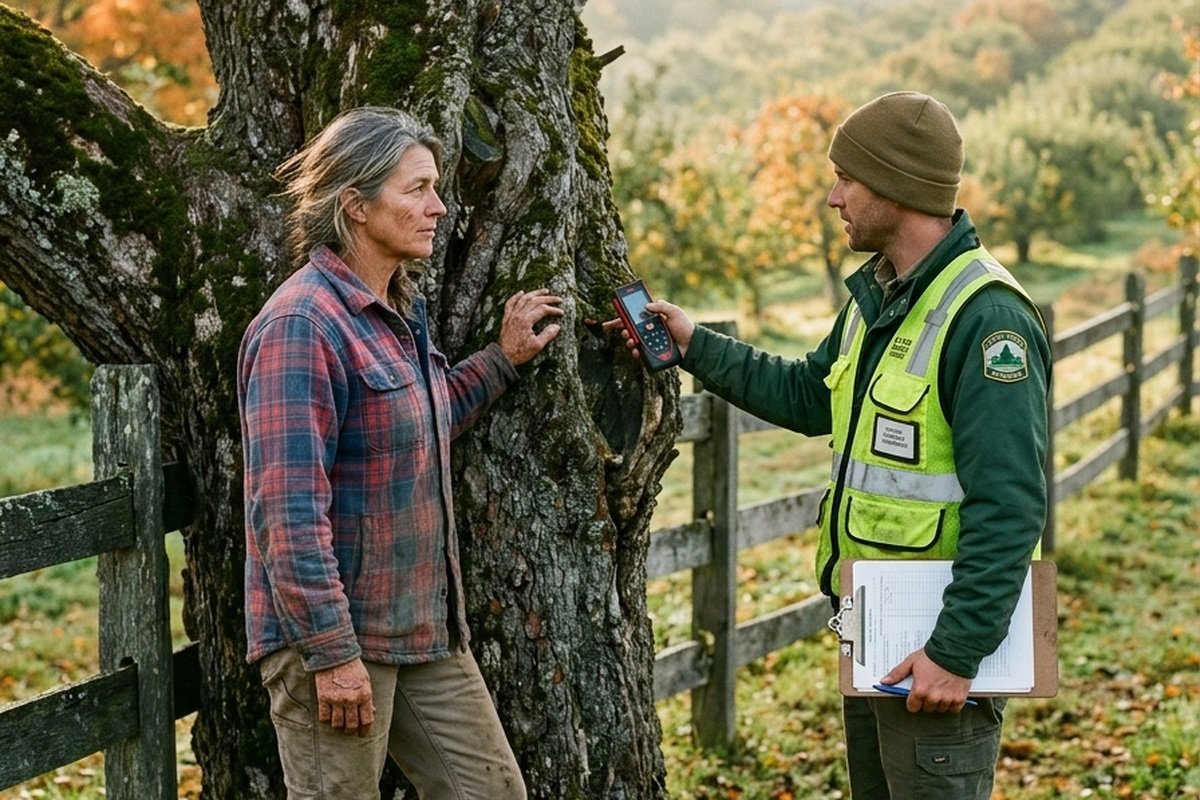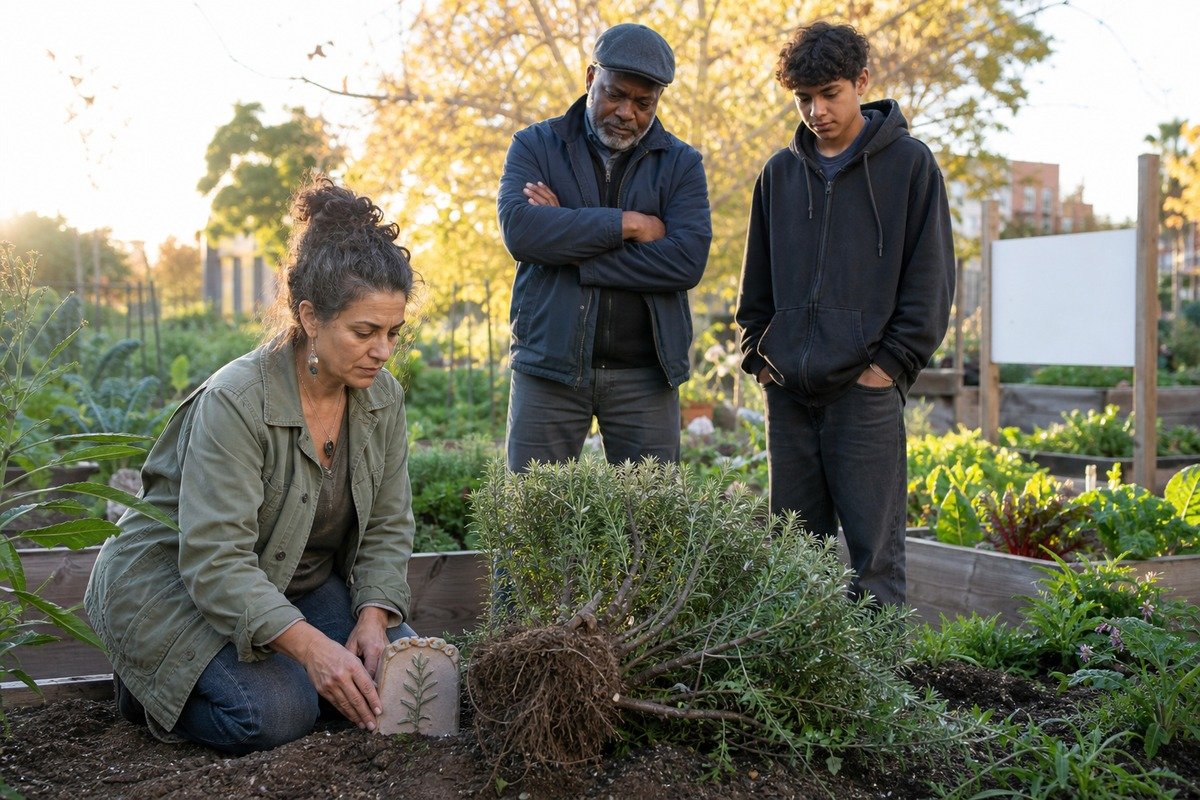
My mother’s rosemary was gone when I arrived for the spring workday.
In its place stood two metal stakes outlining a future sponsor sign. A laminated site map showed the new entrance, a wider path, and a rectangle labeled COMMUNITY PARTNER FEATURE.
Plot 14—the bed my mother tended for eleven years—had been moved behind the compost bins.
Nobody had called me.
The omission was visible in the garden log. Every workday had a page for weather, volunteers, plants moved, and materials purchased. Plot 14's last entry was mine from November, when the youth group mulched the rosemary before frost. The next page jumped to a contractor invoice for clearing the entrance. There was no horticultural note, family notice, or vote identifying which living bed would be cleared.
I had not claimed ownership of the plot after my mother died. The children replanted it each spring, senior volunteers harvested tea, and anyone could sit beside it. My role was to keep the teaching plan and call Mei when a plant failed. That shared use made the silent move worse, not easier. Malcolm had treated the lack of a private owner as a lack of anyone entitled to object. The record showed the opposite: dozens of people had maintained the promise, even though only my phone number appeared beside steward.
The original five-year vote supported that reading. It named the bed a teaching memorial, required annual program reports, and allowed the board to review it after five years. It did not give me a permanent private parcel. Two years remained before that review. Malcolm had bypassed a time-limited public promise that already contained its own lawful way to change course. The annual reports were current and showed no basis for an early removal.
I found the rosemary in three black nursery pots near the tool shed. The roots had been cut to fit. Beside them sat the ceramic markers painted by children from the neighborhood: basil, thyme, marigold, and Ruth’s tea.
My mother, Ruth, started the garden when the lot still contained broken glass. After she died, the board voted to keep Plot 14 as a teaching and memorial bed for five years. I was responsible for maintaining it with volunteers. The agreement had two years remaining.
Board chair Malcolm approached carrying a clipboard. He said the redesign would make the garden more accessible and fund a new irrigation line.
The sponsor, a regional hardware company, had pledged eighteen thousand dollars if its sign could be visible from the street. Plot 14 occupied the only location meeting the visibility clause without removing a mature pear tree.
“We preserved everything,” Malcolm said, pointing toward the pots.
Preservation was not the same as uprooting first and explaining later.
The new memorial location received four hours less sun and drainage from the compost washing area. Rosemary would struggle there. So would the tea plants the after-school group harvested every autumn.
I asked who approved the move.
Malcolm showed me minutes from a board meeting I had missed while caring for my aunt after surgery. The motion authorized “entrance improvements consistent with donor requirements.” It did not name Plot 14 or rescind the memorial agreement.
Two other board members, Keisha and Tom, arrived while we spoke. Keisha looked at the pots and said she had understood the plants would be moved after a family consultation. Tom said the site plan had shown only numbered rectangles, and he did not remember which number belonged to Ruth.
Malcolm had given the landscaper the final instruction alone.
The workday stopped. Twenty volunteers stood among wheelbarrows and seed trays while the board argued beside the empty bed. I did not want grief to become a performance, but the garden had already made a public hole where her work had been.
I asked to see the sponsor contract.
The visibility clause required a “prominent entrance acknowledgment.” It did not specify that precise rectangle. An attached concept drawing placed the sign over Plot 14 because Malcolm had submitted that version during negotiations.
He had created the constraint he now described as unavoidable.
Keisha traced the drawing history on her tablet. The first sponsor concept showed three possible acknowledgment locations: the gate, the tool shed, and an undecided entrance feature. Malcolm's next version removed the alternatives and shaded Plot 14 in the sponsor's colors. He sent that version before the board voted on physical changes. By the time members saw the numbered rectangles, the company had been told one site was preferred.
The paper trail did not show a bribe or a secret payment. It showed something more ordinary: Malcolm narrowing choices privately, then using the resulting deadline to make consultation look impractical. Tom had approved irrigation because the email subject said WATER ACCESS PROJECT. Keisha had approved donor outreach because the motion promised impact review. Neither vote authorized cutting roots. We printed the versions and placed them beside the memorial agreement so the emergency session could examine the sequence instead of arguing about whose memory was kinder.
The contract also required the first six thousand dollars to be returned if installation did not begin by May 1. The garden had already spent twenty-eight hundred on irrigation pipe.
That was the real pressure. Moving the bed back could cost the garden money it did not have.
I photographed the contract, original memorial agreement, nursery pots, cut roots, and site map. Then I called Mei, the horticulturist who had trained our youth volunteers. She arrived after lunch and examined the plants.
Two rosemary bushes could survive if replanted that day. The oldest plant had lost too much root mass and needed a recovery container in the greenhouse. The tea sage would die behind the compost area.
The decision could not wait for the next monthly meeting.
Mei organized a triage table beneath the shade roof. Volunteers labeled each pot, photographed the root balls against a ruler, and mixed soil while she tested drainage in the old bed. The oldest rosemary had a split woody crown and almost no fine roots on one side. Watering it heavily in the wrong location would rot what remained. Her instructions gave us two hours to stabilize the viable plants and move the weakest one under controlled light.
I called three youth-program parents whose children had painted markers. I did not ask them to take sides; I told them objects had been removed and invited them to verify the inventory. Two came with their children. The sight of those students matching painted words to the garden log quieted the board more effectively than another speech from me. Plot 14 was not sentimental space known only through my grief. It contained work products, lesson plans, and living material with identifiable stewards. The emergency was biological, but the evidence of who should have been consulted was administrative and complete.
We held an emergency open session under the shade structure. Malcolm wanted to accept the new location temporarily and revisit it after installation. I objected because temporary landscaping becomes permanent once concrete and donor photographs exist.
Keisha proposed returning the donation. The treasurer said that would leave the garden unable to pay for the pipe already delivered.
A teenager named Luis, who attended Ruth’s last tea workshop, asked why the sign had to stand on the ground. His school mounted donor panels on the fence.
The simple question changed the meeting.
The street-facing fence ran beside the entrance and was visible from both directions. The concept drawing had ignored it because Malcolm assumed the sponsor wanted a freestanding monument.
We called the company’s community-relations director, Saira, on speaker. She had never visited the garden. Malcolm had described Plot 14 as an “underused herb bed” suitable for redevelopment. He had not mentioned a memorial agreement, regular classes, or the mature plants.
Saira said the company wanted visibility, not a fight with a dead founder’s family. She agreed to inspect the fence option the following morning and paused the deadline.
Malcolm accused me of jeopardizing the irrigation project by making an internal dispute sound malicious.
I told him I had described the documents. If accuracy made the decision look worse, tone was not the problem.
That afternoon, volunteers replanted the two viable rosemary bushes in Plot 14. We widened the path by shifting a tool rack instead of narrowing the bed. Mei moved the oldest rosemary to the greenhouse. We returned the ceramic markers but left one empty space where the damaged plant had stood.
The next morning, Saira measured the fence with the landscaper. A horizontal panel would be more visible than the proposed monument and cost twelve hundred dollars less. The company approved the change in writing. The savings covered root care, a ramp at the side gate, and replacement soil.
Before approving the revision, Saira asked the youth group to walk the proposed route with her. A wheelchair user named Nia showed that the new side-gate ramp still ended beside a hose crossing. The landscaper moved the spigot and added a recessed channel. That change had nothing to do with the sponsor dispute, yet it proved the value of consulting people who used the garden instead of treating the concept drawing as complete.
We also held a public inventory of every object removed from Plot 14. Children matched ceramic markers to photographs in the garden log. One marker was missing. A volunteer found it broken beneath the nursery pots, where the landscaper had stacked tools. Malcolm offered to replace it. I asked the original student, now in high school, to decide. She repaired the crack with visible gold-colored resin and wrote the date on the back. The marker returned changed, with the damage recorded rather than hidden.
The funding problem was solved. The governance problem was not.
The treasurer reconstructed every authorization connected to the project. Malcolm had signed the concept submission within his chair limit, but the landscaping instruction committed the garden to changes never described in the approved motion. The contractor had asked whether any protected beds existed. Malcolm answered that all numbered beds could be adjusted. That email mattered because it removed his remaining defense that the landscaper misunderstood a vague plan.
We invited Malcolm to add context before the board considered discipline. He produced messages showing genuine concern about leaking irrigation lines and two summers of volunteer burnout from hand watering. Those concerns explained the urgency of securing money. They did not explain why he labeled a heavily used teaching bed underused. Keisha proposed that both sets of evidence remain together: the project need, the procedural shortcuts, the physical damage, and the successful alternative. Accountability did not require pretending the irrigation problem was invented. It required showing that a useful goal had been pursued by treating consultation as an obstacle.
At the following board meeting, Malcolm admitted he had described the bed as underused because he feared the sponsor would reject any site with community restrictions. He believed the irrigation line would benefit hundreds of future gardeners, while one memorial served one family.
Keisha opened the attendance log. Plot 14 hosted twenty-three youth sessions and nine senior workshops the previous year. Ruth’s tea was not private decoration. It was one of the garden’s most used programs.
The board voted to remove Malcolm as chair for exceeding the motion and misrepresenting the site. He remained a member but lost contract authority. All future donor proposals required a parcel-impact map, notice to assigned stewards, and a public comment period before any physical change.
We also changed the memorial agreement. It no longer promised that every plant would remain forever; gardens change. It did require consultation before relocation, horticultural review, and a written plan for objects, records, and replacement if a plant could not survive.
Drafting that revision took three meetings. Some members wanted permanent veto rights for every memorial family. Others worried that no bed could ever rotate crops or respond to disease. Mei separated attachment from plant care: a rosemary bush might need replacement even when nobody had acted wrongly, while a healthy bed might be moved badly even if every ceramic marker survived. The agreement therefore protected a process, not an illusion of permanence.
Luis asked that youth participants receive notice too, because a family surname did not capture everyone who had built the program. The final form listed the assigned steward, program leaders, and current participant contact. It required a plain-language map showing sun, water, access, and proposed uses. If time-sensitive plant care made advance consultation impossible, two people without contract authority had to document the emergency. Those details came directly from the ways the old process had failed. The rule was not written to make Plot 14 untouchable. It was written so the next change would begin with the people and living things already there.
That distinction mattered. I did not want my mother’s plot frozen beyond usefulness. I wanted change to involve the people who carried its history.
The fence panel was installed six weeks later. It thanked the sponsor in clear lettering without towering over the beds. The irrigation line reduced our summer water use. Wheelchairs could reach Plot 14 along the wider path.
After the first month, the board published an impact report comparing the promised and actual project. It listed the changed sign location, the damaged rosemary, the repaired marker, the new ramp, the hose channel, and every dollar spent. Saira signed the report for the sponsor. Transparency did not ruin the partnership; it gave both sides a record stronger than the photograph Malcolm originally wanted.
The following spring, another donor offered benches in exchange for naming rights. The board mapped three locations and invited stewards to comment before accepting. One site blocked a pollinator bed, so it disappeared from the proposal before money or pride attached to it. The procedure felt slower than Malcolm's method and prevented another emergency meeting.
The oldest rosemary never fully recovered. Mei propagated twelve cuttings from it in the greenhouse. We planted six around the garden and gave six to students who completed the tea workshop.
At the autumn session, Luis placed one cutting in the empty space beside Ruth’s ceramic marker. We did not pretend it was the same plant. We recorded the original’s loss in the garden log and the reason it happened.
Malcolm attended but did not lead. He helped carry water and left after cleanup.
The sponsor sign remains on the fence. Plot 14 remains near the entrance, visible not because a company paid for the view, but because my mother chose that sunny corner before anyone imagined the lot would be valuable.
A community can accept money and still remember that vacant-looking space may already hold a promise.
At the next volunteer orientation, I watched Malcolm explain the relocation rule to twelve new gardeners. He used Plot 14 as the example and did not soften what had happened. Accountability became credible when the person who had moved the marker also taught why no committee could repeat it.