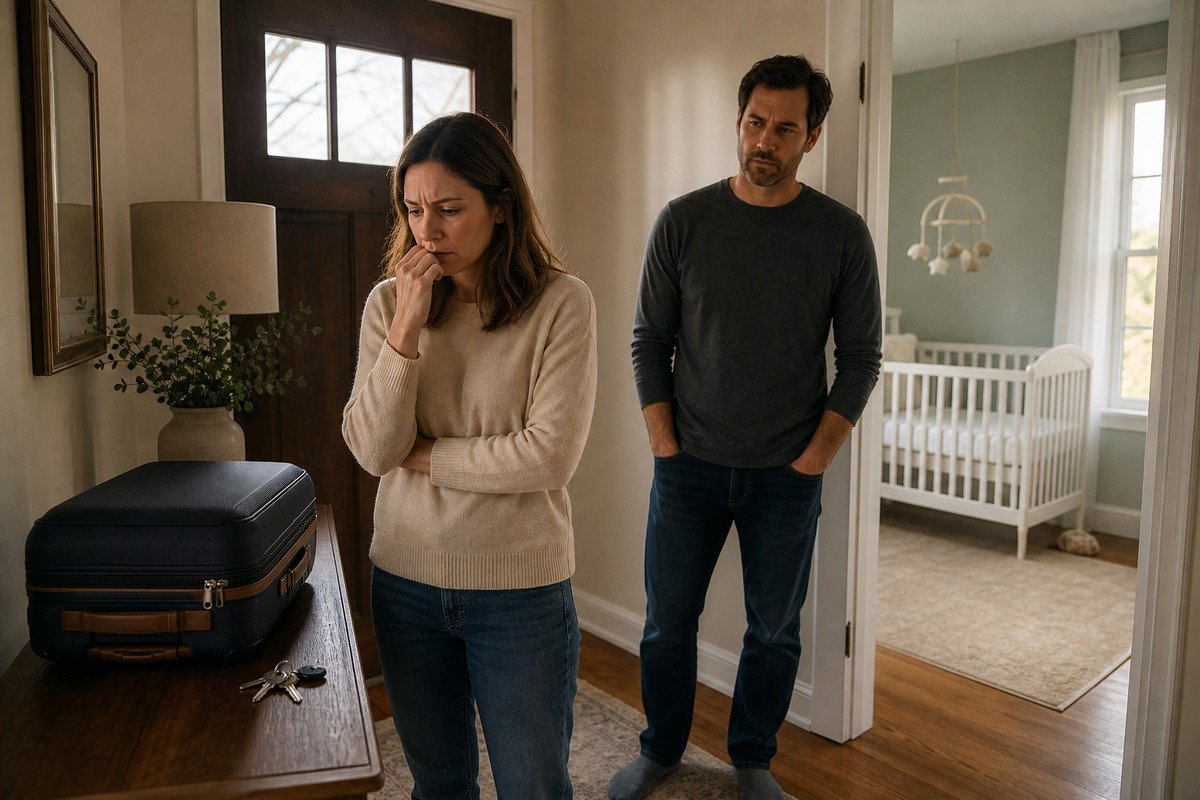
The first sign that my father-in-law was moving into our house was his blue suitcase blocking the nursery door.
I found it on a Wednesday evening after a twelve-hour shift. Beside it sat two grocery bags, a toolbox, and the spare key my husband and I kept inside a ceramic bowl in the kitchen.
Ron came out of the bathroom wearing slippers.
“Owen said I could use the shower before dinner,” he told me.
My husband had not said Ron would be inside our house. He had said only that his father’s apartment needed a plumbing repair.
Owen arrived ten minutes later with three cardboard boxes in the back of his car. When I asked how long the repair would take, he closed the hatch and said the apartment problem was more complicated than he first understood.
Ron’s landlord had ended his month-to-month lease. The building was being renovated, and Ron had thirty days to leave. Twenty-eight of those days had already passed.
“Dad can use the spare room while he looks,” Owen said.
The spare room was not spare to me. It held the crib we had bought after two years of fertility treatment and the paperwork for an adoption orientation scheduled the following month. We had not told our families because we wanted one decision that belonged to us before it became a public hope.
Ron looked from the crib to the suitcase. He had not known about the orientation.
I asked Owen to speak with me in the kitchen. He followed, but he left the door open as if privacy would make the conversation cruel.
He admitted he had given Ron the key that morning. He had also told him the room was available “for a few weeks.” Owen believed I would agree once I understood the deadline.
“You arranged the answer before asking the question,” I said.
He said he was preventing his father from sleeping in his car.
That was a real problem. It did not turn our house into a solution he could promise alone.
Our marriage had survived difficult decisions because we normally slowed them down. We had chosen this house together, compared treatment costs together, and agreed that neither family would receive a key without both of us knowing. Owen was generous, but when he felt someone might judge his generosity, he became secretive first and explanatory later.
Ron had lost his wife three years earlier. Since then, Owen checked on him every Sunday and repaired whatever was broken. I had never objected. I had driven Ron to appointments and helped him sort insurance letters. The issue was not whether he deserved help. It was whether my consent could be treated as the last administrative step.
The nursery made that distinction harder to dismiss. The crib was still wrapped on one side because Owen and I had stopped assembling it when the adoption agency warned us that placement could take a long time. A folder on the dresser held fingerprint instructions, reference forms, and a list of questions we were afraid to ask out loud. Ron's grocery bags leaned against that dresser as if the room had already changed purposes. I asked him whether Owen had told him what the room contained. Ron said Owen had called it unfinished storage. That answer embarrassed him, but it also showed how much information Owen had edited to make two different promises sound compatible.
I carried the grocery bags back to the kitchen instead of clearing space for them. Ron offered to sleep in his car, and Owen immediately used the offer as proof that my boundary was cruel. I told both of them that a frightened person volunteering for the worst option did not make the secret plan acceptable. We needed an actual housing decision, not a contest over who could endure the most discomfort. For the first time that evening, Ron stopped looking at Owen for the answer and asked what choices the landlord had given him.
That evening, the three of us ate soup at the dining table. Ron apologized for arriving before I got home. He said Owen had described the arrangement as settled.
Owen interrupted and said Ron should not be dragged into a marital disagreement.
“He is standing inside it with our key,” I answered.
Ron placed the key on the table.
Then he revealed a second fact. Owen had known about the lease notice for three weeks. Ron had asked him not to tell me because he was embarrassed. They spent those weeks discussing storage units and our spare room while I believed the plumbing story had started that morning.
The argument changed. This was no longer one panicked decision at the edge of a deadline. It was a plan protected by two people until urgency could be used against me.
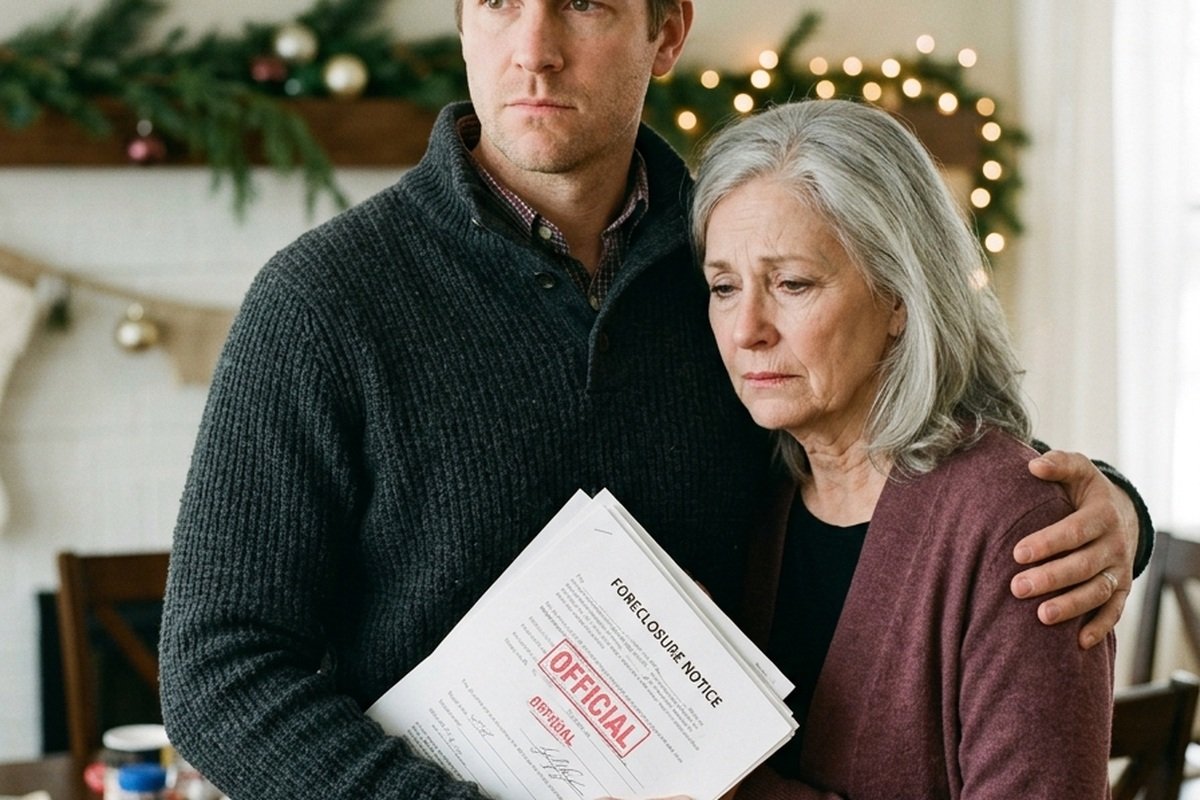
I asked to see the notice. Ron unfolded it from his wallet. The landlord had offered a relocation payment and a list of three senior-apartment buildings. Ron had not called any of them. He thought applying would make the loss permanent.
Owen had interpreted his father’s avoidance as helplessness. Instead of making the calls with him, he offered our room.
We spread the notice and the senior-apartment list across the table. One number had been circled, then crossed out. Ron admitted he had called that building, heard a recorded menu, and hung up when it asked him to choose an application category. Owen had seen the crossed-out number and decided the process was beyond him. Neither man had tried again during the following three weeks. The apparent emergency had grown partly because shame made Ron stop and rescue made Owen stop asking.
I asked Ron what he actually needed from us before noon. He named four things: help understanding the relocation payment, a place to store his tools, a ride to see any apartment he might accept, and one night without being treated like a case file. None of those requests required our nursery. Writing them down changed the problem from an undefined family obligation into tasks we could divide. Owen took responsibility for storage quotes and the landlord payment. I agreed to call the housing office with Ron present. Ron agreed to answer the apartment questions himself, even if the recorded menu made him feel foolish.
We made a temporary decision for that night. Ron could stay until noon the next day. Owen would sleep on the sofa so Ron could use our bedroom, and I would sleep in the nursery. The spare key remained on the table. No boxes would be unpacked.
Owen called that arrangement humiliating.
I told him humiliation was not caused by a one-night boundary. It had been built by weeks of secrecy.
Before work the next morning, I called the county housing office with Ron sitting beside me. They could not place him instantly, but one building on the landlord’s list had a furnished trial unit open for fourteen days. The relocation payment would cover it. A housing counselor could meet him that afternoon.
Ron agreed to the meeting. Owen looked relieved, then ashamed of the relief.
At the housing office, counselor Maribel reviewed Ron’s pension, the relocation payment, and the three applications. One apartment required a twelve-month lease. Another had stairs Ron disliked. The third was smaller than his old place but near his pharmacy and bus route.
Ron answered every question himself. He was not incapable. He was grieving a home that contained the last ordinary years of his marriage.
Maribel asked where he wanted to sleep that night.
He chose the trial unit.
On the drive there, Owen said he had assumed every formal option would be cold and lonely. Ron asked whether Owen had assumed that because he had visited one or because it made bringing him home feel like the loving choice.
Owen had no quick answer.
We carried the blue suitcase into the furnished unit. It had a narrow balcony, two lamps, and a kitchen table scarred by previous tenants. Ron opened the curtains and said the bus stop was closer than he expected.
Maribel walked us through the trial-unit agreement instead of handing it to Owen. The building supplied linens and basic dishes, but residents chose their own visitors and could leave without penalty during the fourteen days. Ron checked the bathroom rail, measured the bedroom wall for his wife's bookcase, and asked whether the balcony allowed herb pots. The manager answered him directly. Each ordinary question made the word placement, which Owen had used all morning, sound less accurate. Ron was not being placed. He was evaluating a temporary home.
At the pharmacy across the street, Ron timed the walk with his phone. It took six minutes at his pace. He recognized a cashier from his old neighborhood and stayed talking long enough that Owen glanced at the clock. I watched my husband discover that his father could form a routine not organized around Sunday repairs. On the way back, Ron asked to see the lease for the smaller apartment near the bus route. The trial unit had not cured his grief. It had given him enough distance from the deadline to make a decision that was not simply Owen's offer or his own car.
Then he asked for the spare key again, not to keep, but to return it to the bowl himself. We drove back together. He placed it beside the mail and said he would wait for an invitation next time.
The immediate housing problem was solved, but our household problem remained.
That Friday, Owen and I attended the adoption orientation as planned. Sitting among couples discussing home studies and safety checks, I felt the weight of the room he had already assigned. A home study was not about producing a perfect household. It was about whether adults could tell the truth about who lived there and how decisions were made.
Afterward, Owen admitted he had not only promised Ron the room. He had planned to postpone our orientation and tell me the program had rescheduled it. He had not sent the email, but the draft was saved on his phone.
When we returned home, we conducted the safety walk the orientation required. The worker's checklist asked who possessed keys, whether adults could arrive without notice, and which room would belong to a child. Each question landed directly on the arrangement Owen had made. We changed the door code, moved Ron's unopened boxes into a rented locker he selected, and photographed the nursery as it actually stood. Owen deleted the false rescheduling draft in front of me, but we kept a screenshot in our counseling notes. Removing a message was not the same as removing the choice that produced it.
The safety walk forced us to examine smaller choices too. Owen had duplicated the spare key at a hardware kiosk without recording the copy, so changing the door code was not enough. We replaced the cylinder and wrote down exactly who received each new key. He called Ron and told him why, without making me deliver the boundary or pretending the locksmith was routine maintenance. Ron said he understood. The conversation lasted less than two minutes, which made the weeks of avoidance look even less necessary.
We also opened the adoption folder together and marked every deadline the secret arrangement would have affected. The orientation could survive a month's pause, but our reference interviews and fire-safety inspection had fixed windows. Owen had imagined postponement as a private kindness to his father. On paper it would have required new explanations from our references, another inspection date, and a false story for the agency. Seeing the consequences in sequence helped him understand that unilateral decisions do not stay contained inside the room where they begin.
That was the deepest breach. He had been willing to alter another shared decision so the first secret would fit.
I asked for a week without adoption paperwork while we decided whether our process was stable enough to continue. That consequence hurt both of us. It also prevented us from treating a child’s future room as a prize in our argument.
We met with a marriage counselor the following Tuesday. Owen explained that his mother’s final illness had trained him to act before asking. During those months, every delay seemed dangerous. After she died, decisiveness became the way he proved he could still protect Ron.
The counselor said a survival habit could be understandable and still be unacceptable inside a shared home.
We wrote three rules. No one received a house key without two yeses. No overnight stay beyond one emergency night was promised without a start date, end date, and alternative plan. Neither of us could postpone a shared commitment to make room for a unilateral family decision.
The counselor asked us to rehearse the next possible emergency. If Ron's trial unit failed at nine on a Sunday night, Owen would tell me the facts before offering a bed. We could approve one night together, call the housing line in the morning, and keep the nursery closed to storage until we made a dated plan. If I said no to anything longer, Owen could disagree without announcing a promise in my name. The exercise felt stiff, but that was useful. Our old habit had relied on believing love would make the right response obvious. The new rules gave us language for the moment when love pointed in different directions.
Owen also called the landlord and asked why the relocation list had arrived so late. The answer was that it had not. Ron had received the first notice thirty days earlier and a reminder two weeks later. Owen placed both dates in our counseling timeline. He did not use them to blame Ron. He used them to identify each day when he had chosen secrecy over help. Accountability became more specific than admitting he should have asked me sooner; it meant acknowledging that he had repeatedly protected the plan from the person whose home it changed.
Ron signed a lease at the apartment near the pharmacy after nine days in the trial unit. The relocation payment covered movers and the first month. Owen helped him choose what to keep, but Ron completed the application and signed the lease himself.
Three weeks later, Ron invited us to dinner at his new place. The blue suitcase was stored in a closet. A photograph of Owen’s mother sat on the scarred kitchen table from the trial unit; Ron had asked the building manager if he could buy it.
He apologized to me without adding that he had been frightened. Owen did the same.
We resumed the adoption process a month later. During the home study, we described the key incident plainly. The social worker asked what had changed. We showed her the written household rules and Ron’s address, not as proof that conflict never happened, but as evidence that secrecy now had a consequence.
The spare key still sits in the ceramic bowl. It is not guarded like a symbol. Ron has his own apartment, and when he visits, he rings the bell.
Helping him mattered. So did the difference between opening our door and discovering that someone else had already given our consent away.