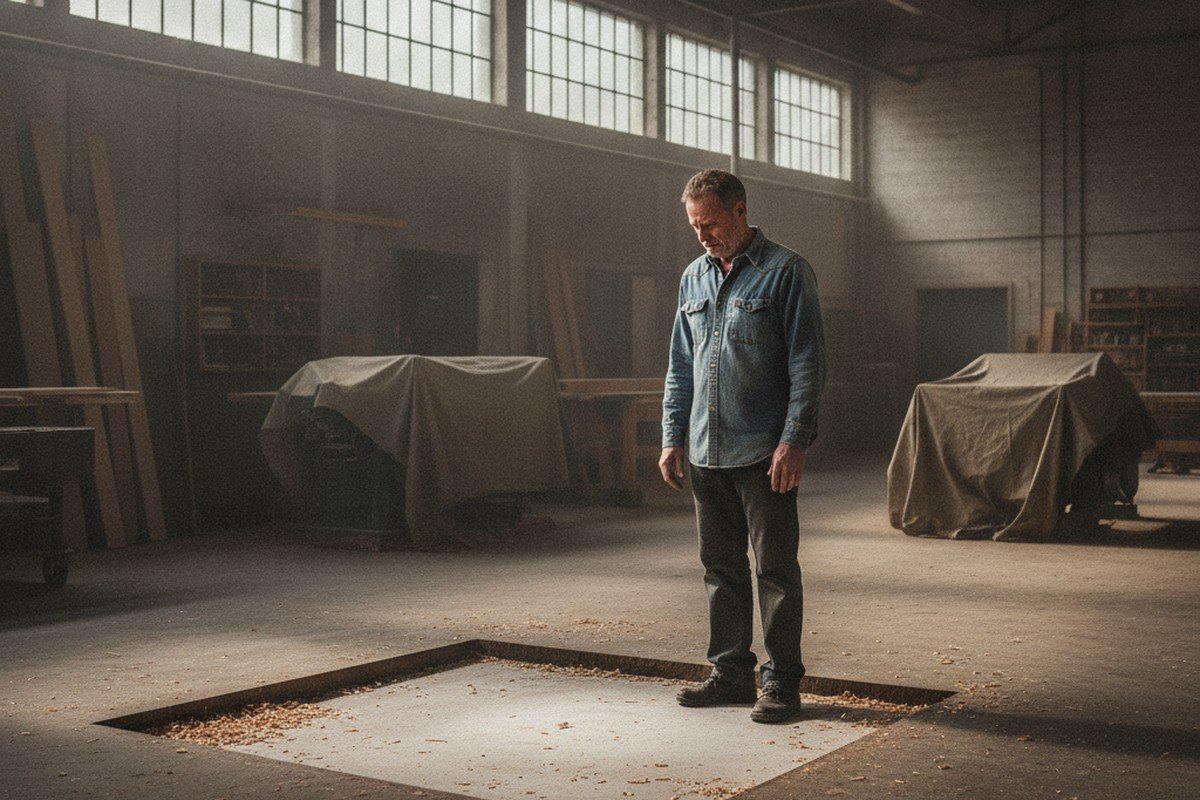
On Monday morning, I clocked in at seven o’clock at the central fabrication facility of Heritage Architectural Woodwork, where I had worked for sixteen years as a senior master joiner.
I was returning from a two-week bereavement leave following the passing of Arthur Pendelton, the legendary master craftsman who had trained me as an apprentice and guided my career for over two decades.
Arthur had retired two years earlier, leaving me his most prized material possession: a massive, hand-carved quarter-sawn white oak tool chest that he had built in nineteen eighty-four.
The chest was a masterwork of joinery, featuring hand-cut dovetail corners, fifteen custom fitted rosewood tool drawers, brass hardware forged by an artisan blacksmith, and over two hundred vintage hand planes and Japanese chisels.
Every single hand plane had been tuned with micrometric accuracy, and the tool steel blades were coated in fragrant camellia oil to prevent corrosion over generations.
Before Arthur passed away in hospice care, he had handed me the small brass key to the inner till, asking me to keep the tradition of bespoke joinery alive in our workshop.
Arthur had spent three years mentoring me through difficult cathedral restoration commissions because he believed that patience and precision were the foundation of great woodwork.
I wanted to prove to Arthur that his belief in me was justified, which was the main reason I arrived early to every morning shift.
I promised Arthur that I would defend the chest and its tools, treating them as sacred trust passed from one generation of woodworkers to the next.
Under our shop union bargaining agreement and written facility master technician contracts, senior joiners were explicitly authorized to maintain personal specialty tool chests within their designated workspace bays.
During my absence, the corporate office had installed a new branch operations supervisor named Gregory Vance, a thirty-two-year-old efficiency consultant brought in to implement lean manufacturing protocols.
Vance possessed zero background in bespoke woodworking, having spent his prior career managing logistics at an automated plastic injection molding warehouse.
He believed that custom wooden furniture and personalized craftsman spaces were outdated inefficiencies that compromised visual uniformity across the shop floor.
He thought that replacing seasoned artisan gear with identical modular plastic lockers would project an image of modern corporate efficiency to visiting corporate executives.
He wanted to impress executive leadership with rapid cosmetic changes, completely disregarding the human value of master craftsman traditions.
He feared that allowing custom tool chests in the facility undermined his authority to enforce uniform lean manufacturing mandates across all assembly lines.
I believed that true craftsmanship required honoring the heritage of master builders who established our industry’s highest standards.
The reason Arthur entrusted that chest to me was his faith that I would preserve the sacred standards of bespoke joinery.
When I walked down the main workshop aisle toward bay number seven, carrying my thermos and clean shop apron, I froze in my tracks as my eyes landed on my workstation.
The spacious cedar assembly bench where Arthur’s oak chest had stood for a generation was completely cleared of tools, equipment, and personal belongings.
In its place, bolted to the concrete floor against the bare cinder block wall, was a narrow, flimsy gray metal storage locker bearing a yellow barcode asset tag.
Arthur’s handcrafted oak chest, containing forty years of irreplaceable antique woodworking tools, had vanished without a trace.
A cold surge of adrenaline surged through my veins as I dropped my bag and rushed to the shop dispatch desk to inspect the shift maintenance logs.
On the clipboard in the supervisor dispatch tray, I found an unfolded pink document titled: “Facility Modernization and Hazardous Clutter Disposal Work Order.”
I picked up the physical document and read the itemized entries with mounting horror and fury.
The document confirmed that Gregory Vance had signed a disposal authorization on Thursday afternoon, ordering the maintenance crew to remove “unauthorized non-standard wooden box and obsolete metal debris” from bay seven.
The attached commercial disposal manifest proved that Vance had contracted with a local industrial metal and timber salvage scrap service, paying eighty dollars to haul the chest away to the county recycling transfer station.
The document proved beyond doubt that Vance had discarded twenty-five thousand dollars of heirloom tools and irreplaceable master artisan equipment as common landfill scrap.
Then I discovered that Vance had also thrown away Arthur’s vintage blueprint portfolio containing original architectural drafting patterns.
Worse still, the shop technician next to me admitted that Vance had laughed while the maintenance crew shoved the antique oak chest onto the flatbed truck.
Another senior joiner in bay six, an elderly craftsman named Marcus, revealed that he had tried to stop Vance, but Vance had threatened him with a disciplinary write-up.
Instead of respecting employee property, Vance had treated a generation of master craftsmanship as disposable garbage.
I felt an overwhelming combination of grief and blind rage, knowing that Arthur’s legacy was sitting inside an industrial scrap yard waiting for an automated compactor.
The consequence of losing those antique hand tools was devastating, because many of the carving profiles were custom ground and could never be replaced at any price.
I marched directly into the glass-walled supervisor office at the front of the shop floor, slamming the door shut behind me.
Gregory Vance was sitting behind a laminate desk, typing on a laptop with a pair of sleek wireless earbuds in his ears.
He looked up with an expression of mild annoyance as I laid the pink disposal work order flat on his desk.
“Mr Vance, where is Arthur Pendelton’s oak tool chest that was stored in bay seven?” I demanded, my voice vibrating with suppressed fury.
Vance removed one earbud, leaned back in his swivel chair, and offered a condescending corporate smirk.
“You must be Nathan,” Vance replied smoothly. “Welcome back. We took the opportunity during your leave to upgrade your bay to our new 5S visual workspace standard.”
“That was not clutter, Mr Vance; that was an irreplaceable handcrafted master tool chest containing twenty-five thousand dollars of precision artisan equipment,” I stated.
“Company policy states that all work bays must utilize standardized corporate lockers to eliminate fire hazards and visual clutter, Nathan,” Vance said dismissively.
“That chest was an eyesore that did not align with our clean-floor modernization goals, so I had facility maintenance scrap it along with the rest of the obsolete shop surplus,” he continued.
“You had zero legal right to dispose of my private personal tools, Vance,” I shouted, leaning across his desk.
“I have a written bay covenant signed by the company president authorizing the permanent placement of that chest in bay seven,” I told him.
The confrontation escalated as Vance insisted that local operational supervisors possessed absolute unilateral authority over all physical assets within the four walls of the facility.
“If you have an issue with company policy, Nathan, you are welcome to file a grievance with human resources, but that old wooden box is gone,” Vance said coldly.
“Which scrap transfer station did your hauling contractor take it to?” I demanded, grabbing the dispatch manifest.
Vance refused to answer, claiming that contacting outside contractors during working hours violated company communication protocol.
That was the moment the confrontation changed when I reached across the desk, picked up the contractor receipt, and read the name of the hauling service: River City Metal and Timber Recycling on River Road.
Then Vance admitted that he had deliberately scheduled the pickup during my bereavement leave because he thought I would not have the energy to fight him.
I pulled out my phone and dialed the direct private cell number of Thomas Sterling, the founder and chief executive officer of Heritage Architectural Woodwork, who had been a personal friend of Arthur for forty years.
When Thomas answered, I explained the situation in thirty blistering seconds: Vance had signed a scrap work order to haul Arthur’s master tool chest to the compactor.
Thomas’s reaction on the other end of the line was instantaneous, thunderous outrage.
“Nathan, get in your truck right now and drive to River City Recycling. I am calling the facility manager there immediately to halt their compactors, and I will meet you at the plant in forty minutes,” Thomas commanded.
I hung up, looked at Vance’s suddenly pale, panicked face, and pointed a finger at his chest.
“If a single chisel in that chest is damaged, Vance, your career in this industry is over,” I said.
I sprinted out of the plant, jumped into my heavy-duty pickup truck, and sped four miles west along the river highway toward the recycling depot.
When I arrived at River City Recycling, clouds of dust and the deafening shriek of industrial shredders filled the air.
A forklift driver was just approaching a massive hydraulic scrap compactor, carrying Arthur’s heavy oak chest balanced on the steel forks.
I jumped out of my truck, waving my arms frantically and shouting at the operator to stop.
The depot operations manager ran out of the scale office waving a clipboard, having just received the emergency phone call from Thomas Sterling.
“Hold the forks! Set it down!” the manager shouted over the roar of the machinery.
The operator lowered the forks, gently setting the oak chest onto a clean wooden pallet near the warehouse loading bay.
I dropped to my knees beside the chest, running my trembling hands across the solid quarter-sawn oak grain and examining the joinery.
Apart from minor surface scuffs on the bottom runner and a layer of metal dust, the chest was completely intact.
I opened the brass latches and inspected the fitted rosewood drawers; every single hand plane, Japanese chisel, and carving gouge was present and undamaged.
Inside the secret inner till beneath the bottom drawer, Arthur’s original apprentice drawings and hand-stamped steel gauges were safely preserved.
Thirty minutes later, Thomas Sterling arrived in his sedan, stepping into the scrap yard with a look of intense relief and righteous indignation.
Thomas personally paid the recycling facility an eighty-dollar release fee and had two depot workers load the heavy chest securely into the bed of my pickup truck.
We drove back to the manufacturing plant, where Thomas summoned Gregory Vance to the central conference room for an immediate executive review.
During that meeting, Thomas made it unmistakably clear that destroying artisan property and violating master technician covenants was grounds for immediate termination.
Vance tried to argue that his lean manufacturing models justified the disposal, but Thomas silenced him with a fury that shook the room.
Thomas issued Vance a formal final written reprimand that was placed permanently in his corporate personnel file, stripping him of all authority over artisan equipment and shop floor layout.
Vance was also ordered to pay the six-hundred-and-fifty-dollar emergency hauling and release fees entirely out of his personal supervisor bonus pool.
The consequence for Vance was a complete loss of professional credibility, while the cost to the company was repaired through renewed executive oversight.
When we unloaded the oak chest back onto the shop floor, ten senior joiners gathered around bay seven, patting the oak lid and expressing their profound relief.
They celebrated the return of the chest as a victory for every skilled tradesperson who refuses to be erased by bureaucratic spreadsheets.
The following morning, on Tuesday, facility maintenance removed the gray metal locker from bay seven, repairing the concrete floor anchors.
I decided that Arthur’s heirloom chest was too precious to remain vulnerable to future corporate bureaucrats.
I transported the oak chest to my private home workshop, where it now sits prominently beneath my timber-framed windows, used daily for my finest bespoke furniture commissions.
Inside the secret till beneath the lower drawers, I discovered a handwritten letter from Arthur addressed to me, written three weeks before his final hospitalization.
Arthur wrote that the true soul of craftsmanship does not reside in computerized machines or corporate quotas, but in the patient hands and faithful heart of the artisan who refuses to compromise.
Reading those words brought tears to my eyes, but it also filled me with a quiet, unshakeable strength that confirmed my convictions.
I framed Arthur’s handwritten letter and hung it directly above the oak chest beside his original brass drafting square.
Now, whenever an apprentice visits my home shop to ask how to tune a smoothing plane or hand-cut a through-dovetail, I open Arthur’s oak chest and show them the enduring standard of master work.
At the plant, Thomas had corporate legal draft an ironclad artisan property rider attached to my employment contract, guaranteeing that my personal tools and workspace choices are legally immune from supervisor interference.
Six months later, Gregory Vance quietly resigned from the company after failing his performance evaluation, having lost the respect of every craftsman in the facility.
Every cabinet, dining table, and architectural mantel I build now carries the unmistakable mark of Arthur’s mentorship, combining timeless elegance with uncompromising structural strength and handcrafted integrity.
My home workshop has become a sanctuary of creative independence where true artisan quality is celebrated without bureaucratic compromise.
Standing at my home workbench on Sunday afternoon, running a smoothing plane across a plank of curly maple, I feel Arthur’s enduring guidance in every stroke.
I fought for what was right, preserved my mentor’s lifelong heritage, and established an unbreakable boundary that honors the true dignity of skilled craftsmanship.