I recognized my own crying before I recognized my own words.
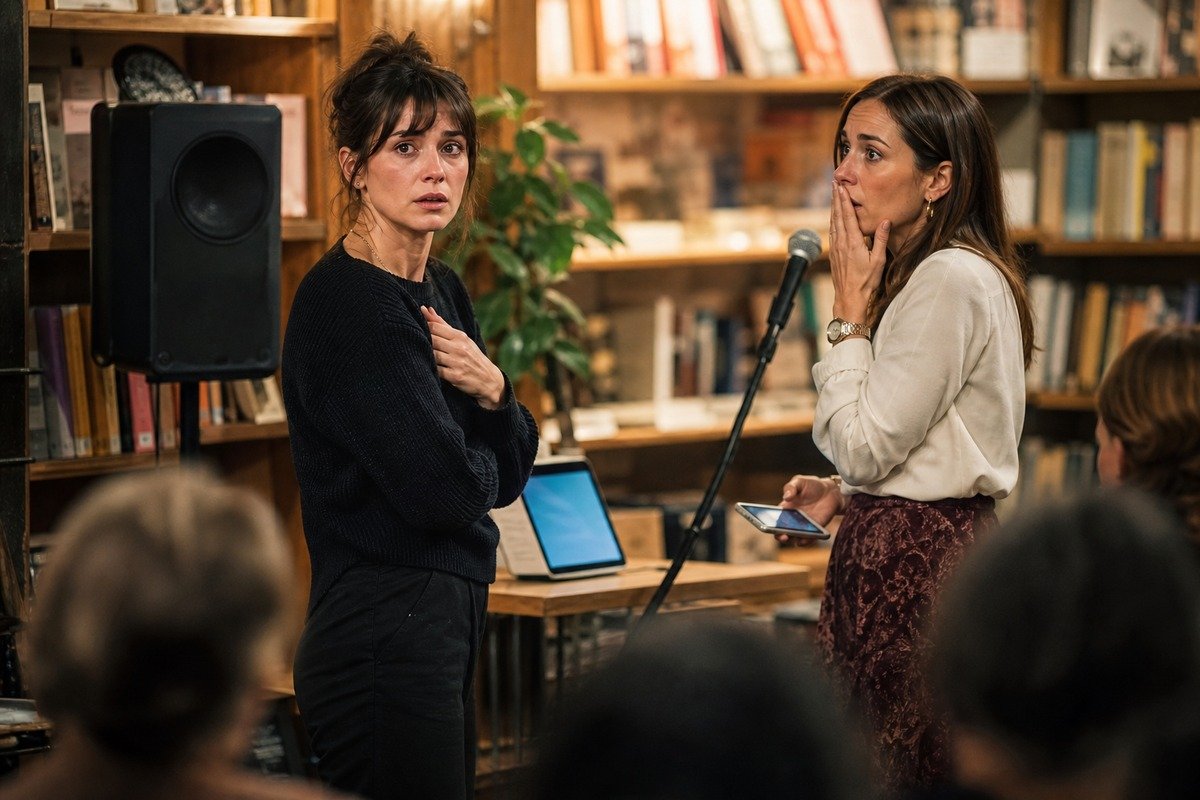
The sound came from a podcast trailer playing through the speakers at a crowded bookstore. My best friend, Celeste, stood near the stage while a projector displayed the cover of her new series about friendship after divorce.
Then my voice said, “I keep checking the driveway even though I know his car is not coming back.”
I had sent that message to Celeste at 1:17 in the morning, three days after my husband moved out. It was not an interview. It was a private voice note sent to the person I trusted most.
The trailer continued under piano music. Celeste’s narration called the clip “a raw dispatch from the center of an ending.” The audience became quiet in the way audiences do when they believe pain has been offered to them on purpose.
I walked out before the applause.
Celeste followed me into the alley behind the bookstore. She said my name once, then stopped because hearing her use it after the recording felt like another claim.
“You said the notes helped you understand what divorce really sounds like,” she told me.
“Understanding is not permission to publish.”
She said the trailer removed my name and changed the pitch slightly. Nobody would know it was me.
The event manager had known. Two mutual friends in the audience had known. My sister texted during the trailer because Celeste had sent her an early link and asked whether the clip felt “too recognizable.”
Celeste had not asked me the same question.
We had been friends for nineteen years. We met in college radio, where she learned to edit sound and I learned to distrust microphones left recording after an interview. When she began producing podcasts, I proofread scripts and celebrated her first sponsorship. She had always described consent as part of good storytelling.
My divorce began ten months earlier after my husband admitted he had been living two versions of our marriage. Celeste sat beside me through the first attorney meeting and brought groceries when I stopped cooking. I sent her dozens of voice notes because speaking was easier than writing.
Some were angry. Some were logistical. The one in the trailer came from a night when I had moved his shoes out of the closet and discovered a clean rectangle in the dust.
Celeste called those recordings a “private archive.” I believed the adjective.
The phrase had started as a joke between us. After especially difficult nights, she would text that the archive was open and I could leave whatever I could not say on a phone call. Sometimes she answered with a grocery list or a reminder to drink water. Sometimes she sent nothing until morning. That uneven, ordinary exchange was why the clips felt so private: they were not polished testimony offered to a producer. They were fragments of a friendship doing its daily work.
I had deleted several messages from my own phone after sending them because I did not want to hear the panic again. Celeste had kept copies in a folder organized by date. She later told me the order helped her understand how grief changed over time. At the bookstore, that explanation sounded less like care than collection. I could accept that she remembered what I had trusted her with. I could not accept that memory had quietly become a searchable production asset. The distinction was not about whether the recordings were powerful. Their power was the reason asking mattered.
In the alley, I asked how many of my messages she had copied into her project.
She said only six.
Only six meant there were five more.
We returned to the empty bookstore after the audience left. The event manager, Jonah, stayed because the store had agreed to host the full-series launch. Celeste opened her editing laptop.
The project folder contained thirteen clips labeled with dates. Six were in finished episodes. Three appeared in sponsor samples. Four were unused. My name appeared in the internal file titles even when the audio was anonymized.
One clip described the amount in our joint checking account. Another repeated my attorney’s advice. A third included my teenage niece asking whether divorce meant I would move away.
Celeste had removed the niece’s voice from the episode, but the original file had been uploaded to the production company’s shared server.
Jonah turned the laptop toward me and began listing access rather than offering reassurance. The editor had downloaded proxies of all thirteen files. The fact-checker had received transcripts of eight. A sponsor representative could stream three samples but was not supposed to download them. The engineer had the raw audio because cleaning my voice required the full frequency range. Each step had sounded routine inside production, yet none of those people appeared in the conversation where I pressed Send at 1:17 in the morning.
We opened one transcript. My niece's name had been replaced with a generic label, but the page still contained her question, my answer, and the date. Celeste had considered that anonymized. I pointed out that our relatives knew the divorce timeline and would recognize the exchange. More importantly, a child had been captured in a file she did not know existed. The harm did not depend on a stranger successfully guessing our names. It began when intimate speech was duplicated, labeled, and circulated for a purpose neither speaker had accepted.
That was the first consequence beyond friendship. A private family conversation now existed in a commercial workflow with an editor, a fact-checker, a sponsor representative, and an audio engineer.
Jonah asked Celeste for the release forms.
She did not have one from me.
She produced a text I had sent months earlier: “Use anything I say if it helps you get through your own mess.”
The message referred to a conversation about what Celeste should tell her sister, who was considering separation. It did not mention a podcast, an audience, a sponsor, or permanent distribution.
Celeste had treated emotional generosity as a media license.
I asked Jonah to cancel the following week’s launch until the production company confirmed where the files had gone. He said the contract was with Celeste, not me, but he would pause ticket sales for forty-eight hours while the store reviewed the consent issue.
Celeste accused me of trying to destroy a year of work.
I told her a year of work should have contained one direct question.
The next morning, I met with Priya, the production company’s standards editor. Celeste joined by video. Priya shared a distribution map: the trailer had been delivered to four podcast platforms, the store event page, two sponsor portals, and a private press folder. It had not yet entered paid advertising.
Priya explained that anonymization reduced identification risk but did not create consent. The company required releases for contributed personal recordings. Celeste had classified my clips as “creator-owned field audio,” implying she made them herself.
Celeste said the classification menu had no option for a friend’s voice note.
Priya answered that the correct response to a missing category was not to choose ownership.
We made a containment plan. The company pulled the trailer, suspended the episodes containing my voice, and issued deletion requests to every contractor. The audio engineer confirmed the raw folder was removed from the shared server. Sponsor copies were replaced with silence while the review continued.
Priya refused to call the first round complete until every recipient answered the same questions. Did the file exist on a local drive, a synced folder, an email attachment, an editing cache, or a backup? Had a transcript been exported? Had anyone forwarded a preview? The engineer found two waveform-cache files that would not play as ordinary audio but still contained recoverable data. The editor found a transcript in a project autosave. Both were deleted while their screens were shared, and the company recorded hashes so the original files could not be reintroduced later under a new name.
Celeste watched the inventory without speaking. At one point she said the process was disproportionate because the trailer had been public for only eleven hours. Priya answered that distribution time and distribution paths were different measurements. Eleven hours was enough for the platforms to make mirrors, the sponsor to archive a sample, and listeners to save a file. A short breach could still require a long accounting. That was the first time Celeste saw the production system she had trusted as an amplifier become a map of responsibility.
My sister joined the deletion review because her voice appeared faintly in one original message. She asked why Celeste had contacted her for recognizability feedback but not for consent. Celeste said she thought my sister could assess risk without becoming emotionally involved. My sister answered that avoiding the person most affected was not objectivity; it was a way to keep the desired answer available. Priya added the exchange to the incident record and required the company to search its backup snapshots. One nightly backup still held four raw notes. An administrator deleted them under a witnessed retention exception and documented the exact snapshot IDs.
I did not ask them to erase Celeste’s entire series. I required every recording from me to be removed, including clips she believed were transformed enough to count as new material.
Celeste had to rebuild six episodes without my voice. Her launch moved by seven weeks. One sponsor withdrew because the new date missed its campaign window. The bookstore replaced the event with a panel on audio consent and invited Priya, not Celeste, to lead it.
For two weeks, Celeste communicated only through the standards editor. Her first apology focused on the harm to me. Her second returned to how much the delay cost. Priya rejected the second as evidence of remediation and asked her to write a source ledger for the entire series.
That ledger revealed another problem. Celeste had used a coworker’s voicemail and a cousin’s wedding speech under similarly broad assumptions. Neither person had signed a release. Both clips were removed.
The issue was not one friendship exception. Celeste had built an editorial habit around intimacy that reached her easily.
Priya compared the three disputed sources. The coworker's voicemail had been sent after a difficult shift. The cousin's speech belonged to a wedding audience, not a podcast audience. My notes had been sent for support. In every case, Celeste had confused access with permission and then treated removal of names as the ethical step. The pattern mattered because it disproved her first defense that divorce had made our situation unusually blurred.
The company required her to rebuild the source ledger from the beginning. For each sound, she had to name who created it, why it was originally made, who controlled the account, what audience first heard it, and what new distribution she wanted. Anything without a documented answer was excluded. The exercise removed several ambient clips that were not dramatic at all. That surprised Celeste. She had imagined consent as a special burden for obviously painful material. Priya showed her that ordinary speech also belonged to its speaker and context. Ethical practice could not depend on an editor correctly predicting which unauthorized use would hurt most.
During the fourth week, she asked to meet at the college radio studio where we had first worked together. The old station manager let us sit in the production room after hours. A red light still illuminated when a microphone was live.
Celeste brought a printed consent protocol. Personal recordings required a specific project description, exact clip, distribution list, withdrawal deadline, and signed approval. Material sent for emotional support was excluded by default.
I asked why she had not followed the standards she already taught younger producers.
She said my messages made the series feel true in a way scripted narration did not. Once she built the trailer around that truth, asking me became dangerous because I might say no.
The red recording light above us was dark, but I still asked the station manager to unplug the microphones before we continued. Celeste looked wounded by the precaution. I told her that was part of the consequence: I no longer trusted a room merely because she said it was private. She checked the cables with me and placed her phone face down on the desk. Only then did we discuss what repair could and could not mean.
I asked whether she would have accepted no if she had approached me before editing. She admitted she might have tried to persuade me by playing the finished cut. That answer showed the new protocol needed a rule against producing a person's vulnerability first and seeking permission after emotional and financial investment made refusal costly. She added a pre-edit consent checkpoint. No personal recording could enter a session timeline without specific written authorization. The rule would not restore our old ease, but it prevented future sources from meeting a completed story and being told that protecting themselves would destroy it.
That admission mattered. She had not forgotten consent. She had avoided it because it could interfere with the work.
I told her we could not resume our friendship on the strength of a policy written for future sources. I needed the private archive destroyed and proof of deletion.
She opened an encrypted drive containing my messages and deleted the folder while the station manager witnessed. The production company provided a signed deletion log from its server and contractors. I kept copies of the log and the original trailer takedown notice.
Celeste released the rebuilt series two months later. The opening episode acknowledged that an earlier version used personal recordings without adequate permission. It did not name me or turn the apology into another piece of my story.
She narrated the emotional moments herself. Reviews described the series as more reflective and less voyeuristic. The lost sponsor did not return.
Our friendship resumed slowly. For several months we met only in public places and discussed work, books, and ordinary life. I stopped sending voice notes. When my divorce became final, Celeste asked whether I wanted company before assuming she belonged in the room.
I said no that morning and yes two days later. She came to my apartment without a recorder, notebook, or questions about how finality sounded. We packed the last folder from the divorce into a cabinet and cooked food neither of us photographed. The evening was uneventful, which was exactly what trust needed. Not every meaningful moment had to become material, and not every silence had to prove that I was still angry.
Our friendship never returned to the version that produced the archive. We use text for practical plans and speak in person about anything I would not want copied. Celeste sometimes asks whether that boundary is permanent. I tell her permanence is not the useful question. The useful question is whether she can respect it without turning each act of restraint into evidence that I should relax. So far, she has. That does not erase the commercial path my voice traveled. It gives our remaining friendship a shape that no longer depends on unlimited access.
The bookstore eventually hosted her delayed event. I did not attend. That was not punishment. It was one boundary that did not need to prove forgiveness.
Instead, I attended Priya's consent panel several weeks later and listened from the back row. The speakers discussed withdrawal windows, family voices captured in backgrounds, and the difference between source protection and source permission. Nobody played my recording. My experience contributed only through rules that did not require the audience to consume it again.
The original clip is no longer online, but I still hear the opening breath when I remember it. What hurt was not that strangers heard me cry. It was that my closest friend believed removing my name removed her obligation to ask.
Anonymity can protect a source. It cannot manufacture permission from silence.