On Monday morning, I walked through the double brass doors of the Helvetia Heritage Horology Workshop on Montgomery Street, carrying my leather briefcase and precision loupe kit.
As a master watchmaker certified by the Swiss Antiquarian Horological Federation, I had spent nineteen years restoring high-complication mechanical timepieces, vintage marine chronometers, and antique pocket watches.
Our workshop occupied the top floor of a historic 1910 limestone commercial building, flooded with even northern daylight ideal for microscopic escapement adjustments.
For sixteen years, my primary workstation had been an irreplaceable masterpiece: a 1954 custom watchmaker workbench handcrafted from aged European walnut and quarter-sawn white oak.
The bench had been built by my late mentor, Master Horologist Klaus Weber, who had trained me from an eager twenty-three-year-old apprentice into a master craftsman before passing away four years ago.
The bench was not mere furniture; it was a calibrated precision tool, featuring forty-two felt-lined swallowtail drawers shaped specifically to hold balance staffs, pallet jewels, and antique hairspring truing calipers.
It featured an integrated solid cast-iron watchmaker lathe mounting bracket, calibrated brass armrests designed to prevent muscle fatigue during six-hour microscopic balance wheel adjustments, and a recessed lambskin sweep catch that had captured thousands of microscopic pivot screws over sixty years.
When Klaus passed away, his estate formally deeded the bench to me as my personal professional property, a gift recognized in our formal employment agreement contract with the workshop’s parent restoration trust.
Two months ago, the trust hired a new regional facilities operations manager named Patrick, a corporate bureaucrat obsessed with modern aesthetic standardization and corporate floor-plan uniformity.
Patrick had spent twenty years managing call centers and logistics depots, possessing zero understanding of the delicate physics and acoustic requirements of precision horology.
From his first week on site, Patrick had complained about the diverse, vintage wooden furniture in our restoration department, calling it non-standard clutter that failed to align with corporate branding.
I had repeatedly and firmly told Patrick that my workbench was private, certified professional equipment essential for handling seventy-thousand-dollar vintage Patek Philippe and Vacheron Constantin restoration commissions.
I thought that my written employment contract rider had settled the matter, never imagining Patrick’s staggering arrogance and disregard for craftsmanship.
The reason Patrick targeted my workbench was a desperate urge to hit his quarterly workspace modernization bonus targets before his annual performance review.
He wanted to present a sterile, uniform open-plan office layout to the executive board to justify his department’s budget expenditures.
I believed that common sense would prevail in a heritage restoration studio, but Patrick feared that allowing individual exemptions would weaken his administrative control.
He wanted all employees to conform to corporate furniture standards, regardless of the specialized technical requirements of their trade.
The reason Klaus built this bench from European walnut was to absorb microscopic vibrations so that delicate watch balance pivots would not snap during calibration.
I thought our parent trust had firmly insulated our workshop from corporate meddling, but Patrick routinely treated our artisan tools as disposable office surplus.
I feared that if I did not defend my workstation, Patrick would gradually replace all our specialized antique horological equipment with generic commercial office supplies.
I wanted our workshop to maintain the highest Swiss standards of craftsmanship, never allowing commercial bureaucracy to degrade our heritage work.
Last week, I had traveled to Chicago to deliver a keynote paper at the National Antiquarian Horological Conference and conduct certified appraisals for two historic museum collections.
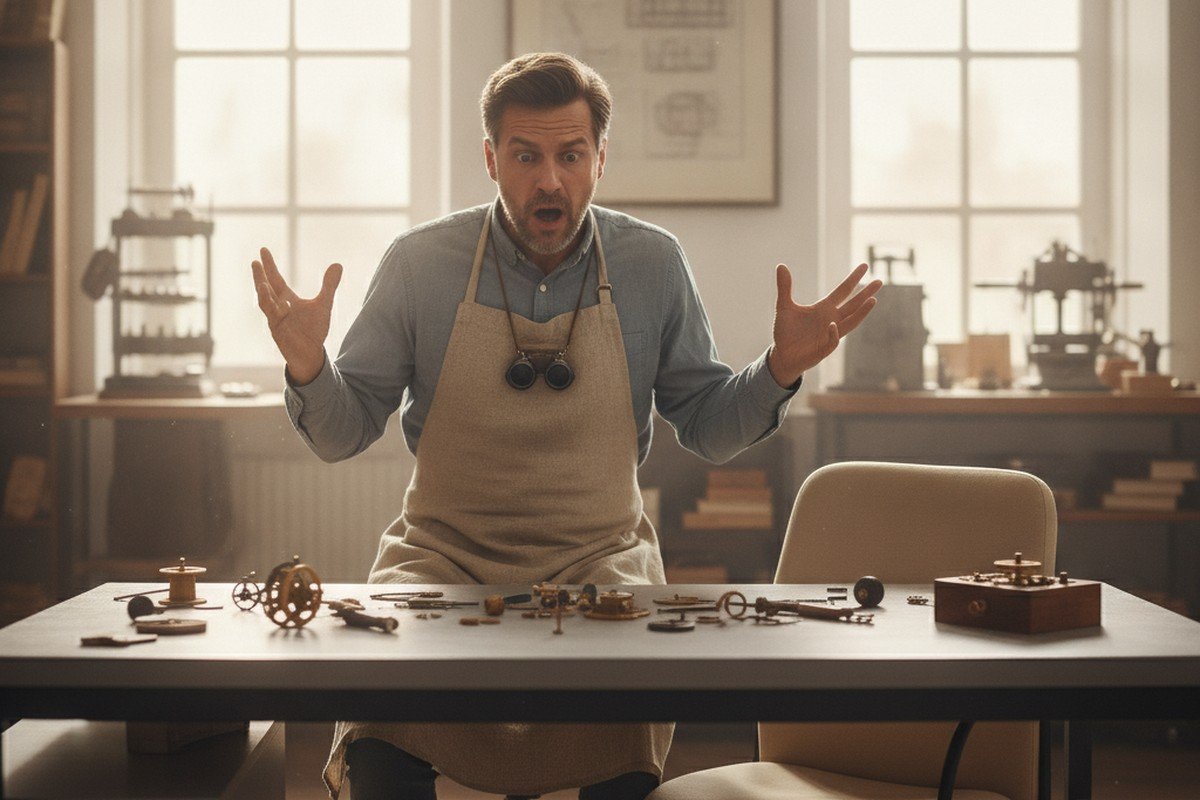
At eight-thirty on Monday morning, I stepped into the horology workshop, expecting to sit at Klaus’s walnut bench and begin adjusting a 1928 split-second chronograph.
I froze dead in my tracks, my briefcase dropping from my hand onto the hardwood floor as a wave of icy shock stopped my breath.
Where Klaus’s magnificent six-foot walnut workbench had stood for six decades, there was now a flimsy, mass-produced grey laminate modular office desk with plastic cable grommets and hollow steel legs.
My custom lathe mount was gone; the velvet-lined drawers were gone; the calibrated brass armrests had vanished.
Piled carelessly into three cardboard recycling boxes on the floor were hundreds of my delicate precision tweezers, antique Swiss staking punches, and microscopic jewel gauges, tossed together like junk metal.
A wave of sick panic swept over me as I realized that fragile ruby pallets, vintage balance wheels, and irreplaceable antique parts had been dumped haphazardly into shipping cartons.
This reckless action meant that thousands of dollars of delicate antiquarian watch components had been compromised, which meant that weeks of restoration projects would be delayed.
The cost of recalibrating delicate balance wheels and replacing bent pivot tweezers would take weeks of intense labor and substantial expense.
I rushed over to the workshop assistant, a young apprentice named Leo who looked pale and terrified.
“Leo, where is my workbench? Where is Klaus’s bench?” I demanded, my hands shaking uncontrollably.
“Marcus, Patrick brought a commercial junk removal crew in here on Friday afternoon right after you left for Chicago,” Leo whispered, looking around nervously.
“Patrick told the movers that your old desk was damaged commercial salvage and ordered them to haul it away to make room for the new corporate workstation,” Leo explained.
“He didn’t touch the tools?” I asked in horror.
“He ordered two maintenance workers to scrape your drawers into those cardboard boxes in twenty minutes so the carpet installers could work over the weekend,” Leo answered.
I ran down the hallway to the facilities office, throwing open Patrick’s door without knocking.
Patrick was sitting at a glass desk sipping a latte, looking up with an expression of mild annoyance.
“Marcus, please knock before entering my office,” Patrick said calmly.
“Where is my watchmaker workbench, Patrick?” I asked, my voice vibrating with intense, lethal rage.
“Oh, you saw your new desk? Looks fantastic, doesn’t it?” Patrick replied with a smug smile. “The grey laminate matches the updated corporate design standards we are rolling out across the entire regional facility.”
“That bench was not company property, Patrick! It was deeded to me personally by Klaus Weber, and it was protected under my certified employment contract!” I shouted.
“Marcus, calm down,” Patrick scoffed, waving his hand dismissively. “That old desk was sixty years old, scratched, stained with oil, and a total eyesore. We upgraded you to an ergonomic, height-adjustable workstation that costs fifteen hundred dollars.”
“Where did the salvage crew take it?” I demanded, slamming my palm onto his desk.
Patrick sighed, opening a metal filing drawer and pulling out a yellow carbon-copy document.
I opened the paper and read the document carefully: a commercial haul receipt and scrap transfer manifest from Bayview Metal and Timber Reclamation Depot, dated Friday at four-fifteen in the afternoon.
The itemized receipt listed: “One lot bulky wooden office salvage, broken desk materials, non-reusable wood waste.”
The document confirmed that Patrick had signed the disposal order as corporate surplus discard, authorizing the transfer station to crush or incinerate the bench for municipal scrap.
“They took it to the industrial transfer station on Harbor Boulevard,” Patrick said casually. “It is probably in the wood shredder by now, so there is no point in throwing a tantrum.”
“You just destroyed an irreplaceable 1954 artisan masterpiece and committed criminal conversion of personal property valued at over twenty-five thousand dollars,” I told him with icy precision.
“That old wood wasn’t worth twenty-five thousand dollars, Marcus, stop exaggerating,” Patrick replied, rolling his eyes.
“Klaus Weber was one of five master craftsmen honored by the Swiss Horological Guild, and that bench was cataloged in the National Horological Register!” I responded.
Then Patrick admitted that he had deliberately scheduled the removal while I was out of state so that I could not interfere with his office renovation schedule.
That was the moment the argument changed, because I discovered that Patrick’s actions were premeditated corporate vandalism designed to assert dominance.
Instead of acting in the company’s interest, he had exposed the entire restoration firm to catastrophic legal liability and reputational damage.
Worse still, another facilities worker entered the room holding an invoice for carpet tiles, asking Patrick where to bill the commercial disposal haul.
Then Patrick claimed that the facilities budget had already absorbed the disposal fee, but I refused to listen to administrative excuses.
Instead of accepting the new particle board desk, I demanded that David Vance issue an immediate written disciplinary citation.
Worse still, another junior technician revealed that Patrick had attempted to discard several antique cast-iron lathe beds earlier that year.
Until that confrontation, Patrick had believed that nobody would challenge his corporate authority, but my decisive stand changed the balance of power in our studio.
I refused to allow my mentor’s sixty-year legacy to be shredded in a municipal waste incinerator.
I grabbed the yellow scrap manifest from his desk, pulled out my smartphone, and dialed the managing partner of the restoration trust, David Vance.
“David, I am standing in Patrick’s office. While I was in Chicago, Patrick hauled my personal, deeded Klaus Weber workbench to Bayview Reclamation as scrap wood,” I said directly.
David was silent for five seconds before exploding in shock. “He did what? Marcus, that bench is insured under our heritage rider for thirty thousand dollars!”
I told David that I was heading to the reclamation yard immediately and expected him to meet me there with corporate legal counsel.
I sprinted to my car and drove twelve miles through industrial traffic to Bayview Metal and Timber Reclamation on Harbor Boulevard.
The reclamation depot was a vast, muddy industrial lot piled with crushed shipping containers, scrap iron, and demolition timber under screaming gulls.
I ran into the dispatch office, slammed the yellow manifest onto the counter, and confronted the yard foreman, a gruff man in an orange reflective vest.
“I need to locate the contents of this transfer manifest from Friday afternoon! It contains a priceless antique watchmaker workbench!” I said frantically.
The foreman looked at the ticket, scratched his beard, and checked his computer screen.
“Friday afternoon scrap load number four-two… that truck was tipped into the covered indoor salvage bay for specialty hardwood inspection, not the outdoor crusher,” the foreman told me.
We ran across the muddy yard to covered bay number three, where incoming antique architectural salvage was held before processing.
There, sitting beneath a plastic tarp beside a stack of vintage warehouse beams, was Klaus’s walnut workbench, intact, solid, and unharmed.
The custom brass armrests were still attached, the forty-two swallowtail drawers were in their slots, and the solid European walnut frame had survived without a single crack.
Inside the bottom drawer, Klaus’s handwritten leather-bound repair logs from 1958 were still tucked safely in their cedar compartment, untouched by water or grime.
A wave of profound, tearful relief washed over me as I touched the smooth, aged wood of the bench, feeling Klaus’s presence and the continuity of our craft.
Ten minutes later, David Vance arrived at the depot accompanied by a commercial moving truck and two certified fine-art handlers.
David examined the bench, visibly relieved, and personally supervised the art handlers as they wrapped the walnut structure in heavy quilted moving blankets and secured it onto air-ride suspension straps.
By noon, the moving truck had transported Klaus’s workbench back to the horology workshop, carrying it carefully up the freight elevator.
The generic grey laminate desk was unbolted, disassembled, and stacked in the hallway for return to the corporate office furniture warehouse.
Klaus’s bench was reinstalled in its rightful place beneath the north-facing windows, perfectly aligned with the morning light.
Over the next three days, Leo and I painstakingly examined my precision tools, cleaning every staking punch, balance caliper, and ruby jewel with ultrasonic solvents to verify that no components had been bent or chipped.
Fortunately, my precision tools had survived without structural damage, though the reckless dumping had cost twenty-four hours of non-billable labor to re-inventory and organize.
The consequence for Patrick was swift and absolute: David Vance convened an emergency board meeting on Tuesday morning, reviewing the yellow scrap manifest and the violation of my employment rider.
Then David Vance discovered that Patrick had forged the facilities disposal sign-off without secondary executive review.
Another board member admitted that Patrick’s actions violated company heritage preservation bylaws.
Patrick refused to apologize, but the board voted unanimously to terminate his contract on the spot.
Patrick was summarily terminated for gross insubordination, unauthorized destruction of certified heritage assets, and creating massive legal liability for the restoration trust.
The trust issued a formal written letter of apology to me, accompanied by a permanent addendum to the building lease designating my workshop space as protected heritage artisan territory exempt from facilities management jurisdiction.
The consequence for our workshop was a complete renewal of our sacred craft; the apprentices learned firsthand that true craftsmanship cannot be commodified or replaced by corporate mediocrity.
The following month, the restoration trust established the Klaus Weber Horological Heritage Fund, providing certified tooling grants for young apprentices.
The regional museum curator visited our workshop on Friday morning to inspect the completed 1928 chronograph, weeping with joy upon seeing the timepiece ticking again.
The curator presented our workshop with an official commendation from the municipal historical society, recognizing our defense of traditional craft.
Leo spent his evenings cataloging Klaus’s original horological notebooks, indexing sixty years of escapement calculations for future generations.
Whenever I sit at the walnut bench under the gentle north light, I feel the unbroken continuity of nineteen years of discipline and love for this craft.
On Thursday afternoon, I sat at Klaus’s restored walnut bench with apprentice Leo, showing him how to calibrate an antique hairspring using the solid brass truing caliper.
Watching Leo’s eyes widen as he learned the subtle feel of balancing an antique escapement reminded me why Klaus had invested so many patient years in my own training.
Three weeks later, I completed the delicate restoration of the 1928 split-second chronograph, its gold balance wheel ticking with flawless Swiss precision at twenty-eight thousand eight hundred vibrations per hour.
I placed the completed timepiece in its mahogany presentation box, listening to the rhythmic, hypnotic heartbeat of the escapement echo across the workshop.
Running my hand along the smooth, polished walnut edge of Klaus’s bench, I felt a deep, enduring sense of gratitude and triumph.
The following month, the horological guild published a special feature in their quarterly journal highlighting our recovery of the Klaus Weber workbench.
The article emphasized the critical importance of preserving artisan-designed historical workbenches against corporate workspace uniformity.
Leo framed a copy of the guild journal and hung it beside the workshop entrance, serving as a permanent reminder to every apprentice who walks through our doors.
True mastery requires honoring the physical tools and personal legacies that make timeless work possible.
Now the vintage clock movements tick with clarity, our restoration sanctuary stays inviolate, and the heritage workbench remains the beating heart of our studio.
The bench stands as a fortress of skill and quiet dignity.
I defended my mentor’s legacy through swift, resolute action, proving that true art and master craftsmanship will always outlast corporate arrogance.