On Tuesday morning, the tranquil quiet of our historic brick brownstone on Maple Street was shattered at six o’clock by the deafening roar of pneumatic jackhammers.
The violent mechanical vibrations rattled my coffee mug off the kitchen counter and sent hairline plaster dust showering down from our twelve-foot living room ceilings.
For nine years, I had lived in the garden apartment of this landmark nineteen-twenties four-story brownstone, working as an independent botanical illustrator and landscape author.
The defining feature of our building was an enclosed eighty-foot private rear courtyard garden, bounded by historic hand-laid red brick walls, mature weeping cherry trees, and perennial flowering beds.
When I signed my long-term tenancy lease, the landlord had attached a legally binding residential garden rider granting the four building tenants exclusive, private enjoyment of the courtyard.
The courtyard was our urban oasis, a serene sanctuary where we held quiet weekend reading sessions, cultivated heirloom vegetables, and escaped the relentless noise of metropolitan traffic.
Three months earlier, our building had been purchased by a corporate property conglomerate managed by Donald Vance, a commercial real estate developer known for aggressive asset monetization.
Donald had immediately eliminated our building recycling service, cut back on hallway custodial maintenance, and installed commercial digital surveillance cameras in our residential entryway.
He frequently complained that residential brownstones in our historic district were under-monetized properties that needed modern commercial revenue streams.
Because our residential leases were protected under municipal rent stabilization ordinances, Donald could not evict us or raise our rents without cause.
The century-old courtyard was the heart and soul of our Maple Street brownstone.
Over nine years, I had cultivated climbing wisteria along the brick trellis, nurtured heritage hydrangeas, and designed a stone birdbath where local finches gathered at dawn.
My upstairs neighbors, David and Sarah, frequently sat with me on summer evenings under the shade of our weeping cherry tree, sharing coffee and discussing municipal news.
Because our courtyard provided rare green space in a dense urban neighborhood, protecting it was an existential priority for every resident.
I believed that our lease rider granted us absolute legal protection against commercial development.
I feared that Donald’s industrial charging stations would destroy our tranquil sanctuary and turn our home into a hazardous commercial fleet depot.
I wanted to defend our historic property and preserve our community peace, so I refused to allow the contractors to proceed with their demolition.
The thought of our beloved urban garden being replaced with concrete and charging cables filled me with unyielding determination.
We had tended that soil through drought and winter frost, investing our own hands into every blooming branch.
The original red brick masonry had endured a century of seasonal thaws, representing a living connection to the city’s architectural craftsmanship.
I threw on my work boots, ran through the ground-floor rear hallway, and pushed open the heavy courtyard door into an appalling scene of industrial destruction.
A crew of six demolition contractors wearing hard hats were tearing up our historic red brick pavers with heavy pneumatic pavement breakers.
The centenarian weeping cherry tree had been chopped down and fed through an industrial wood chipper idling in the alleyway, its fragrant sawdust blanketing the shattered earth.
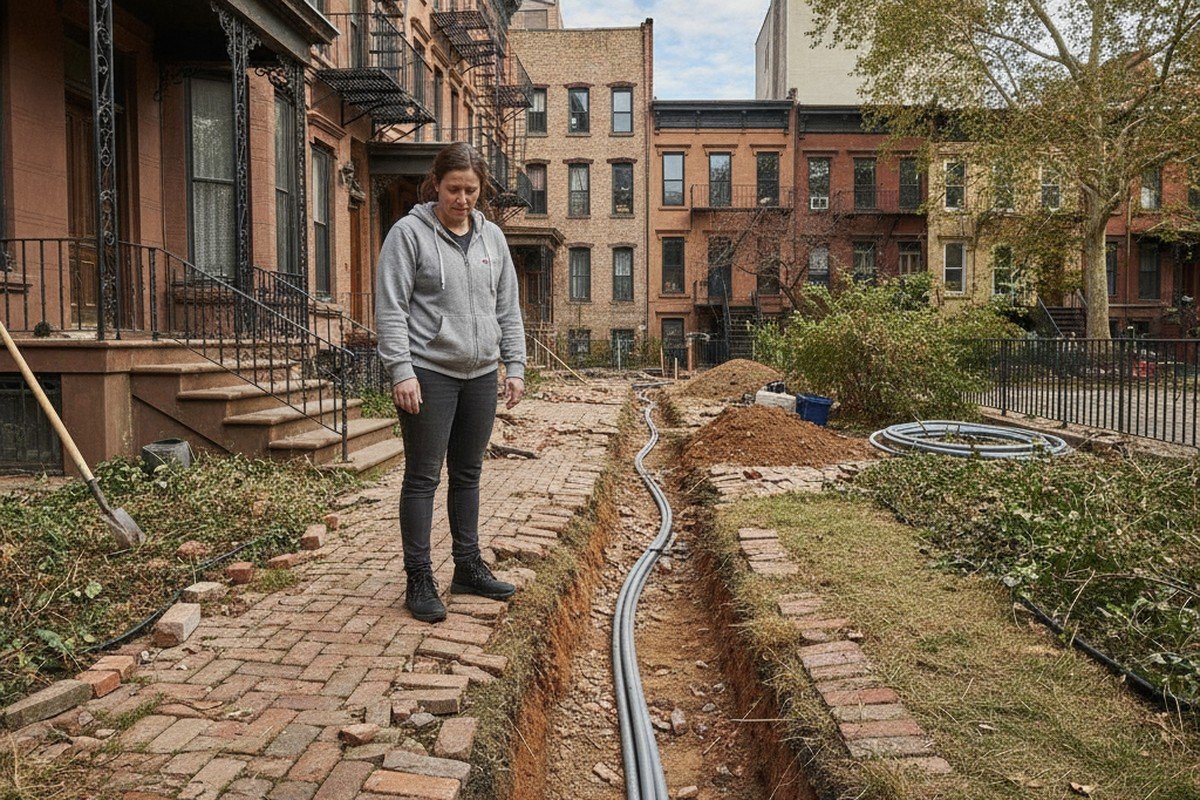
Two large diesel trenchers were digging deep electrical trenches straight through our perennial flower beds toward our basement utility room.
Parked in the service lane behind the garden were four commercial electric delivery vans bearing the logo of an express courier logistics company.
I confronted the site foreman, shouting over the roar of the machinery and demanding to know who had authorized the destruction of our private garden.
The foreman pulled a laminated commercial work order from his clipboard and handed it to me with indifferent efficiency.
The work order stated that contractor project number five-six-one was converting our residential courtyard into an eight-bay high-voltage commercial fleet charging terminal.
The document showed that Donald Vance had executed a five-year commercial master lease with the express logistics courier, renting our private courtyard for seven thousand dollars per month as an overnight fleet charging depot.
I looked at the document and reviewed the permit authorization section, noticing that Donald had filed the municipal application under an emergency residential electrical maintenance permit rather than a commercial zoning variance.
Even worse, the contractor schematics revealed that the heavy three-phase high-voltage charging cables were being tapped directly into our building’s master electrical service panel in the basement.
The reason this conversion was so catastrophic was that operating a high-voltage commercial charging depot inside an enclosed residential courtyard posed severe fire hazards, toxic lithium battery thermal runaway risks, and twenty-four-hour industrial vehicle noise.
Furthermore, our neighborhood was zoned strictly as a low-density R-two historic residential conservation district where commercial fleet depots and paid vehicle charging operations were expressly prohibited by municipal law.
I believed that if the commercial charging bays were completed, our historic garden would be permanently turned into an asphalt industrial parking lot, destroying our quality of life and tanking our property safety.
I feared that an electrical battery fire in the enclosed courtyard would trap tenants on the upper floors of the four-story brownstone with zero escape routes.
I wanted to protect our home, our historic neighborhood, and our legal tenancy rights, so I refused to permit another inch of demolition.
The thought of Donald Vance trampling our legal leases and turning our sanctuary into a diesel-and-battery fleet depot filled me with ferocious resolve.
I stepped directly in front of the active pavement breaker, held up my lease document, and ordered the construction crew to halt their machinery immediately.
The foreman cursed loudly, signaling his operators to cut their engines, and dialed Donald Vance on speakerphone.
Donald Vance arrived fifteen minutes later in his luxury German sedan, stepping into the torn-up courtyard with an aggressive, hostile scowl.
“Marcus, get out of the way of the contractors right now!” Donald shouted, pointing an accusatory finger at my chest.
“This building is private corporate property, and I have the absolute legal right to optimize its outdoor footprint for modern infrastructure!”
“Donald, you signed a binding residential garden rider granting us exclusive private amenity rights to this courtyard,” I replied, keeping my voice cold and rock-solid.
“You bulldozed a century-old garden without a commercial zoning variance, you forged an emergency repair permit, and you are tapping commercial fleet chargers into our residential electrical feed!”
Donald laughed dismissively, claiming that residential garden riders were unenforceable lifestyle courtesies that held zero legal weight against corporate owner improvements.
Instead of halting the destruction, Donald threatened to initiate retaliatory eviction proceedings against any tenant who interfered with the contractors.
In the courtyard, Donald Vance stepped aggressively toward David and Sarah, waving his corporate lease documents in their faces.
“You tenants are tenants, not owners!” Donald yelled angrily. “You have zero say in how this property generates commercial infrastructure revenue!”
“Donald, our residential lease rider is an explicit covenant running with our tenancy,” Sarah retorted with fierce confidence.
“You cannot unilaterally demolish our private garden to install commercial delivery charging bays without city permits and tenant consent!”
Miss Eleanor, who had lived on the top floor for thirty-two years, pointed her walking cane at the industrial trenchers.
“This brownstone was built in nineteen twenty-four, Donald Vance, and no corrupt corporate landlord is going to turn our garden into an asphalt parking lot!” Miss Eleanor declared firmly.
David stepped forward, holding up our master lease agreement, and told Donald that we had already alerted our city council representative.
We made it clear to Donald that our resolve was unbreakable and that the law was firmly on our side.
Faced with our united front, Donald realized that his intimidation tactics would not cause us to back down.
That was the moment the argument changed, because my fellow tenants—Sarah from the second floor, David from the third, and Miss Eleanor from the top floor—walked into the courtyard holding their executed lease riders.
Then Donald admitted that he had already accepted forty-two thousand dollars in advance commercial infrastructure grants from the logistics courier.
This revelation proved that Donald had premeditated the entire illegal demolition weeks ago, choosing to deceive his residential tenants for massive corporate profit.
Worse still, another document produced by David showed that Donald had attempted to reclassify our residential basement as an industrial battery storage vault.
I discovered that Donald had never notified the local municipal historic preservation board, knowing full well that altering the landmark courtyard required public hearings and historical impact reviews.
Until that morning, I had viewed Donald as merely an indifferent corporate landlord, but his ruthless disregard for law and tenant safety proved he was entirely predatory.
I pulled out my mobile phone and placed an emergency priority call to the municipal Department of Buildings special enforcement bureau and the city fire marshal.
I reported an active unpermitted high-voltage commercial installation and illegal demolition within a designated historic conservation district.
Within thirty-five minutes, two official city enforcement vehicles and an emergency inspection van from the municipal historic preservation commission pulled up to the curb.
The lead building inspector, accompanied by a senior city fire marshal, marched through the hallway into the courtyard with clipboards and digital meters.
The fire marshal immediately inspected the basement electrical room, which confirmed that the contractors were illegally bypassing residential circuit breakers to supply high-voltage current to the outdoor charging lines.
When the Department of Buildings enforcement van arrived, lead inspector Robert Martinez stepped into the courtyard with a handheld noise meter and digital camera.
Martinez reviewed Donald’s fraudulent repair permit, comparing the electrical schematics with the three-phase commercial conduits exposed in the dirt.
“Mister Vance, this is not an emergency residential repair; this is an unauthorized industrial fleet charging facility in an R-two historic residential zone,” Martinez announced sternly.
The city fire marshal opened the electrical access panel in the cellar, discovering hazardous ungrounded wiring that violated municipal electrical codes.
The inspectors immediately slapped stop-work orders across every courtyard entrance, ordering the contractors to shut down all diesel generators under penalty of immediate arrest.
Inspector Martinez handed Donald the formal violation notice, which recorded four separate structural infractions carrying mandatory daily fines.
The city official warned Donald that any further tampering with the site would result in immediate criminal citations and property confiscation.
The construction crew packed their hydraulic tools and heavy hoses in record time, eager to avoid being caught up in Donald’s legal infractions.
“This is a severe class-one life safety hazard,” the fire marshal announced with booming authority. “Shut down this entire site immediately!”
The building inspector examined Donald’s fraudulent repair permit, shook his head in disgust, and issued a stop-work order on the spot.
The city inspector slapped a bright red Stop Work Order placard onto the courtyard doorway, halting all construction activity with immediate effect.
The inspector issued Donald Vance four mandatory municipal summonses totaling forty-five thousand dollars in civil penalties for unpermitted commercial construction, illegal tree removal, and deceptive permit filing.
The fire marshal ordered the construction crew to immediately cap the electrical conduits, disconnect the trench cables, and remove their heavy machinery from the premises.
Donald Vance stood in the torn-up dirt, his face pale and contorted with fury as his lucrative commercial fleet depot vanished before his eyes.
The logistics courier immediately terminated their master lease agreement with Donald, citing his failure to secure legal municipal zoning variances.
Over the next forty-eight hours, our tenant association met with a top municipal housing rights attorney to enforce the restoration of our courtyard.
Our attorney filed an emergency petition in housing court, compelling Donald Vance under court order to restore the courtyard to its original historic condition.
The court decree mandated that Donald replace every brick paver, plant new mature cherry trees, restore the perennial beds, and grant every tenant a fifty percent rent abatement for six months to compensate for the disturbance.
The financial consequence for Donald Vance was catastrophic: he was forced to spend twenty-eight thousand dollars restoring the historic garden, pay forty-five thousand dollars in city fines, and forfeit hundreds of thousands in expected commercial revenue.
On Monday morning, the municipal historic preservation commission issued a formal restoration directive, ordering Donald Vance to re-lay every historic brick under landmark supervision.
Two weeks later, the housing court approved our tenant association’s settlement, locking in mandatory six-month rent abatements and fifty thousand dollars in garden restoration escrow funds.
A team of master heritage masons arrived to carefully hand-set new antique red brick pavers and plant two mature ornamental cherry trees in our courtyard.
Three months later, our garden bloomed with vibrant perennial flowers once again, filled with the soothing scent of moist earth and blossoming cherry flowers.
Gathered around our shared cedar dining table on a warm July evening, my neighbors and I raised our glasses in celebration of our united courage.
A home is defined by the community that protects it, and the sanctuary we defended now stands completely safe for years to come.
Now, whenever the morning breeze rustles the cherry leaves outside my bedroom window, I know that our unity saved this sanctuary.
Historic neighborhoods survive only when the people living in them refuse to be intimidated by reckless commercial exploitation.
Our brownstone stands tall on Maple Street, completely peaceful, entirely restored, and forever guarded by genuine neighbors.
And whenever I walk across the hand-laid brick pavers in the quiet morning light, I will remember the day we fought for our garden and won.
The consequence for our building was an unbreakable tenant alliance and absolute legal protection for our residential sanctuary.
The cost of the battle was days of noise and legal confrontation, but the cost of surrender would have been the permanent loss of our home’s peace and safety.
Because our tenant association acted swiftly and mobilized city enforcement, Donald’s illegal scheme was crushed in less than two hours.
Two months later, the restoration was complete: new hand-laid red brick pavers gleamed in the sun, two beautiful young cherry trees swayed in the breeze, and vibrant perennial flowers bloomed once again along the garden walls.
On Saturday afternoon, all four households gathered in the restored courtyard around a long wooden table for our annual summer garden dinner.
Listening to the gentle rustle of the leaves and the quiet laughter of neighbors, I knew that community solidarity is the greatest defense against corporate greed.
A home is not merely an investment asset to be stripped and exploited; it is a sacred space where human beings live, work, and find peace.
The courtyard remains quiet, completely peaceful, permanently protected, and forever guarded by the people who call it home.
I will continue illustrating our urban flora from my garden studio, grateful for the neighbors who stood shoulder-to-shoulder to defend our sanctuary.
True neighborly trust cannot be purchased, and the boundary we established will preserve our homes for generations.
And whenever I step into the sunlit courtyard to smell the blossoming cherry flowers, I will remember the Tuesday morning we stood our ground and saved our home.