On a crisp Saturday morning in late September, I was awakened at seven o’clock by the violent shuddering roar of heavy diesel excavators outside my bedroom window.
For eight years, I had lived in apartment three-B of the Willow Creek Terrace residential complex in our city’s quiet riverfront neighborhood.
In our central courtyard, surrounded by brick garden walls, was an eight-thousand-square-foot community vegetable garden established by our resident council ten years ago.
Our garden contained forty raised cedar planting beds, heirloom tomato vines, raspberry brambles, three dwarf apple trees, and a central stone gathering arbor.
Every tenant in our building had invested hundreds of hours cultivating organic produce, hosting neighborhood harvest suppers, and teaching local children about urban agriculture.
Our residential lease agreements contained an explicit garden easement covenant, guaranteeing tenant access and preservation of the green courtyard as an essential property amenity.
Our property landlord, Martin Briggs, was a commercial real estate speculator who had purchased the building eighteen months ago and constantly sought ways to squeeze revenue from common areas.
Briggs had previously attempted to convert tenant storage lockers into fee-based mini-warehouses and tried to charge monthly fees for visitor parking stalls.
Two months earlier, Briggs had attended our resident meeting and hinted that our garden courtyard had prime commercial visibility along the newly widened commuter boulevard.
Our resident council had voted unanimously to reject any commercial development, reminding Briggs that our lease covenants legally protected the garden until twenty thirty-five.
Ten years ago, when our building was owned by an elderly couple who loved horticulture, our courtyard was an empty patch of gravel.
Our resident council spent four months digging out the gravel, hauling twenty tons of organic compost, and hand-building cedar beds.
Every spring, our tenants planted heritage tomatoes, sweet peppers, snap peas, and lavender, creating a lush communal oasis.
Elderly residents who lived alone found companionship among the tomato vines, while young children learned how seeds grow into food.
Because our city had few public parks in our neighborhood, preserving our garden courtyard was essential for our mental and physical health.
I wanted to protect our neighborhood sanctuary, so I volunteered as our resident council garden coordinator every summer.
We had installed a rainwater catchment system and drip irrigation lines, funding every component through bake sales and monthly tenant dues.
Over sixty families in Elmwood Terrace contributed their labor, transforming the neglected urban space into a flourishing community green.
When Martin Briggs purchased the apartment complex two years ago through Briggs Urban Real Estate LLC, he made vague promises to respect tenant amenities.
In our signed lease agreements, section fourteen clearly established a common area garden easement running with our tenancies through twenty thirty-five.
The covenant explicitly protected the central courtyard as recreational green space, prohibiting commercial conversions or vehicle storage.
Briggs, however, was an aggressive developer who saw every square foot of green space as wasted monetization potential.
For months, Briggs had sent ambiguous building memos hinting that courtyard maintenance costs were straining the property’s operating budget.
Our resident council had repeatedly pointed out that tenant volunteers paid for all seeds, soil, and water tools without landlord subsidy.
On Saturday morning, I threw on my jacket and rushed down the central stairwell into the courtyard, my heart pounding in disbelief.
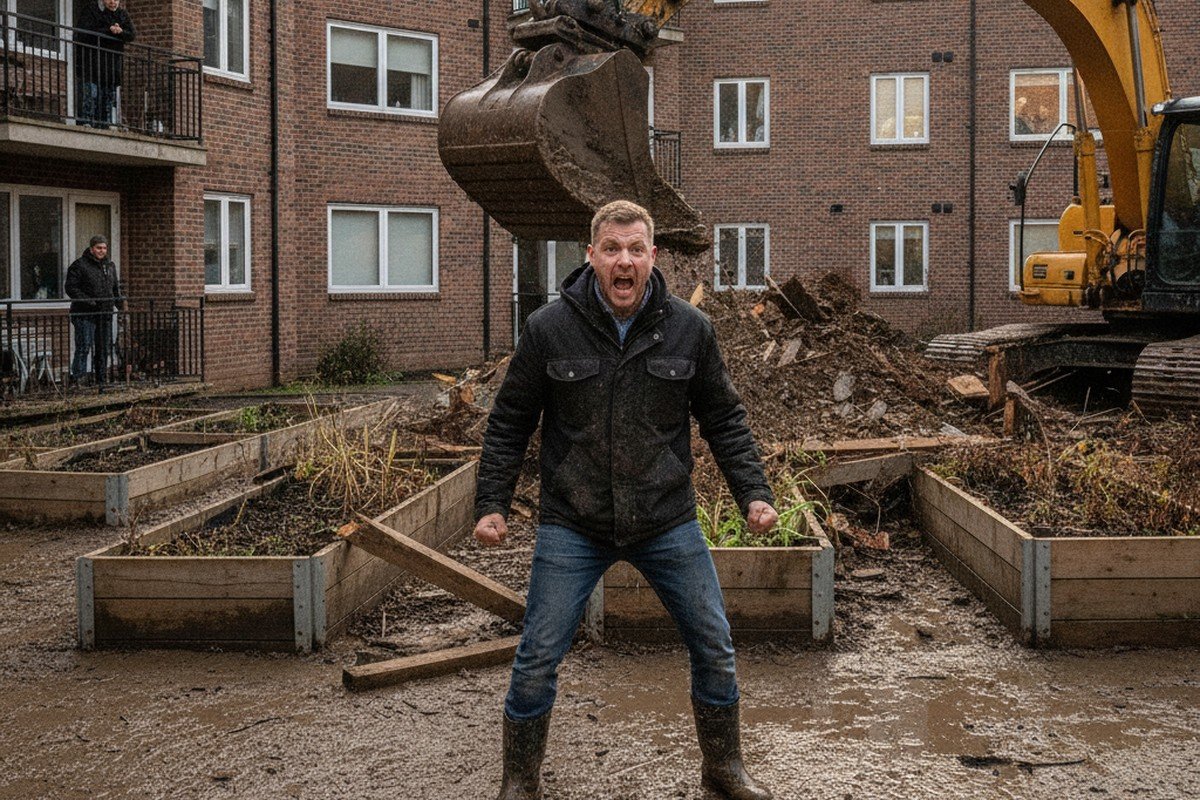
A massive yellow tracked excavator with a hydraulic demolition claw was actively crushing our cedar garden beds into splintered kindling.
Two dump trucks were idling on our lawn, while workers in orange vests were unloading prefabricated steel foundation pilings for two commercial digital billboard towers.
Our heirloom tomato plants were being ground into the mud, our raspberry vines were torn from their trellises, and our hand-built stone arbor lay in a pile of crushed rubble.
Dozens of tenants were standing in their bathrobes and work clothes along the perimeter pathway, shouting in anguish as the demolition crew destroyed ten years of our community labor.
I sprinted across the muddy lawn toward the job foreman, shouting at him to shut down the heavy machinery immediately.
The foreman stepped down from his truck, holding a metal clipboard and chewing gum with complete indifference.
He handed me an excavation work order and a municipal commercial sign permit issued by the city zoning department forty-eight hours earlier.
I looked at the document and reviewed the permit specifications, which authorized the erection of two fifty-foot illuminated digital advertising billboard signs directly in our courtyard.
The paperwork confirmed that Martin Briggs had leased our courtyard ground easement to Apex Outdoor Advertising for fourteen thousand dollars a month on a twenty-year commercial lease.
Standing in the muddy courtyard, I examined the municipal commercial sign permit that the excavation foreman had handed to me.
The zoning application revealed that Martin Briggs had submitted forged photographs showing our courtyard as vacant construction debris.
The document confirmed that Apex Outdoor Advertising had agreed to pay fourteen thousand dollars monthly for two digital billboard faces.
The paperwork proved that Briggs had signed an indemnification clause promising to clear all residential opposition at his own expense.
The reason this destruction was so unconscionable was that Briggs had intentionally sent the bulldozers at dawn on a holiday weekend.
I realized that Briggs had planned a smash-and-grab demolition to destroy our garden before tenants could obtain a court injunction.
I checked the permit application number on the city planning portal using my smartphone, which showed the permit was marked conditional.
The document confirmed that commercial excavation required thirty days of posted public notice and a neighborhood council hearing.
Briggs had bypassed the public hearing requirement by filing an emergency utility repair affidavit that was completely fraudulent.
I showed the lease agreement covenant to the excavation contractor, whose eyes widened as he realized he was executing an illegal destruction.
The contractor ordered his workers to turn off the excavator engines while he called his company liability insurance attorney.
The paperwork verified that Briggs had lied to the contractors, telling them that the property was fully cleared of residential rights.
I reviewed the municipal code violations listed on the city portal, noting that unauthorized soil removal carried severe civil penalties.
The record confirmed that our common area garden easement was formally registered with the county recorder of deeds.
Attached to the permit was an affidavit signed by Martin Briggs claiming that the courtyard was an abandoned, vacant utility lot with zero residential use.
I opened the contractor folder and read the municipal filing, which proved that Briggs had forged a fraudulent zoning application while keeping the entire project hidden from tenants.
I stared at the documents in white-hot fury, realizing that Briggs had bulldozed our cherished community sanctuary for corporate billboard cash.
Just then, a sleek black sedan pulled up along the curb, and Martin Briggs stepped out wearing an expensive tailored overcoat and sunglasses.
He walked toward the demolition site with an arrogant smirk, holding a leather portfolio under his arm.
I marched straight up to Briggs, holding the forged zoning permit in front of his face.
“Briggs, you ordered this demolition illegally! You forged a municipal permit claiming this garden was vacant land!” I shouted.
Briggs adjusted his sunglasses, sneering with patronizing contempt. “Ortiz, calm down. It was a patch of dirt with some overgrown weeds. Digital billboards bring modern economic vitality and substantial commercial revenue.”
“Our lease agreements contain a binding covenant protecting this garden until twenty thirty-five!” I retorted.
“A covenant in a residential lease doesn’t stop a landlord from maximizing property value, Ortiz,” Briggs said dismissively. “If you don’t like the billboards, you are free to break your lease and move to the suburbs.”
When Briggs arrived at the courtyard curb, the confrontation escalated as dozens of tenants surrounded his luxury sedan.
“Briggs, you brought heavy excavators to destroy our private garden without a single hour of legal notice!” I shouted.
“This property belongs to my LLC, Ortiz! You rent square footage inside the walls, not the commercial soil!” Briggs sneered back.
“Our lease agreements contain a binding common area easement covenant that runs with the land until twenty thirty-five!” Elena Cruz shouted.
Instead of halting the excavators, Briggs ordered the demolition crew to start drilling into our concrete retaining wall.
That was the moment the confrontation reached its boiling point, because several tenants stood directly in front of the excavator treads.
Then Briggs admitted that he had already collected a one-hundred-thousand-dollar non-refundable signing bonus from the billboard company.
Hearing his admission revealed that he had gambled our home’s peace for a corporate windfall, expecting tenants to remain silent.
I told Briggs that the city building inspector was five minutes away, and if the machinery moved another inch, he would be jailed.
Worse still, another subcontractor admitted that Briggs had planned to pour asphalt over the entire garden by noon to make it irreversible.
Briggs refused to stand down, threatening to issue immediate eviction notices to every tenant standing in the courtyard.
The tenants changed their response, linking arms across the courtyard entrance and singing neighborhood folk songs with unbroken solidarity.
Until that morning, Briggs had assumed that our diverse, working-class building would fracture under legal intimidation.
But seeing grandmothers, teachers, and young nurses standing shoulder to shoulder broke his arrogant composure completely.
Then the city chief building inspector arrived in a marked municipal vehicle, siren flashing as he stepped into the courtyard.
The reason our entire building stood united against the bulldozers was because our garden was the soul of our community.
I feared that if we surrendered our courtyard to billboard corporations, our children would lose their only green space in the city.
I wanted to protect the dignity of our elderly neighbors whose daily joy came from tending their rosemary and tomato beds.
Because our community believed that shared spaces belong to human connection rather than corporate advertising, we thought of our protest as essential.
We knew why Briggs had attempted his dawn raid: he wanted to create an irreversible fait accompli before our attorneys could file an injunction.
I wanted to prove that tenant solidarity can defeat predatory real estate greed, so I held our ground with absolute conviction.
Inspector Marcus Diaz inspected the excavation pit, reviewed the conditional permit, and compared it with Briggs’s fraudulent emergency affidavit.
Diaz posted a bright red official stop-work notice on the driver’s cab of the heavy excavator, ordering all machinery shut down immediately.
“Mister Briggs, your sign permit is revoked for criminal misrepresentation on a municipal filing,” Inspector Diaz announced publicly.
“If a single engine turns over on this property again today, the police department will impound the machinery and place you under arrest.”
The excavation crew packed up their tools, apologized to our resident council, and drove their heavy flatbed trailers away from our street.
Briggs climbed back into his luxury sedan and sped off, his one-hundred-thousand-dollar billboard scheme in complete ruins.
The reason this destruction was so monstrous was that urban community green spaces cannot be replaced once paved over with commercial concrete.
I believed that if the contractor poured the steel foundation pilings today, our courtyard would be permanently lost to corporate advertising.
I feared that allowing Briggs to bulldoze our legal rights would empower predatory landlords across our city to trample tenant covenants.
I wanted to protect our home and force Briggs to face total legal accountability, so I refused to yield an inch of our soil.
I immediately coordinated with our resident council president, Elena Cruz, who was an attorney with the local municipal legal aid society.
Elena drafted an emergency ex parte injunction petition and called the city chief building inspector, reporting an active permit fraud.
Within forty-five minutes, two city code enforcement cruisers and a police unit arrived at the courtyard with flashing lights.
The chief building inspector reviewed our signed lease covenants, our ten-year garden tax exemption records, and Briggs’s fraudulent zoning application.
The inspector was furious, realizing that Briggs had lied on a sworn municipal document.
The inspector issued an immediate Stop Work Order, posted red violation notices on the excavator cabs, and ordered the demolition crew to vacate the property immediately.
Briggs’s arrogant smirk completely collapsed as the police warned him that continuing construction would result in immediate criminal arrest.
On Monday morning, Elena Cruz presented our case before the county municipal court judge, who issued a permanent preliminary injunction against the billboard development.
The judge ruled that Briggs had committed intentional fraud and breach of covenant, voiding his twenty-year lease with Apex Advertising.
The court ordered Briggs to pay one hundred and twenty thousand dollars in civil damages into our resident council account to completely restore our courtyard.
Over the following spring, our community worked together to reconstruct our raised cedar beds, plant new heirloom fruit trees, and rebuild our central stone arbor.
Now, our community garden blooms more vibrantly than ever, standing as an enduring testament to the power of community solidarity against corporate greed.
Following the court injunction, the municipal zoning commission revoked Apex Outdoor Advertising’s commercial permit with prejudice.
The city building department fined Martin Briggs forty-five thousand dollars for filing false statements on a municipal zoning petition.
The court appointed an independent special master to oversee the restoration of our courtyard, paid entirely from Briggs’s escrow accounts.
Over the next four months, landscape contractors laid fresh fertile topsoil, installed fifty new cedar beds, and planted mature apple trees.
Our resident council held a grand reopening harvest festival in May, with over one hundred neighborhood families gathering in the courtyard.
Martin Briggs was forced to sell the residential property to a community housing cooperative after defaulting on his commercial loans.
Now, as the summer evening sun casts golden light across our flourishing vegetable beds, our garden stands as a beacon of unity and strength.
Over the following weeks, our neighborhood association helped three other tenant complexes establish legal garden easements.
Elena Cruz harvested forty pounds of heirloom beefsteak tomatoes from her restored bed, sharing baskets with every family in our building.
The city council drafted a municipal ordinance named after Elmwood Terrace to protect historic urban gardens from predatory commercial rezoning.
Our local library archived our legal briefs and courtyard photos, preserving the story of our defense for future urban community leaders.
Our housing cooperative established an organic seed bank in the building community room, sharing drought-resistant heritage seeds across the city.
Every autumn, tenant families gather beneath the courtyard apple trees to press fresh cider and celebrate the enduring power of ordinary people standing together.
Months later, our children play safely among the lavender rows, knowing that community solidarity protected our home.
When older tenants gather on the wooden benches at dusk, their smiles reflect the quiet triumph of having defended our soil.
We proved that when working families stand shoulder to shoulder, no unscrupulous developer can uproot their shared roots.
Every strawberry blossom and rosemary sprig that blooms here reminds us of the strength we discovered when we united as one.
Our neighborhood flourishes with green life, standing tall as an unbreakable symbol of shared dignity and collective purpose.
The courtyard remains a living testament that ordinary neighbors standing together can overcome corporate greed and defend their sanctuary.