At 2:13 a.m., a man I had never met called to report a sprinkler spraying his driveway.
He sounded angry that I did not already know his address.
I told him he had the wrong number. He read my number back from a yellow flyer the homeowners association had placed in every mailbox: AFTER-HOURS NEIGHBORHOOD EMERGENCY LINE—ELENA RUIZ.
Below my name were instructions to call for water leaks, fallen branches, gate failures, noise, suspicious vehicles, and “other urgent community concerns.”
I had agreed to none of it.
The caller kept talking while I opened the neighborhood group chat. There were seven new messages. One neighbor had called about a barking dog. Another wanted to know whether a flickering pool light was dangerous. A third had sent a photograph of an overturned trash bin.
I shut off the broken sprinkler at the shared valve because water was flooding the sidewalk, then emailed the HOA board from my kitchen table.
Remove my number immediately. I am not the emergency line.
At six in the morning, board president Wade replied that the arrangement was temporary and thanked me for “continuing the community spirit” I had shown during the winter outage.
That outage had lasted three days. A transformer failure knocked out power to half the subdivision during freezing rain. I volunteered to maintain a phone tree for elderly residents until electricity returned. I made twelve calls, delivered batteries, and stopped when the utility restored service.
Wade had converted a three-day outage favor into a permanent job.
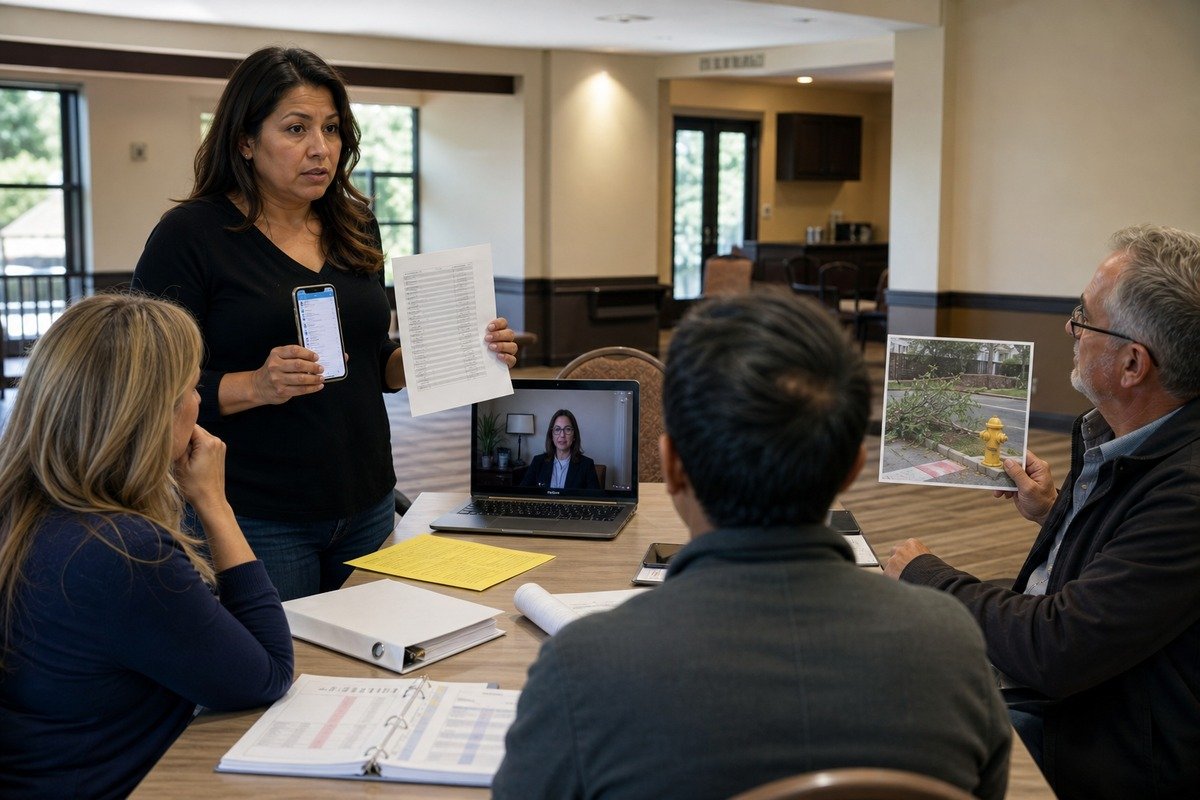
By breakfast, I had received twenty-three calls or texts. I put my phone on silent and walked to the clubhouse, where Wade and treasurer Luis were preparing for the monthly board meeting. Property manager Simone joined by video.
Wade said the association’s after-hours contract expired at the end of the previous month. The renewal price had increased. Until the board reviewed alternatives, someone responsible needed to receive calls.
“Then the board members can publish their own numbers,” I said.
He said residents already trusted me.
Simone interrupted. Her company had offered a thirty-day extension while the board voted. Wade declined it.
Luis looked surprised. He asked to see the email.
Wade said the extension still cost money and that he believed volunteer coverage would demonstrate whether the service was necessary.
I asked who told him I volunteered.
He referred again to the outage.
“An emergency ends,” I said. “It does not become my position description.”
The flyer had already created more than inconvenience. While we argued, Missus Patel came into the clubhouse carrying a fallen-branch photograph. The branch blocked the red curb beside a fire hydrant. She had called my number twice and assumed nobody cared when I did not answer.
That was a genuine safety issue hidden among complaints about bins and barking dogs.
Simone called the city’s nonemergency line and the landscaping contractor. The branch was removed within an hour. Then she asked Wade for the service contract and current emergency procedures.
He brought a binder from the board cabinet. Inside was the expired after-hours contract, a call-routing chart, and a budget worksheet. One line reduced property-management costs by replacing the contracted service with “resident volunteer coverage.” My name appeared in the notes.
The worksheet was dated two weeks before the flyer.
This was not a temporary decision made after the contract expired. Wade had included my unpaid labor in the proposed budget without speaking to me.
Luis asked whether the rest of the board had approved the change. The meeting minutes showed a vote to “evaluate resident-led alternatives,” not to publish a resident’s personal number. Wade believed the language gave him discretion to test one.
Simone said a test required a participant.
We canceled the regular agenda and held an emergency board session that evening. Before it began, the association sent a correction through email, text, and a new flyer. It said my number had been published without authorization and was not an HOA contact. Wade wanted the correction to call it an administrative error. I insisted on the phrase without authorization.
The calls slowed but did not stop. People had saved the number. I changed my voicemail to direct emergencies to 911, utility failures to the utility, and association issues to Simone’s office. I did not answer individual complaints.
At the evening meeting, more than forty residents attended. Some were angry at Wade. Others were angry at me for not continuing until a replacement existed. One man said everyone had to contribute to community safety.
I asked whether he wanted his number on the next flyer.
He said that was different because he traveled for work.
The contradiction helped the room. Volunteer labor was generous when it belonged to someone else.
Simone presented the actual options. The board could restore the after-hours contract, hire a different provider, rotate only elected board members who explicitly agreed, or limit after-hours intake to defined maintenance emergencies. None of those options made an untrained resident responsible for sorting every concern.
Missus Patel described the branch by the hydrant. She said she did not blame me; the flyer had made her believe my phone was part of a monitored system. That false confidence was more dangerous than having no number at all.
The following morning, Simone and I compared my call log with the property manager's overnight incident list. Six reports appeared only on my phone. Two others had reached both places, which meant residents were already guessing which channel counted. One voicemail described a garage door stuck open but gave no address. Under the flyer, I would have been expected to investigate a stranger's property in the dark. Under the restored system, the dispatcher could verify the caller, address, and service obligation before sending anyone.
Simone documented the comparison for the board packet. I redacted caller numbers before sharing my log and refused Wade's suggestion that I forward the voicemails themselves. Correcting the emergency process did not entitle the association to a second use of residents' personal information.
At the next open meeting, Simone demonstrated the new intake form with a fictional leak. Residents could see what information a dispatcher collected and when the issue escalated. The exercise took four minutes. It replaced Wade's vague promise of community spirit with a process people could test, price, and hold accountable.
The board also published quarterly response statistics so savings could never again hide a service gap.
Luis opened the budget worksheet on the projector. The savings from eliminating the contract were smaller than Wade had suggested because the management company charged separately for unplanned morning follow-up. The board had been trading a clear service for hidden labor and uncertain response.
Wade apologized to me but defended the goal. He said dues had risen twice and residents complained about every increase. I believed him. I also believed he had solved a political problem by assigning its risk to me.
The board voted to restore the after-hours contract for thirty days while requesting three competitive proposals. Wade voted yes. The association paid to reprint the directory and sent a second correction instructing residents to delete my number.
We also created an emergency matrix. Fire, medical danger, and crimes went to 911. Utility outages went to the utility. Shared water leaks, gates, and fallen branches went to the contracted line. Noise and ordinary maintenance went to the portal for next-business-day review. The matrix fit on one page because “call Elena” was no longer pretending to be a system.
The next question was accountability.
Luis proposed censuring Wade for acting beyond the vote and using resident information without consent. Wade said censure would make future presidents afraid to respond quickly. I said quick action was not the issue; he had planned the change for two weeks and placed my name in a budget worksheet.
The censure passed. Wade remained on the board but stepped down as president. Luis served as interim chair until the next election. The association adopted a rule that no resident’s contact information could be published for a role without a signed, time-limited agreement.
I did not join the board. Several neighbors suggested I should because I had “handled the crisis well.” That compliment carried the same trap as the flyer. Competence did not create consent.
For the next month, I kept a call log of every HOA message that still reached me. There were fourteen in the first week, five in the second, and one in the fourth. I forwarded only the dates and categories to Simone so the association could see how slowly bad information disappeared. I did not become an alternate dispatcher.
The new contract began after thirty days. It cost each household less than the price of one coffee per month. The board published the emergency matrix beside the number and reported response times at meetings.
Missus Patel later invited me for tea. She had laminated the matrix and taped it inside her pantry door. She apologized for knocking on my door with the branch photograph.
I told her she had done what the flyer instructed. The failure belonged to the people who made a private phone look like public infrastructure.
My number stayed the same. I refused to change it because someone else had misused it. What changed was the neighborhood’s understanding of availability.
During the outage, I had chosen to help for three days. That choice mattered precisely because it had an end. The HOA’s mistake was not appreciating my volunteer work too much. It was treating one act of care as permission to draft every future hour of my life.