On Thursday evening, the monthly general assembly of the Whispering Pines Homeowners Association convened in the newly renovated clubhouse auditorium.
As a senior clinical research statistician at the regional medical center, my professional life revolved around data integrity, clinical trial protocols, and strict patient confidentiality.
For years, I had maintained rigorous standards in handling protected health information, knowing that privacy is fundamental to human dignity.
My daily work required analyzing blinded clinical data from autoimmune trials, ensuring that sensitive human records were shielded from commercial exploitation.
Because medical ethics form the bedrock of clinical research, I treated confidentiality as an absolute professional obligation.
Four years earlier, I had purchased a quiet ranch-style home in Whispering Pines, drawn by its peaceful walking trails and well-tended community gardens.
Two years into my residence, I was diagnosed with a severe autoimmune condition that triggered debilitating dermatological flares and systemic nerve pain upon brief exposure to direct ultraviolet radiation.
My primary rheumatologist, Dr Sterling, had carefully outlined an environmental accommodation plan to allow me to spend time outdoors safely.
Dr Sterling explained that ordinary patio umbrellas and canvas awnings were chemically incapable of filtering high-intensity ultraviolet wavelengths.
To manage my health while continuing to enjoy my small backyard garden, my specialist recommended installing a specialized louvered pergola equipped with certified UV-blocking architectural polycarbonate panels.
These panels possessed certified German optical coatings engineered to absorb ninety-nine point eight percent of ultraviolet radiation while permitting natural diffused light.
Six months prior to the meeting, I had submitted a comprehensive architectural variance application to the HOA Architectural Review Committee.
Dr Sterling provided a signed clinical statement outlining how solar ultraviolet exposure compromised my immune system at the cellular level.
Because the request involved personal health accommodations, my physician had provided a confidential medical certification letter detailing my diagnosis and the therapeutic necessity of the shade structure.
The committee chairman, Richard, had met me in my backyard to review the blueprints, verify the property line setbacks, and inspect the dark-bronze powder-coated aluminum framing.
Richard noted that the structure blended harmoniously with the neighborhood’s Craftsman architectural motifs and complied fully with all municipal codes.
The committee had reviewed the documentation, consulted the association bylaws regarding medical accommodations, and issued a formal written approval signed by two committee officers.
I had paid nine thousand four hundred dollars to a licensed landscape contractor to construct the tasteful dark-bronze pergola behind my patio, fully compliant with every setback requirement.
The licensed landscape contractor, David Mercer, had built over thirty compliant structures across the county, providing certified architectural blueprints that matched every Whispering Pines covenant.
However, our HOA board president, Brenda Higgins, was a retired municipal clerk known throughout the neighborhood for her domineering enforcement of aesthetic conformity.
Brenda believed that any deviation from the community’s original architectural catalog diluted property values and undermined her absolute authority over neighborhood aesthetics.
She had been traveling out of state when the architectural committee granted my variance, and she was incensed that an accommodation had been approved without her personal endorsement.
The reason Brenda targeted my property was her obsession with maintaining unchecked control over the board and her resentment of any resident who questioned her arbitrary dictates.
She wanted desperately to overturn my variance and establish a precedent that no medical accommodation would ever be granted without her sole personal sign-off.
I believed that my confidential medical documentation was securely filed in the management company’s protected archives under state privacy laws.
I thought our community leaders understood the sacred boundary separating neighborly governance from private personal health information.
I feared that Brenda’s vindictive nature would create unnecessary tension, but I never anticipated that she would commit a calculated violation of civil privacy rights.
The thought that my private medical struggles could become neighborhood gossip filled me with profound dread.
I wanted nothing more than to live quietly, tend my garden in safety, and contribute positively to our neighborhood community.
At six-thirty in the evening, residents began trickling into the clubhouse lobby, picking up printed agendas and chatting over paper cups of cider.
I walked through the double doors, took an agenda from the table, and noticed several unfamiliar entries regarding architectural enforcement audits.
In the lobby, several neighbors greeted me warmly, asking about the progress of my autumn perennial plantings beside the patio.
At seven o’clock in the evening, I took a seat in the fourth row of the crowded clubhouse meeting room alongside seventy of my neighbors.
Another fifty residents were attending remotely via the association’s official live-stream broadcast, which was being recorded for public distribution.
Brenda stood at the front podium wearing a tailored blazer, smiling coldly as she clicked through her PowerPoint presentation on an enormous projection screen.
When she reached the agenda section titled ‘Unauthorized Architectural Variances and Neighborhood Consistency,’ the slide abruptly changed.
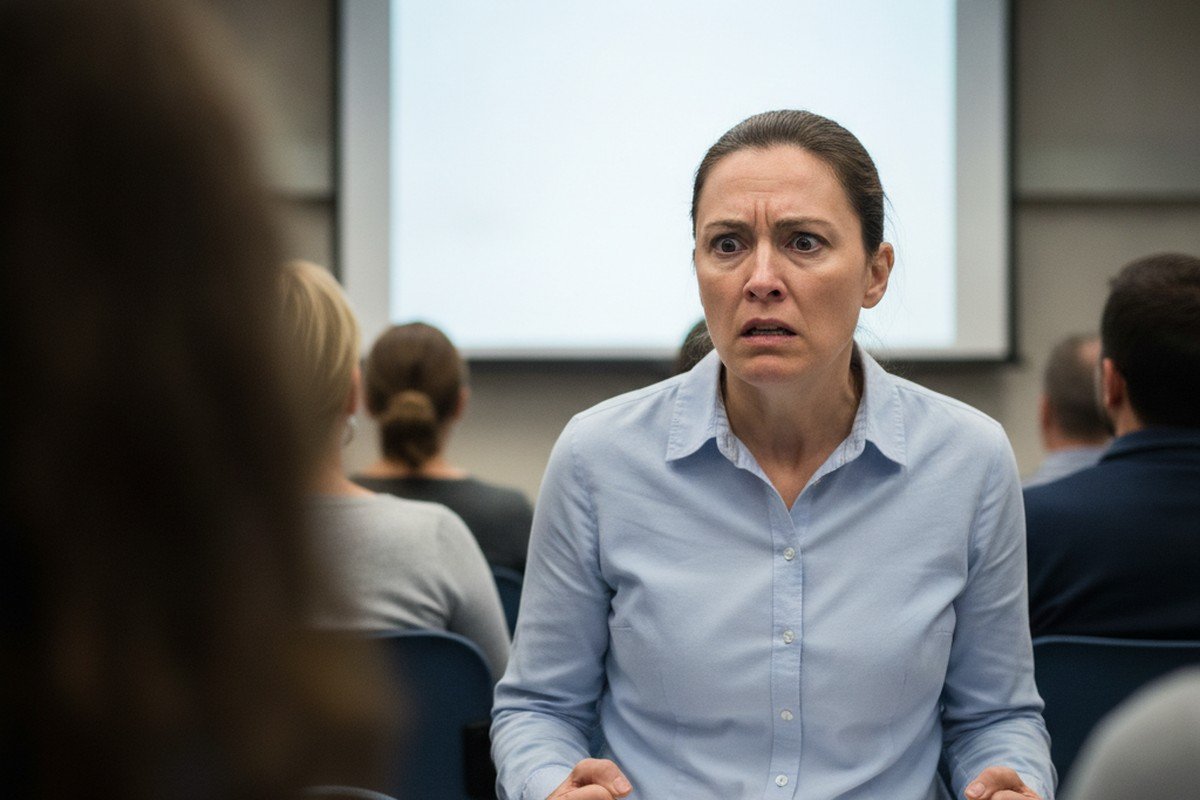
I froze in my seat, feeling the blood drain from my face as a wave of cold shock washed over me.
Projected ten feet tall across the auditorium screen was an unredacted high-resolution scan of my confidential medical exemption letter, displaying my full legal name, home address, and specific medical diagnosis.
The slide also featured my physician’s private clinic letterhead, treatment regimen notes, and personal medical history.
A chorus of bewildered murmurs broke out across the auditorium as neighbors squinted at the giant screen in confusion.
Brenda tapped the microphone with her manicured fingernail, her voice echoing loudly through the clubhouse speakers.
“Some homeowners believe they can use alleged health sensitivities to install unauthorized industrial pergolas that violate our neighborhood aesthetic harmony!” Brenda announced with theatrical disdain.
“This resident claims sunlight causes her pain, yet our bylaws do not recognize personal physical excuses to bypass standard roofline regulations!” Brenda continued, gesturing to my private records.
My hands began to shake with righteous anger as dozens of neighbors turned in their seats to stare at me with pity and morbid curiosity.
This calculated betrayal meant that my intimate medical condition had been broadcast to over one hundred neighbors without my knowledge or consent.
The breach of trust was catastrophic; Brenda had weaponized my private disability in a public forum to score petty bureaucratic points and intimidate the community.
The consequence was devastating: my professional reputation, personal dignity, and sense of safety in my own neighborhood were severely damaged.
The cost of enduring such humiliating exposure was an emotional wound that threatened my peaceful life in the subdivision.
I stood up from my chair, my voice ringing out with clear, unwavering authority that silenced the entire auditorium.
“Brenda, turn that projector off immediately!” I demanded, walking down the center aisle toward the podium.
Brenda smirked, leaning into the microphone. “Elena, this is an open community meeting, and the board has a duty of absolute transparency regarding architectural exceptions.”
“You have displayed my confidential medical records in direct violation of state privacy statutes and federal Fair Housing accommodation protections!” I answered, holding my smartphone up to record the screen.
“This is association business, Elena, and you are out of order!” Brenda snapped, her voice rising in pitch.
“Every single person in this room and on that live stream is currently witnessing a willful, unlawful disclosure of private health information,” I told the assembly.
Several neighbors stood up in protest; Arthur, a retired attorney sitting in the front row, voiced immediate outrage.
“Brenda, shut that screen down right now! What you are doing is completely illegal!” Arthur shouted from his seat.
Arthur stood in the aisle and cited the specific state residential confidentiality code, warning that Brenda was exposing the entire association to catastrophic statutory liability.
Flustered by the sudden rebellion, the HOA secretary scrambled across the stage and pulled the projector power cord from the wall outlet, plunging the screen into darkness.
The meeting instantly dissolved into chaos as residents shouted questions and demanded explanations from the board.
Brenda banged her gavel frantically, attempting to regain control, but the authority she had cultivated for six years evaporated in minutes.
Instead of apologizing, Brenda threatened to assess a daily fine of two hundred and fifty dollars against my property until the pergola was dismantled.
That was the moment the argument changed, because Brenda’s unhinged arrogance alienated even her most loyal board supporters.
Then the HOA treasurer, David, stood up and publicly admitted that Brenda had pressured him to retrieve my confidential file from the locked archives without board approval.
This revelation proved that Brenda had acted entirely on her own, abusing administrative privileges to orchestrate a premeditated public humiliation.
Worse still, I discovered that Brenda had printed fifty paper copies of my medical file and placed them in the attendee packet bins at the entrance.
Until that evening, many residents had tolerated Brenda’s strictness, but her malicious cruelty crossed a line that no community could stomach.
I gathered the paper copies from the entrance table, documented the witnesses, and walked out into the cool evening air with quiet determination.
That night, I sat at my dining room table, organizing the printed meeting packets, the video clips, and my original architectural approval documents into a secure digital folder.
Marcus noted that the Fair Housing Act explicitly mandates that housing providers grant reasonable accommodations when supported by reliable medical documentation.
I reviewed each document meticulously, noting down the exact timestamp from the live stream and transcribing the offensive statements made from the podium.
On Friday morning, I met with Marcus Vance, a prominent civil rights and disability law attorney at his downtown office.
In his fifth-floor conference room, Marcus reviewed the live-stream video recording, the paper meeting packets, and the original signed architectural variance approval.
“Elena, this is one of the most egregious violations of Fair Housing disability privacy I have seen in twenty years of practice,” Marcus said, setting his pen down.
“Brenda Higgins exposed the entire HOA corporate entity to massive statutory damages and civil penalties,” he added.
Marcus explained that under the Fair Housing Act and state confidentiality laws, statutory penalties could reach sixteen thousand dollars per individual disclosure, alongside substantial punitive damages.
He emphasized that board members who act with intentional malice outside their fiduciary scope lose the protection of corporate indemnity.
“The law provides absolute protections for reasonable medical accommodations in residential communities, and Brenda’s actions constitute willful statutory harassment,” Marcus stated firmly.
Marcus drafted a formal statutory cease-and-desist demand, an immediate litigation hold notice, and a comprehensive civil rights complaint.
The legal notice was served via process server to each individual HOA board member and the association’s legal counsel at three o’clock that afternoon.
The letter demanded an immediate public retraction, the permanent preservation of my architectural variance, the resignation of Brenda Higgins, and the destruction of all improperly distributed medical copies.
On Saturday morning, several concerned neighbors gathered near the community clubhouse, organizing an informal petition expressing solidarity with my medical privacy rights.
Arthur and other senior residents collected sixty-five homeowner signatures within four hours, demanding an extraordinary meeting to remove Brenda from office.
In the afternoon, Arthur delivered the signed petition directly to the management company headquarters, attaching my attorney’s formal notice.
On Sunday evening, neighbors stopped by my porch to offer words of comfort, expressing embarrassment that our community had been dragged into Brenda’s abusive crusade.
On Monday evening, the HOA board held an emergency executive session with their corporate insurance defense attorney.
The association attorney informed the board in blunt terms that defending Brenda’s intentional misconduct was impossible and would exhaust the HOA’s directors-and-officers insurance coverage.
The corporate counsel warned that Brenda’s deliberate public display fell outside the policy indemnity scope, exposing her to direct personal financial liability.
The board recognized that Brenda had placed every homeowner’s equity in jeopardy through her personal vendetta.
By a unanimous four-to-zero vote, the board stripped Brenda of her presidential title and demanded her immediate resignation from the board of directors.
At seven o’clock on Tuesday evening, an emergency general assembly was convened via video conference.
Vice President Sarah Coleman addressed the community, reading a formal written apology drafted by the association’s legal counsel.
The board officially reaffirmed my architectural variance in perpetuity, issuing an irrevocable certificate of compliance for my UV-blocking pergola.
Furthermore, the board announced that Brenda Higgins had resigned from all community committees and would no longer have access to association records.
To prevent future abuses, the HOA established a strict data privacy protocol, transferring all medical and accommodation files to an external third-party compliance administrator.
The community also drafted an official resident privacy bill of rights, barring any board officer from examining health-related filings without legal counsel present.
The financial consequence for the association was settled when their insurer covered my legal fees totaling eight thousand five hundred dollars, without assessing any special fee on homeowners.
The consequence for Brenda was total social ostracization; her influence in Whispering Pines was completely dismantled, and neighbors openly avoided interacting with her during morning walks.
The consequence for our community was a profound awakening to mutual respect, civil rights, and compassionate neighborly governance.
In the aftermath of the dispute, several neighbors visited my porch to deliver handwritten notes of apology and support, bringing fresh baked goods and potted flowering perennials.
Over the following weeks, my pergola became a peaceful sanctuary where I could sit among blooming hydrangeas and fragrant jasmine without fear of ultraviolet exposure or neighborly hostility.
Sitting under the protective canopy in the quiet evening hours, I felt an overwhelming sense of relief that my home had become a true haven of health and dignity.
Now I enjoy the morning breeze under my shaded canopy, watching songbirds flutter across the garden while resting in total comfort.
The following month, the neighborhood garden club invited me to host an afternoon tea beneath my pergola, celebrating community solidarity and healing.
We shared cups of fresh chamomile tea and lemon shortbread while discussing autumn gardening tips under the cool protection of the bronze louvered roof.
Three months later, our neighborhood hosted an autumn harvest social in the central courtyard under new, respectful board leadership.
I attended the gathering with a deep sense of relief and quiet confidence, chatting warmly with friends as golden leaves fell across the lawn.
My home had become a place of genuine security, lasting tranquility, and renewed community friendship.
I defended my dignity and my rights by confronting arrogance with unwavering legal resolve, transforming a painful betrayal into an enduring victory for fairness.
The resolution of this crisis proved that transparency and justice will always prevail when individuals stand up against authoritarian overreach.
Now the community stays united, the pergola remains an architectural gem, and my privacy stands protected for all the years to come.
Because true community thrives on mutual empathy and respect, I stood firm and transformed a cruel exposure into an enduring sanctuary.
Sitting in the gentle shade of my dark-bronze pergola as the afternoon sun cast warm patterns across the stone patio, I embraced the quiet dignity of my restored life.
The healing power of justice had transformed my garden into an unshakeable haven of peace and lasting security.