On Monday morning, I unlocked the heavy steel roll-up door of our family precision machine shop just as the sunrise touched the river docks.
For fifty-four years, Miller Precision Tooling had operated out of our brick industrial building, manufacturing specialized rifle barrels, custom bushings, and aerospace prototype components.
My late grandfather Silas Miller, a master toolmaker and Navy machinist veteran, had founded the business with a single Monarch ten-double-E precision toolroom lathe purchased in nineteen forty-eight.
That lathe was widely considered by machinists to be the finest manual toolroom turning machine ever manufactured, capable of holding tolerances down to fifty millionths of an inch.
Silas had spent three decades training me on that specific machine, teaching me how to read dials by touch, grind custom carbide tool bits, and cut flawless single-point threads.
When Silas passed away fourteen months earlier, his probate estate had deeded the machine shop building and all industrial equipment solely to me to carry on the family trade.
Over the past three weeks, I had spent sixty hours machining a ceremonial Damascus steel rifle barrel for Silas’s upcoming memorial marksmanship match.
The delicate final thread-cutting operations were scheduled for this week, requiring the flawless accuracy of our grandfather’s vintage Monarch lathe.
My thirty-year-old cousin Tyler, who worked as an independent marketing consultant, had always viewed our industrial shop with thinly veiled disdain.
Tyler lived in an upscale riverfront condominium, drove a leased luxury sports car, and spent every family dinner lecturing our relatives on decentralized finance, automated arbitrage bots, and speculative cryptocurrency tokens.
Eight months earlier, Tyler had launched an offshore digital currency investment group called Nexus Yield Capital, borrowing money from extended family members to fund his high-risk ventures.
Silas had repeatedly warned Tyler against seeking get-rich-quick schemes, but Tyler dismissed our grandfather’s trade discipline as antiquated blue-collar drudgery.
Because Tyler had zero involvement in shop operations, I rarely saw him except at major holiday dinners.
Every dial on the Monarch lathe had been touched by Silas’s calloused hands through fifty years of honest manufacturing.
During my five-year apprenticeship, Silas taught me that a true machinist respects the machine as a living partner in precision work.
He showed me how to maintain the oil reservoirs, adjust the headstock bearings, and check the alignment of the tailstock center against a hardened test bar.
Because Silas had invested his soul into building our precision tooling shop, preserving his equipment was my life’s highest calling.
I believed that letting Silas’s legacy slip away would dishonor everything he had sacrificed to establish our family trade.
I feared that Tyler’s reckless greed would erase three generations of industrial craftsmanship overnight.
I wanted to keep our shop intact and honor our grandfather’s memory, so I refused to let his prized lathe disappear into an overseas scrap container.
The thought of our family shop falling silent because of a cousin’s get-rich-quick gamble made my determination absolute.
As I walked across the shop floor on Monday morning carrying my morning thermos of black coffee, my eyes locked onto the central bay in absolute paralysis.
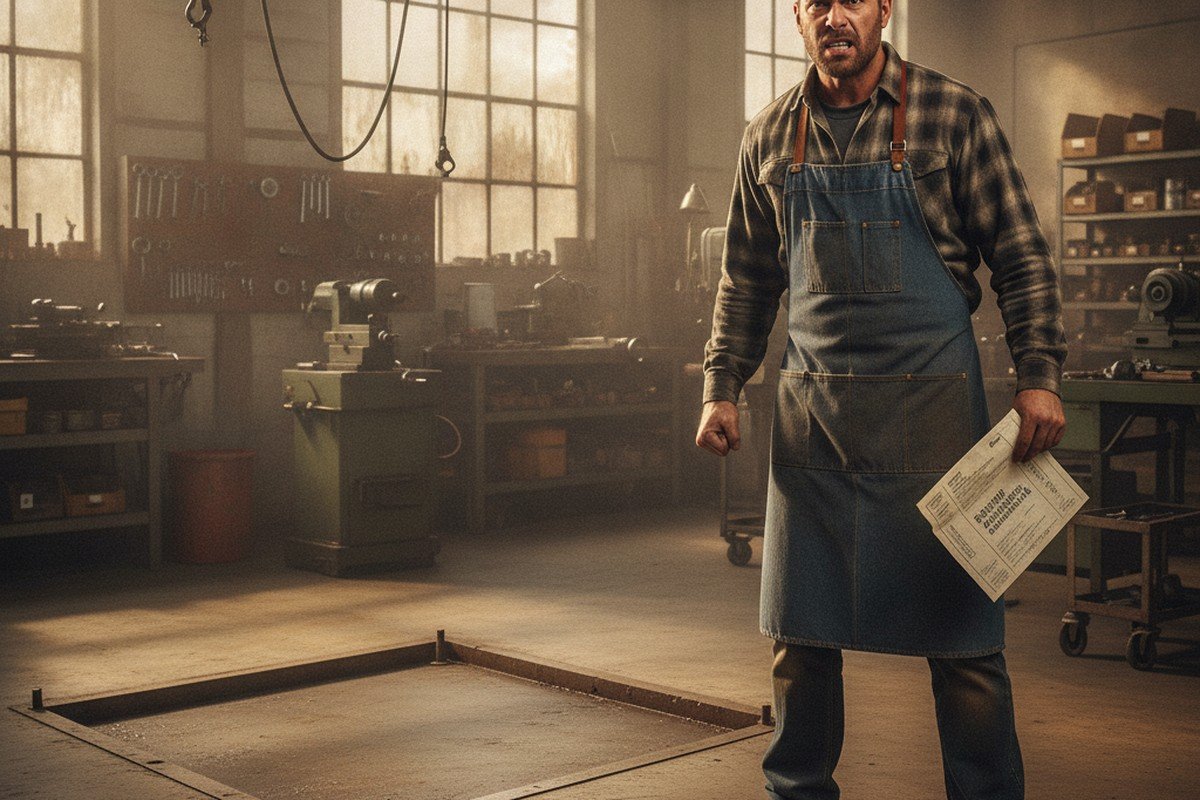
The heavy concrete machinery pad where Silas’s four-thousand-pound Monarch lathe had stood for half a century was completely bare.
Four severed anchor studs protruded from the fractured concrete, raw three-phase electrical wires hung exposed from the overhead conduit, and heavy grease stains marked where the machine had been dragged toward the loading bay.
I dropped my coffee thermos to the concrete floor, my heart hammering violently against my ribs as shock gave way to pure adrenaline.
I ran to the rear loading dock and noticed fresh tire tracks from a heavy industrial rollback truck and gouges in the steel threshold.
Taped to the electrical disconnect box was a carbon-copy paper manifest enclosed in a clear plastic work pouch.
I snatched the document and read the heading: Apex Industrial Liquidations and Auctioneers, Commercial Consignment Agreement.
The contract stated that machine lot number seven-four-two, described as a 1948 Monarch Toolroom Lathe, had been consigned for emergency liquidation with an expedited cash advance of seven thousand dollars.
I looked at the document and reviewed the signature line, which contained Tyler Miller’s printed name and bold signature beneath a fraudulent designation claiming he was managing executor of the Miller Family Trust.
Attached to the consignment contract was a forged power-of-attorney affidavit bearing a bogus notary stamp executed only forty-eight hours earlier.
The paperwork confirmed that the machine had been loaded onto an Apex transport rig on Saturday afternoon while our shop was closed for the weekend.
Even worse, the auction receipt indicated that the lathe was scheduled for immediate open bidding at Apex’s regional industrial liquidation warehouse at ten o’clock that very morning.
The reason this seizure was so catastrophic was that once industrial machinery crosses an auction block, title transfers immediately to winning wholesale buyers.
Industrial scrap merchants and overseas export brokers routinely purchase vintage toolroom lathes to strip their rare cast-iron aprons and salvage copper windings.
I believed that if the Monarch lathe crossed the auction block, our grandfather’s prized machine would be loaded onto an outbound cargo container within hours and lost forever.
I feared that the ceremonial memorial rifle barrel could never be finished, and that Silas’s life work would be traded away for worthless digital speculation.
I wanted to protect Silas’s legacy and bring my cousin to complete legal justice, so I refused to waste a single second.
The thought of Tyler pawning our family’s mechanical heart to fund an offshore crypto margin call filled me with ice-cold fury.
I sprinted to my truck, grabbing our certified shop deed, Silas’s probate distribution decree, and the original nineteen forty-eight factory machine purchase manifest from our office safe.
I dialed Tyler’s cellular number while accelerating onto the industrial bypass toward Apex’s auction terminal twelve miles away.
As I accelerated down the industrial bypass, Tyler continued shouting over the phone, claiming that digital currencies would make industrial machining obsolete.
“Evan, manual lathes are relics from the industrial past!” Tyler insisted defensively. “My crypto protocol was projected to yield forty percent annualized returns!”
“Your protocol was a hollow pyramid scheme that just collapsed, Tyler!” I answered coldly. “And you stole an irreplaceable family heirloom to delay your personal bankruptcy!”
I disconnected the call, focused entirely on reaching the liquidation warehouse before the morning auction gavel fell.
I checked the road ahead, knowing that every minute delayed increased the risk of our equipment being auctioned away.
Tyler answered with a hurried, tense whisper, the background noise filled with airport boarding announcements.
“Tyler, I am standing on the empty concrete pad where Silas’s lathe was bolted down,” I shouted into the phone. “You forged an executor affidavit and sold our grandfather’s machine to Apex Liquidations for seven thousand dollars!”
Tyler choked on his words, coughing nervously before attempting a rushed, defensive justification.
“Evan, listen, don’t overreact,” Tyler pleaded frantically. “My crypto liquidity pool faced an emergency liquidation liquidation event over the weekend. I had forty-eight hours to post collateral or lose sixty thousand dollars! I was going to buy the lathe back from the winner next week after my token unlock!”
“You cannot buy back an antique lathe once an international salvage buyer loads it into a shipping crate, Tyler!” I roared.
“You committed felony grand larceny and commercial forgery against our family, and I am walking into the auction house right now with law enforcement!”
Instead of showing remorse, Tyler insisted that an idle piece of manual machinery was an inefficient asset that deserved to be deployed into high-yield digital capital.
That was the moment the argument changed, because I realized Tyler’s obsession with crypto speculation had completely destroyed his basic moral compass.
Then Tyler admitted that he was already sitting at the regional airport, planning to fly out to a digital currency summit in Miami.
This revelation proved that Tyler had planned to cash the liquidation advance and abandon our family to deal with the fallout.
Worse still, another message popped up on my phone from our uncle, revealing that Tyler had also asked to borrow fifteen thousand dollars from Silas’s widow three days earlier.
I discovered that Tyler’s startup was hopelessly insolvent and that he was desperately stripping every accessible asset to stay ahead of his creditors.
Until that morning, I had viewed Tyler as merely foolish, but his willingness to steal our grandfather’s legacy proved he was dangerous and unprincipled.
At nine-forty-five, I pulled into the crowded gravel lot of Apex Industrial Liquidations, where hundreds of machinery buyers in work boots were inspecting rows of milling machines, presses, and lathes.
I walked directly into the executive dispatch office, slammed Silas’s certified probate deed onto the counter, and demanded to speak with the lead auction manager.
The manager, a veteran industrial appraiser named Donald Briggs, looked startled by my entrance and examined my paperwork with intense scrutiny.
I showed him the certified probate court distribution order and the original factory serial number certificate, which verified that Silas had bequeathed the Monarch lathe exclusively to me.
I pointed to the forged power-of-attorney form in Tyler’s consignment file, highlighting the fraudulent notary commission number that did not match state records.
“Mister Briggs, lot seven-four-two is stolen property,” I said firmly. “The consignor holds zero legal title, his affidavit is forged, and if this machine is offered for auction, Apex will be liable for commercial conversion and receiving stolen industrial goods.”
Donald Briggs’ face hardened as he reviewed the serial numbers, recognizing the immense legal liability facing his firm.
In the auction yard, industrial buyers were milling around rows of CNC machinery, but Silas’s Monarch lathe stood out with its immaculate classic green enamel and polished cast-iron handwheels.
A veteran toolmaker in work overalls was admiring the lathe’s bed ways, remarking to his partner that you could never find an original ten-double-E in such pristine condition.
Seeing strangers preparing to bid on Silas’s pride made my stomach knot with urgency.
I walked straight into the management office and presented Silas’s notarized probate distribution deed and our municipal business registration records.
Donald Briggs compared the serial numbers on my certified probate document with the consignment intake tag, which confirmed beyond all doubt that Tyler held zero ownership authority.
Briggs picked up his phone and summoned the warehouse foreman, ordering him to chain the lathe to the recovery bay and clear the lot listing immediately.
I reviewed the printed consignment cancellation notice, which verified that the illegal auction lot was completely expunged from the catalog.
He grabbed his two-way radio immediately, calling the main auction ring with an urgent command.
“Pull lot seven-four-two off the floor right now!” Briggs ordered his ring coordinator. “Red-tag the Monarch lathe immediately. Do not take a single bid.”
Two minutes later, Briggs confirmed that the lathe had been locked down in the secure staging bay and that Tyler’s seven-thousand-dollar cash advance had been stopped and reversed.
I stood beside Silas’s lathe in the staging bay, running my hand across its smooth, heavy cast-iron bed, feeling an overwhelming rush of relief.
The machine was completely intact: the precision compound slide, the taper attachment, and the original chrome dials had not been harmed during transit.
I hired a professional heavy equipment machinery rigger to transport the four-thousand-pound lathe back to Miller Precision Tooling that afternoon.
The cost of the emergency transport, crane rigging, and precision re-anchoring came to twelve hundred dollars, which I paid on the spot.
By four o’clock on Monday afternoon, Silas’s Monarch lathe was back on its concrete pad, leveled with precision machinist levels, and bolted down with hardened anchor rods.
When Tyler learned that his consignment advance had been canceled and that the auction house was filing a criminal fraud referral with the district attorney, his venture collapsed.
He was forced to forfeit his leased sports car, liquidate his personal holdings to repay his family debts, and face formal investigation for commercial document forgery.
Our extended family rallied around our machine shop, and Silas’s widow firmly condemned Tyler’s betrayal.
On Tuesday morning, I reconnected the three-phase electrical lines, checked the spindle runout with a tenth dial indicator, and verified that the lathe was running with absolute precision.
I spent the rest of the week finishing Silas’s ceremonial memorial rifle barrel, cutting the final barrel threads to within twenty millionths of an inch.
The consequence for Tyler was total financial and personal ruin: his crypto startup dissolved, his reputation was shattered, and he was required to repay twelve hundred dollars in rigging damages under threat of prosecution.
The consequence for our machine shop was complete legal clarity and reinforced physical security that guarantees our heritage will endure.
On Wednesday morning, our local machinist association president stopped by the shop to inspect our newly re-anchored Monarch lathe.
He looked at the precision test cuts on the Damascus steel barrel, nodding with deep respect for the machine’s enduring accuracy.
Two weeks later, the county prosecutor’s office contacted me to confirm that Tyler had signed a formal confession admitting to document forgery and illegal conversion.
Tyler was required to complete two hundred hours of community labor and make full financial restitution for all rigging and transportation expenses.
Three months later, our shop secured a major long-term aerospace prototyping contract, proving that authentic manual precision remains indispensable in the modern world.
The Monarch lathe continues turning day after day, steady, flawless, and completely protected by the principles that built our family business.
Standing beside the humming spindle in the afternoon sun, I felt Silas’s enduring presence guiding every cut.
Honest machinery responds only to truthful craftsmanship, and no digital illusion can ever replace the integrity of genuine steel.
The workshop remains our family anchor, entirely sovereign, completely unencumbered, and permanently safe.
I will continue passing down Silas’s lessons to future generations with unwavering pride and gratitude.
And whenever I guide a piece of cold steel through the turning centers, I will remember the Monday morning I protected what our grandfather built.
I installed heavy commercial security roll-doors, dual deadbolts, and high-definition video surveillance covering every bay in the shop.
Because I intervened with decisive legal evidence before the auction began, Silas’s lathe was saved without a scratch, and our memorial timeline was preserved.
On Saturday morning, at the regional Silas Miller Memorial Match, I fired the first ceremonial shot with the custom rifle barrel crafted on his machine.
The shot struck dead-center in the target bullseye at six hundred yards, echoing across the valley hills like a resounding tribute to his memory.
True craftsmanship requires discipline, honesty, and respect for the tools that sustain life; it cannot be replaced by reckless shortcuts.
The Monarch lathe stands proud in the center of our shop floor, solid, unyielding, and forever safeguarded against deceit.
I will continue practicing Silas’s trade with the meticulous devotion he instilled in me, honoring his life through honest labor.
And whenever I turn the handwheel and watch a fine curl of steel peel off the lathe spindle, I will remember the Monday morning I fought to bring our grandfather’s legacy home.