The first time I saw my son's name on a fight card, it was in an email asking whether I wanted two ringside seats or four.
Eli Ortiz, sixteen years old, 138-pound novice division, Saturday at seven.
Under coach, the card listed my younger brother, Leon.
I read the email in the grocery-store parking lot with melting ice cream in the back seat. Three months earlier, I had agreed that Eli could train at Leon's boxing gym twice a week. I had said yes to jump rope, footwork, heavy bags, and supervised conditioning. I had said no to competitive sparring and no to a match. Leon had looked directly at me across our kitchen table and said he understood.
Now the message included a link to buy tickets.
I called Leon before I called Eli. The gym was loud behind him. A bell rang, people shouted, and Leon said, "Can I call you after this round?"
"You can explain why my son is on Saturday's fight card."
The noise seemed to fall away from his end of the line. He said Eli had brought in the consent form two weeks earlier. He said the head coach had matched him with another novice from a gym across town. He said Eli was ready.
"That was not my question."
Leon lowered his voice. "The form has your name on it."
I left the groceries with my husband, Theo, and drove to the gym.
Eli was wrapping his hands when I arrived. He saw my face, then the printed fight card in my hand, and stopped pulling the cloth between his fingers. Leon led us into the equipment room. The head coach, Marisol, joined us carrying a blue folder.
Inside was a medical questionnaire, a copy of Eli's birth certificate, and a parental-consent form. MAYA ORTIZ was printed on the signature line in careful block letters.
It was my name. It was not my signature.
I asked Eli whether he had written it. He stared at the concrete floor.
Leon said, "He told me you changed your mind."
"And you did not call me?"
He took out his phone and opened their messages. One from Leon said, Your mom okay with the novice card? Eli had answered, She knows I'm ready, followed by a boxing-glove emoji. Leon had treated that as permission even though he already knew what I had said at the kitchen table.
Marisol removed the form from the folder. She told Eli the match was canceled immediately. The gym would lose the registration fee, and the other coach would need to find a replacement. She also told Leon he was finished assisting with youth registrations until she reviewed what had happened.
Eli finally looked up. "You didn't even ask why I wanted to do it."
"You did not give me the chance," I said. "You signed my name."
He pulled off one hand wrap and threw it onto the bench. Leon moved toward him, but I told Leon not to turn himself into the comforting adult after helping create the problem.
The argument followed us home. Eli said I had been waiting for an excuse to stop him from boxing. He reminded me that I had allowed him to play soccer for eight years even though players collided and got hurt. He said boxing was the first sport at which he felt disciplined instead of merely tolerated.
That last word made me pause.
Eli had been cut from the school soccer team in September. He told us he was relieved because practices conflicted with an advanced science class. I believed him. Leon later invited him to the gym, and within weeks Eli was waking before school to run. His grades improved. He measured his meals without becoming obsessive and kept a training notebook beside his chemistry book. I had praised every change while refusing to discuss the one goal he cared about.
None of that excused the forged form. It did explain why a flat no had become, in his mind, a wall he had to go around.
My fear had a history too. Our father boxed in local tournaments when he was young. By his fifties, he struggled with headaches and sometimes lost the thread of conversations. No doctor ever told us boxing caused it, but Leon remembered the same evenings I did: Dad sitting in the dark because ordinary light hurt. When Eli first asked about competition, I saw those evenings before I saw my son.
Leon knew that. He also believed I had turned an uncertain connection into a permanent verdict against the sport he loved.
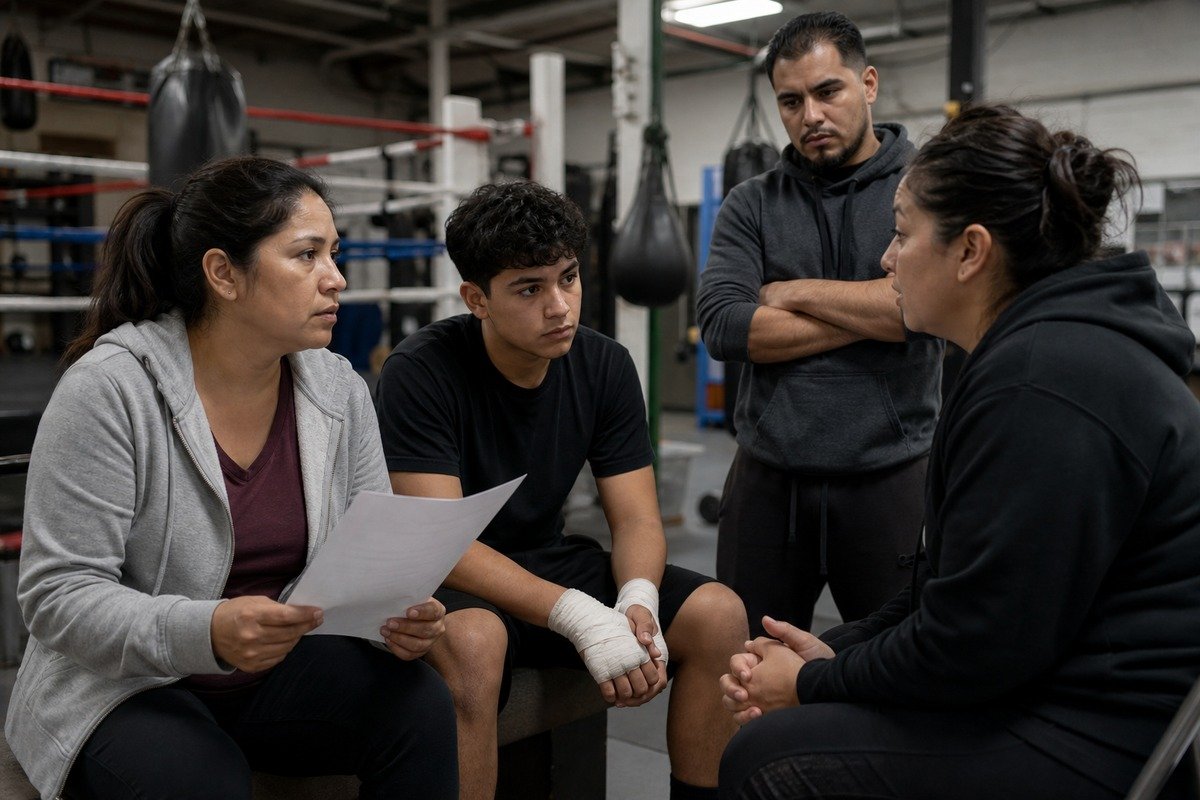
The next morning, Marisol asked all three of us to meet at the gym while it was closed. She placed the forged consent form between us and separated the questions.
First: Had Eli trained safely enough to be considered for a novice bout? She said yes. He had completed the required conditioning, controlled sparring, and medical examination.
Second: Had I authorized a bout? No.
Third: Had Leon met his responsibility as an adult coach by relying on a teenager's message instead of confirming with a parent whose refusal he had personally heard? No again.
Eli tried to argue that the medical exam proved he could make his own decision. Marisol told him physical readiness did not erase consent rules. Then she told me that family history and fear were reasons to ask better questions, not reasons to pretend the sport had no safety structure.
She showed us the gym's progression plan: technical assessment, controlled sparring logs, physician clearance, opponent matching, headgear rules for skills exhibitions, and a written concussion protocol. I had never asked to see any of it. I had made my decision from memories of Dad and fragments of internet articles. Leon had responded to my refusal by helping Eli conceal the next step. Between us, we had taught Eli that information was something adults selected to strengthen positions.
That was the turning point. The problem was no longer simply whether Saturday's match would happen. It would not. The problem was whether the next family decision would be made with the same mixture of fear, secrecy, and selective evidence.
I asked Eli to bring me his training notebook. The early pages were lists of exercises. Later entries included notes about distance, balance, and how panic made him close his eyes when punches came toward him. In one entry he had written, Leon says courage is keeping your eyes open.
I asked why the match mattered now.
He said two boys from the soccer team had come to the gym for a trial class. One joked that Eli was only there to get fit because nobody would let him fight. Eli wanted the match partly to prove them wrong. More than that, he wanted a result nobody could dismiss as a consolation prize after being cut.
"So you signed my name because you wanted them to stop laughing?" I asked.
"I signed it because you had already decided I would never be ready."
Both statements could be true. Neither made the signature acceptable.
We made three decisions that morning.
Eli would withdraw from the match and repay the lost registration fee from his weekend job. He would apologize to Marisol and to the other novice whose match had been disrupted. For six weeks, he could continue conditioning and non-contact technical work, but he would not spar.
Leon would accept the gym's suspension from youth registration. He would not discuss competition with Eli privately or present himself as the parent who understood while I was the parent who feared. Any future proposal would come through Marisol with the same records available to Theo and me.
I would not make "never" the substitute for a safety review. During those six weeks, Theo and I would meet with the sports physician, read the gym protocol, and watch two full supervised sessions. At the end, we would decide about a controlled skills exhibition, not a competitive bout.
Eli said the plan was just a slower no. I told him it might still end in no, but it would be a no tied to evidence and conduct rather than a memory I had never explained.
The immediate consequence was ugly. Eli barely spoke to Leon for two weeks. Leon blamed me for humiliating him at the gym, then admitted Marisol was right to suspend him. The other novice found a replacement, but Eli still sent an apology. He handed Marisol the first forty dollars of the lost fee in an envelope and paid the rest over three Saturdays.
At the physician's appointment, Eli asked more questions than I did. He wanted to know how symptoms were reported, what ended an athlete's season, and whether headgear prevented concussion. The answers were less reassuring than Leon's enthusiasm and less catastrophic than my assumptions. Risk could be reduced, not erased.
Six weeks later, we watched Eli complete a three-round skills exhibition with no winner declared. The goal was defense, clean technique, and following the referee instantly. I sat in the second row, not ringside. Leon stood on the opposite side of the gym with the other assistants and did not enter Eli's corner.
Eli kept his eyes open.
Afterward, he asked whether I would approve a novice bout in the spring. I said we would review the sparring logs and physician's advice then. He did not smile, but he nodded. A conditional answer was not the victory he had tried to steal with my signature. It was something harder: a process he had to keep earning.
Leon returned to youth coaching after completing the gym's consent training. Marisol added a rule requiring staff to confirm every minor's first competition directly with a parent or guardian, even when a form appears complete. Leon hated that the rule existed because of him. He follows it exactly.
I kept the forged form in our household file. Not to use against Eli forever, and not as proof that boxing was dangerous. I kept it beside the physician's notes and the repayment receipts because all three record different parts of the same lesson.
My brother believed readiness could replace permission. My son believed my fear made deception necessary. I believed saying no ended my responsibility to understand what I was refusing.
Saturday's fight never happened. The more important contest did: whether the adults in Eli's life would keep pulling him between courage and caution, or build a way for him to face both honestly.