My stepson’s mother called to ask why I had declined her wedding invitation for him.
I was standing in the school pickup line when Lila read the RSVP message aloud.
Caleb will not attend. Please do not pressure him or ask him to participate in the ceremony. —Rachel
The message had been sent from my email at 10:42 the previous night.
I had not written it.
Caleb was seventeen. He lived with my husband Tom and me during the school week and with Lila most weekends. The adults had spent years building a careful, imperfect routine after a divorce that once turned every school event into a seating negotiation.
Lila’s wedding to Andre was six weeks away. Caleb had complained about the formal clothes and the long drive, but he had never said he would not attend.
I promised Lila I would look at my sent mail and call her back.
The message was there. So was a deleted invitation link in my browser history. My laptop had been open on the dining table while I showered. Caleb had been doing homework beside it.
When he got into the car, I asked whether he used my email.
He stared out the window and said, “You were going to tell her no anyway.”
“I was not invited to answer for you.”
He said Lila listened to me more than she listened to him. If the refusal came from my account, she would stop asking.
That explanation made me angrier, not less. He had used my name as a wall between himself and his mother.
At home, Tom wanted to call Lila immediately and tell her Caleb had lied. Caleb ran upstairs and slammed his door. Tom followed, already speaking in the hard voice that made every conflict sound like a courtroom.
I stopped him on the stairs.
“We correct the email first,” I said. “Then we find out what he is avoiding.”
I sent Lila a short message: The RSVP did not come from me and does not represent my decision. Caleb used my account without permission. We are addressing it and will ask him to contact you directly.
I did not accept the invitation for him. Correcting one false answer did not give me authority to replace it with another.
Lila replied that she needed space until morning.
Caleb refused dinner. Around nine, he came downstairs for water and saw the printed wedding invitation beside my laptop. He said the ceremony was “all about family healing” and nobody cared whether he wanted to perform that story in front of a hundred people.
The phrase sounded too specific.
I asked what he meant by perform.
He took a small card from his backpack. Lila had mailed it inside his invitation. On the front was a picture of the venue. On the back, she had written that she hoped he would give a three-minute toast about family healing and welcoming Andre.
Caleb had not shown the card to Tom or me.
He did not dislike Andre. He disliked being asked to explain the divorce as a journey toward a better family. He worried that praising the wedding would betray his father. He worried that refusing the toast would hurt his mother. He worried that attending without enthusiasm would become evidence that Tom had turned him against her.
So he chose a fourth option: make me the villain who prohibited everything.
“You used my email because you thought everyone could stay angry at me instead of you,” I said.
He admitted it.
Tom sat across from him. For several minutes, he said nothing. Then he asked whether Caleb believed attending the wedding betrayed him.
Caleb said sometimes it felt that way.
Tom looked ashamed. He had never told Caleb to skip the wedding, but he made sarcastic comments about the venue cost and Andre’s family. He called the event “the grand rewrite.” Each comment told Caleb there was a correct emotional side even if no one stated the rule.
I asked Caleb what he actually wanted.
He wanted to attend the ceremony. He liked Andre and wanted his mother to be happy. He did not want to give a toast, pose for a staged “new family” photograph, or stay until midnight. He wanted to leave after dinner and sleep at our house.
Those were negotiable boundaries. None required identity theft by email.
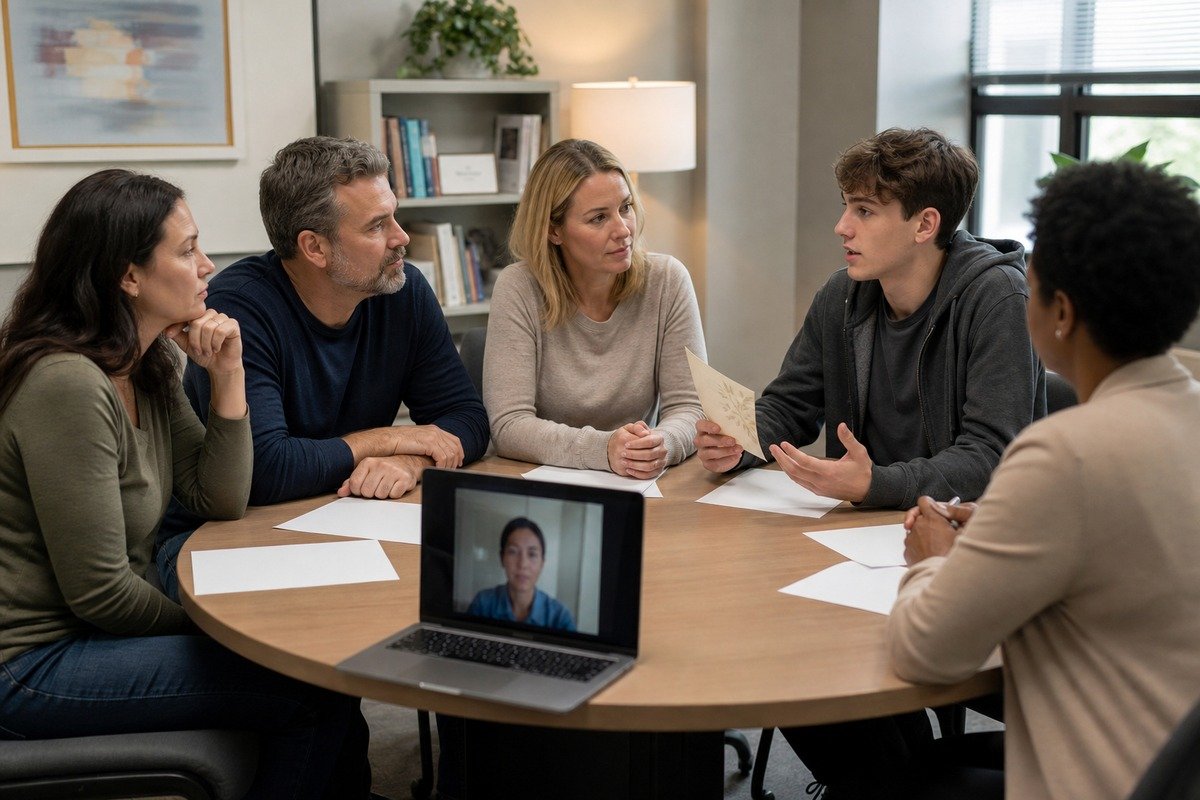
The next morning, Lila asked us to meet with the school counselor, Ms. Vega, who had helped the family with transitions before. Caleb objected that a wedding was not a school issue. Ms. Vega said her role was not to decide the RSVP. She could help him say what he had been avoiding.
In her office, she placed four sheets of paper on the table: what I want, what I fear, what I can offer, and what is not mine to manage.
Caleb wrote that he wanted to attend. He feared being turned into a symbol. He could offer photographs before the ceremony and presence through dinner. The toast was not something he could offer. His parents’ feelings about each other were not his to manage.
Tom wrote that he could transport Caleb home and stop mocking the wedding. Lila wrote that she could remove the toast request and stop treating visible enthusiasm as proof of loyalty. I wrote that my email and my name were not tools for anyone else’s boundary.
Andre attended the meeting by video. He said he had not known about the toast card. Lila had imagined the speech as a way to show guests that Caleb accepted him. Andre said he preferred an honest quiet teenager to a public endorsement extracted under pressure.
Lila cried. She said she had spent years afraid every limit from Caleb originated in Tom’s house. The false email seemed to confirm that fear because it came from me.
I understood why the message hurt. I did not accept responsibility for writing it.
Caleb read his worksheet aloud. Then he apologized to Lila and to me separately. To her, he said he should have declined the toast directly. To me, he said he used my reputation as the strict parent because it felt safer than owning his answer.
We opened the invitation link on his phone. Caleb submitted a revised RSVP under his own name: yes to the ceremony and dinner, no toast, leaving after dinner. Lila emailed the photographer to remove the planned “family healing” portrait from the required list. Casual pictures could happen if Caleb agreed in the moment.
Two days later, Caleb and I met at the dining table with the account activity page open. He showed me exactly how he had used the unlocked laptop, found the invitation in the browser history, and deleted the confirmation message. He had not guessed my password or entered any other account. I saved the security log before signing out every session.
Then he drafted the correction. His first version said the message resulted from a misunderstanding. I asked what that phrase concealed. He deleted it and wrote that he had knowingly used my email so his refusal would look like my decision. The accurate sentence embarrassed him, but it restored the record Lila would rely on later.
The email misuse still needed a consequence. Caleb lost unsupervised laptop access for two weeks and had to review account security with me. I changed my password and enabled automatic locking. He also wrote a correction from his own address so Lila had a record that I had not tried to block the wedding.
Tom’s consequence was less visible but equally important. For six weeks, he made no jokes about the venue, Andre, or the marriage in Caleb’s hearing. When friends asked whether the wedding was awkward, he said it was Lila’s event and Caleb was free to participate without taking sides.
The pressure did not disappear immediately. A week before the ceremony, Lila asked whether Caleb might reconsider “just thirty seconds” at the microphone. He replied himself: no toast. She accepted the answer without calling us.
On the wedding day, Caleb wore the suit he had complained about and carried the toast card in his pocket, not because he planned to use it, but because he wanted to remind himself he had answered it.
Tom drove him to the venue. I stayed home. My absence was not punishment or protest; the invitation was for Caleb’s family on that side, and nobody needed me present to prove cooperation.
Lila sent one photograph before the ceremony. Caleb stood beside her and Andre, shoulders relaxed, no staged banner behind them. Later, Caleb texted Tom that dinner was running twenty minutes late and asked whether pickup could move.
He left after dinner as agreed.
When he came home, he said the ceremony was good, the speeches were too long, and Andre’s aunt danced better than everyone. He had taken photographs with both sides of the family. No one handed him a microphone.
The sent-mail record, wedding invitation, toast card, counselor’s worksheet, and revised RSVP all remained part of what happened. We did not retell the incident as a communication mix-up. Caleb had impersonated me because the adults around him made honest boundaries feel dangerous.
He was responsible for the impersonation. We were responsible for changing the conditions that made it useful.
Months later, Lila invited Caleb and Tom to a cookout at her new home. Caleb answered from his own phone. Tom did not ask what response would make him look loyal. I did not offer to compose it.
The repair was not that everyone became one healed family. It was that Caleb no longer needed to borrow my name to survive being part of two.