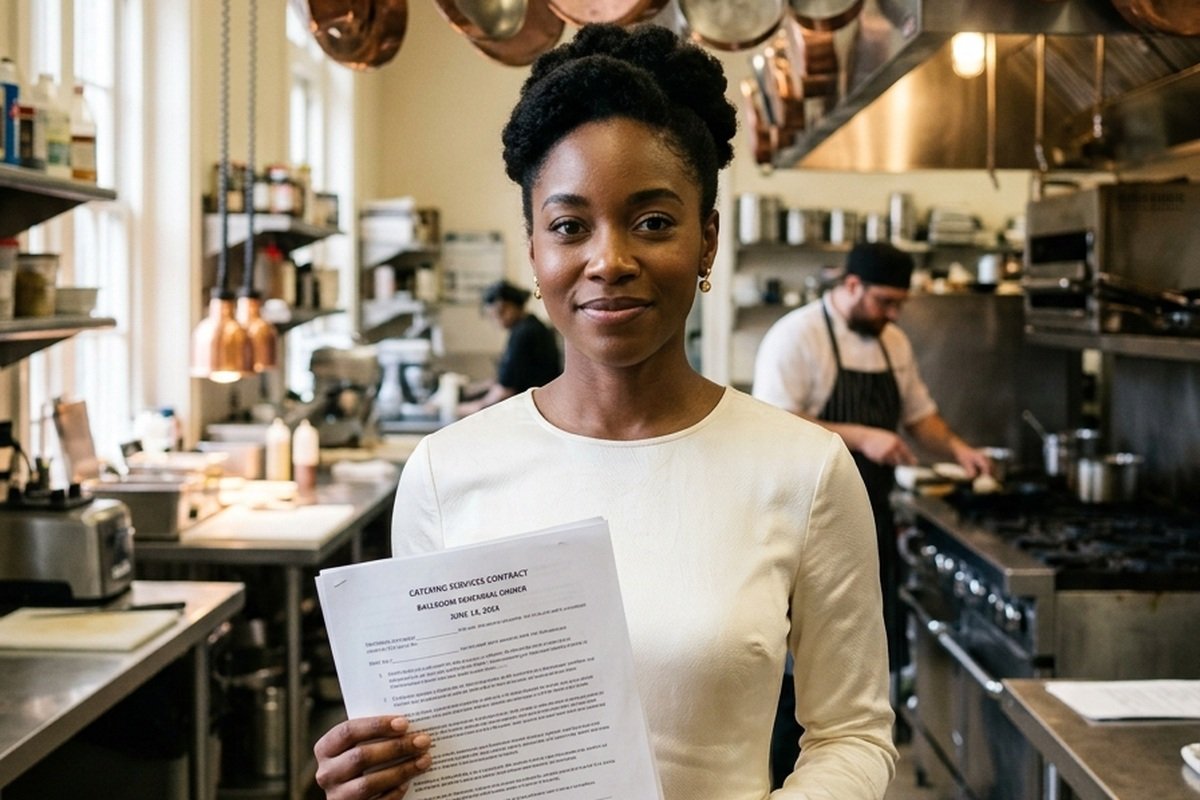
Eighteen months after I closed my catering business, a restaurant buyer emailed to order 240 jars of my pepper sauce.
He congratulated me on “bringing Ember Table back” and attached a wholesale invoice with my old logo in the corner.
I read it twice from the desk of the nonprofit where I now managed community classes. Ember Table had no kitchen, no insurance, and no active business license. Its bank account was closed. The pepper sauce recipe lived in a blue recipe binder on the top shelf of my apartment closet.
The invoice listed my mother’s phone number.
I called her before replying to the buyer.
Denise answered over the noise of a crowded room. I heard metal lids snapping and someone calling for another case of bottles.
“Where are you?” I asked.
She said the Saturday market kitchen.
“Why is a restaurant trying to buy my sauce from you?”
There was a pause long enough for the room behind her to become quiet.
“It is not exactly your sauce,” she said.
I drove to the market.
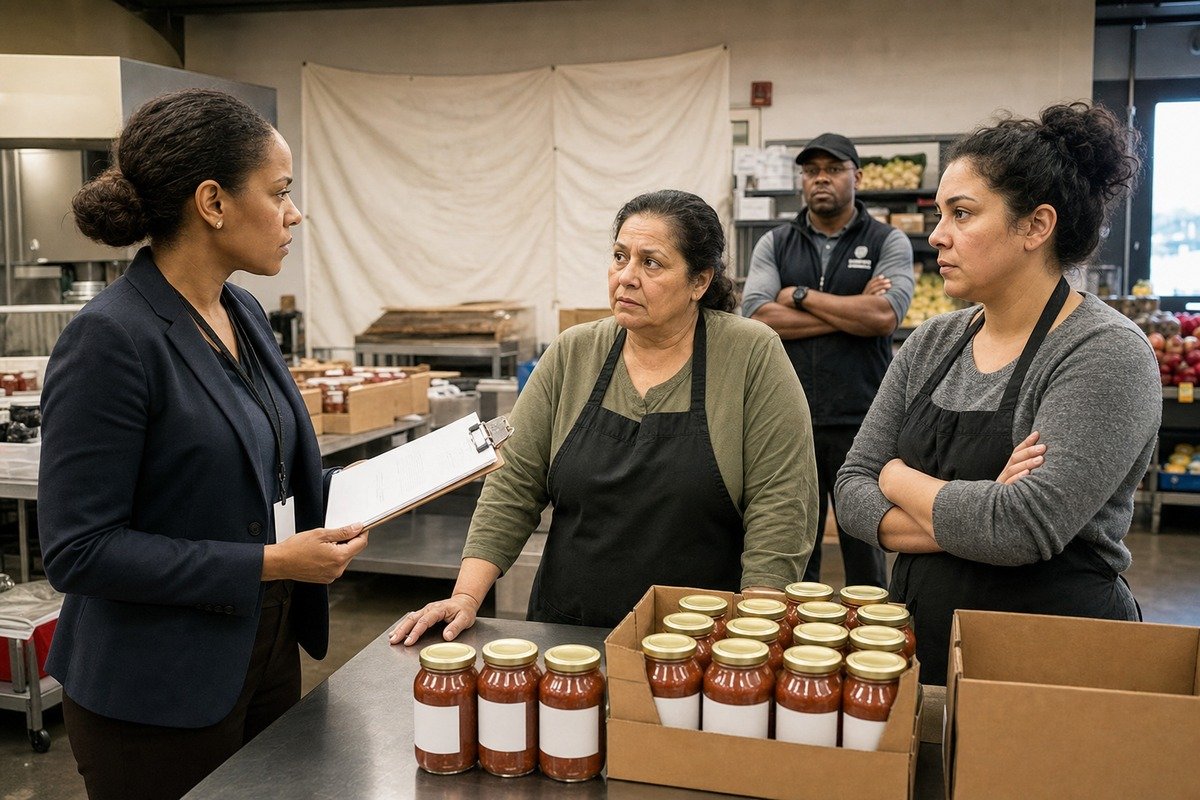
The old Ember Table banner hung above a rented prep station. My former assistant Rosa was filling glass jars. Two people I did not know tightened lids and pressed labels onto the sides. The labels carried my old flame-shaped mark, my former business address, and the words Original Pepper Sauce.
My mother stood beside six cardboard cases with a production log on a clipboard.
I did not shout. That surprised both of us.
I picked up a jar and read the ingredient line. Peppers, vinegar, garlic, brown sugar, spices.
“Where is the mustard?” I asked.
Rosa stopped filling jars.
My recipe used mustard powder. It was not optional and it was not hidden inside a vague spice blend on the labels I had approved when the business was open. Mustard needed to be declared for customers who relied on allergen information.
Denise said they had reduced the amount.
“Reduced is not removed.”
The market director, Pauline, came over after hearing my name. She had approved the kitchen rental because Denise submitted an old Ember Table insurance certificate and a letter saying the renewal was pending. The certificate had expired the month I closed.
Pauline halted the session. Every filled jar stayed on the table. The cases already sold that morning had to be identified.
Before we made the first recall call, Pauline moved us into the market office. She placed three forms between us: product withdrawal, seller correction, and kitchen suspension. Denise reached for the withdrawal form and wrote Ember Table in the business field. I stopped her hand before the pen touched the paper.
I said that the name could not withdraw a product it did not authorize.
Rosa supplied the names of the people who had actually produced the batch. Pauline entered Denise as the seller responsible and marked the old company identity as unauthorized. The distinction slowed us down by ten minutes, but it prevented the recall itself from becoming another false record under my name.
My mother called that an overreaction. Rosa did not. She opened the production log and began listing customers from the receipt book.
I told the restaurant buyer that the invoice was unauthorized and the order could not be filled. Then I photographed the labels, the wholesale invoice, the recipe page lying beside the stove, and the production log. I hated the instinct to gather evidence around people I loved, but I had learned what a missing record could cost during the final months of Ember Table.
The business had not failed because customers stopped coming. It failed because I stopped sleeping.
For seven years I catered office lunches, graduations, and small weddings. I cooked, priced, hired, trained, answered complaints, repaired equipment, and checked every label. During the last year, I began waking at three in the morning convinced I had forgotten a delivery. I once drove to the kitchen in pajamas to confirm a refrigerator was cold.
Closing was not a sudden collapse. It was a deliberate exit. I completed every contract, paid the staff, sold most equipment, canceled the licenses, and offered references. Rosa found part-time work at a bakery. My mother called the closure a rest period even after I told her it was permanent.
At the market, Denise finally explained what she had done.
Rosa’s bakery had cut her hours. Two other former workers were struggling. Customers still asked my mother whether the pepper sauce would return. She believed one market batch could create enough orders to employ the old crew and show me the business no longer had to depend on me.
“You were supposed to see that it could run without you,” she said.
“Then why did you use my name, my recipe, and my expired certificate?”
She said people trusted Ember Table.
That was the answer. She wanted a business independent of me while borrowing every piece of credibility I had built.
Pauline required a recall notice for the morning’s jars because the label omitted mustard and the seller identity was invalid. Rosa and I called each buyer from the receipt book. Nine jars came back unopened. Three customers reported that they had not used theirs. No one reported a reaction. Pauline kept written records and suspended the stall pending review.
The restaurant buyer canceled the 240 jars and sent me a copy of every message with Denise. In one, she had promised that I would oversee “final flavor approval.” I had not known the batch existed.
That evening, we met in my apartment with the blue recipe binder on the table. Rosa came because her labor and reputation were part of the problem. Pauline joined by video for the regulatory steps.
We separated what could not continue from what might still be possible.
Ember Table would not reopen. My old logo, address, certificates, invoice template, and recipe could not be used. The recalled jars would be destroyed under the market’s process, not quietly relabeled. My mother would refund the buyers and cover the kitchen fee.
Rosa asked whether the workers could create their own sauce.
I almost said no because I heard the question as another request for my labor. Then she clarified. They wanted to form a worker-owned cooperative, develop a different recipe, obtain their own licenses, and use their own name. They wanted advice on the closure checklist, not access to Ember Table.
Denise looked relieved, as if the cooperative rescued her plan.
I told her it did not erase what she had done. She had produced food under my identity, misstated insurance, omitted an allergen, and promised my participation. Helping Rosa would be a separate decision.
For the next eight weeks, those decisions stayed separate.
The following Tuesday, Rosa met the other workers in a library conference room. I attended only for the first fifteen minutes to hand over a blank version of my closure checklist. The sheet covered licenses, insurance, ingredient review, temperature logs, labor costs, and refund procedures. It contained no formulas from Ember Table and no recipe instructions.
One worker asked whether I would let them describe the cooperative as founded by my former crew. I said they could describe their own work histories, but they could not imply my endorsement. Rosa rewrote the proposed biography while I watched. Then I left them to decide membership shares and voting rules without me in the room. That exit mattered. Advice had a boundary only if I practiced leaving when my part was finished.
My mother completed the recall notice and refunds. She sent written corrections to the restaurant buyer and the market. Pauline required her to attend the market’s labeling course before she could volunteer in any food stall again. Denise disliked being treated as a beginner, but she went.
Rosa and the other workers met without the blue recipe binder. They called their project Juniper Street Foods and started with roasted tomato relish, not pepper sauce. A small-business clinic helped them register a worker-owned cooperative. A food-safety adviser reviewed their production log and labels. Every ingredient appeared by name.
I attended one meeting as a paid consultant for two hours. We discussed vendor deposits, temperature records, and how to calculate labor before setting a price. I did not taste the product, design the label, or sign their forms.
Denise asked why I would help them but not return.
“Because helping someone build a door is different from being pushed back through mine,” I said.
The cooperative received approval for a limited market launch after eight weeks. Their stall used a green wordmark, plain cartons, and no reference to Ember Table. Rosa handed Pauline the new service contract, insurance certificate, and allergen sheet before the first jar went onto the table.
My mother worked the cash box under Rosa’s supervision. She wore a Juniper Street apron and did not tell customers the product came from my recipe. It did not.
I visited near closing. The display was almost empty. Rosa had kept two jars aside for the workers who had packed the first batch. She offered me one as a customer, not as the absent owner of a revived business.
I bought it.
Denise and I took longer to repair. She had imagined that my closure left an abandoned structure the family could occupy. She had not understood that closing Ember Table was an act of agency, not a gap in judgment waiting for her correction.
Three months later, the old wholesale invoice and recall notice remained in my files. The blue recipe binder remained on my closet shelf. Juniper Street Foods had its own production log, its own recipes, and its own consequences.
The distinction mattered more than whether their relish sold well. My former workers had created employment without pretending I had returned. My mother had learned that preserving an opportunity did not permit her to borrow another person’s name.
And I had learned I could support what came next without reopening what I had chosen to end.