Five years after I quit my father's restaurant, a customer sent me a photograph of the staff schedule with my name written across the top.
SOFIA — GENERAL MANAGER, FRIDAY THROUGH SUNDAY.
Underneath, someone had drawn a small star and written Welcome back.
I was at my desk in the county library when the message arrived. I managed building operations for six branches. I had a budget meeting in twenty minutes and no plan to spend the weekend running Casa Alvarez, the restaurant where I had worked from age thirteen until I was twenty-eight.
I called my father.
Rafael answered over the lunch rush. Plates clattered behind him. He said, "I was going to tell you tonight."
"Tell me what? That I have a shift?"
"Not a shift. A transition."
He had put my name on three weeks of schedules. He had also told the produce supplier, the landlord, and twenty-two employees that I was returning to stabilize the restaurant while he handled a health matter.
The health matter was shoulder surgery scheduled for the following Tuesday.
I knew his right shoulder hurt. I did not know he had torn a tendon, postponed surgery twice, or lost enough strength that the prep cooks were lifting stockpots for him. My anger made room for fear, but it did not disappear.
"Why didn't you ask me?"
"Because you would say you have your own job."
"I do have my own job."
He said the restaurant was my job too, whether I admitted it or not.
That sentence carried the entire reason I had left.
Casa Alvarez opened when I was nine. By middle school I rolled napkins after homework. In college I came home every weekend to close the books. When my mother died, I delayed graduate school and worked full time because Dad could not manage the kitchen and the office alone. Every temporary sacrifice became evidence that the restaurant was my future.
At twenty-eight, I accepted an entry-level facilities position at the library. Dad called it a phase. When I was promoted, he said management experience would help when I came back. I stopped arguing and simply built a life he continued to describe as preparation for his.
After work, I drove to the restaurant.
The dining room smelled of roasted peppers and furniture polish. Dad was at the host stand wearing his black apron. His right arm stayed close to his body. Several employees applauded when I entered. I wanted to turn around, but doing so would make them pay for a promise they had not invented.
Mei Chen, the floor supervisor, hugged me and said she was relieved. She had worked at Casa Alvarez for eleven years and knew every vendor, reservation pattern, and staff conflict. If anyone could stabilize the restaurant, it was Mei.
"Why aren't you acting manager?" I asked.
Her expression changed. Dad answered for her. Mei was excellent with service, he said, but suppliers and the bank expected family leadership during an absence.
Mei looked at the floor.
In the office, Dad showed me a folder labeled SOFIA TRANSITION. It contained vendor contacts, payroll dates, his surgery instructions, and a catering contract for a three-hundred-person anniversary dinner. He had signed the contract four days earlier and scheduled it for the second weekend of his recovery.
"You accepted this after you knew you needed surgery?"
"I accepted it because you would be here."
He had built a commitment on top of an assumption, then used the commitment to make my refusal expensive.
I told him to remove my name from the schedule that night. He said changing it would frighten the staff and invite vendors to tighten payment terms. I said leaving it would be a lie.
We argued until Mei knocked on the office door to report that a cook had cut his hand. She handled the injury, reassigned the station, called the worker's wife, and updated the incident log before Dad and I finished disagreeing about whether she could manage.
The next morning, I used a personal day and returned for the opening shift. I did not come as general manager. I came to see what Dad believed required me.
Mei ran the floor. Omar, the kitchen lead, checked deliveries and changed two specials when the fish order arrived short. Luis in the office processed payroll. Dad moved among them correcting details and answering questions they had already answered.
At ten, the produce supplier called and asked for Sofia. Dad had told him I would approve orders during recovery. I handed the phone to Mei. She reviewed the quantity, caught a duplicate case of tomatoes, and reduced the invoice by four hundred dollars.
At noon, the landlord stopped by to welcome me back. He said Dad had assured him the Alvarez succession was settled, which made a planned lease renewal easier.
Succession. Not three weeks of medical coverage.
I asked Dad what he had promised. He admitted the landlord wanted a five-year renewal and worried the restaurant depended too heavily on him. Dad said my return proved continuity. He had not signed the lease yet, but he had allowed the landlord to believe I would.
That was the turning point. The schedule was not a desperate recovery plan made by a frightened man facing surgery. It was a public draft of my future, circulated in the hope that enough people would depend on it before I could object.
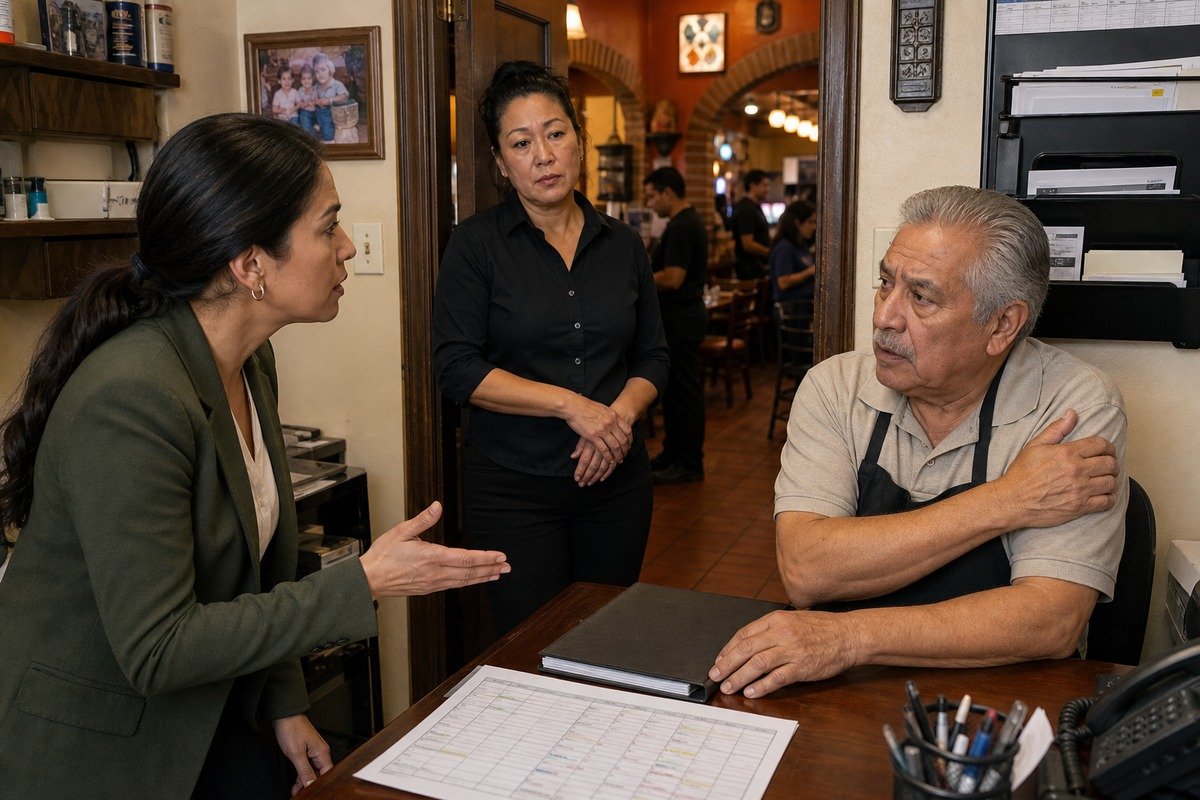
I called a meeting after the lunch service with Dad, Mei, Omar, and Luis. Dad resisted including employees in a family decision. I told him the decision affected their jobs and had already been announced to them.
I began with the truth. I was not returning as general manager. I had not approved the schedule, catering contract, or lease representation. Dad would be absent for surgery and recovery. The restaurant needed an interim structure based on the people who actually worked there.
Omar said he could run the kitchen but not payroll. Luis could handle payroll but not staff disputes. Mei already coordinated both sides but lacked authority to change vendor orders or discipline employees without Dad.
Dad said giving that authority to a non-family employee would be risky.
Mei asked, very calmly, what part of the restaurant she had not already been trusted to protect. She had opened during floods, closed during power failures, mediated between cooks, trained hosts, and carried cash deposits to the bank. The only missing evidence was the Alvarez name.
Dad looked at me as if I had arranged an ambush. I had arranged a confrontation. There was a difference: everyone affected was in the room, and no one was pretending agreement already existed.
I proposed a written ninety-day plan. Mei would become interim general manager with a temporary pay increase and defined authority. Omar would control kitchen purchasing within a set budget. Luis would send weekly cash and payroll reports to Dad and Mei. I would spend four hours each Sunday reviewing facilities, vendor contracts, and the surgery-recovery checklist because those tasks matched my actual expertise. I would not manage shifts, sign the lease, or promise a permanent return.
The anniversary dinner had to be reconsidered separately. Omar said the kitchen could handle two hundred guests during Dad's recovery, not three hundred. Mei called the client with Dad present and offered a smaller event plus referrals for the remaining guests. The client reduced the booking to two hundred twenty and accepted a simplified menu.
Dad called the plan humiliating. I told him surgery was not humiliating, needing employees was not humiliating, and admitting he had promised my labor without permission was not humiliating. Refusing to correct the promise because other people might see his fear would be costly, not dignified.
He signed the interim plan the next day.
Then he called the staff together. He said he had put my name on the schedule before asking me and had presented an unsettled succession as fact. He introduced Mei as interim general manager. The applause for her was louder than the welcome I had received, and Dad heard it.
The immediate weeks were not smooth. Dad tried to answer restaurant calls from the surgical center until I took his phone and gave it to my aunt. Mei made mistakes: she underestimated a Saturday rush and approved overtime that hurt the week's margin. Omar resisted documenting purchases. Luis sent the first report two days late.
But the restaurant did not need an imaginary returning daughter. It needed authority matched to work and mistakes visible enough to correct.
On Sundays, I reviewed the aging water heater, negotiated a service contract, and organized the building records. Those tasks felt different from the years when every skill I offered became proof I belonged there forever. The written plan gave my help an edge. It ended.
Dad's recovery took eleven weeks instead of six. By the time he returned, Mei had renegotiated two vendor schedules and reduced reservation errors. The anniversary dinner finished twenty minutes late but under budget. The client sent a thank-you photograph of the full room.
The landlord still wanted succession evidence before renewing the lease. This time, Dad did not write my name on it. He offered Mei a permanent general-manager position with profit-sharing and a two-year leadership review. Omar received a formal kitchen-manager role. Dad kept ownership and reduced his weekly hours.
I attended the lease meeting only to explain the building-maintenance plan. When the landlord asked whether I might take over one day, I said no. Dad did not correct me, soften it, or call it a phase.
Five months later, I brought my library team to Casa Alvarez for lunch. A new schedule hung near the kitchen. MEI — GENERAL MANAGER was printed at the top. My name appeared once at the bottom beside a Sunday note: Sofia — inspect water heater replacement, 2 p.m.
It was a task I had agreed to do.
Dad still wishes the restaurant will remain in the family forever. I no longer argue with the wish. I argue only when he turns it into someone else's obligation.
The old schedule with my name across the top is folded inside the transition folder. Dad wanted to throw it away. I kept it because the correction matters as much as the mistake. A family business can preserve recipes, names, and memories. It cannot preserve itself by treating a daughter's life as an unsigned contract.