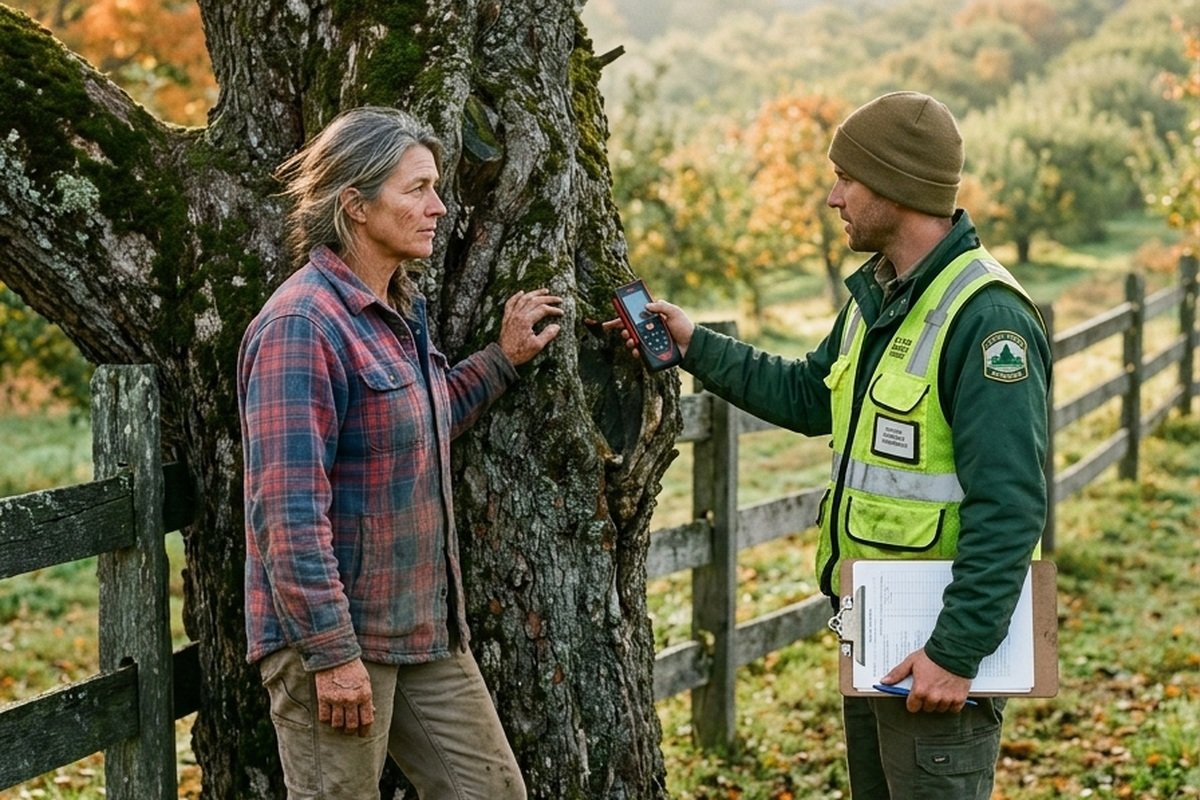
For over seventy-five years, the quiet sanctuary of Whispering Pines Hollow in western Massachusetts had been defined by a magnificent, living natural cathedral. When my great-grandfather purchased our six-acre homestead in 1948 following his return from naval service in the Pacific, the boundary line separating our land from the northern parcel was anchored by four colossal, ancient white oak trees (*Quercus alba*). Arborists and state forestry historians who visited the property estimated that these four titans had taken root in the early 1870s, their massive trunks spanning over five feet in diameter and their soaring, emerald canopies interlocking seventy feet in the air. For four generations of our family, those white oaks were not mere timber; they were sacred guardians of our history. My grandfather had carved our family crest into an iron boundary stone at the base of the central oak, my mother had built her childhood tree swing from its lowest horizontal bough, and my husband David and I had exchanged our wedding vows in their dappled shade fifteen years ago.
The oaks also served an indispensable ecological and physical function that protected our very lives and home. Positioned along the steep geological ridge that sloped down toward the valley creek, their sprawling, century-old taproot networks anchored tens of thousands of tons of unstable glacial till soil. During the torrential autumn flash floods and severe springtime thaws that regularly battered Berkshire County, those massive root systems acted as an immense natural sponge, absorbing tens of thousands of gallons of runoff and preventing catastrophic mudslides from washing away our stone retaining walls and family vegetable gardens. Every summer, migratory songbirds, barred owls, and generations of gray squirrels nested in the hollows of their ancient limbs. We treated those trees with the reverence one accords to living monuments, investing thousands of dollars over the years in certified organic root aeration, lightning protection copper cabling, and gentle deadwood pruning performed by licensed conservation arborists.
The peaceful tranquility of our valley shattered in the autumn of 2024 when the adjacent twelve-acre northern estate was acquired by Pierce Sterling, a forty-four-year-old hedge-fund managing director who had recently relocated from Manhattan. Pierce was a man whose entire worldview was governed by domination, speed, and the unyielding conviction that sufficient capital could steamroll any civil boundary. He possessed an icy, superior gaze and wore tailored designer athleisure, treating the local township officials like personal retainers. He immediately leveled the historic 1920s stone farmhouse on his parcel, replacing it with a monolithic, fifteen-thousand-square-foot ultra-modern glass-and-steel mansion that looked like a hostile corporate headquarters dropped into our rustic woods.
Pierce surrounded his property with eight-foot black security fences, blinding commercial LED floodlights that burned throughout the night, and a constant procession of heavy earthmoving equipment that rattled our windowpanes from dawn until dusk. From our very first interaction, Pierce made his entitlement blindingly clear. He walked across our shared gravel drive wearing high-end designer sunglasses, an unlit Cuban cigar clenched between his teeth, holding an architectural landscape master plan rolled under his arm. ‘David, Laura,’ Pierce announced with condescending familiarity, pointing his diamond-ringed finger toward our ridge. ‘Those four massive oak trees on the property line are blocking the morning western sunlight from hitting my proposed infinity pool and championship tennis court. They drop tons of messy acorns and leaves across my manicured lawn. I’m having my excavation contractors bulldoze them next Tuesday. I’ll even throw a couple grand your way for the firewood.’
David and I were stunned by his brazen audacity. We immediately stood our ground, explaining calmly but firmly that the white oaks were located entirely on our side of the legal boundary line, that they were century-old heritage specimens protected under state forestry conservation guidelines, and that we would never consent to their removal under any circumstances. Pierce’s affable corporate mask slipped instantly, revealing a sneering, predatory hostility. ‘Listen to me, tree-huggers,’ Pierce growled, his face inches from David’s. ‘In my world, obstacles get removed. You can take my generous cash offer today, or I will make your lives a living nightmare. Everything has a price, and I always get what I want. You can’t stop progress with sentiment.’ We immediately sent a certified cease-and-desist letter from our real estate attorney, warning Pierce that any trespass or damage to our boundary trees would result in immediate legal prosecution.
For nearly nine months, an uneasy, arctic silence settled between our properties. Pierce completed the construction of his sprawling glass mansion, but the excavation for his tennis court remained stalled near the ridge boundary. We believed our certified legal warning and the presence of our survey boundary markers had deterred him from attempting anything reckless. In late September, to celebrate our fifteenth wedding anniversary, David and I embarked on a long-planned, ten-day hiking trip across the remote backcountry trails of the Canadian Rockies, leaving our property in the care of our trusted neighbor, an elderly retired dairy farmer named Thomas Higgins.
On the sixth morning of our trip, while we were at a trailhead lodge in Banff, my cell phone began buzzing incessantly with frantic text messages and missed calls from Thomas. When I finally reached him, Thomas’s voice was shaking with tears and trembling fury. ‘Laura… you have to come home immediately,’ Thomas choked out, his breath ragged. ‘Pierce brought in a rogue commercial logging crew yesterday at dawn with two industrial cranes and four industrial wood chippers. They cut down the boundary fence while I was in town at the feed store. Laura… the ancient oaks are gone. They cut them all down to the dirt.’
A sickening wave of nausea washed over me, dropping me to my knees on the wooden porch of the Canadian lodge. We caught the earliest red-eye flight back to Boston, driving through the night in stunned, horrified silence. When our car turned onto Whispering Pines Hollow at seven o’clock the following morning, the sight that greeted us was an apocalyptic nightmare. Our majestic, century-old green cathedral had been completely obliterated. Where towering white oaks had stood for one hundred and fifty years, filtering golden sunlight and rustling in the autumn breeze, there was now a raw, scarred wasteland of torn earth, deep bulldozer ruts, and four colossal, sawed-off tree stumps bleeding fragrant sap into the cold morning air.
The massive hundred-foot logs had already been hauled away on flatbed commercial trailers, leaving only heaps of wood chips, shattered branches, and our crushed stone retaining wall behind. Even worse, the heavy excavation tracks had gouged massive trenches across our property line, tearing through our perennial gardens and severing the underground drainage tiles that protected our foundation from hillside runoff. A yellow Caterpillar excavator bearing the logo of *Sterling Capital Holdings* was parked brazenly across our boundary line, its steel bucket resting on the stump of the central oak where my grandfather’s carved iron marker had been violently pried out and discarded into the mud.
As David and I stood in the wreckage, sobbing uncontrollably at the senseless destruction of our heritage, the glass front doors of Pierce Sterling’s mansion swung open. Pierce walked toward us holding a cup of espresso, wearing a tailored fleece vest, a smug, contemptuous smirk plastered across his face. ‘Welcome back, neighbors,’ Pierce called out casually, leaning against the boundary fence. ‘Told you they were coming down. The construction foreman got a little overzealous with his boundary markers while I was away at my Hamptons house, but what’s done is done. Call your lawyer. I’ll write you a check for ten thousand dollars to settle the landscaping trespass, and we can all move on with our lives.’ He looked at our devastated faces with utter indifference, convinced that a few thousand dollars from his pocket change would erase a century and a half of living history.
David rushed toward the fence line, his voice cracking with volcanic fury. ‘You sociopath! You hired a crew while you knew we were out of the country! You stole four hundred years of combined tree life from this valley! We had certified survey stakes driven three feet deep in the earth!’ Pierce didn’t even flinch. He took a slow sip of his espresso, his smirk widening into a mask of pure corporate malice. ‘David, stop crying over firewood,’ Pierce sneered, waving his hand toward the devastated hillside. ‘Look around you. It’s dirt and scrub wood. My tennis court is increasing the aggregate property values of this entire township by millions of dollars. Do you honestly think a local Berkshire county judge cares about four old oak trees when a multi-million-dollar taxpayer is building world-class amenities?’
Pierce pulled an envelope from his pocket and tossed it onto the hood of our truck. ‘There’s a certified cashier’s check for twenty-five thousand dollars. That is five times the timber value of those logs at the local sawmill. Take it, sign the mutual waiver of release, and plant a couple of ornamental Japanese maples. If you drag this into court, my corporate litigation firm in Boston will tie you up in depositions for the next seven years until you go bankrupt from legal fees. In the end, you’ll get market timber value—a few grand—and you’ll be broke. Be smart for once in your life.’
When I stepped forward, holding the jagged fragment of my grandfather’s iron boundary stone that had been shattered by the excavator, Pierce looked down his nose at me with venomous disdain. ‘You think you’re special because your grandfather bought some cheap farmland after the war, Laura?’ Pierce whispered mockingly. ‘You’re provincial peasants clinging to rot. Progress doesn’t stop for sentimental nostalgia. The oaks are in the wood chipper, the concrete trucks are arriving on Friday, and there isn’t a single thing you can do to stop me.’ He turned on his heel, tossed his empty paper cup into the brush on our side of the fence, and strolled back into his mansion, laughing with his construction superintendent.
David and I stood by the bleeding oak stumps in the freezing morning mist, our hands trembling with rage. But beneath our grief, a cold, steel-hard resolve began to take shape. Pierce believed that trees were valued like cordwood bought at a gas station. He believed that the law operated purely on the arrogance of billionaires who could bully working families into submission. What Pierce Sterling did not know was that Massachusetts possesses some of the most stringent, unforgiving timber trespass and statutory tree conservation laws in the entire United States. Under Massachusetts General Laws Chapter 242, Section 7, willful and unlawful destruction of another person’s trees does not result in cordwood scrap value; it triggers mandatory **treble damages** based on comprehensive forensic arboricultural appraisal. Pierce had not merely cut down trees; he had walked into a legal minefield with a sledgehammer.
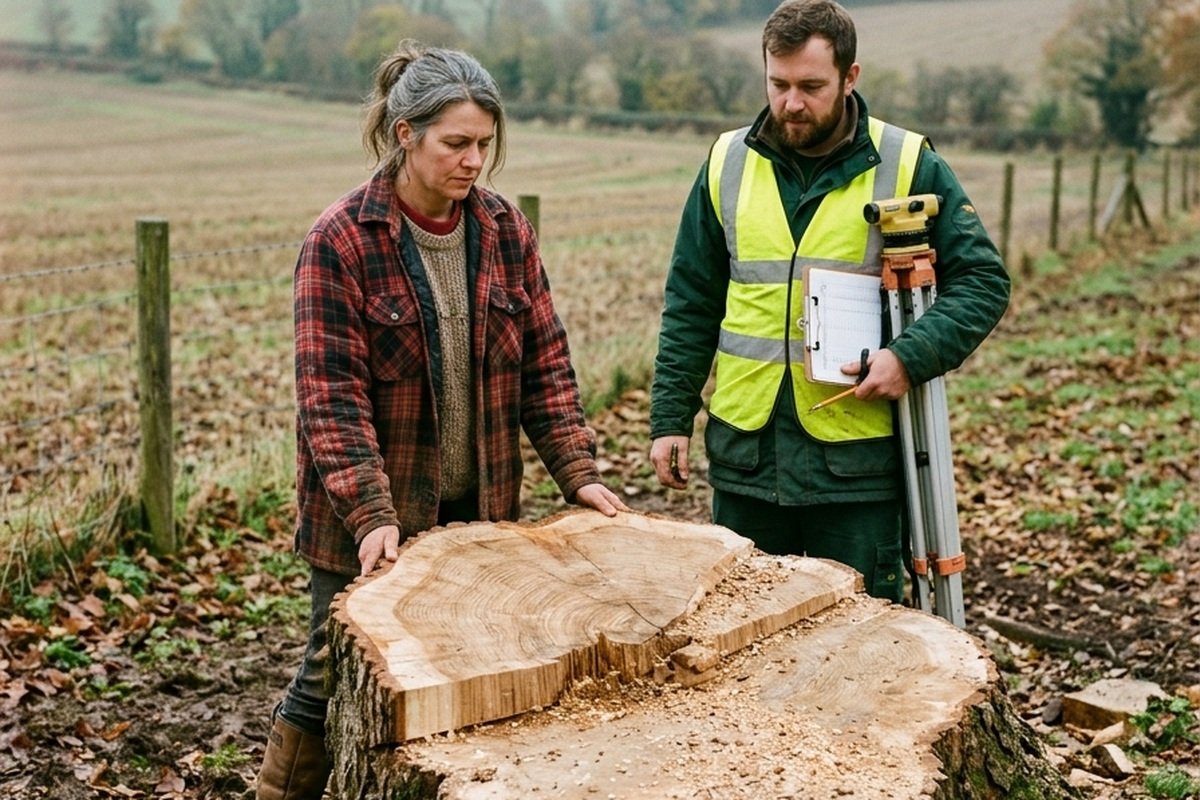
At eight o’clock the following morning, David and I retained Eleanor Vance-Cross, one of New England’s foremost agricultural land-use litigators, alongside Dr. Alistair Finch, a world-renowned board-certified forensic arborist with the American Society of Consulting Arborists. Accompanying Dr. Finch was a licensed land surveyor and a forensic structural civil engineer. When the team arrived at Whispering Pines Hollow, Dr. Finch knelt beside the massive white oak stumps, running his hands over the exposed growth rings with solemn, scholarly reverence.
‘These are not just ordinary trees, Mrs. Vance,’ Dr. Finch said, his voice trembling with professional outrage. ‘These specimens were pristine *Quercus alba* dating back to approximately 1868. Their root systems were biologically flawless, with canopy spreads exceeding eighty feet and perfect trunk symmetry. In urban and estate forestry, specimens of this historic magnitude and replacement impossibility are appraised under the *Trunk Formula Method* established by the Council of Tree and Landscape Appraisers (CTLA).’ Over the next four days, Dr. Finch’s team conducted microscopic core sampling of the remaining root structures, high-resolution 3D laser topography scans, and ecological soil compaction testing.
What Dr. Finch compiled was a devastating masterwork of forensic liability. The four heritage white oaks had an appraised baseline replacement and ecosystem value of **three hundred and ninety-five thousand dollars**. But the destruction extended far beyond the timber itself. The civil structural engineer determined that the violent ripping of the taproots by the excavator had destabilized thirty vertical feet of hillside slope, directly causing severe soil compaction, erosion channels, and structural failure of our ninety-foot historic stone retaining wall. Restoring the geological slope, installing specialized micropile retaining barriers, hauling in engineered structural backfill, and performing complete horticultural remediation would cost an additional **two hundred and eighty thousand dollars**.
Even more damningly, our surveyor uncovered concrete proof that Pierce had acted with calculated, premeditated malice. When subpoenaed by our attorney, the owner of the rogue logging company confessed that Pierce had explicitly ordered him to fell the trees while David and I were out of the country, assuring the contractor that ‘I will pay any nominal landscaping fine out of my petty cash reserves.’ Furthermore, the surveyor confirmed that every single cut was executed three to eight feet *inside our legally registered boundary line*, making Pierce’s defense of ‘accidental encroachment’ an outright lie.
Armed with Dr. Finch’s certified three-hundred-page appraisal report, the civil engineering slope failure analysis, and the contractor’s written confession, Eleanor Vance-Cross filed an emergency verified complaint in Berkshire Superior Court. Under Massachusetts timber law, when an unlawful cutting is determined to be willful, deliberate, and without license, the court is statutorily mandated to award **three times the actual appraised value** of the trees, alongside full restoration costs and attorney fees! The presiding superior court judge, horrified by the photographic evidence of intentional environmental vandalism, immediately issued an emergency temporary restraining order freezing all construction on Pierce’s tennis court, impounding his excavation equipment, and granting an emergency pre-judgment attachment lien of **one million, five hundred thousand dollars** against Pierce Sterling’s estate.
Pierce Sterling had no idea the legal hammer had already fallen. Continuing his pattern of untouchable arrogance, Pierce had scheduled an extravagant, black-tie charity reception at his glass mansion for Saturday evening, hosting eighty prominent Wall Street associates, venture capital partners, local zoning board members, and luxury lifestyle editors to celebrate the completion of his modern estate. Flanking his grand marble terrace were champagne ice sculptures, live jazz musicians, and glossy architectural renderings displaying his proposed championship tennis court.
Pierce stood on his elevated terrace holding a glass of vintage scotch, basking in the praise of his wealthy peers. ‘When you acquire raw land, you must impose order upon chaos,’ Pierce boasted into the wireless microphone, laughing heartily with three investment bankers. ‘Local resistance is inevitable from provincial folks who lack imagination. But with enough vision and executive resolve, you clear away the dead wood and create true modern luxury.’
Before the applause could fade, the glare of emergency red and blue flashing lights cut through the glass walls of the mansion. Pulling up Pierce’s winding private driveway were two Berkshire County Sheriff cruisers, alongside a flatbed commercial transport truck from the state environmental conservation police and County Chief Civil Sheriff Marcus Vance. Marching onto the manicured terrace were Sheriff Vance, two armed deputies, Dr. Alistair Finch in his forensic arborist uniform, attorney Eleanor Vance-Cross, David, and me. I was wearing my dark work coat, holding a certified copy of the one-and-a-half-million-dollar pre-judgment attachment order in my hand.
The live jazz band immediately stopped playing. Over eighty elite guests in tuxedos and designer evening gowns gasped in collective shock, stepping away from the terrace perimeter. Pierce’s face flushed a furious purple. He stepped toward the sheriff, his voice shaking with hostile rage. ‘Sheriff, what is the meaning of this outrage? This is a private charity gala on private residential property! Remove these people immediately or I will have your badge!’
Sheriff Marcus Vance did not halt his stride until he stood inches from Pierce’s face. ‘Mr. Pierce Sterling, shut your mouth and listen very carefully,’ Sheriff Vance commanded, his authoritative voice echoing across the silent marble terrace. ‘By order of the Massachusetts Superior Court, an emergency pre-judgment execution and stop-work injunction has been issued against this parcel under Case #2024-CV-8812. Your tennis court construction has been permanently shut down for felony timber trespass, willful environmental degradation, and malicious destruction of historic property.’
Eleanor Vance-Cross stepped onto the terrace steps, holding Dr. Finch’s enlarged forensic appraisal charts displaying the crushed century-old oaks and the boundary survey lines, placing them directly on Pierce’s champagne display for his Wall Street partners to see. ‘Mr. Sterling,’ Eleanor announced loudly, her voice cutting through the horrified crowd, ‘you intentionally trespassed onto my clients’ land and illegally leveled four 150-year-old white oaks while they were out of the country. Dr. Finch has concluded forensic appraisal under state law. With statutory treble damages, geological slope restoration, and punitive environmental sanctions, your liability exceeds one million, two hundred and eighty thousand dollars. Furthermore, the court has placed a formal pre-judgment lien against this entire property, and we are seizing that excavator sitting on my clients’ land right now.’ A chorus of stunned whispers broke out among Pierce’s colleagues, several of whom shook their heads in utter disgust and immediately called for their chauffeurs to leave.
Pierce Sterling’s smug, untouchable veneer shattered into complete, hysterical panic. ‘It was an accident! The logging crew misread the map! My lawyers will settle this for twenty grand on Monday!’ Pierce shouted, his hands trembling as he spilled his scotch across his tailored trousers. Sheriff Vance merely stepped forward, placing a hand on his tactical duty belt. ‘Mr. Sterling, you have thirty minutes to dismiss your guests and clear this terrace. If your contractors touch another inch of that soil, you will be transported to the county jail for criminal contempt.’ Over eighty high-society guests filed out of the mansion in embarrassed silence, leaving Pierce standing alone amid melted ice sculptures and half-eaten hors d’oeuvres.
The legal annihilation that followed over the subsequent nine months was total and uncompromising. Facing the contractor’s sworn confession, Dr. Finch’s unassailable CTLA appraisal methodology, and satellite timestamp imagery proving premeditation, Pierce’s high-priced Boston litigation firm realized they had zero defense. At the summary judgment hearing, Superior Court Judge Katherine Ross delivered a blistering memorandum of decision, stating that Pierce’s conduct demonstrated ‘reprehensible arrogance, conscious disregard for statutory property rights, and malicious environmental devastation.’
Judge Ross entered a final, unappealable civil judgment against Pierce Sterling for **one million, two hundred and forty-two thousand dollars**—representing statutory treble damages for the four white oaks, two hundred and eighty thousand dollars in full geological slope reconstruction and retaining wall restoration, and eighty-five thousand dollars in reasonable attorney fees and expert witness costs. To satisfy the judgment, Pierce was forced to liquidate an offshore investment portfolio, cutting a certified bank check directly to David and me.
The fallout did not stop in the courtroom. Humiliated by the public exposure in regional newspapers and shunned by his corporate peers who refused to be associated with an environmental pariah, Pierce abandoned his plans for the championship tennis court. The county conservation commission denied all future zoning variances on his parcel due to the severe erosion risks his illegal excavation had created. Within a year of the judgment, Pierce put his glass mansion up for sale at a steep eight-hundred-thousand-dollar discount, retreating back to New York with his financial and social reputation permanently tarnished.
Spring returned to Whispering Pines Hollow with a triumphant renewal of life. With the one-point-two-million-dollar recovery safely deposited, David and I did not indulge in vanity. We hired a premier civil geotechnical engineering firm to permanently reconstruct our hillside slope, installing heavy granite retaining terraces, deep-rooted native willow stabilizers, and advanced underground drainage systems that secured our land for the next century.
In honor of the fallen titans, we established the *Whispering Pines Heritage Oak Conservatory*. In the very location where our ancient trees had stood, Dr. Alistair Finch helped us plant eight mature, twenty-foot white oak saplings grown from genetically certified New England heritage stock. Surrounding the saplings is a beautiful, hand-carved stone memorial garden where our grandfather’s restored iron boundary stone has been set in polished Massachusetts granite, bearing the inscription: *’Unyielding Roots, Eternal Guardians — Truth Outlasts Arrogance.’*
The migratory songbirds and barred owls have already begun returning to our hillside, nesting in the surrounding woodland and filling the crisp morning air with their vibrant choruses. Our neighbors throughout the valley regularly stop by on their evening walks, sitting on the stone memorial benches to admire the new growth and celebrate a victory that proved ordinary working families can stand up to arrogant wealth and win.
Last night, as the sun dipped behind the western mountains, casting long golden shadows across our restored hillside, David and I walked out to the ridge. The young white oak saplings stood proud and resolute, their fresh green leaves rustling softly in the evening breeze. David took my hand, kissing my forehead as we looked out across the valley we had fought so fiercely to protect.
Arrogant people believe that money gives them the right to rewrite boundaries and erase history with a wave of their hand. But true wealth is not measured in hedge funds, tennis courts, or glass mansions; it is rooted in the sacred stewardship of the land, the honor of ancestral memory, and the courage to hold the line against tyranny. Our ancient oaks may have fallen, but their legacy has taken root deeper than ever before—unbroken, protected, and standing tall for generations to come.