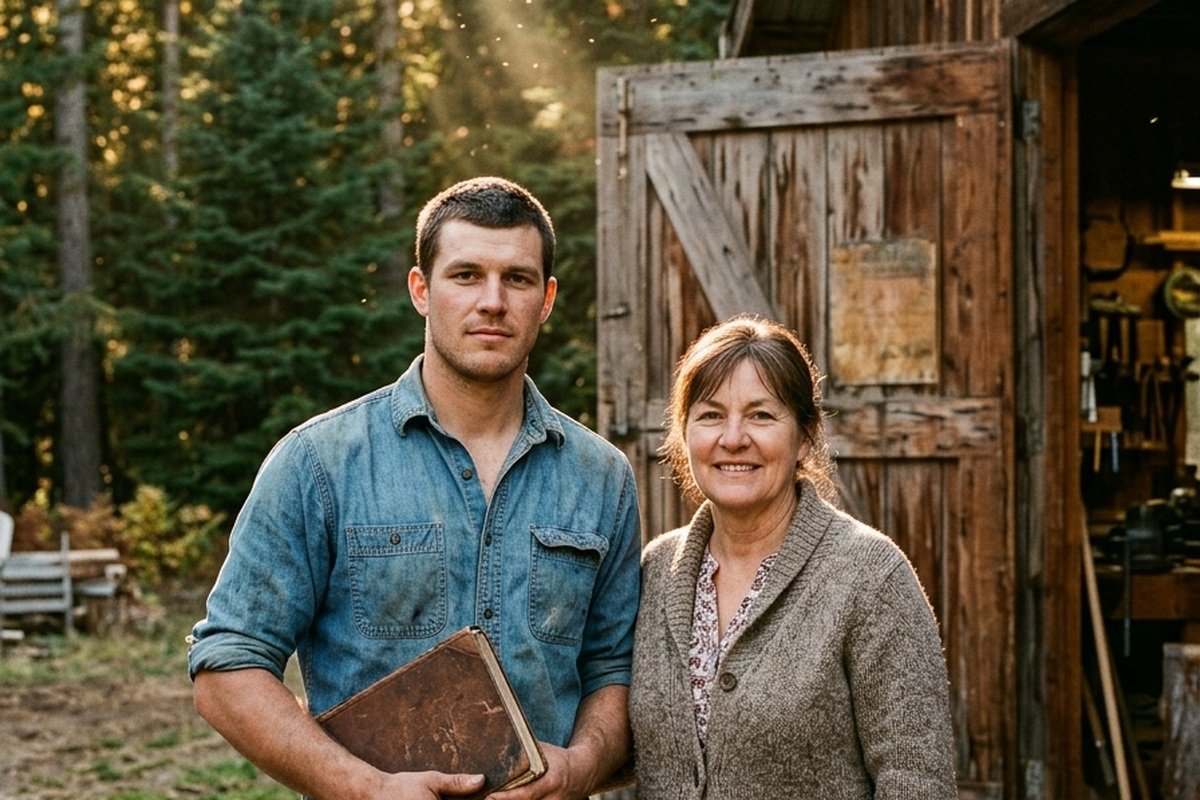
For sixty-two years, Cedar Creek Valley was measured by the steady hum of the Vance Timber Mill. Founded in 1964 by my grandfather, Arthur Vance, the sixty-five-acre riverside property was more than a commercial logging outfit; it was a sanctuary of craftsmanship where three generations learned that honest labor was the only currency that never devalued. I was ten when Grandpa Arthur placed a Japanese pull saw into my hands, guiding my fingers along the grain of fallen black walnut. He taught me to read tree rings like scripture, whispering that every knot proved a storm the tree had survived. While the world surrendered to particle board and flat-pack furniture, the Vance Workshop held stubbornly to mortise-and-tenon joints, tung oil finishes, and heritage dining tables built to outlive the families who bought them.
My mother, Clara, gave her adult life to preserving that legacy alongside him. When my father passed away during my sophomore year of high school, Grandpa held our home together. My mother managed the administrative ledger, timber sourcing compliance, and the grueling daily maintenance of kiln dryers and lumber sheds. For the final seven years of Grandpa’s life, when vascular dementia began to steal his balance and memory, Clara never considered placing him into a nursing home. She moved into the farmhouse’s southern bedroom, waking at four every morning to administer medications, bathe aching joints, and guide him across the gravel drive so he could sit beside the great lathe, watching morning mist rise off the river.
Throughout those seven grueling years of eldercare, my mother’s older brother, Douglas, was an abrasive ghost. Douglas lived nearly four hundred miles away in an affluent lakeside suburb of Chicago, styling himself as a high-flying commercial real estate syndicator. He drove a leased midnight-blue Mercedes-Benz, wore tailored Italian sport coats, and possessed an innate ability to make anyone who worked with their hands feel profoundly inferior. He visited Cedar Creek perhaps once every two years, arriving unannounced on a Sunday afternoon, taking selfies near lumber stacks to project a folksy family image on social media, complaining bitterly about rural internet, and departing before sunset.
Whenever my mother gently approached him about sharing the mounting financial burden of Grandpa’s prescription therapies or property taxes, Douglas would scowl and launch into a rehearsed monologue about his capital being locked in offshore portfolios and escrow accounts. ‘You have no business acumen, Clara,’ Douglas would sneer. ‘You and Dad are sitting on sixty-five prime riverfront acres producing pennies in lumber sawdust when any competent asset manager could parcel this tract out into luxury suburban subdivisions for multi-million-dollar payouts. If you want cash flow, stop playing pioneer woman with rustic chairs and liquidate the dead weight.’
Grandpa Arthur, even in his declining state, understood exactly what Douglas was. On an unseasonably warm afternoon in October, three months before his passing, my grandfather summoned me and my mother into the workshop office. The smell of cedar sawdust and machine lubricant hung thick in the golden air. With trembling hands, the old man placed his weathered brass pocket watch and the heavy, notched iron master key to the workshop into my palm. ‘Douglas has dollar signs where his soul ought to be, Mark,’ Grandpa whispered, his voice cracking with fierce clarity. ‘He thinks land is just dirt you pave over for a quick commission. But this mill belongs to the hands that sweat over it. I promised your mother on the day you were born that she would never be cast out of her home, and I took steps to make sure of it. When the wolves come circling, don’t you flinch. Look behind the iron. The truth is built deeper than their lies.’ We believed we understood his poetic sentiment, never suspecting that within ninety days, those cryptic words would become the thin barrier standing between our family and total financial ruin.
Grandpa Arthur passed away peacefully in his sleep on a frigid Tuesday in early January, surrounded by the quiet ticking of the grandfather clock he had hand-carved in 1978. The funeral was a testament to the lives he had touched; over three hundred local carpenters, arborists, forestry stewards, and valley neighbors packed the small stone chapel to pay their final respects. Douglas arrived ten minutes after the service began, accompanied not by his family, but by a sharply dressed corporate attorney named Richard Sterling, who spent the graveside eulogy checking the stock ticker on his smartphone. Douglas shed zero tears. Instead, while mourners were gathered at the fellowship hall sharing memories, Douglas was observed walking the perimeter fence of the mill with an iPad, photographing road frontage and pointing out elevations to his lawyer.
The initial shock arrived less than seventy-two hours later during the formal reading of the will at an antique law office in the county seat. The attorney handling the proceedings, Horace Gable, adjusted his spectacles with visible discomfort as he retrieved a yellowing document dated July 14, 1999. It was a twenty-seven-year-old last will and testament that Grandpa Arthur had drafted shortly after my grandmother’s death, when Douglas was still an ambitious student and long before his predatory financial habits had manifested. Under the rigid terms of this antiquated instrument, Grandpa’s entire real property estate—comprising the sixty-five-acre timber farm, the commercial lumber mill, and the main family farmhouse—was devised solely and unconditionally to his firstborn son, Douglas Vance. Clara was granted a pitiful residual cash bequest of fifteen thousand dollars from an old savings account that had long since been depleted by medical bills.
My mother sat frozen in her wooden chair, the blood draining completely from her face. ‘Mr. Gable, this makes no sense,’ she stammered, her voice shaking violently. ‘My father lived with me for seven years. We restructured the property debt together in 2014 when the timber market crashed. Dad told me repeatedly that the land had been secured in a protective family entity so that Mark and I could continue operating the mill. He knew Douglas wanted to bulldoze the entire forest.’ Horace Gable looked down at his blotter with genuine remorse. ‘Mrs. Vance, I can only execute the document currently registered in the county probate registry. Unless a valid, executed codicil or superseded trust deed is formally filed, this 1999 instrument stands as your father’s legally binding disposition.’
Before my mother could catch her breath, Douglas stood up from across the conference table, buttoning his suit jacket with a chilling, self-satisfied grin. ‘Well, little sister, the law is the law,’ Douglas said smoothly, checking his gold wristwatch. ‘Dad always understood executive capability. He knew that leaving high-value commercial acreage to a sentimental homemaker and a sawdust-covered trade worker would lead to bankruptcy within eighteen months. Richard and I have already initiated the probate transfer paperwork with the circuit court. I suggest you begin packing your personal effects immediately.’
I rose from my chair, my fists clenched at my sides, every muscle in my body vibrating with rage. ‘You didn’t spend five minutes caring for him while he was dying, Douglas! My mother bathed him, fed him, and kept the lights on when you wouldn’t even answer your telephone! You have no right to touch this land!’ Douglas didn’t even blink. He merely smirked, stepping behind his attorney like a coward shielding behind an armed guard. ‘Save the high-school theatricals for someone who cares, Mark. As of this morning, I am the lawful personal representative and sole heir of Vance Holdings. You have seventy-two hours to vacate the premises and remove your clothing. Anything remaining on the property at noon on Friday will be declared abandoned commercial inventory and auctioned off to defray probate expenses.’
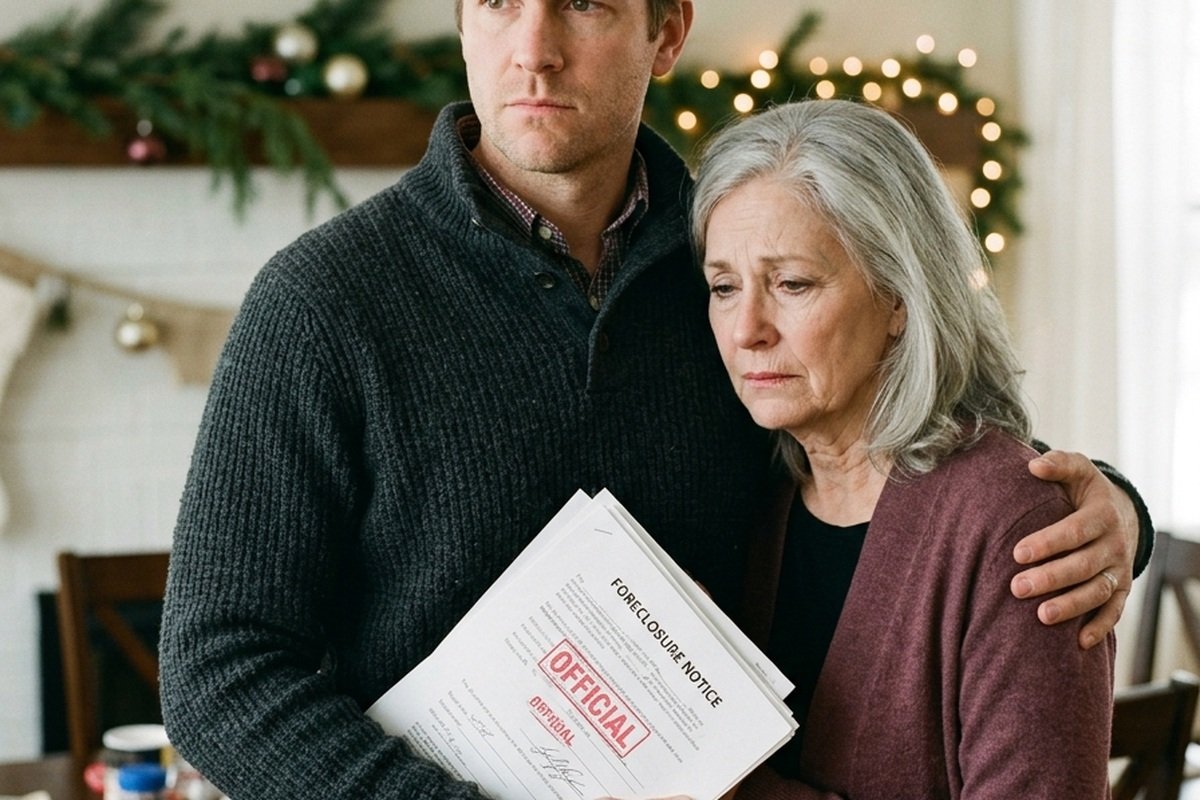
When my mother and I returned to the farmhouse that afternoon, our world was shattered into pieces. At precisely eight o’clock the following morning, the crunch of heavy tires on gravel signaled Douglas’s immediate offensive. He did not come alone. Following behind his Mercedes were two white utility trucks bearing the logo of a private commercial security firm, alongside a flatbed commercial transport carrying heavy industrial chains, padlocks, and steel security barriers. Four burly private security guards in high-visibility vests climbed out of the vehicles and immediately began securing the perimeter gate, driving warning stakes into our flowerbeds and wrapping thick hardened-steel chains around the front entrance of the primary woodworking shop.
My mother rushed onto the front porch, her hands trembling as she pulled her wool cardigan tight against the bitter winter chill. ‘Douglas, what in God’s name are you doing?’ she cried out, her voice echoing across the frost-covered gravel yard. ‘This is my home! Mark and I have custom furniture orders inside that shop with client deposits! We have drying walnut slabs worth eighty thousand dollars that require daily atmospheric monitoring! You can’t just lock us out of our livelihood!’ Douglas stepped forward, holding an iced latte in one hand and a clipboard of legal notices in the other. He looked at my mother not as a sister who had shared his childhood, but as an annoying squatter occupying prime real estate.
‘Listen to me very carefully, Clara,’ Douglas declared in a voice loud enough for the security contractors to hear. ‘This property is now private commercial holding under Vance Capital Asset Management LLC. You do not own this dirt. You do not own the buildings. Your presence here is an unmitigated liability to my pending transaction.’ He pulled a glossy multi-page architectural prospectus from his leather folder and thrust it toward our faces. Across the cover, in bright crimson lettering, were the words: *RIVERSTONE GLEN: LUXURY ACTIVE-ADULT SUBDIVISION & COMMERCIAL STRIP PLAZA*. Underneath was an artist’s digital rendering of our century-old timber forest completely leveled, replaced by rows of cookie-cutter vinyl mansions, asphalt parking lots, and an upscale strip mall.
‘I have already executed an exclusive contract of sale with Apex Development Partners for three point eight million dollars,’ Douglas announced, puffing out his chest with unbridled arrogance. ‘A five-hundred-thousand-dollar non-refundable earnest deposit is sitting in escrow pending title clearance. Do you honestly think I care about a few piles of rotting logs and dusty workbenches when millions of dollars are on the table? Dad was a dinosaur who wasted his life making rocking chairs for church bazaars. I am turning this dead asset into generational wealth. You and your son are an impediment to progress.’
When I stepped between Douglas and my mother, warning him that entering the workshop without an official sheriff’s eviction writ was a civil violation, Douglas signaled his head of security. A muscular guard with a sidearm stepped forward, placing a hand on his tactical belt. ‘Mark, don’t test me,’ Douglas whispered with venomous delight. ‘I have filed an expedited petition for commercial ejectment. By noon tomorrow, the county sheriff will personally escort you off this land in handcuffs if you step foot past that gate. You are permitted to enter the main shop for precisely sixty minutes between four and five o’clock this evening under armed escort to retrieve your personal hand tools. After that, the electronic codes will be wiped, the locks will be replaced, and trespassers will be prosecuted to the maximum extent of the penal code.’ He turned on his polished Italian loafers, climbed back into his Mercedes, and slammed the door, leaving us standing in the freezing wind surrounded by armed strangers.
At four o’clock that afternoon, under the watchful gaze of an armed security guard stationed inside the workshop doorway, I began gathering my personal chisels, hand planes, and measuring calipers into heavy canvas duffel bags. My heart felt as though it were being squeezed in an iron vise. The sweet, familiar aroma of cured pine, linseed oil, and walnut dust seemed to mock the injustice unfolding around us. Every beam in this cathedral of wood had been raised by my grandfather’s sweat; every rack of seasoned timber represented years of selective harvesting that preserved the delicate ecological balance of our valley. And now, a parasitic speculator who hadn’t swung a hammer in forty years was preparing to sell it all to bulldozers.
As I packed my tools near the rear bay of the mill, my eyes landed upon Grandpa Arthur’s favorite possession: a massive, five-thousand-pound cast-iron patternmaker’s lathe built in 1948 by the Oliver Machinery Company. Grandpa had spent six months in his youth restoring that iron beast, anchoring its four-inch steel footings directly into the reinforced concrete foundation of the shop. Standing beside the machine, his dying words suddenly detonated in my memory with electric precision: *’Look behind the iron. The truth is built deeper than their lies.’* My grandfather had not been speaking metaphorically; he was a master carpenter who hid secrets where no ordinary man would ever think to look.
I pretended to drop an Allen wrench beneath the lathe’s heavy cast-iron gear casing, kneeling down on the sawdust-covered floor behind the massive tailstock. The guard at the door was busy texting on his phone, entirely indifferent to my movements. Running my fingertips along the antique beadboard wainscoting directly behind the motor mount, my knuckles tapped against a hollow sound. There was a faint seam in the quarter-sawn oak paneling—imperceptible unless viewed from floor level. With trembling fingers, I retrieved a hardened steel pick from my tool roll, slipped the blade into the tiny shadow gap, and pushed upward with steady leverage. A spring-loaded wooden latch clicked softly, and a twelve-inch section of the baseboard swung open on miniature brass piano hinges.
Recessed three inches inside the structural brick pillar was a heavy, fireproof steel Meilink safe, its combination dial finished in blackened antique bronze. Suspended from a leather loop beside the dial was a handwritten tag written in Grandpa Arthur’s bold drafting script: *’For Clara and Mark. Only when the wolf shows his teeth.’* Next to the tag hung a small brass index card stamped with three numbers: 44 – 18 – 62. The exact year Grandpa bought the mill, the year my mother was born, and the year the first lumber saw spun to life. With my heart pounding against my ribs like a trip-hammer, I dialed the combination and turned the heavy steel handle. The door swung open silently on oiled bearings.
Inside the safe lay three distinct documents that changed everything. The first was an official 2014 Warranty Deed and Restructured Equity Agreement, accompanied by stamped county auditor receipts. It proved that ten years earlier, when Douglas had defaulted on a reckless commercial bank loan that threatened the family mill, my mother, Clara, had liquidated her late husband’s entire life insurance policy of three hundred and twenty thousand dollars to pay off the bank lien. In exchange, Grandpa Arthur had formally transferred an irrevocable sixty percent undivided equity interest in the sixty-five-acre estate to Clara and me, held under the *Vance Heritage Land and Living Trust*! Arthur had only retained a forty percent life-estate interest, meaning that Douglas’s 1999 will had attempted to devise property that Arthur did not even legally own!
The second document was even more explosive: a certified forensic bank audit compiled by an independent certified public accountant three months before Grandpa’s death. It detailed how Douglas, utilizing an old financial power-of-attorney granted during a temporary hospital stay in 2021, had systematically forged Arthur’s signature to execute a four-hundred-and-fifty-thousand-dollar commercial mortgage against Arthur’s personal credit line just twenty-one days before his death, funneling the illicit cash through a shell corporation named *Apex Horizon Holdings LLC*—the exact same entity fronting the purchase contract! Douglas had secretly taken out a fraudulent loan against our grandfather’s name to fund his own earnest money deposit!
The third item was a sealed manila envelope containing a pristine thumb-drive video recording and a certified testamentary codicil executed on November 12, 2024, signed and notarized by the county’s former presiding probate judge, Judge Evelyn Crawford. In the legal instrument and accompanying video testimony, a lucid, resolute Arthur Vance explicitly revoked all prior wills, disinherited Douglas Vance entirely for gross fiduciary fraud, and bequeathed one hundred percent of his remaining equity to Clara and Mark. Grandpa hadn’t forgotten to update his will; he had set an unbreakable legal trap, waiting for Douglas to expose his crimes under oath before springing the jaws shut.
Instead of revealing our discovery to Douglas or filing an immediate injunction that would allow him to alter his story or declare personal bankruptcy, my mother and I took the evidence straight to the private chambers of Judge Evelyn Crawford and the County District Attorney’s Special Financial Crimes Division. When District Attorney Thomas Reynolds reviewed the forensic trail—the forged signatures, the unauthorized mortgage, the wire transfers to Douglas’s offshore shell company, and the videotaped codicil—his jaw tightened into a grim line of professional outrage. ‘Mrs. Vance,’ Reynolds said, closing the leather folder with a heavy thud, ‘your brother hasn’t just committed civil fraud. He has engaged in grand larceny, aggravated identity theft, bank fraud, and felony elder financial exploitation. We are going to let him dig his grave to the exact depth he desires before we fill it in.’
Douglas had scheduled his grand victory celebration for Friday evening at seven o’clock in the crystal-chandeliered ballroom of the Cedar Creek Valley Country Club. Over one hundred and fifty prominent guests had gathered for what Douglas billed as the *’Vance Estates Transformation Gala’*. In attendance were the regional partners of Apex Development Corporation, county zoning board members, commercial banking executives, real estate syndicators, and local press corps who had been invited to witness the ceremonial signing of the multi-million-dollar land acquisition agreement that would officially pave over the historic Vance Timber Mill.
Douglas stood on the elevated stage behind a polished mahogany podium, wearing a bespoke double-breasted tuxedo and basking in the adoration of investors who believed he was about to deliver a sixty-five-acre riverfront goldmine. Flanking him on stage were enlarged architectural foam-board displays showing the bulldozing of our family forest. ‘Ladies and gentlemen, distinguished investors, and honored civic leaders,’ Douglas boomed through the microphone, his voice dripping with triumphant vanity. ‘For decades, this valley’s prime waterfront acreage has been held hostage by nostalgic sentimentality and low-yield lumber sawdust. But true leadership requires the vision to dismantle the past to construct the future. Tonight, as the sole lawful heir and executor of the Vance estate, I proudly execute the contract that brings four million dollars of premier development to our community!’
A smattering of polite applause began to ripple across the ballroom as the CEO of Apex Development stepped forward with a gold fountain pen. But before the nib could touch the parchment, the heavy double oak doors at the back of the banquet hall swung open with a resounding bang that silenced the room instantly. Walking down the center aisle, their boots clicking firmly against the polished parquet floor, were County Sheriff Marcus Cole, two uniformed deputies, District Attorney Thomas Reynolds, retired Judge Evelyn Crawford, my mother Clara, and me. Clara was dressed not in mourning black, but in an elegant sapphire dress, holding the original certified 2014 trust deed in her hands.
Douglas froze, his face flushing crimson with sudden fury. He leaned into the microphone, his voice booming with nervous hostility. ‘Security! Remove these people immediately! This is an exclusive private function! What is the meaning of this circus, Sheriff?’ Sheriff Cole did not halt his stride until he stood directly at the foot of the stage, flanked by his armed deputies. ‘Mr. Douglas Vance, step away from that table and step off that stage right now,’ Sheriff Cole commanded, his deep baritone carrying across the breathless ballroom. Douglas tried to force a dismissive laugh, turning to the Apex executives. ‘Don’t worry, gentlemen, this is just my disgruntled sister throwing a temper tantrum because she was left out of our father’s will. She has no standing here!’
‘On the contrary, Mr. Vance,’ District Attorney Reynolds announced loudly, stepping onto the stage stairs and displaying a certified judicial order bearing the gold seal of the Circuit Court. ‘Mrs. Clara Vance and her son Mark are the lawful majority owners of the Vance Timber Mill under an active, unassailable 2014 Land Trust holding sixty percent undivided fee-simple equity. Your 1999 will has been formally superseded by an executed 2024 testamentary codicil certified by Judge Crawford, which completely disinherits you. You hold zero legal authority to execute any deed, transfer, or sale contract on that property. This entire transaction is void as a matter of law.’
A collective gasp tore through the country club ballroom. The CEO of Apex Development immediately dropped the golden pen as if it had burst into flames, backing away from Douglas with an expression of sheer horror. ‘What is he talking about, Douglas?’ the CEO demanded, his face turning pale. ‘You provided us with certified title affidavits stating you were the sole unencumbered heir!’ Douglas began to sweat profusely, the color draining from his face until he resembled a ghost in a tailored suit. ‘It’s a mistake! It’s a forged document! Horace Gable filed the probate petition! My lawyer will clear this up in five minutes!’
District Attorney Reynolds did not give him a fraction of an inch to breathe. ‘Mr. Vance, we are not here merely to halt an unlawful civil closing. Four hours ago, a forensic warrant was executed on your corporate accounts at First Federal. We have uncovered the four-hundred-and-fifty-thousand-dollar fraudulent commercial line of credit you executed in your dying father’s name using a revoked power-of-attorney, along with the unlawful wire transfer directly into your escrow holding company to finance your personal debt. You are under arrest for grand theft, aggravated identity fraud, bank fraud, and felony elder financial exploitation.’
Sheriff Cole mounted the stage steps, unhooking a pair of stainless-steel handcuffs from his duty belt. In front of the entire assembly of county dignitaries, real estate titans, photographers, and local news journalists whose flashbulbs illuminated the stage in blinding bursts of white light, Sheriff Cole forced Douglas’s arms behind his back. The sharp, mechanical *click* of the ratchets locking around Douglas’s manicured wrists echoed through the microphone with devastating finality. ‘You have the right to remain silent,’ Deputy Martinez recited into the stunned silence of the room. Douglas began to tremble, his slick composure collapsing into hysterical pleading. ‘Clara! Clara, please! Don’t do this to your own brother! We’re blood! Tell them this is a family misunderstanding!’
My mother stood tall at the center of the aisle, her chin held high and her eyes completely dry. ‘You stopped being my brother the day you padlocked my home and tried to bulldoze Dad’s life’s work, Douglas,’ she replied, her voice steady and clear. ‘You told me that money was the only language that mattered. Now you can explain your business acumen to the state penitentiary.’ As Douglas was marched in handcuffs down the center aisle, past the very investors he had sought to deceive, the local news cameras recorded every second of his public disgrace.
The legal and financial destruction that followed was absolute and merciless. Within forty-eight hours, the county circuit court entered an emergency injunction freezing all of Douglas Vance’s commercial and personal bank accounts. Apex Development immediately terminated their contract of sale and filed a multi-million-dollar civil lawsuit against Douglas personally for fraud, breach of warranty, and punitive damages. Six months later, faced with overwhelming forensic documentation, the videotaped codicil, and unassailable handwriting analysis, Douglas accepted a comprehensive plea agreement to avoid a twenty-year maximum state prison sentence. He was sentenced to seven years at the state correctional facility, ordered to pay five hundred and eighty thousand dollars in full restitution, and forced into personal Chapter 7 bankruptcy, surrendering his luxury vehicles, his suburban residence, and every penny of his fraudulent assets.
Spring arrived in Cedar Creek Valley with a burst of emerald foliage, wildflowers blooming along the riverbanks, and the sweet, resinous scent of freshly milled white pine filling the crisp morning air. With the fraudulent claims permanently extinguished and title to the entire sixty-five acres restored exclusively to Clara and me, we began the work of revitalizing our heritage. The private security chains that Douglas had wrapped around our front gate were cut off with an oxyacetylene torch, their melted remnants forged into a decorative iron plaque that now hangs above the workshop threshold, inscribed with Grandpa Arthur’s favorite maxim: *’Built on Truth, Standing for Generations.’*
The five-hundred-thousand-dollar recovery from Douglas’s liquidated assets and forfeited bonds was not squandered. Rather than expanding into reckless commercial mass production, my mother and I established the *Arthur Vance Memorial Timber and Craft Guild*, an accredited non-profit apprenticeship center dedicated to teaching sustainable selective forestry and historic woodworking techniques to youth and military veterans transitioning back to civilian life. Within our first year, eight young apprentices were working in the shop alongside me, their faces illuminated by the golden afternoon sunlight as they learned to master the Japanese pull saws and hand planes that Grandpa had loved so dearly.
The historic 1948 Oliver lathe, which had guarded our family’s salvation behind its cast-iron base, remains the proud centerpiece of our main production floor. Every custom dining table that leaves our mill now bears an embossed brass seal beneath the tabletop, commemorating the date the timber was harvested, the apprentice who shaped it, and the unbroken chain of custody that kept this sacred ground free from corporate greed. Our order books are now filled for the next three years, with commissions arriving from museums, civic centers, and private collectors across the continent who value authentic soul over synthetic convenience.
Last Sunday, as the sun began to dip behind the western ridge of the valley, casting long amber shadows across the lumber yard, my mother and I walked down to the riverbank where Grandpa Arthur’s ashes had been scattered among the wild willows. Clara reached out, taking my hand in hers, her face radiant with a profound, unshakeable peace that had been absent for too long. We stood together listening to the gentle rushing of the water and the distant, familiar hum of the mill running true and steady in the evening breeze.
True family wealth is never measured in bank accounts, stock tickers, or multi-million-dollar subdivision balance sheets. It is measured in the sacred covenants kept between generations, the courage to stand firm against betrayal, and the enduring honor of hands that build rather than destroy. My uncle believed that by seizing a piece of paper, he could steal our soul; but he forgot that roots planted in honesty run deeper than any storm can shake. As long as the river flows through Cedar Creek Valley, the Vance Timber Mill will remain standing—unbroken, uncompromised, and forever home.