The sound that woke me on a Tuesday morning was not the quiet chirping of morning sparrows or the distant hum of the interstate.
It was the deafening, mechanical roar of three commercial chainsaws chewing through ancient hardwood, vibrating through the floorboards of my bedroom like a small earthquake.
I threw on a pair of jeans and work boots, sprinted down the hallway, and burst through the back patio door into my yard.
What I saw stopped my breath dead in my throat.
Along the eastern boundary line of my two-acre wooded property in northern Westchester County, four men in orange helmets were systematically carving into the base of our historic oak grove.
These weren’t small saplings or decorative perimeter shrubs.
These were four colossal white oak trees, over one hundred and ten years old, with five-foot-wide trunks that had towered over the ridge long before either of our houses had been constructed.
My grandfather had purchased this land in 1954, and I had spent my entire childhood climbing among those massive, spreading branches.
By the time I reached the fence line, two of the grand oaks were already lying across the grass in splintered heaps of shredded bark and shattered timber.
The chainsaw operators were actively notching the trunk of the third tree.
“Stop! Turn those engines off right now!” I screamed, waving my arms frantically as sawdust showered through the air.
The crew foreman, a tired-looking man with ear protection resting on his collar, killed his chainsaw and signaled to his crew.
“What’s the problem, buddy? We’re on a commercial clearing contract,”
“The problem is you are trespassing on private property and cutting down trees that belong to me!” I yelled, my hands shaking with sheer fury.
Before the foreman could answer, a sleek golf cart purred across the manicured lawn of the neighboring estate.
Richard Sterling stepped out.
Sterling was fifty-five, a retired private equity partner who had bought the adjoining five-acre parcel eighteen months earlier.
He wore spotless white tennis shorts, a navy cashmere pullover draped over his shoulders, and designer sunglasses.
In the year and a half since moving in, Sterling had made life in our quiet semi-rural township miserable.
He had attempted to petition the zoning board to outlaw outdoor fire pits, filed noise complaints against our neighbor’s rescue dogs, and repeatedly bragged at neighborhood meetings about his influential connections in county politics.
“Relax, Mark, don’t have a coronary,” Sterling said smoothly, adjusting his sunglasses as he walked toward the boundary line.
“I hired this crew to clear the perimeter buffer. I’m building a regulation clay tennis court and an outdoor pavilion with an Italian wood-fired pizza oven.”
“Your tennis court is on your property! These oaks are on my property!” I shouted, pointing directly at the ground.
“You crossed the line by nearly twenty-five feet! Look where your crew drove the excavator!”
Sterling offered a condescending, dismissive smirk, waving his hand as if brushing away an annoying fly.
“Mark, don’t be ridiculous. That dilapidated old wire fence back there was crooked and rotting. The true property line obviously follows the natural crest of the hill.”
“Besides, those old trees were an eyesore. They blocked the western sunset view from my master terrace and dropped leaves into my infinity pool.”
“I did you a massive favor by cleaning up your overgrown brush. When the project is finished, I’ll pay my landscaper to plant a nice row of emerald arborvitae along the fence to give you some privacy.”
“You did me a favor?!” My voice cracked with disbelief. “You just destroyed century-old landmark trees without a permit, without notice, and without my permission!”
“Listen to me very carefully, neighbor,” Sterling said, his voice dropping into a cold, menacing corporate drawl.
“I am spending two point four million dollars transforming this estate into a premier architectural showcase.”
“I don’t have time to haggle with a middle-school science teacher over some firewood.”
“Take whatever timber is on the ground to heat your living room this winter. If you try to delay my contractors, my legal team will file an injunction against you for interference that will cost you every dime you have in the bank.”
He turned his back on me, climbed into his golf cart, and drove back toward his limestone mansion.
My chest felt so tight I could barely breathe.
I looked down at the severed rings of the first fallen giant—over a century of growth rings, tight and dense, bleeding fresh sap onto the soil.
I knew that losing my temper would accomplish nothing against a man who treated money like a weapon.
I pulled out my phone and did two things immediately: I called the Bedford Police Department to report criminal trespass and destruction of property, and I called Evelyn Vance, an independent certified consulting arborist whose firm specialized in forensic botanical appraisal.
Within forty-five minutes, Officer Miller from the local police department arrived.
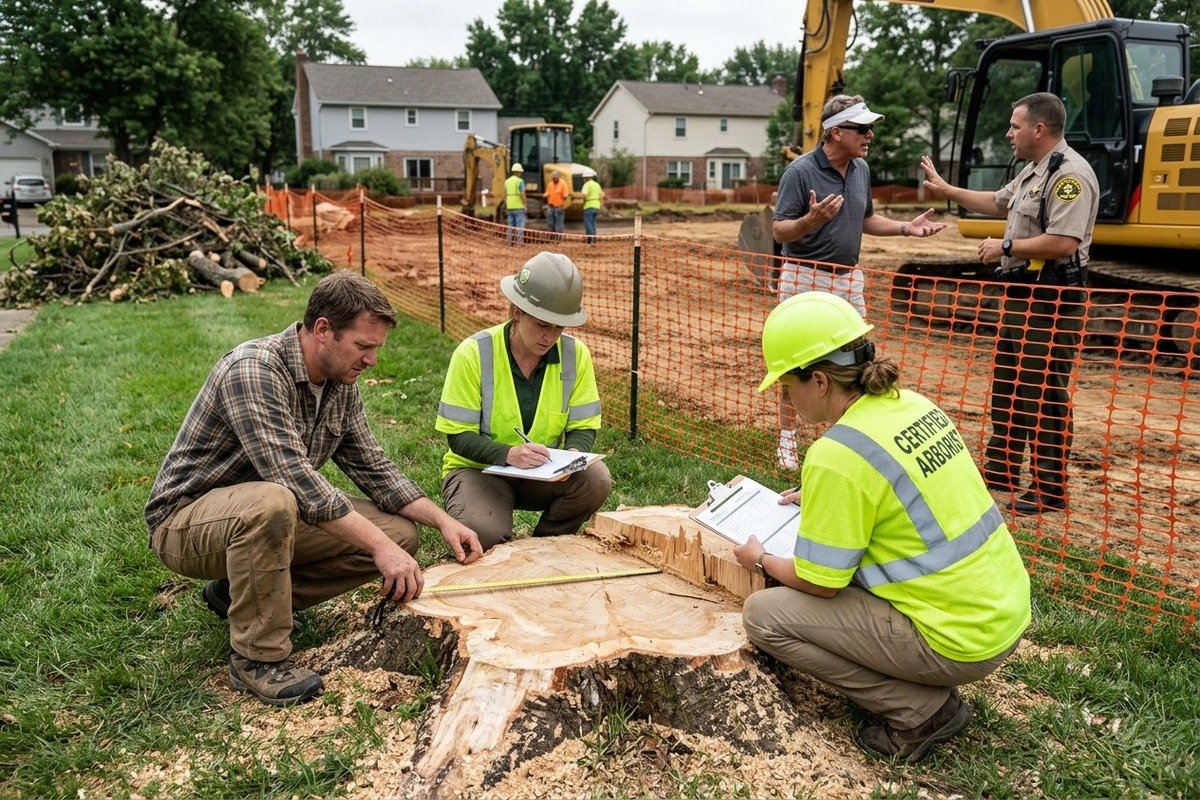
Miller took photographs of the tire tracks, the severed trunks, and the temporary construction fencing.
Sterling strolled down his driveway, smiling warmly and offering Miller a cold bottle of sparkling water while dropping the name of our town council president.
Miller was polite but firm: “Mr. Sterling, this is a property boundary dispute with potential criminal damage. I am issuing an official stop-work directive on this perimeter until a licensed surveyor certifies the legal markers.”
Sterling rolled his eyes and scoffed. “Fine. Have your little surveyor come out. But when he confirms the line, I’m billing Mark for my crew’s lost hourly rates.”
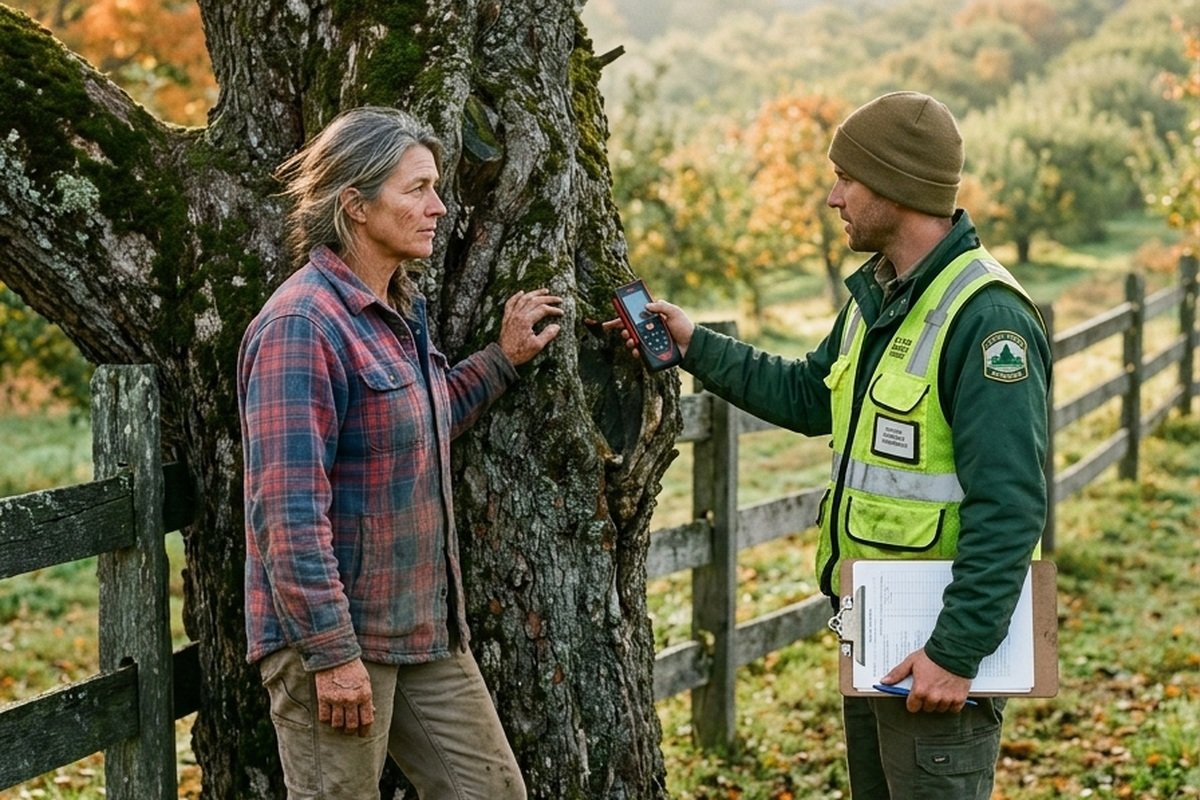
The next morning, Evelyn Vance arrived at my property accompanied by a licensed state land surveyor.
Evelyn was fifty, sharp-eyed, and held master certifications from the International Society of Arboriculture (ISA) and the American Society of Consulting Arborists.
She carried specialized measuring calipers, ultrasonic wood-density testing probes, and high-precision GPS tracking beacons.
For six hours, the surveyor located the original iron boundary pins buried twelve inches beneath the soil, cross-referencing county tax maps and historical land deeds dating back to 1922.
The surveyor drove bright fluorescent-pink steel stakes into the ground, running a high-tension string line between the certified pins.
When the string was tied off, the reality of Richard Sterling’s arrogance was laid bare for the entire world to see.
The entire oak grove was not even close to the boundary.
The four trees had stood twenty-eight feet inside my legal property line.
The excavator tracks, the orange construction silt fence, and forty tons of dumped gravel were all trespassing squarely on my land.
Evelyn walked down the line of pink stakes, shaking her head in profound professional disgust.
“Mark, this is one of the most egregious cases of deliberate timber trespass I have seen in twenty-five years of forensic practice,”
“Do you know what kind of trees these were?”
“They were white oaks—Quercus alba,” I replied quietly.
“They were pristine, mature specimen white oaks in peak physiological health,” Evelyn corrected me firmly.
“Under New York State law—specifically Real Property Actions and Proceedings Law Section 861—anyone who cuts, removes, or despoils trees on another person’s land without permission is liable for timber trespass.”
“And in New York, the law doesn’t measure timber by cordwood value or commercial lumber board feet.”
“It is measured by the Trunk Formula Method: the full replacement cost, biological appraisal value, environmental canopy loss, and site restoration required to return the property to its exact pre-casualty state.”
Evelyn spent three full days compiling a seventy-two-page forensic botanical appraisal.
Her calculations were mathematically devastating.
A 110-year-old white oak with a sixty-inch diameter at breast height cannot simply be bought at a garden center and planted.
Because trees of that magnitude cannot be transported intact, the ISA Trunk Formula calculates the appraised amenity value of each mature specimen based on trunk cross-sectional area, species rating, location factor, and physical condition prior to damage.
Evelyn valued the two completely destroyed oaks at $84,000 each.
The third tree, which had been notched with deep chainsaw wounds into its structural vascular cambium, was declared biologically non-viable and posed a severe falling hazard, requiring an additional $18,000 in emergency crane removal and $76,000 in replacement value.
The fourth tree had suffered seventy percent root-zone compaction and mechanical severing from the heavy excavator tracks, with an appraised diminution of value assessed at $42,000.
Then came the site restoration: deep root soil aeration, stump grinding, five years of soil rehabilitation, and the planting of mature nursery-grown replacement canopy trees.
The base appraised compensatory damages totaled $213,400.
When Evelyn handed me the certified appraisal binder, she smiled with a glint of steel in her eyes.
“Now, Mark, take this document to a specialized property litigator. Because RPAPL 861 has a very special provision for people like Richard Sterling.”
Under New York Real Property Actions and Proceedings Law § 861, if the plaintiff proves that the defendant acted willfully, intentionally, or without plausible cause to believe the land was their own, the court is legally mandated to award treble damages—triple the full appraised value—plus mandatory attorney fees and survey costs.
I hired James Thornton, a veteran land-use and environmental litigator in White Plains.
Thornton didn’t just send a polite complaint.
He filed a formal verified summons and complaint in the Westchester County Supreme Court for intentional timber trespass, reckless endangerment of property, and common-law conversion, attaching Evelyn’s forensic appraisal and the certified surveyor’s plat.
The total damages claimed in the lawsuit: $640,200 in treble damages, plus $45,000 in statutory legal fees.
When Richard Sterling was served with the lawsuit at his country club lunch on a Friday afternoon, his initial reaction was pure mockery.
He forwarded the papers to his high-priced Manhattan corporate law firm, telling them to ‘crush this annoying high school teacher with motions to dismiss.’
Two weeks later, Sterling received a sobering reality check from his own senior litigation partner.
Tree law in North America is famously merciless.
Courts do not view hundred-year-old trees as mere landscaping; they view them as irreplaceable ecological assets.
And because Sterling had ignored the police stop-work order, admitted on record that he thought the trees were ‘an eyesore that blocked his view,’ and failed to commission a pre-construction survey before deploying commercial chainsaws, his defense of ‘good faith mistake’ was legally dead on arrival.
His own lawyers warned him: if this goes before a Westchester County jury, you will lose, and the judge will have no discretion but to enforce the statutory treble multiplier.
Sterling’s swagger vanished overnight.
He tried calling me on my cell phone, leaving conciliatory voicemails offering to ‘sit down like gentlemen over coffee and work out a reasonable neighborly settlement of twenty thousand dollars.’
I didn’t answer his calls. Every communication was directed to Thornton.
When Thornton formally rejected his lowball offer and requested a trial date before Justice Connolly, Sterling began to panic.
Furthermore, Thornton had filed a notice of pendency (lis pendens) against Sterling’s estate, effectively freezing his ability to refinance or sell the property while the environmental litigation was pending.
Four months into the legal proceedings, during a mandatory court-ordered settlement conference in the county courthouse, Richard Sterling finally realized he had no escape.
He sat across the conference table, his designer cashmere replaced by a subdued gray suit, his face pale and haggard.
His attorney presented their final settlement offer.
Sterling agreed to pay the full treble-damage demand: $640,000 in certified funds.
In addition, the settlement agreement contained binding legal covenants:
1. Sterling was required to pay all surveyor fees ($6,800) and arborist forensic fees ($12,400).
2. Sterling had to pay for a certified tree preservation specialist to install permanent root-barrier shielding along the property boundary.
3. Sterling was legally barred from building his tennis court within fifty feet of the boundary line, forcing him to completely redesign his outdoor layout and scrap his planned pavilion.
4. Sterling had to fund the planting of twelve mature, twenty-foot-tall swamp white oak and sugar maple specimen trees along our property buffer, complete with an automated deep-root drip irrigation system maintained at his expense for seven years.
Standing on the courthouse steps after signing the final decree, Sterling walked past me, his jaw clenched so tight a vein was bulging in his temple.
“You ruined my entire architectural vision for that property,” he hissed under his breath.
I looked him straight in the eyes with calm, unshakeable composure.
“Those trees stood on that ridge through two world wars, the Great Depression, and four generations of my family,”
“You didn’t respect the land, you didn’t respect your neighbors, and you thought your money made you immune to the law.”
“It took you thirty minutes to cut down a century of history. It’s going to take you the rest of your life to pay for it.”
Today, the border between our properties looks entirely different.
The formal deposition of the tree-clearing contractor, Gary Kowalski, proved to be another fatal blow to Sterling’s legal posture.
Under oath, Kowalski produced a series of timestamped text messages from Sterling sent the weekend prior to the cutting.
When Kowalski had explicitly asked for the certified surveyor pins and expressed concern about the boundary markers, Sterling had texted back: ‘Don’t worry about pins. Just cut everything up to the crest of the ridge. The neighbor is a timid schoolteacher who won’t do anything, and if he squawks, I’ll throw five grand at him to shut him up.’
Seeing his own cynical words printed in black and white in an official deposition transcript completely eviscerated any lingering pretense of innocence.
Furthermore, the Bedford Town Environmental Conservation Board convened an emergency public hearing after our story began circulating among local conservation groups.
The board unanimously voted to revoke all active residential building permits for Sterling’s property, citing catastrophic violation of the municipal wetlands buffer and unauthorized clearing of designated critical environmental canopy.
Every single contractor on his site was forced to pack up their equipment and leave, turning his multi-million-dollar renovation into a silent, muddy monument to reckless entitlement.
The new oak and maple trees are flourishing, their vibrant green canopies spreading in the breeze, supported by deep mulch and healthy soil.
Beyond the fence, Sterling’s backyard remains an empty, unfinished dirt lot.
After paying the $640,000 judgment and burning hundreds of thousands in legal bills, he ran out of liquidity for his luxury pavilion.
Our local community rallied around our property in a way that truly restored my faith in human decency.
Dozens of neighbors whom Sterling had previously intimidated or bullied brought over fresh-baked pies, offered words of encouragement, and even volunteered their weekends to help Evelyn Vance spread organic protective mulch around the surviving root zones.
It was a powerful reminder that while wealth can buy prime acreage and heavy machinery, it can never purchase the genuine respect, solidarity, and moral foundation of a united community.
Three weeks ago, a ‘For Sale’ sign went up at the entrance to his estate.
Whenever I sit on my back porch in the cool evening shade with a warm cup of coffee, listening to the wind rustling through the branches of our new trees, I am reminded of an ancient truth that entitled bullies never seem to learn.
Nature takes a hundred years to build a masterpiece—and the law has very deep roots.