For three straight years, my life was measured in lines of embedded C++ code, Fourier transform matrices, and cold cups of black coffee at three o’clock in the morning.
I was twenty-nine years old, working as the lead flight-guidance architect at Apex Dynamics, an elite defense aviation contractor in northern Virginia.
While my college friends were buying houses and taking beach vacations, I lived in a dim cubicle behind two biometric security doors, developing an autonomous optical obstacle-avoidance algorithm codenamed ‘Aegis-Seven.’
In contested electronic warfare environments where GPS signals are jammed by hostile ground stations, military unmanned aerial vehicles are effectively blinded.
Aegis-Seven was designed to solve that existential vulnerability.
Using real-time optical flow disparity and localized inertial micro-telemetry, the software allowed swarms of micro-drones to navigate dense urban canyons and underground bunker networks without relying on satellite triangulation or radio beacons.
It was my masterwork, an intellectual breakthrough that had consumed every ounce of my youth and stamina.
My senior vice president of engineering, Gregory Vance, had not written a single line of functional code in fifteen years.
Vance was fifty, charismatic, perpetually tanned from corporate golf outings, and possessed an uncanny talent for translating other people’s intellectual sweat into his own promotion packets.
Whenever our engineering team hit a major technical milestone, Vance would smooth the lapels of his custom Italian suits, walk into the executive boardroom, and use words like ‘my vision,’ ‘my strategic roadmap,’ and ‘my engineering breakthrough.’
I tolerated his arrogance because I believed that technical reality always speaks for itself.
I thought that as long as the Pentagon contract was secured, my contribution would be recognized and my career would be cemented.
I was disastrously naive.
Three weeks before our final, high-stakes demonstration for the Department of Defense—a $45 million procurement contract with the joint military drone command—the patent office published our application filing.
On Friday morning, I opened the United States Patent and Trademark Office electronic gazette to review our formal patent submission.
My hands froze on the keyboard.
Under ‘Sole Inventor and Primary Patent Assignee,’ there was only one name listed: Gregory P. Vance.
Beneath his name, listed as a junior commercial development officer with a 20% equity royalty allocation, was Tyler Vance—Gregory’s twenty-three-year-old nephew who had spent his entire summer internship playing video games in the breakroom.
My name did not appear anywhere on the thirty-eight-page filing.
Not as an inventor, not as a contributor, and not as an engineering lead.
My blood ran ice-cold as adrenaline surged through my veins.
I grabbed my laptop, marched down the mahogany hallway to Vance’s corner executive suite, and pushed through the heavy frosted-glass door.
“Gregory, what is this?” I demanded, slamming the printed patent front-page onto his mahogany desk.
“You filed the Aegis-Seven autonomous guidance architecture under your own name and your nephew’s name! I wrote eighty-four thousand lines of this algorithm!”
Vance did not even look up from his financial spreadsheet.
He took a slow sip of espresso, set his ceramic cup down with deliberate calm, and adjusted his silk cuffs.
“Alex, close the door and take a seat,” he said smoothly, his voice dripping with condescending corporate authority.
“The patent assignment was an executive corporate decision made in consultation with our board of directors.”
“You are an salaried employee of Apex Dynamics. Under section four of your employment agreement, all intellectual work product created during your tenure is company property.”
“Our corporate patent committee determined that having a senior executive officer with Department of Defense security clearance listed as the primary inventor strengthens our procurement posture with the Pentagon.”
“Strengthens our posture?!” I shouted, my voice trembling with fury. “You don’t even know what a Kalman filter is, Gregory! Your nephew doesn’t know the difference between a microcontroller and an HDMI cable! That patent represents three years of my life!”
Vance’s face darkened instantly. The polite mask vanished, replaced by the cold, calculating cruelty of a corporate predator.
He pressed the intercom button on his desk.
“Sarah, please have corporate security and Mr. Henderson from Human Resources meet me in my office immediately.”
Within ninety seconds, two burly security guards in dark uniforms and the head of HR entered the room.
Vance leaned back in his leather executive chair and looked at me with cold, dismissive contempt.
“Alex, your emotional instability, aggressive insubordination, and lack of collaborative teamwork have made your continued presence at Apex Dynamics untenable,”
“You are being terminated for professional incompetence, effective immediately.”
“Your security clearance is suspended, your network access has been revoked, and you have fifteen minutes to collect your personal belongings under armed escort.”
“If you attempt to contact our clients, our board members, or the Department of Defense, our legal team will sue you for commercial trade secret theft and enforce a three-year non-compete that will leave you bankrupt.”
The security officers stood over me as I emptied my desk drawer into a single cardboard box.
Vance watched from the doorway with his arms crossed, a smug, victorious grin plastered across his face.
“Enjoy your vacation, Alex,” he whispered as I walked toward the glass lobby doors. “The Pentagon will be very impressed with my demo next Thursday.”
What Gregory Vance in his blinding, narcissistic arrogance had completely failed to understand was that complex algorithms are not bricks you can simply steal and mortar into a wall.
Algorithms are living, interconnected ecosystems of mathematical logic.
Four years earlier, while completing my doctoral dissertation in non-linear robotics at MIT, I had developed an open-source mathematical matrix library called ‘Hyperion-Math.’
I had registered the library under the GNU General Public License Version 3 (GPL-v3), with the international copyright registered under my personal name at the United States Copyright Office.
When I built Aegis-Seven for Apex Dynamics, I incorporated Hyperion-Math as the core algorithmic engine for the real-time sensor disparity calculations.
Under federal copyright law and the terms of the GPL-v3 license, any commercial proprietary software that incorporates a GPL-v3 library must either open-source its entire codebase to the public, or purchase an authorized commercial exemption token signed by the original copyright holder.
To prevent unauthorized reverse-engineering by bad actors, Hyperion-Math contained an automated cryptographic compliance validation loop.
Every thirty days, the software performed an encrypted cryptographic handshake with an authenticated public server to verify that the commercial entity held a valid, active commercial license.
The commercial exemption token for Apex Dynamics was registered under my private cryptographic key, set to expire on the second Tuesday of every month unless renewed by the original author.
And Vance had just fired the original author six days before the monthly renewal.
On Thursday morning at ten o’clock, the main auditorium at the Walter E. Washington Convention Center in Washington, D.C., was filled with four hundred defense dignitaries.
In the front rows sat three-star generals, Department of Defense procurement directors, foreign military attaches, and the entire executive board of Apex Dynamics.
The demonstration was the crown jewel of the national defense aviation expo.
Vance was on stage in his element.
He wore a pristine three-piece navy suit, wireless microphone clipped to his silk lapel, pacing across the stage with the theatrical confidence of a Silicon Valley tech titan.
“Distinguished leaders, what you are about to witness is the future of autonomous battlefield survival,” Vance proclaimed, projecting his voice with practiced charisma.
“For three years, under my direct technical guidance and leadership, our engineering laboratory has solved the greatest obstacle in autonomous flight: absolute GPS independence.”
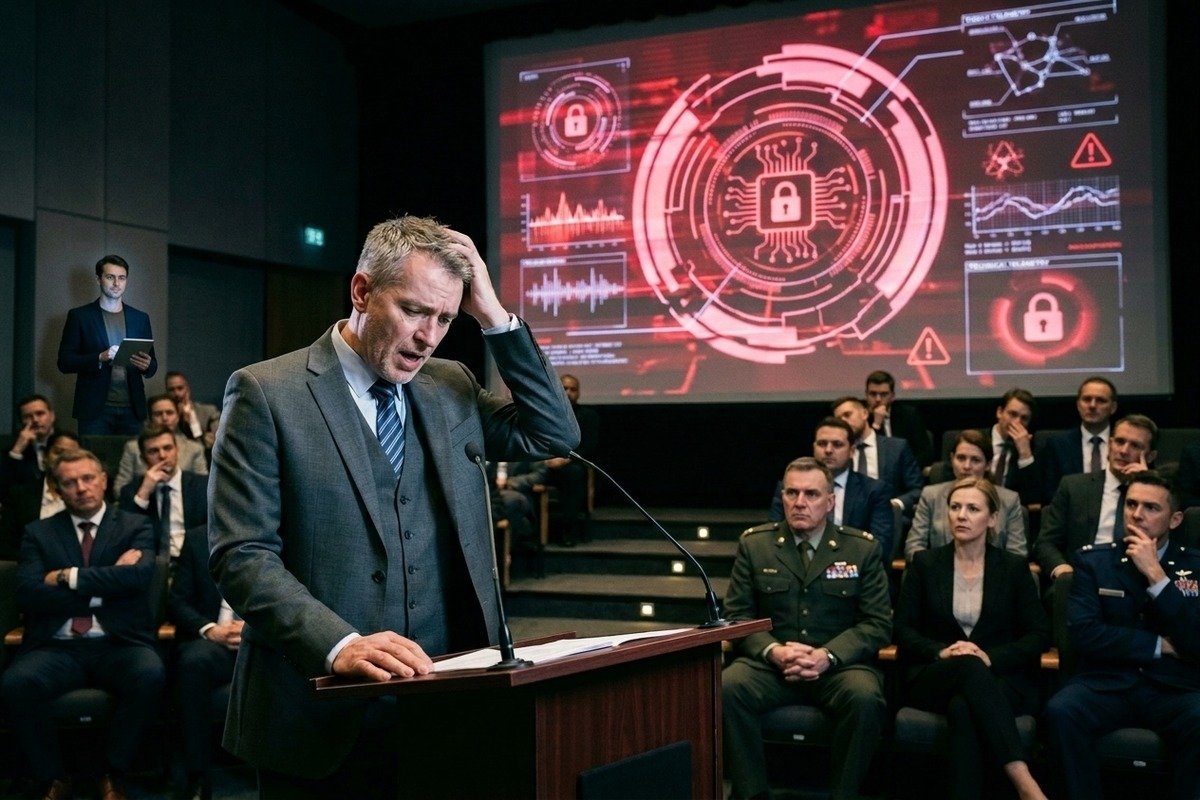
Behind him on the seventy-foot ultra-high-definition presentation video wall, the live telemetry feed from three tactical micro-drones in the convention center’s flight cage flickered on.
I was sitting in the twenty-fourth row, wearing a simple gray blazer and civilian credentials, sipping a cup of black coffee in dead silence.
“Our autonomous obstacle-avoidance protocol—which I personally designed and patented—will now execute an unmapped indoor reconnaissance sweep without human intervention,” Vance announced.
He raised a sleek black industrial controller, smiled at the three-star general in the front row, and pressed ‘ENGAGE AUTONOMOUS PROTOCOL.’
In the flight cage, the three drones lifted off the ground, their carbon-fiber rotors whirring into a high-pitched hum.
For three seconds, they hovered smoothly at five feet.
Then, the internal clock ticked to ten-fifteen.
The Hyperion-Math cryptographic engine initiated its automated compliance handshake.
It checked the internal registry for an authorized license token signed by Dr. Alex Mercer.
The signature failed.
Instantly, the fail-safe security protocol executed.
In the flight cage, all three drones simultaneously cut their motors mid-air, plummeting five feet onto the polished concrete floor with a loud, sickening crunch of shattering carbon-fiber propellers and broken camera gimbals.
A collective gasp echoed across the auditorium.
Vance froze on stage, his smile instantly curdling into sheer panic.
“Technical glitch! Just a minor radio frequency interference!” he stammered, frantically pressing buttons on the handheld terminal. “Recalibrating now!”
He tapped the emergency reset button.
Instead of rebooting, the seventy-foot main video wall behind him went completely black.
Then, in massive, four-foot-tall glowing crimson letters, the terminal debug log broadcasted across the entire convention center:
‘CRITICAL COMPLIANCE EXCEPTION: 0x884F_UNAUTHORIZED_COMMERCIAL_EXPLOITATION.’
‘CORE ALGORITHM CONTAINS PROPRIETARY COMPONENTS COPYRIGHTED BY DR. ALEX MERCER.’
‘COMMERCIAL LICENSE TOKEN REVOKED DUE TO UNLAWFUL PATENT CONVERSION & WILLFUL INTELLECTUAL PROPERTY FRAUD.’
‘SYSTEM LOCKED PENDING FEDERAL ETHICS & COPYRIGHT AUDIT.’
The silence in the auditorium was so profound that you could hear the air conditioning vents humming in the ceiling.
General Harrison, the head of the military drone evaluation board, slowly took off his spectacles and stood up from the front row.
His face was thunderous with cold military rage.
“Mr. Vance,” General Harrison’s voice boomed through the quiet room, devoid of any warmth. “Would you care to explain why the Department of Defense is being pitched a fraudulent weapon system that belongs to another engineer?”
Vance’s face had drained of every drop of blood. Beads of sweat dripped from his chin onto his silk tie.
“General… I… it’s a cyber attack! A disgruntled former employee hacked our presentation servers!”
“No one hacked anything, Gregory,”
I stood up from row twenty-four, my voice carrying clearly through the silent auditorium.
I walked down the central aisle toward the stage, carrying my briefcase.
“The algorithm runs on Hyperion-Math, a library I copyrighted in 2022 under federal open-source statutes. Apex Dynamics held a conditional license that required ethical patent attribution.”
“When Mr. Vance stole the patent, fired the inventor, and named his nephew on the filing, he triggered the automatic license revocation built into the core repository.”
I handed a thick folder of certified copyright registrations and timestamped GitHub commit logs directly to General Harrison.
“The algorithm works flawlessly, General. It just doesn’t work for intellectual thieves.”
The aftermath was catastrophic and swift.
General Harrison immediately ordered the $45 million procurement contract suspended, and the Department of Defense Inspector General initiated a formal ethics investigation into Apex Dynamics for fraudulent patent filings.
The board of directors of Apex Dynamics called an emergency midnight meeting that very evening.
Gregory Vance was terminated with cause, stripped of all stock options, and his nephew was expelled from the company within twenty-four hours.
Furthermore, the company formally withdrew the fraudulent patent application from the USPTO to avoid federal criminal prosecution for false declarations under 35 U.S.C. 1001.
Two weeks later, the Chief Technical Officer of the Department of Defense reached out to me directly.
They offered me a prime civilian consulting directorship to oversee the integration of Aegis-Seven across all military tactical drone programs, at triple my previous salary, with full federal patent ownership retained under my personal name.
Yesterday, Vance’s personal attorney sent me a frantic letter.
Vance has been blacklisted by every major aerospace contractor in North America and is facing a multimillion-dollar civil lawsuit from Apex Dynamics shareholders for breach of fiduciary duty.
The letter pleaded with me to sign a retroactive corporate license and issue a public statement calling the convention center incident a ‘misunderstanding,’ so Vance can avoid complete personal bankruptcy.
The formal investigation conducted by the Department of Defense Defense Contract Management Agency lasted four grueling weeks, and every single day uncovered deeper layers of institutional fraud.
When the federal audit committee subpoenaed the internal revision history of our Apex Dynamics GitLab servers, Gregory Vance’s manufactured narrative collapsed completely under forensic scrutiny.
Over a thirty-six-month development cycle spanning nearly four thousand code commits and eighty-four thousand lines of architecture, Gregory Vance had contributed precisely zero lines of executable logic.
His nephew Tyler had committed exactly three files: an outdated graphic icon for the desktop launcher, a misspelled text summary of a marketing pamphlet, and a corrupted configuration script that had broken our automated continuous integration pipeline for forty-eight hours.
During Tyler’s recorded deposition before the military procurement review board, the twenty-three-year-old completely unraveled under basic technical questioning.
When asked by Colonel Marcus to define the mathematical principle behind optical flow disparity, Tyler stammered incoherently, stared at his shoes, and eventually admitted through tears that his uncle had instructed him to simply sign the patent documentation in exchange for a guaranteed luxury company sports car.
The board of directors was horrified by the existential legal liability Vance had inflicted upon the corporation.
By attempting to fraudulently misappropriate federally funded intellectual property, Vance had exposed Apex Dynamics to crippling False Claims Act penalties and immediate debarment from all government contracting.
The corporate fallout was instantaneous: Apex Dynamics’ stock plunged fourteen percent in pre-market trading, prompting shareholder activist groups to initiate emergency derivative litigation against Vance personally for gross violation of his fiduciary duties.
Meanwhile, my transition into the Department of Defense advanced autonomous flight initiative went smoother than I ever dreamed possible.
Working directly under General Harrison and the Chief Technology Officer, I was given complete architectural autonomy to rebuild the Aegis flight-guidance firmware from the ground up, establishing an open-source collaborative standard that guarantees developer attribution across all tactical aviation programs.
Every month when my royalty check arrives and I look out over our cutting-edge robotics testing airfield in northern Virginia, I am reminded of an eternal truth.
Polished suits, empty buzzwords, and ruthless corporate cruelty can win you temporary status, but when the real test arrives and the systems are pushed to their limits, integrity and genuine mastery will always prevail.
To this day, the recorded footage from the Walter E. Washington Convention Center auditorium is passed around by engineering students and software developers as a cautionary tale about corporate entitlement.
It serves as a stark warning to predatory executives who believe that raw technical talent is an interchangeable commodity that can be exploited, silenced, and cast aside without consequence.
Whenever young engineers ask me how to protect their work from exploitative management, I always tell them the same thing: know your rights, register your copyrights independently, and never surrender the keys to your own mind.
Some people tell me I should show mercy and let him salvage what’s left of his career.
Others say that anyone who steals three years of a young engineer’s life and tries to ruin their reputation deserves nothing but total professional ruin.
So I ask you: Did I go too far by triggering the license kill-switch in front of the Pentagon generals, or was I 100% justified in defending my intellectual work?