For twenty-two months, our household lived under what my husband, Derek, grimly described as ‘wartime financial austerity.’
Every grocery receipt was scrutinized under the harsh kitchen light like an IRS audit.
If I spent four dollars on a punnet of fresh strawberries for our daughters, Lily and Maya, Derek would pinch the bridge of his nose, let out a trembling sigh, and stare at the kitchen wall as if I had driven our family to the brink of financial insolvency.
“We are on the razor’s edge, Clara,” he would whisper, his voice tight with manufactured exhaustion.
“The commercial HVAC sector is completely frozen. Interest rates are up sixty percent, our supply lines are backed up ninety days, and my business line of credit is maxed out.”
“If we don’t cut every discretionary expense to zero, the bank is going to foreclose on everything we own.”
I believed every word he said.
I was thirty-four years old, working thirty-two hours a week as a pediatric dental hygienist, and I loved my husband with the kind of blind, unconditional loyalty that makes you excuse every red flag.
When Derek insisted fourteen months ago that we had to sell our suburban three-bedroom colonial—the home we had brought both our girls home to from the maternity ward—I cried for three days in the pantry.
Derek held my hands and promised that selling the house was a temporary tactical retreat.
“We liquidate our equity, pay off the commercial vendor debt, and rent for eighteen months until the market stabilizes,” he assured me.
“I promise you, Clara, by next summer we’ll buy a place with a real backyard again.”
We walked away from the closing table with three hundred and twenty thousand dollars in net equity.
Within forty-eight hours, Derek announced that every penny had to be wired directly into his firm’s corporate capital escrow account to prevent commercial bankruptcy.
He signed a one-year lease on a cramped, eighty-year-old two-bedroom rental apartment situated above a light-industrial auto-repair garage on the edge of the city.
The walls smelled perpetually of stale motor oil and damp insulation. In the girls’ bedroom, black mold crept along the baseboards behind their secondhand bunk beds no matter how many times I scrubbed them with bleach.
I canceled my dental continuing education courses, stopped buying new clothes, and learned to stretch five pounds of ground beef across seven days of dinners.
Meanwhile, Derek’s business ‘stress’ kept him away from home more and more.
He claimed he was working eighty-hour weeks traveling between regional client facilities in Atlanta, Tampa, and Miami, trying to drum up commercial contract renewals.
Whenever he came home, he wore rumpled shirts, complained about his back, and reminded me that every extra dollar had to go toward business survival.
Last Tuesday morning at ten o’clock, Derek was away on another four-day ’emergency client procurement trip’ in southern Florida.
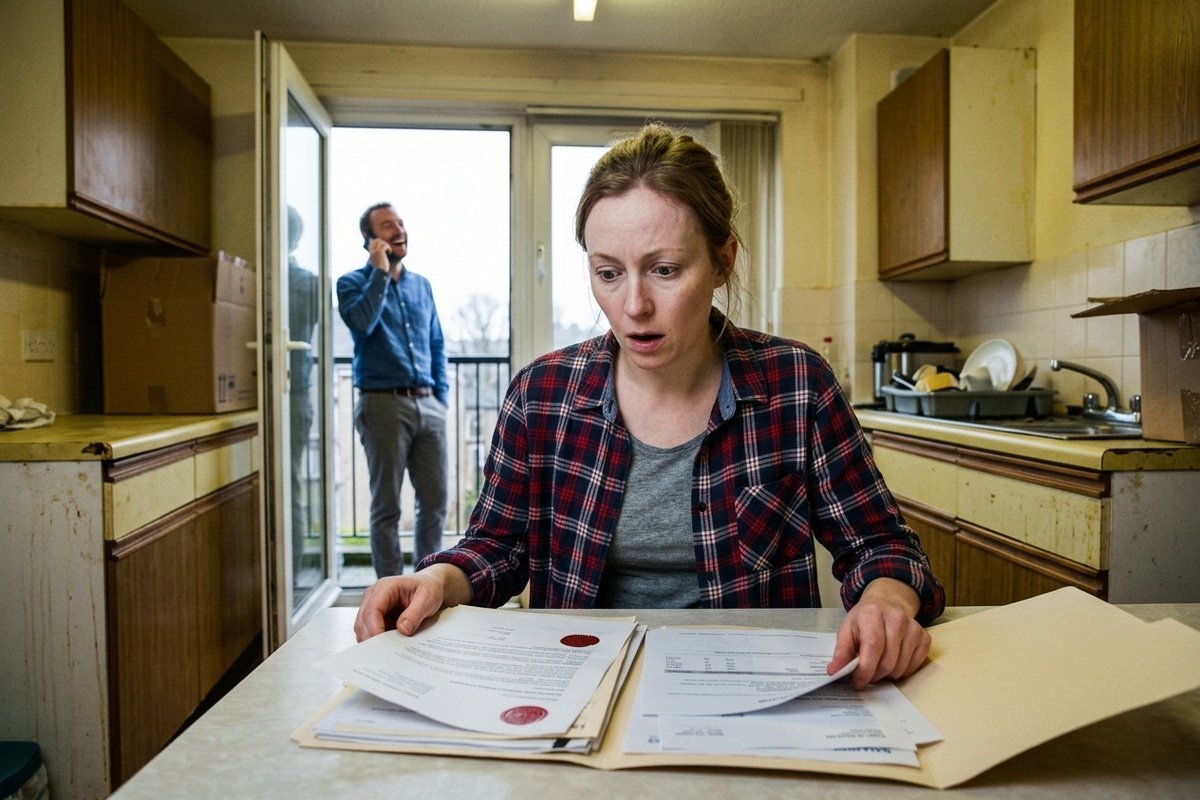
I was sitting at our small faux-wood laminate kitchen table in my gray dental scrubs, feeding six-year-old Maya oatmeal before school, when a loud, double knock rattled the aluminum screen door.
Standing on the cracked concrete porch was a uniformed United States Postal Service courier holding a registered priority delivery clipboard.
“Certified registered mail for Vanguard Asset Management LLC, attention Derek Lawson,” the mail carrier said.
“I’m his wife, Clara Lawson,” I replied, wiping my hands on a dish towel. “He’s out of state until Friday on business.”
The carrier checked his digital scanner. “As long as you’re a resident adult family member at this address and can show government photo identification, you can sign on behalf of the registered entity.”
I showed my driver’s license, signed the digital pad, and took the heavy, rigid cardboard envelope.
In the upper left corner was an embossed gold foil crest from Meridian Private Trust & Wealth Management, a high-net-worth boutique banking institution based in Delaware.
Across the center was a bold red printed notice: ‘CONFIDENTIAL ANNUAL FIDUCIARY COMPLIANCE AUDIT & TAX EXEMPT BOND PORTFOLIO CERTIFICATION.’
I stood frozen in the narrow hallway.
In our seven years of marriage, Derek had never mentioned a company named Vanguard Asset Management LLC.
His heating and cooling business was registered as Lawson Climate Solutions. Why would a Delaware private wealth management trust be mailing confidential asset portfolios to our moldy rental address?
With trembling fingers, I slid a butter knife under the cardboard seal and pulled out a thirty-page comb-bound financial dossier.
As I flipped to the summary statement, my knees gave out completely. I collapsed onto the kitchen chair, staring at the numbers in stunned, disbelieving horror.
The document was a certified year-end accounting statement for Vanguard Asset Management LLC, established exactly sixteen months ago—two weeks before Derek had convinced me to put our family colonial on the market.
The sole managing member, registered owner, and 100% equity holder was Derek Lawson.
And the portfolio balance listed at the bottom of the ledger was not zero.
Under ‘Tax-Exempt Municipal & Commercial Infrastructure Bonds,’ the balance was $480,000.
Under ‘Liquid High-Yield Money Market Reserve,’ the balance was $142,350.
Total asset valuation: $622,350.
Beneath the summary was an itemized cash-flow disbursement log showing that Derek’s private LLC had been quietly generating $2,850 every single month in tax-free dividend interest.
Every month, that money was automatically swept into a private personal checking account at a branch in Brickell, Miami.
The date of the initial deposit into Vanguard LLC was August 14th of last year—the exact day our home equity funds had supposedly been wired to ‘prevent commercial bankruptcy.’
He hadn’t saved his business. He hadn’t paid vendor debts.
Derek had systematically stripped our family of our home, siphoned our life savings into a hidden corporate shell, and moved our daughters into a mold-infested hovel while he sat on nearly two-thirds of a million dollars in liquid wealth.
Hot tears of rage and betrayal stung my eyes as my gaze wandered to the bottom of page four.
Attached to the portfolio audit was a copy of an operating agreement amendment drafted by a corporate divorce attorney in Miami.
In the notes section was a typed memorandum: ‘Structure entity to maintain separate non-marital character prior to anticipated formal dissolution proceedings in Q4.’
He wasn’t planning on buying us a house next summer.
Derek was running the clock out on our one-year apartment lease, keeping me impoverished and dependent, so that when he served me with divorce papers, he could claim zero marital assets, pay minimum statutory child support, and walk away with six hundred thousand dollars clean.
I didn’t call Derek. I didn’t send a screaming text message. My hands stopped shaking, replaced by an icy, analytical clarity.
I took the dossier directly to my uncle, Richard Cole, who had retired as a senior fraud investigator for the state department of revenue.
Richard looked over the documents for forty minutes in his study, his expression darkening with every page.
“This isn’t just marital concealment, Clara,” Richard said, taking off his reading glasses. “This is premeditated fraudulent conveyance of marital real estate equity.”
Within two hours, Richard had me in the office of Sarah Davenport, the most ruthless forensic family law litigator in the county.
By Wednesday afternoon, Sarah had filed an emergency ex-parte motion before Superior Court Judge Patricia Sterling.
Attached to the motion were the certified Meridian Trust statements, our marital closing documents, and an expedited petition for emergency asset sequestration.
At nine o’clock on Thursday morning, Judge Sterling signed an emergency freezing order locking every commercial account, bond portfolio, and wire routing tied to Vanguard Asset Management LLC and Derek Lawson’s Social Security number.
On Friday evening at seven-thirty, the front door of our rental apartment clicked open.
Derek walked into the kitchen wearing a fresh linen shirt, carrying an expensive leather weekend duffel bag and a box of cheap bakery donuts.
He looked sun-tanned, relaxed, and remarkably rested for a man supposedly drowning in eighty-hour workweeks.
“Hey, babe!” he called out casually, setting the donuts on the counter. “Miami was brutal. Meetings went until midnight every day. You wouldn’t believe the commercial rates they’re quoting.”
He looked at the empty stove. “Didn’t you start dinner yet? I’m starving.”
I was sitting at the laminate kitchen table, wearing my work scrubs.
In front of me was a neat manila folder.
“Dinner is going to have to wait, Derek,” I said, my voice dead calm.
Derek frowned, crossing his arms. “Clara, don’t start with an attitude. I’ve been breaking my back in Florida trying to keep a roof over our heads.”
“Is that where you were?” I asked softly. “Breaking your back? Or checking on your Brickell checking account?”
Derek’s eyes narrowed slightly, but his confidence didn’t crack. “What are you talking about?”
I slid the thirty-page Meridian Trust audit dossier across the table, along with the signed court freezing order stamped in bright red ink.
Derek glanced at the gold seal on the cover.
In a fraction of a second, the color drained completely from his face, leaving his Miami tan looking like yellow parchment.
His hands flew to his chest. He reached down and opened the folder with trembling fingers.
“Where… where did you get this?” he whispered, his voice cracking into a dry wheeze.
“You opened my business mail?! That is a federal crime, Clara! You had no right to open that envelope!”
“I signed for certified registered mail delivered to my legal residence on behalf of a household entity,” I replied, looking right into his panicked eyes.
“Six hundred and twenty-two thousand dollars, Derek.”
“While Lily and Maya slept in a room with black mold on the baseboards. While I skipped dental seminars and ate canned beans so we wouldn’t ‘go bankrupt.’”
“You sold our home, hid the equity in a Delaware shell company, and paid a Miami divorce lawyer to structure an exit strategy so you wouldn’t have to support your own daughters.”
Derek dropped into the wooden chair opposite me. The smug, controlling husband had vanished, replaced by a trembling, terrified fraudster.
“Clara, listen to me… it’s not what you think,” he pleaded, reaching across the table to grab my hand.
I yanked my hand back with disgust.
“I was protecting the family!” he stammered, tears of panic finally welling in his eyes. “If my HVAC company went into commercial receivership, the creditors could have seized our home equity!”
“I put it into bonds to shield it from litigation! I was going to bring it all back into our joint account as soon as the market settled!”
“Then why does your operating agreement amendment specify ‘separate non-marital character for upcoming dissolution proceedings’?” I asked.
Derek opened his mouth, but no sound came out.
“Judge Sterling signed an emergency freezing injunction yesterday morning,” I informed him calmly.
“Every dollar in Vanguard Asset Management is locked under judicial sequestration. Your business accounts are subject to an independent forensic audit.”
“And Detective Hayes from the county financial crimes unit has already scheduled an interview regarding fraudulent conveyance of homestead real estate.”
Derek clutched his head in his hands, rocking back and forth against the laminate table.
“You’re destroying my business, Clara! If my partners find out about this, they’ll force me out of the firm! We’ll lose everything!”
“You already lost everything, Derek,” I said, standing up.
“You lost your home, you lost your wife, and you lost your right to be respected by your daughters.”
“You have two hours to pack your clothes and leave this apartment.”
“The sheriff’s department has already served your temporary restraining order, and our formal custody hearing is on Tuesday morning.”
Derek stood in the doorway of the apartment for nearly ten minutes, alternating between weeping apologies and furious threats, but I never said another word.
At nine-thirty, he loaded his duffel bag into his SUV and drove away down the industrial park access road.
It has been eight weeks since that evening.
Under Judge Sterling’s temporary orders, Derek was ordered to pay maximum temporary child support, cover the entirety of our daughters’ medical and educational expenses, and pay ten thousand dollars toward my forensic accounting fees.
Last week, my girls and I moved out of that moldy apartment forever.
We are now settled into a clean, sunlit three-bedroom townhouse with hardwood floors, a small flower garden, and zero mold.
Derek’s partners at the HVAC firm discovered that he had also used company lines of credit to fund personal travel expenses, and they have formally initiated a partnership buyout to remove him from the firm.
Yesterday, Derek’s mother called me, weeping on the phone.
She begged me to withdraw my report to the state department of revenue, claiming that if Derek loses his professional contractor’s license over corporate tax evasion, he will never be able to earn enough to support the girls in the future.
She asked if I could settle for half the bond equity in mediation and keep the state investigators out of it.
So I ask you: Did I go too far by reporting his shell company to state investigators, or was I 100% justified in holding him accountable for financial fraud?
My uncle Richard spent the entire weekend combing through Derek’s Delaware filings, uncovering three additional corporate bank accounts opened under fictitious business names.
Every single account told the exact same story: deliberate, methodical diversion of marital funds directly into high-yield commercial paper while our joint household account was artificially kept at four hundred dollars.
He even found an uncashed dividend check for three thousand dollars tucked inside the secret folder that Derek had forgotten to deposit before his trip.
When Sarah Davenport presented the full audit trail to Judge Sterling in chambers, the judge did not hesitate for a single second.
“In twenty years on the family bench, I have rarely seen such calculated, malicious concealment of basic marital assets,” Judge Sterling noted for the formal record.
“The respondent’s attempt to impoverish his own minor children while shielding liquid bond portfolios will be penalized to the fullest extent permitted by state law.”
Yesterday morning, I took Lily and Maya to their new school bus stop at the corner of our tree-lined street.
For the first time in two years, Lily looked up at me with a carefree smile, holding a fresh strawberry juice box in her small hands.
Watching them laugh as they climbed the yellow bus steps reminded me that the painful battle for financial truth was worth every single sleepless night.
Real security does not come from appeasing someone who sees you as a liability; it comes from having the strength to demand what is rightfully yours.
The dental practice where I work offered me a promotion to lead hygienist supervisor this past week, complete with health insurance coverage and an education reimbursement stipend that will allow me to finish my specialized orthodontic certifications.
Looking out the large bay window of our new living room as the autumn dusk settles over the yard, I feel an overwhelming sense of calm that I haven’t known in years.
My daughters are thriving, our refrigerator is full of fresh fruit, and no one will ever again make us feel guilty for simply living with dignity.