For six months leading up to our wedding, my garage workshop smelled of dried black walnut, lemon oil, and linseed resin.
Every evening after leaving my job at an architectural design consultancy, I put on my leather apron, clamped on my dust mask, and planed down four solid eight-foot planks of kiln-dried timber.
Those planks were not ordinary lumber ordered from a commercial commercial depot.
They had been milled twenty years ago from a fallen black walnut tree on my late grandfather’s farm in Virginia, the very land where my parents had exchanged their vows before they were taken from me in a highway collision during my sophomore year of college.
Building that wedding arbor with my own hands was my way of bringing my parents into the ceremony, of having their presence frame the exact spot where Julian and I would begin our marriage.
Julian understood that completely.
He spent countless Saturday mornings holding the opposite ends of heavy crossbeams, sanding dowel joints until his fingers were stained dark brown, and cheering me on as the geometric arch finally took shape.
It was clean, minimalist, and breathtaking: two interlocking octagonal frames that symbolized shelter, endurance, and quiet devotion.
His mother, Evelyn, despised it from the moment she first saw a conceptual sketch on our kitchen table.
Evelyn was fifty-six, wealthy from her second husband’s commercial logistics enterprise, and fiercely obsessed with the conservative social hierarchy of her suburban parish council.
To Evelyn, a wedding was not an intimate personal covenant between two individuals; it was a public theater performance designed to display her piety, wealth, and maternal authority to three hundred regional dignitaries.
“A wooden frame, Maya?” she had remarked back in April, peering through her gold-rimmed bifocals while turning the drawing over as if looking for the rest of it.
“It looks like a livestock pen from an organic dairy farm. People expect marble, bronze candelabras, and consecrated iconography. My family has been married under St. Jude’s altar canopy for three generations.”
“Julian and I aren’t having a church ceremony, Evelyn,” I replied gently, keeping my tone respectful. “We chose the botanical conservatory because of the natural light and the garden setting.”
“And the walnut arch holds deep sentimental significance for my family.”
Evelyn let out a theatrical sigh, patted Julian’s arm, and murmured, “Well, darling, I just hope your guests don’t think we couldn’t afford proper ecclesiastical decor.”
Over the following months, Evelyn attempted to undermine nearly every aesthetic decision we made.
She called the florist behind my back to demand white lilies instead of the wildflowers we selected.
She badgered the caterer to substitute an artisanal farm-to-table dinner with a formal plated prime rib service.
Each time, Julian and I held a united front, politely but firmly reversing her unauthorized changes and reminding her that we were funding the entire wedding ourselves.
The Friday before the ceremony, our rehearsal went off without a hitch.
The venue was a stunning 1920s steel-and-glass greenhouse conservatory surrounded by reflecting pools and heirloom rose gardens.
Julian and my brother-in-law carefully transported the walnut arbor in a padded flatbed trailer, secured it to the polished terrazzo floor with discreet brass anchoring brackets, and stepped back to admire it.
In the late afternoon sun filtering through the ribbed glass ceiling, the dark wood glowed with a warm, rich amber luster.
Even the venue director, Hannah Vance, stopped in her tracks and clasped her hands together.
“Maya, this is the most exquisite handcrafted focal piece we’ve ever had in this pavilion,” Hannah said warmly.
“We’ll lock the conservatory doors at eight tonight. The security sensors will remain active until six tomorrow morning when the florist team arrives.”
Evelyn, who was standing near the entrance sipping bottled sparkling water, stared at the arch in stony silence.
She didn’t compliment it. She didn’t say goodbye. She simply gathered her designer cardigan and walked out into the twilight.
The morning of the wedding arrived with clear blue skies and crisp autumn air.
I arrived at the conservatory at eight-thirty with my bridal party, carrying our dress bags and makeup cases, my heart fluttering with nervous joy.
As we pushed open the heavy brass double doors of the main greenhouse hall, the air smelled suddenly different—heavy with burning frankincense and damp church velvet.
I looked down the central floral aisle toward the altar platform, and my breath caught in my throat.
My walnut arbor was gone.
In its place stood an enormous, heavy, gilded baroque church reredos—a twelve-foot-tall wooden altarpiece encrusted with tarnished gold leaf, heavy red velvet draping, and two towering brass candelabras holding unlit beeswax tapers.
It looked like a set piece dragged out of a medieval European cathedral, completely suffocating the airy glass pavilion.
“What… what is this?” I stammered, dropping my garment bag onto a wooden bench.
From behind the towering gold screen stepped Evelyn.
She was already fully coiffed in a pastel lavender silk dress, wearing a three-strand pearl choker and carrying a leather-bound prayer book.
She smiled at me with triumphant serenity, clasping her hands over her waist.
“Good morning, Maya darling! Don’t look so bewildered. Consider it my ultimate wedding gift to you and Julian.”
“Where is my arbor, Evelyn?” I demanded, my voice shaking with rising adrenaline.
“Where is the walnut arch I built for my parents?”
Evelyn waved her hand dismissively, her smile turning pitying.
“The venue staff called me late last night, darling. Apparently, the dowels on that wooden contraption were unstable. The city fire marshal did an inspection and declared it an uncertified structural hazard.”
“They said it couldn’t remain on the platform without voiding the facility insurance.”
“So the night maintenance crew took it out to the disposal dumpster behind the composting sheds.”
The room spun. Blood roared in my ears. “They threw it in the trash?!”
“Now, don’t be hysterical on your wedding day, Maya,” Evelyn said, her voice dropping into a patronizing coo.
“I anticipated that your amateur project wouldn’t meet commercial code. So I called Monsignor Gallagher at the diocese at midnight, chartered a private flatbed transport, and secured St. Michael’s original 1890 chapel reredos.”
“Our guests will now witness a ceremony of true dignity and consecrated grace. You should be thanking me instead of glaring at me.”
My maid of honor, Chloe, rushed toward the kitchen to find Julian, while my bridesmaids stood frozen in collective horror.
Within three minutes, Julian sprinted through the conservatory doors in his dress shirt and suit trousers, his face flushed and furious.
“Mom, what did you do?!” Julian shouted, his voice echoing off the glass vaulted ceiling.
“Where is Maya’s arch?!”
“Julian, lower your voice in the presence of consecrated altar furnishings!” Evelyn scolded, crossing her arms defensively.
“I saved your wedding from looking like a third-rate barn dance! The venue condemned her wooden frame! It was a fire hazard!”
“That is an absolute lie, Mrs. Mercer.”
The sharp, authoritative voice cut through the pavilion.
Walking briskly down the central aisle came Hannah, the venue director, accompanied by two uniformed private security officers.
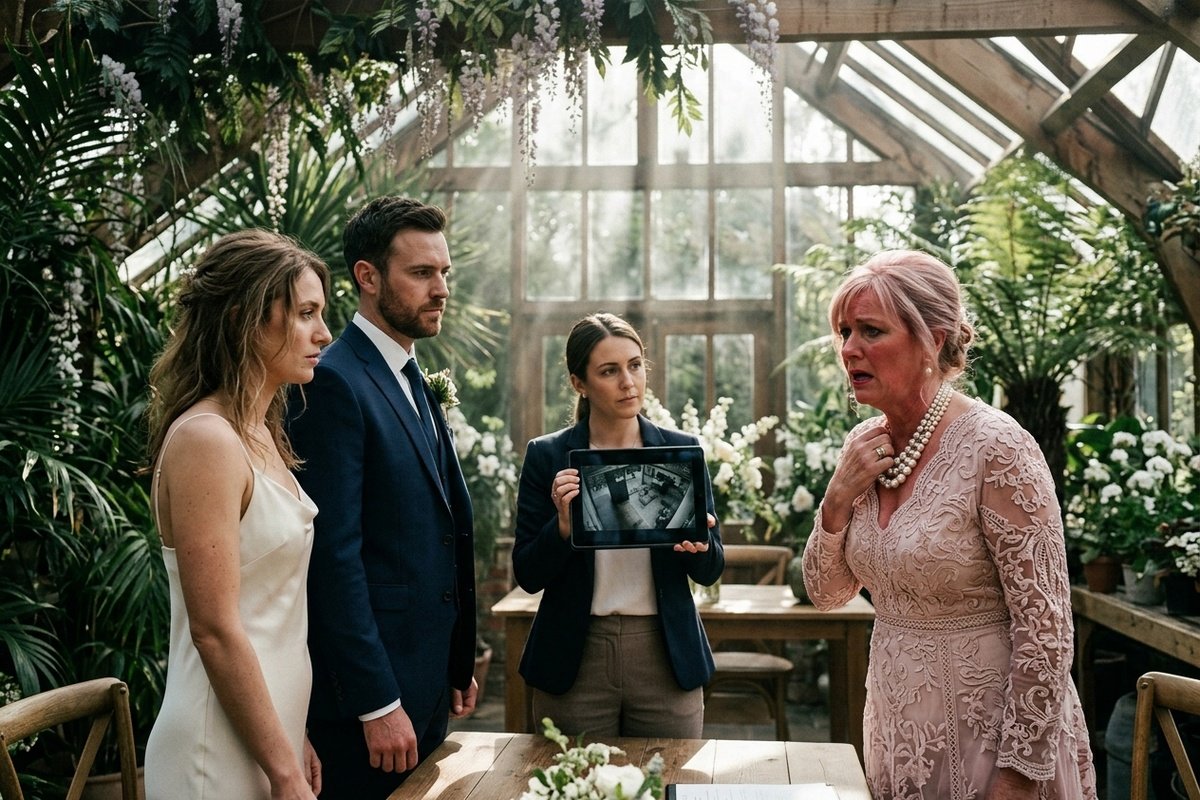
In Hannah’s hands was an iPad Pro, its screen illuminated with the timestamped dashboard of the facility’s high-definition surveillance network.
“I am the sole authorized facility director for this conservatory,” Hannah said, stopping three feet from Evelyn.
“No city inspector was called. No staff member contacted you. And our safety certification for Maya’s walnut arbor was formally approved and signed at four o’clock yesterday afternoon.”
Evelyn stiffened, her regal poise beginning to fray around the edges.
“Well… someone called me claiming to be from management! I was merely acting in good faith!”
“You weren’t acting in good faith, Mrs. Mercer,” Hannah said calmly, turning the iPad screen toward Julian, me, and the entire bridal party.
“At four-fifteen this morning, our perimeter motion cameras triggered along the south delivery dock.”
Hannah pressed play.
The 4K camera footage was crystal clear in the morning light.
On screen was Evelyn’s silver Mercedes SUV, followed by a twenty-foot commercial U-Haul rental truck.
Evelyn stepped out of her vehicle in dark slacks and a trench coat. She met two men in work jumpsuits near the security gate.
The camera angle captured her opening an envelope, counting out several thick stacks of hundred-dollar bills, and handing them to the driver.
Then, using a master gate access card that she had swiped from the florist’s clipboard during rehearsal, Evelyn unlocked the delivery bay doors.
The footage showed the two men using cordless drills to unscrew Maya’s brass floor anchors, lifting the walnut arbor with deliberate care, wrapping it in heavy moving blankets, and sliding it into the back of the U-Haul truck.
Then, the men unloaded the massive gilded church screen and hauled it into the conservatory.
The video ended with Evelyn standing by the open U-Haul, watching the truck drive away down the service road toward the highway.
Silence descended upon the conservatory so absolute you could hear the water dripping from the hanging orchid baskets.
Evelyn stared at the tablet, her face transforming from aristocratic superiority into sickly, pale panic.
Her jaw twitched. Her hand flew to her throat, clutching her pearls.
“That… that footage doesn’t prove anything! I was having it moved to climate-controlled storage so it wouldn’t get scratched by the caterers!”
“You told my bride that the venue threw her parents’ memorial into a trash incinerator, Mom,” Julian said, his voice dropping into a terrifying, deadly calm.
He stepped directly in front of her, looking at his mother as if seeing her true face for the very first time in his life.
“Where is the U-Haul, Evelyn?” Julian whispered.
Hannah stepped forward. “Detective Kowalski from the county sheriff’s department is already parked behind the rental vehicle at the public rest stop three miles west.”
“The driver confessed immediately upon being questioned. The truck is currently being escorted back to our loading dock right now with the walnut arbor completely intact.”
A collective gasp of relief broke from my bridesmaids. Tears spilled over my eyelashes as Chloe hugged my shoulders.
Julian didn’t hug anyone. He stood motionless, his eyes locked on his mother.
Slowly, deliberately, Julian reached down to his wrists. He unfastened the antique gold-and-sapphire cufflinks that Evelyn’s father had passed down to him on his eighteenth birthday.
He took Evelyn’s shaking hand, placed the cufflinks firmly into her palm, and closed her fingers over them.
“Julian… sweetheart, please…” Evelyn stammered, genuine tears of humiliation welling in her eyes.
“I only wanted you to have a holy, respectable marriage! I did it for your own reputation!”
“You did it for yourself, Mom,” Julian said, his voice cracking with heartbreak and unyielding resolve.
“You have spent thirty years treating everyone in your life like chess pieces on your personal social board.”
“You lied to my face. You desecrated my wife’s tribute to her deceased parents. And you committed criminal trespass on private property five hours before my ceremony.”
Julian turned to Hannah. “Can your security team supervise the removal of this church prop?”
“Already underway, Mr. Mercer,” Hannah replied, signaling her crew.
Four venue workers in work gloves immediately stepped forward with dollies, disconnecting Evelyn’s gilded reredos and wheeling it toward the loading dock.
Julian turned back to his mother.
“Here are your options, Evelyn,”
“You can walk out of this conservatory right now, get into your Mercedes, and drive home to your parish council.”
“Or you can sit in the very last row of the guest gallery, in dead silence, with a sheriff’s deputy standing beside your chair.”
“And if you ever speak to Maya with anything less than total humility, you will never see our future children.”
Evelyn looked around the room. Not a single person—not the caterers, not the bridesmaids, not her son, and not me—offered her a shred of sympathy.
Her facade collapsed completely.
She didn’t stay for the last row.
Clutching her prayer book and her returned cufflinks, she rushed out of the conservatory into the glaring morning sun, her heels clicking frantically against the flagstones.
At ten-fifteen, the U-Haul truck arrived at the delivery dock.
Julian, my brother-in-law, and two venue technicians carefully unloaded my walnut arbor.
Aside from a small scuff on the lower left crossbeam, it was completely unharmed.
We anchored it back onto the platform under the soaring glass roof, weaving fresh eucalyptus, white garden roses, and ivy through the geometric frame.
At two o’clock in the afternoon, the ceremony began.
As I walked down the aisle with my arm tucked into my brother’s, the autumn sunlight hit the walnut wood, illuminating the grain with the warmth of a hundred memories.
When I stood beneath that arch and looked into Julian’s tear-filled eyes, I didn’t see the shadow of Evelyn’s deceit.
I saw a man who had chosen our love, our truth, and our future over toxic family tradition.
We exchanged our vows without a microphone, our voices carrying clearly across the quiet garden pavilion.
It has been three weeks since the wedding.
The walnut arbor now stands permanently in the center of our backyard garden, framed by climbing wisteria.
Evelyn recently sent a certified letter through an attorney demanding that we reimburse her four thousand two hundred dollars for the emergency diocese rental fee and the U-Haul moving charges.
She claims that because Julian ‘threatened’ her with public humiliation, we are legally liable for her contractual out-of-pocket expenses.
Some of Julian’s older aunts have called, begging us to pay the bill and issue a private family apology so Thanksgiving won’t be ruined.
Julian wants to send her the security camera footage on a thumb drive along with a formal cease-and-desist order.
So I ask you: Would you pay a single dollar to keep the family peace, or would you let the legal consequences fall exactly where they belong?
My grandfather had built his own workshop behind the apple press when he returned from naval service in 1954, hand-forging his own drawknives and chisels from salvaged leaf springs.
He used to say that wood remembers every blow and every stroke of the plane, and if you treat the grain with patience, it will stand strong long after your own breath has left you.
Working with his vintage block planes on those Virginia walnut beams felt like holding an unbroken conversation across sixty years of family heritage.
When the diocese representative called Julian the following Tuesday, he was genuinely horrified to learn that Evelyn had chartered the chapel altarpiece under the pretense of an approved diocesan youth rally.
Father Thomas sent a formal letter of apology to our home, expressing deep regret that sacred chapel artifacts had been weaponized in a family dispute, and he personally waived the rental deposit that Evelyn had claimed we owed.
Meanwhile, Julian aunt Beatrice left three lengthy voicemails insisting that a mother pride was more important than sentimental scrap lumber, warning us that family estrangement is a curse that follows you into old age.
Julian listened to the voicemails once, archived them into our family legal file, and never replied.
Some bridges are burned not out of malice, but because the fire on the other side threatens to consume everything you have worked so hard to build.