On Tuesday evening in mid-October, I attended our annual Oakridge Neighborhood Association budget assembly in the community library basement.
For eighteen months, our historic preservation committee had raised forty-six thousand dollars to restore the century-old timber playground in Memorial Park.
Generations of neighborhood children had climbed the hand-hewn cedar towers, but weather and dry rot had forced the city parks division to yellow-tape the structure in June.
Our committee had hosted weekend pancake breakfasts, silent art auctions, and neighborhood fun runs, collecting donations from hundreds of local families.
Because the park was the beating heart of our historic district, rebuilding the playground with sustainable cedar was our neighborhood’s collective dream.
As committee chairman, I had coordinated every design drawing with certified timber architects, ensuring full compliance with municipal safety standards.
Donald Fletcher was the treasurer of our neighborhood association board, a retired corporate comptroller who lived in an opulent brick house on Hillcrest Ridge.
Donald frequently boasted about his fiscal conservatism, audited petty cash envelopes with pedantic zeal, and insisted on sole signatory authority over our capital improvement account.
Donald lived on a steep hillside property where seasonal rain erosion had caused his backyard terrace to tilt dangerously toward the road below.
For months, Donald had grumbled about the exorbitant sixty-thousand-dollar quotes he received from commercial masonry contractors to stabilize his private slope.
Before we launched our capital campaign, our historic preservation committee spent two months documenting the playground’s architecture.
We photographed every dovetail timber joint and hand-planed balustrade crafted by our town’s founding carpenters in nineteen twenty-two.
Generations of children had scraped their knees on those steps, carved their initials into the corner posts, and learned courage on the high swinging bridge.
My late grandfather had helped plant the sugar maples encircling the play field when the park was dedicated as a World War One memorial.
Because our historic park represented our community’s shared heritage, safeguarding the renovation funds was an absolute sacred trust.
I wanted to protect that legacy with complete financial transparency, so our committee published every single donor receipt in our monthly gazette.
We held monthly community dinners at the neighborhood hall, where young parents and retired teachers contributed whatever spare cash they could afford.
Local school children collected aluminum cans and held car washes, proudly handing our treasurer jars of nickels and dimes totaling hundreds of dollars.
Every dollar represented sacrificial trust from families who believed our neighborhood was worth investing in for the next century.
Donald Fletcher had served as board treasurer for nine years, cultivating a reputation as a meticulous gatekeeper who scrutinized every postage stamp.
He lived at the highest elevation in the neighborhood, where his two-story brick mansion looked down across the valley floor.
In private conversations, however, Donald frequently lamented that his property was unfairly exposed to seasonal hillside erosion.
He often complained that the association dues were insufficient to cover the infrastructure demands of the ridge properties.
Our board had repeatedly explained that private slope stabilization was the individual homeowner’s responsibility, not a community expense.
When Donald distributed the quarterly association financial packets at the meeting, I immediately flipped to the Memorial Park escrow line.
Instead of showing our forty-six thousand dollar balance, the audited capital reserve column showed a balance of exactly one thousand four hundred dollars.
“Donald, there must be a typographical error in section three,” I said, raising my hand from the third row. “The playground escrow account was forty-six thousand dollars last month.”
Donald adjusted his gold spectacles, offering a tight, condescending smile that did not reach his eyes.
“Mister Vance, our executive committee had to address an urgent structural contingency to mitigate municipal liability along the Hillcrest ridge corridor,” Donald declared smoothly.
I felt a wave of icy apprehension wash over me as I stepped forward to inspect the attached disbursement summary.
The itemized expenditure list revealed that Donald had authorized a forty-four-thousand-dollar electronic wire to Granite Ridge Geotechnical Contractors.
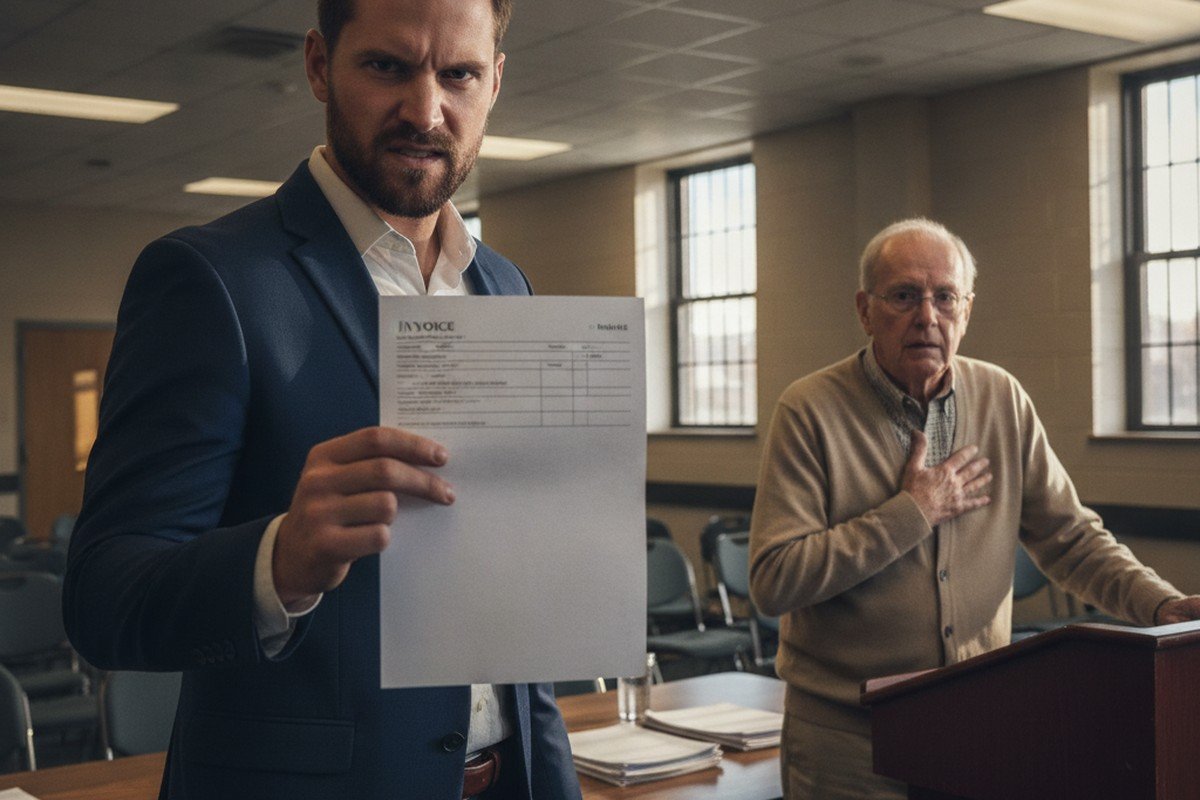
The project description on the invoice read: “Emergency retaining wall reinforcement and decorative stone drainage terrace at twelve forty-eight Hillcrest Ridge.”
Twelve forty-eight Hillcrest Ridge was Donald Fletcher’s private home address.
I looked at the document in stunned disbelief, holding the invoice up for the entire assembly to see.
Inside the library basement, I pulled up the state corporate registry and our neighborhood association banking portal on my laptop.
The online bank record showed that Donald had initiated the forty-four-thousand-dollar transfer as a single outbound wire on Monday morning.
The document confirmed that Donald had checked the emergency infrastructure waiver box, which bypassed the mandatory two-signature rule.
The paperwork proved that Granite Ridge Contractors had already billed thirty thousand dollars in heavy excavation and poured concrete.
The reason this embezzlement cut so deeply was that Donald had weaponized our trust to subsidize his personal real estate luxury.
I realized that Donald viewed our community’s sacrifice as nothing more than a private rainy-day fund for his backyard landscaping.
I reviewed the contractor invoice details, which listed imported cut flagstone, automated terrace lighting, and private weeping willow planters.
None of those line items had anything whatsoever to do with municipal stormwater mitigation or neighborhood association easements.
The document showed that Donald had signed the work order under the fraudulent title of executive project manager.
I printed the full bank audit trail and the contractor work contract, creating an undeniable twenty-page folder of criminal self-dealing.
Elena Rossi contacted the municipal parks director immediately, warning that our grant deadline was endangered by an internal misappropriation.
The parks director confirmed that the city would freeze the fifty-thousand-dollar matching funds by Friday at five o’clock if escrow remained deficient.
“Donald, you wired forty-four thousand dollars of our community playground fund to build a luxury stone retaining wall in your own private backyard!” I announced.
Gasps of outrage erupted across the library basement as dozens of neighbors jumped to their feet in furious protest.
Donald slammed his ledger shut, his face flushing crimson as he tried to shout down the gathering.
“That slope borders our association access easement! If my hillside collapsed, the neighborhood association would face millions in civil liability!” Donald shouted.
“Your private backyard terrace is not an association easement, Donald! You used our children’s playground money as your private construction loan!” Elena Rossi countered.
The reason this embezzlement was so devastating was that our municipal matching grant deadline was only five days away.
I believed that if the forty-four thousand dollars was not returned to escrow by Friday, the city would cancel our fifty-thousand-dollar matching funds forever.
I feared that decades of community trust would be shattered, leaving our neighborhood children without a safe place to play.
I wanted to protect the integrity of our neighborhood, so I refused to let Donald hide behind manufactured corporate jargon.
The next morning, I arrived at Donald’s hillside property with two licensed municipal surveyors and our neighborhood association vice president.
A fleet of heavy cement mixers and stone haulers was parked along Hillcrest Ridge, pouring reinforced concrete into an elaborate three-tiered retaining wall.
I handed the site foreman a copy of the city code enforcement stop-work petition and demanded to see Donald.
At Donald’s hillside property, the confrontation intensified as he attempted to order our committee members off the public road.
“Marcus, you and your committee are creating a public nuisance in front of my residence!” Donald yelled, waving his phone.
“Donald, you took forty-four thousand dollars of children’s playground money to build your patio!” I shouted back from the curb.
“We have the wire confirmations and the contractor invoices, Donald! The entire neighborhood knows what you did!” Elena shouted.
Instead of showing remorse, Donald claimed that stabilizing the ridge prevented catastrophic mudslides that would damage lower streets.
“I am protecting property values for the entire neighborhood, Marcus! You should be thanking me instead of harassing me!” Donald argued.
That was the moment the confrontation reached its climax, because Donald’s delusions of grandeur had completely erased his moral compass.
Then Donald admitted that his commercial property insurance company had denied his erosion claim two months earlier.
Hearing his admission revealed that he had stolen our community playground fund only after his private insurance refused to pay.
Worse still, another subcontractor on site admitted that Donald had promised them an additional ten thousand dollars upon completion.
Donald refused to surrender his treasurer keys, until the city building inspector pulled his marked vehicle up to the curb.
The inspector examined the massive concrete retaining wall and discovered that Donald had never pulled a municipal hillside grading permit.
The city building inspector declared the entire construction site an unpermitted structural hazard, ordering immediate work cessation.
Donald’s arrogant expression dissolved into sheer panic as he realized he was facing both criminal conversion charges and city code fines.
The reason our neighborhood committee stood so fiercely against Donald was because our children’s future cannot be bartered for private luxury.
I feared that if we allowed this theft to go unpunished, our residents would lose all faith in community cooperation and public service.
I wanted to protect the memory of the town founders and honor every family who donated their hard-earned dollars to the park.
Because our neighborhood believed that public trust is the sacred cornerstone of civic life, we thought of this stand as our moral duty.
We knew why Donald had acted with such reckless haste: he believed his status as a retired corporate executive placed him above the law.
I wanted to demonstrate that ordinary citizens standing together with undeniable documentation will always defeat corrupt entitlement.
By Thursday afternoon, our association legal counsel and the county prosecutor presented Donald’s attorney with a draft felony complaint.
Donald’s attorney advised him that a criminal trial would result in mandatory prison time for grand larceny and breach of fiduciary trust.
Donald signed an immediate restitution agreement, liquidating his private investment accounts to wire forty-four thousand dollars back into escrow.
He also surrendered his treasurer books, submitted his immediate resignation from the board, and paid all accrued association legal expenses.
On Friday morning at nine o’clock, our committee walked into the city parks department with the certified bank escrow certificate.
The parks commissioner approved our municipal matching grant on the spot, congratulating our neighborhood on its courageous defense of the park.
Donald walked out onto his new flagstone patio in a silk robe, holding a cup of espresso and scowling down at us.
“Marcus, you are trespassing on private property! Leave my driveway before I contact local law enforcement!” Donald ordered.
“Donald, call the police right now! We have the bank wire records, the city zoning application, and the municipal easement map!” I answered firmly.
Instead of showing shame, Donald insisted that his property value anchored the entire district’s tax base.
That was the moment the confrontation reached its breaking point, because Donald’s arrogance blinded him to the illegality of his theft.
Then Donald admitted that he had planned to repay the association over ten years through quiet installment transfers from annual dues.
Hearing his admission revealed that he had converted our public charity into an unauthorized, zero-interest personal line of credit.
The city building inspector arrived forty minutes later, reviewing Donald’s permit and discovering that he had filed the application under false association authority.
The inspector issued an immediate red-tag stop-work order and cited Donald for unpermitted commercial structural alterations on residential soil.
By Thursday afternoon, our neighborhood legal counsel filed an emergency petition for an ex-parte freezing order against Donald’s personal accounts.
Faced with criminal embezzlement charges and asset freezing, Donald broke down in his attorney’s office and agreed to a full settlement.
Donald transferred forty-four thousand dollars from his private retirement savings back into the Memorial Park playground escrow account in certified funds.
He also paid four thousand dollars in association legal fees and signed an irrevocable resignation from all community board positions.
On Friday morning, I hand-delivered the verified escrow certificate to the city parks commissioner, securing our fifty-thousand-dollar municipal matching grant.
Two months later, the timber construction crew began assembling the new cedar towers in Memorial Park, surrounded by cheering families.
Donald Fletcher put his hillside house up for sale and moved out of our historic district in quiet disgrace.
Now, every Saturday afternoon, the laughter of neighborhood children echoes across the cedar swings and climbing bridges, proving that community courage prevails over selfish greed.
Over the following weeks, our neighborhood association established a new three-officer digital signatory protocol for all escrow transactions.
The municipal building department required Donald to remediate his unpermitted hillside retaining wall entirely at his own expense.
Donald Fletcher sold his mansion on Hillcrest Ridge at a substantial loss and relocated out of state, unable to face his former neighbors.
In the spring, certified timber artisans arrived in Memorial Park to begin erecting the magnificent century-cedar playground structure.
Hundreds of neighbors gathered for our ribbon-cutting celebration in May, watching children race across the high wooden towers with boundless joy.
A bronze plaque was mounted at the playground entrance honoring the unity, courage, and vigilance of the Oakridge neighborhood families.
Now, every autumn afternoon, as golden maple leaves drift across the cedar swings, the park remains an enduring sanctuary of community honor.
Elena Rossi was elected our new association treasurer, managing our civic accounts with open ledger books and complete public transparency.
Young families continue to move into Oakridge, drawn by the vibrant spirit of a community that knows how to protect what it loves.
Our volunteer maintenance team meets on the first Saturday of every month to oil the cedar handrails and plant seasonal flowering bulbs around the park perimeter.
When older residents sit on the memorial benches under the maples, they tell stories of how our neighborhood refused to be intimidated.
Months later, when we look up toward Hillcrest Ridge, we remember that our united voices defended our children’s sacred playground.
The state historic commission awarded Oakridge the municipal civic preservation medal for our community’s tireless defense of public space.
Local high school volunteers painted a colorful timber mural along the picnic shelter, depicting the historic maples and laughing children.
Our annual neighborhood budget assembly now operates with unanimous consensus, celebrating five consecutive quarters of surplus capital.
The memory of Donald’s arrogance faded into a cautionary lesson about the vital importance of watchful community stewardship.
Whenever families gather under the shade of the cedar playground at sunset, the air is filled with shared laughter and deep contentment.
The sound of cedar swings swaying in the autumn wind reminds us that public trust is a priceless treasure worth defending.
Our town council officially designated Memorial Park as a protected civic landmark, preventing any future unilateral diversion of municipal funds.
We showed that true neighbors do not stay silent when public funds are threatened, creating an enduring standard of civic vigilance.
The children who play on those cedar towers will grow up knowing their parents fought to preserve their playground.
Our neighborhood remains stronger, wiser, and permanently united in defense of our shared heritage.
The park stands as living proof that when honest neighbors unite, integrity always triumphs over arrogance and deception.