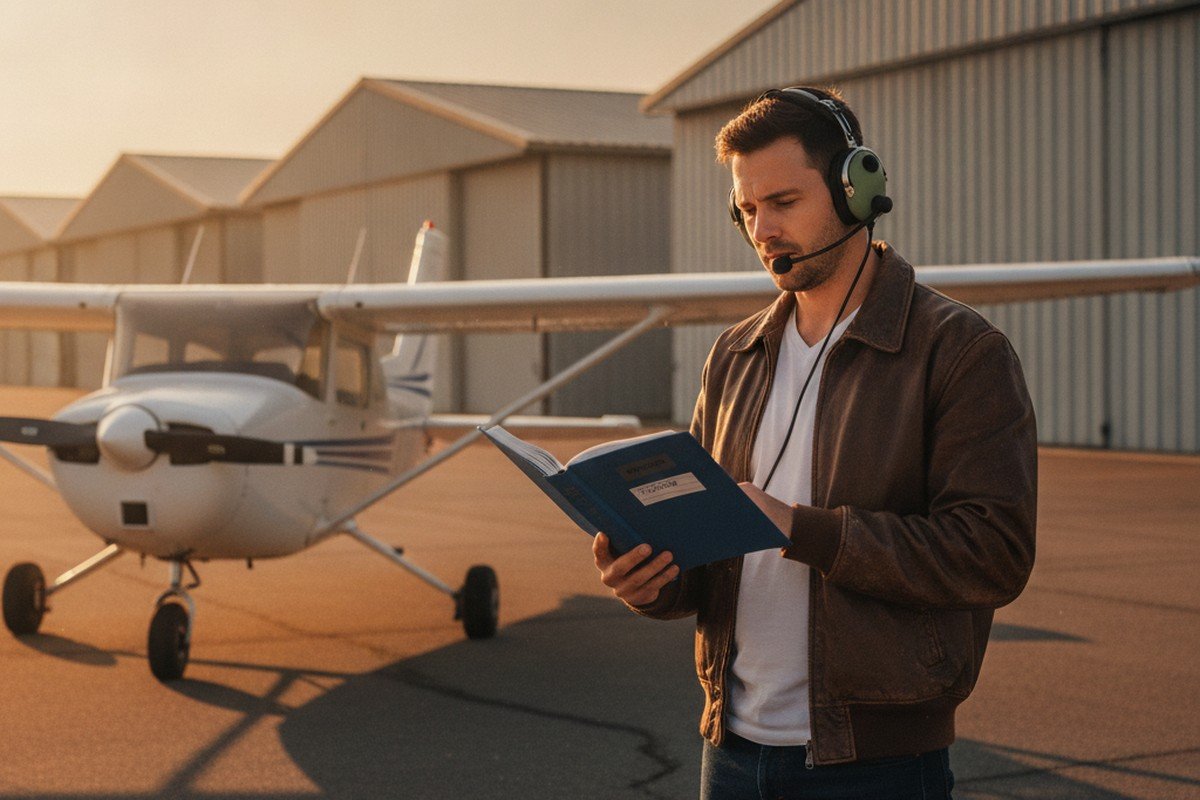
On Thursday morning, the crisp autumn dawn illuminated the twin asphalt runways of Pine Valley Regional Airport as I pre-flighted my trainer aircraft.
For eighteen months, I had poured every spare hour and every dollar of my savings into earning my commercial pilot certificate.
Commercial aviation certification requires rigorous precision, strict flight discipline, and a minimum of two hundred and fifty authenticated aeronautical hours, including fifty hours of solo cross-country navigation.
To fund my training, I had worked sixty hours a week as an industrial maintenance technician, saving eleven thousand dollars into a dedicated flight escrow account at Summit Aviation Academy.
I had completed twenty-two solo cross-country flights over the preceding six months, flying solo navigation legs across three states in a single-engine Piper Archer.
Every flight had been an intense test of piloting skill, managing unexpected headwinds, navigating complex controlled airspace, and executing precision landings on unfamiliar mountain runways.
My chief flight instructor, Captain Bradley Thorne, was a former regional airline pilot who managed the academy’s flight training syllabus.
Bradley was obsessed with advancing his personal career, constantly talking about his ambition to join an international cargo freight carrier as a heavy jet captain.
To qualify for the cargo carrier’s elite hiring pool, Bradley needed to accumulate eighty additional hours of certified multi-engine and cross-country turbine pilot-in-command flight time before the autumn deadline.
Bradley was notoriously arrogant, frequently dismissing student concerns and treating flight academy resources as his personal aviation playground.
Because Bradley was the school’s chief instructor, all student logbook endorsements and final stage check authorizations required his administrative signature.
Every dollar of my eleven-thousand-dollar flight account represented relentless sweat working graveyard shifts at the paper mill.
I had spent cold winter mornings pre-heating engine oil sumps, scraping frost from wing surfaces, and studying FAA airspace charts by flashlight.
During my solo cross-country navigation legs, I had encountered severe downdrafts over the ridge lines, executed precautionary diversions around thunderstorms, and handled alternator failures with calm discipline.
Flying solo across three states taught me to rely entirely on my own aeronautical judgment, making me a true pilot in command.
Because aviation demands unflinching honesty, I had maintained meticulous flight logs with exact tachometer and Hobbs meter times.
I believed that the sky is unforgiving to shortcuts and that every logged hour must represent genuine piloting experience.
I feared that losing those fifty hours would set my commercial aviation dreams back by years and cost thousands of dollars I did not have.
I wanted to earn my wings with honor, so I refused to let Bradley’s arrogant theft derail my life.
A pilot’s logbook is a sacred legal document that records an airman’s genuine journey through the skies.
To forge entries in that blue book is to betray the trust upon which all aviation safety rests.
My final commercial pilot checkride was scheduled for Friday morning with Federal Aviation Administration Designated Pilot Examiner Warren Hayes.
At ten o’clock on Thursday morning, Examiner Hayes arrived at the flight academy briefing room to conduct our mandatory pre-checkride paperwork and logbook audit.
Warren Hayes was a legendary aviation inspector with thirty-five years of military and commercial experience, known for meticulous attention to regulatory detail.
Examiner Hayes sat at the wooden briefing table, opened my blue pilot logbook, and began cross-referencing my flight entries against the academy’s master aircraft dispatch records.
As Examiner Hayes flipped through the recent entries, his weathered brow furrowed into an intense, severe frown.
Hayes pushed the logbook across the table, tapped a series of highlighted dates with his pen, and looked me in the eyes with grave skepticism.
“Nathan, we have a catastrophic regulatory discrepancy here,” Examiner Hayes said quietly.
“Your personal logbook shows fifty hours of solo cross-country pilot-in-command time in Piper Archer tail number six-two-four Victor. But the academy’s official dispatch ledger records those exact flight hours as dual instructional flights with Captain Bradley Thorne acting as pilot-in-command.”
I stared at Examiner Hayes in total, paralyzed shock, feeling the room tilt on its axis as blood drained from my face.
I looked at the document and reviewed the master dispatch log, which clearly showed that every single one of my twenty-two solo cross-country flights had been administratively reclassified as dual instruction.
Attached to the dispatch ledger were flight hour transmission slips submitted to the federal aviation portal, showing that Bradley Thorne had logged all fifty hours under his personal commercial turbine prerequisite record.
Bradley had used my paid flight hours, funded by my hard-earned eleven-thousand-dollar escrow account, to artificially inflate his own pilot-in-command credentials for the cargo airline application.
Even worse, because the academy’s official master records showed dual instruction rather than solo flight, my commercial certification application was legally deficient by fifty hours, disqualifying me from taking Friday’s checkride.
The reason this theft was so catastrophic was that submitting fraudulent flight hours to the FAA carries severe federal penalties, including immediate revocation of student pilot licenses and lifetime bans from aviation.
Examiner Hayes was bound by federal aviation regulations to report the discrepancy as an intentional logbook falsification unless verifiable evidence proved the flights were flown solo.
I believed that if I could not prove my solo status immediately, my entire aviation career would be extinguished before it even began.
I feared that Bradley Thorne’s selfish ambition would destroy eighteen months of sacrifice and steal eleven thousand dollars of my hard work.
I wanted to clear my name, hold Bradley accountable, and earn the commercial wings I had fought so hard to achieve, so I refused to let his fraud stand.
The thought of Bradley stealing my hours while I flew through mountain turbulence alone filled me with ice-cold, determined rage.
“Examiner Hayes, I flew every single one of those fifty hours completely solo in that airplane,” I stated with fierce, unwavering clarity.
“Captain Thorne was never in the cockpit. I paid for solo aircraft rental, and Bradley altered the school dispatch logs to pad his own resume.”
Examiner Hayes leaned back, his eyes narrowing with keen professional interest.
“Nathan, accusations of logbook fraud are a federal matter,” Hayes said solemnly. “If you claim these hours were flown solo, you must produce independent, immutable physical evidence that confirms you were the sole occupant of that aircraft.”
“Give me thirty minutes, Examiner Hayes,” I answered. “I will produce proof that no one can forge.”
I walked straight into the chief instructor’s office, where Bradley Thorne was sipping coffee and reviewing resume packets.
“Bradley, Examiner Hayes just audited my logbook for tomorrow’s checkride,” I said, shutting the office door.
“You reclassified fifty hours of my solo cross-country flights as dual instruction and logged my flight time under your name.”
Bradley choked on his coffee, slamming the mug down and glaring at me with aggressive hostility.
“Keep your voice down, Nathan!” Bradley hissed furiously. “You don’t understand how professional aviation works. The school’s insurance requires a supervising instructor of record on long-range dispatches. Logging dual time protected the academy, and you still got the stick time!”
“Logging dual time disqualified me from my commercial checkride, Bradley!” I roared.
“And you didn’t supervise anything; you were sitting in your office while I flew three hundred miles to Cedar Rapids alone! You committed federal logbook fraud using my tuition money!”
Instead of showing remorse, Bradley threatened to fail my stage check and pull my solo endorsements if I escalated the issue to the FAA.
That was the moment the argument changed, because I realized Bradley truly believed student pilots were powerless to challenge his authority.
Then Bradley admitted that he had already submitted the fraudulent hours to the international cargo carrier’s hiring portal.
This revelation proved that his theft was fully premeditated and designed to fast-track his private hiring timeline.
Worse still, another student’s training folder on his desk showed that Bradley had pulled the exact same maneuver on two other commercial candidates.
I discovered that Bradley had systematically embezzled over one hundred and twenty flight hours from academy students over the past year.
Until that morning, I had respected Bradley’s aviation experience, but his ruthless dishonesty proved he was entirely unfit to wear captain’s wings.
I did not bother arguing further; I turned on my heel and walked directly to my flight bag to assemble my evidence.
Modern aviation creates an extensive digital and physical footprint that no dishonest instructor can erase.
I opened my tablet and pulled up my personal flight tracking data from my external ADS-B portable GPS receiver, which recorded high-resolution satellite flight tracks for every cross-country flight.
The digital ADS-B flight records proved that during every flight, my transponder transmitted my assigned solo student squawk code, verified by regional air traffic control centers.
Furthermore, I retrieved my physical fuel receipts from every remote destination airport: Cedar Rapids, Rockford, and Des Moines.
I unfolded the printed fuel receipts and reviewed the signature lines, which confirmed that Nathan Cross had personally fueled aircraft six-two-four Victor at every remote field.
Even more decisively, I produced the destination airport ramp service logs and security camera timestamps, which showed me walking alone onto the flight line, ordering fuel, and paying with my personal credit card.
I returned to the briefing room and laid the complete evidentiary dossier before Examiner Hayes.
Examiner Hayes reviewed the satellite ADS-B flight logs, the transponder squawk records, the signed fuel manifests, and the remote ramp video confirmations.
When the FAA safety inspectors arrived at Pine Valley Airport, Lead Inspector David Miller demanded the academy’s official dispatch records.
Inspector Miller pulled up the national radar tracking replays on his laptop, cross-referencing the transponder squawk codes with Nathan Cross’s student pilot certificate number.
The FAA radar logs proved conclusively that no certified flight instructor was aboard aircraft six-two-four Victor during those twenty-two cross-country flights.
Inspector Miller looked at Bradley Thorne with icy professional disdain.
“Captain Thorne, you knowingly certified false official aeronautical records submitted to the federal government,” Inspector Miller stated solemnly.
“That is a direct violation of federal aviation regulations and carries immediate revocation of your commercial privileges.”
Bradley sat with his head in his hands, completely unable to dispute the objective radar records.
Hayes examined the records in deep, silent concentration for fifteen minutes, his expression softening into absolute respect.
“This evidence is conclusive beyond all possible doubt,” Examiner Hayes announced with booming authority. “These flights were flown entirely solo by Nathan Cross.”
Examiner Hayes picked up his official phone immediately and dialed the FAA Regional Flight Standards District Office.
Within an hour, two federal aviation safety inspectors arrived at Pine Valley Airport to seize the academy’s dispatch records and interrogate Bradley Thorne.
Faced with immutable digital radar tracks and signed fuel manifests, Bradley Thorne broke down and signed a full written confession.
The FAA inspectors immediately suspended Bradley Thorne’s flight instructor certificate and commercial pilot privileges pending formal revocation proceedings.
The aviation academy owner arrived at noon, offering me a profound apology and issuing an immediate four-thousand-five-hundred-dollar training refund for the administrative disruption.
The flight school’s master dispatch ledger was officially corrected and certified by the FAA inspectors, restoring all fifty solo cross-country hours to my permanent record.
The consequence for Bradley Thorne was catastrophic: his airline job offer was instantly revoked, his instructor career was terminated, and he was referred for federal enforcement action.
The consequence for me was complete vindication, absolute regulatory compliance, and cleared authorization for my commercial examination.
The cost of the battle was intense stress and hours of rigorous verification, but the cost of surrender would have been the permanent destruction of my dream.
Because I maintained meticulous independent flight evidence, the truth prevailed, and the aviation system was purged of a corrupt instructor.
On Friday morning at eight o’clock, Examiner Hayes and I walked out to Piper Archer six-two-four Victor under clear blue skies.
Over four hours of rigorous oral examination and flight testing—steep spirals, commercial power-off accuracy landings, and emergency procedures—I flew with flawless confidence.
When the wheels touched down on runway two-seven and we rolled to a stop, Examiner Hayes turned to me with a broad, proud smile.
During Friday’s checkride, Examiner Warren Hayes tested every maneuver to strict commercial practical test standards.
We performed steep sixty-degree bank turns, chandelles, lazy eights, and emergency engine-out simulated landings to the hundred-foot runway marker.
Throughout four demanding hours in the sky, I demonstrated the precision and confidence born of genuine solo flight experience.
Examiner Hayes noted in his official debrief that my situational awareness and cross-country flight planning were exemplary.
The academy owner personally signed my flight account release, ensuring that all remaining escrow funds were fully protected.
Walking across the tarmac with my commercial certificate in hand, I felt the immense pride that comes only from honest achievement.
The flight line was peaceful under the evening stars, and the hum of distant aircraft sounded like an invitation to a promising future.
“Congratulations, Captain Cross,” Hayes said, extending his hand. “You have earned your commercial pilot certificate with the highest marks I’ve awarded this year.”
Later that afternoon, the flight academy staff gathered on the tarmac to pin my commercial wings to my flight jacket.
Two weeks later, the Federal Aviation Administration delivered my permanent plastic airman certificate embossed with gold seals.
Three months later, I received my first formal hiring offer as a first officer for a regional turboprop airline, embarking on my professional career.
Now, whenever I throttle up on the runway and lift into the quiet morning sky, I remember that integrity is the true compass of aviation.
Holding that newly stamped temporary airman certificate in my hands, looking up at the vast open sky, I knew that true flying is built on honor, skill, and unflinching integrity.
A true aviator commands the sky not merely through technique, but through absolute honesty to the craft and to the truth.
My pilot logbook rests in my flight bag, perfectly authenticated, completely unclouded, and forever protected against deceit.
I will continue flying toward my professional airline career with the same unwavering discipline that guided me through that trial.
In the hangar office, I carefully logged the practical test pass into my blue logbook with black permanent ink.
Examiner Hayes signed his official endorsement in the back pages, certifying my aeronautical competence under federal law.
Every single hour recorded in those pages represents authentic airmanship earned through disciplined sweat and uncompromised focus.
The sky does not grant favors to pretenders, and true pilots are forged through truth, precision, and respect for the regulations.
I packed my headset and navigation charts into my flight bag, ready to begin the next chapter of my professional aviation journey.
Looking out at the runway beacons glowing amber in the twilight, I felt a deep sense of accomplishment and unshakeable resolve.
Authentic wings cannot be bought or stolen; they must be earned one hour at a time in the open sky.
And whenever I climb through the cloud deck into the brilliant sunlight above, I will remember the Thursday morning I fought for my hours and won my wings.