On Monday morning, I walked up the broad granite steps of the Millfield Memorial Library just as the autumn sun broke through the coastal fog.
For thirty-four years, the library’s oak-paneled south wing had housed the town’s founding historical archive, a sacred repository of regional heritage.
The archive contained hand-written town meeting charters dating back to eighteen forty-two, original hand-drawn survey maps of our river crossings, nineteenth-century water rights ledgers, and audio reels documenting oral histories from local coal miners and dockworkers.
As the president of our local historical preservation society, I had spent five years cataloging these documents to prepare our comprehensive bicentennial memorial exhibition.
The library building itself had been gifted to the town in nineteen twelve by industrialist Thomas Millfield under an irrevocable deed of trust mandating that the south wing remain dedicated solely to civic educational preservation.
Thomas Millfield had explicitly stipulated in his grant that the collection should serve as a permanent civic anchor for students, historians, and working families.
Six weeks earlier, the municipal board had appointed a new head library director named Brenda Lawson, an ambitious administrator whose background was in commercial hospitality marketing.
Brenda had repeatedly argued in town council meetings that public libraries should function as modern revenue centers rather than quiet repositories of aged paper.
She frequently proposed converting our reading rooms into tourist retail boutiques, artisan coffee bars, and commercial meeting spaces to capture revenue from coastal weekend visitors.
Because our historical society held an official municipal charter, I had reminded Brenda that Thomas Millfield’s trust covenant legally protected the historical archives from commercial repurposing.
The collection included irreplaceable Civil War enlistment rosters hand-penned by local volunteer captains in eighteen sixty-one.
It held forty years of harbor master logbooks recording every schooner and steam packet that delivered coal and timber to our historic river port.
Thomas Millfield had spent thirty years collecting these regional artifacts, believing that understanding working-class history gave young citizens pride in their hometown.
When Millfield endowed the library, he established a permanent municipal covenant requiring the town to maintain the south wing free from commercial exploitation.
Because our historical society had preserved these fragile documents through generations of careful handling, we felt a profound moral duty to guard them.
I believed that if we allowed the town’s history to be dispersed, future generations would lose their cultural anchor.
I feared that Brenda’s commercial scheme would set a dangerous precedent for privatizing other public civic treasures.
The town charters contained the signatures of early blacksmiths, weavers, and shipwrights who had built our coastal community with their own hands.
Preserving those physical signatures was a matter of intergenerational honor that transcended any temporary municipal budget deficit.
I believed that Brenda understood the legal boundaries established by the town deed.
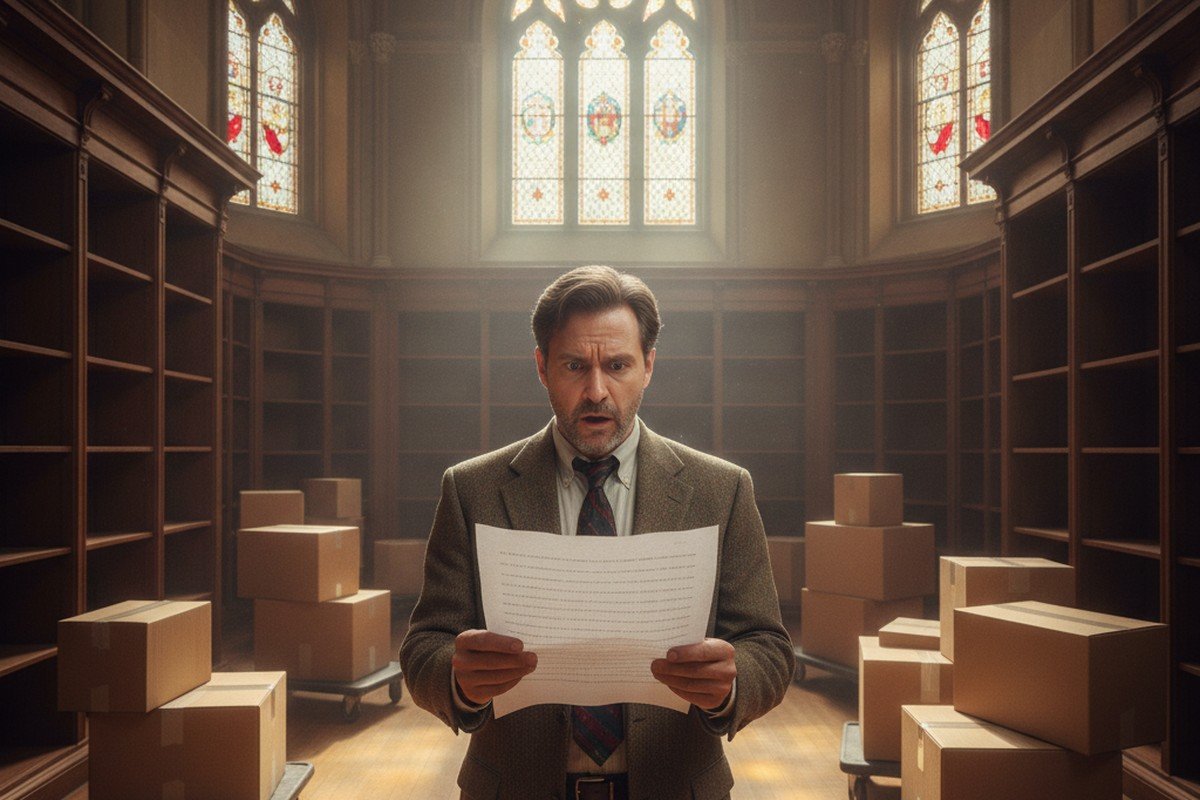
However, when I pushed open the double oak doors of the historical wing on Monday morning, I froze in utter disbelief.
The towering floor-to-ceiling quarter-sawn oak bookcases that had held hundreds of bound archive volumes for over a century were completely stripped bare.
In the center of the historic room, where students and researchers once studied beneath green glass banker lamps, three commercial carpenters were assembling modular metal retail gondolas and acrylic souvenir display cases.
Stacks of glossy cardboard cartons bearing commercial shipping labels sat piled along the wainscoted walls, containing hundreds of promotional ceramic mugs, plastic keychains, and screen-printed tourist sweatshirts.
Piled haphazardly near the freight exit were forty-five heavy corrugated boxes marked with red grease pencil for immediate transfer.
I approached the lead carpenter and demanded to know where the municipal historical records had been relocated.
The carpenter shrugged, pointing toward a clipboard hanging on the wall containing an administrative facility modification directive signed by Brenda Lawson.
I pulled the document from the clipboard and reviewed the typed text, my hands trembling with cold indignation as I read the instructions.
The directive stated that archive room four-A had been officially de-accessioned to establish the Millfield Heritage Gift Emporium, a commercial retail operation expected to generate forty thousand dollars in annual merchandising revenue.
I looked at the document and reviewed the disposal manifest, which confirmed that two centuries of hand-bound town ledgers had been loaded into an unheated municipal maintenance truck bound for an uninsulated salt storage depot.
Attached to the directive was an itemized invoice showing that Brenda had spent eight thousand five hundred dollars of the library’s discretionary endowment fund to purchase retail fixtures and souvenir inventory.
The reason this displacement was so catastrophic was that antique nineteenth-century rag paper and leather book bindings degrade rapidly in damp, unheated conditions.
Storing delicate historic manuscripts in an open salt depot during autumn rains would cause catastrophic mold outbreaks, page warping, and permanent chemical decay within seventy-two hours.
I believed that if those boxes remained in the salt shed through the coming nor’easter storm, our town’s complete founding documentary history would be destroyed beyond recovery.
I feared that two centuries of civic memory would be traded away for plastic souvenirs and commercial vanity.
I wanted to protect the heritage of our ancestors and preserve the historical integrity of our community, so I refused to allow Brenda’s commercial project to proceed.
The thought of Thomas Millfield’s solemn gift being reduced to a tourist trinket shop filled me with ferocious determination.
I marched directly into Brenda’s executive corner office, shut the door firmly behind me, and looked her in the eye.
Brenda looked up from her computer screen with a practiced, polished corporate smile, gesturing toward a leather armchair.
“Samuel, good morning! I assume you’ve seen our exciting modernization project underway in the south wing?” Brenda asked cheerfully.
“Brenda, you stripped two centuries of hand-written municipal archives from our historic library and sent them to a damp salt shed in cardboard boxes,” I said, keeping my voice cold and uncompromising.
Brenda’s smile faded into an expression of impatient bureaucratic condescension.
“Samuel, those musty old ledgers were taking up prime real estate that generated zero income,” Brenda answered dismissively.
“Modern libraries must be economically self-sustaining. The Millfield Gift Emporium will fund our digital media licenses and bring tourists through our doors. Those dusty records can sit in the municipal garage until someone requests them.”
“Those dusty records are the legal founding documents of our township, Brenda!” I replied with rising force.
“They contain original cemetery maps, land grant deeds, and veteran pension rolls that exist nowhere else on earth. And moving them violates the nineteen-twelve deed of trust!”
Instead of showing concern, Brenda insisted that as executive director, she held absolute administrative discretion over space allocation.
That was the moment the argument changed, because I realized Brenda cared nothing for community preservation and recognized only commercial metrics.
Then Brenda admitted that she had already scheduled a ribbon-cutting ceremony with regional retail bloggers for Friday afternoon.
This revelation proved that she had orchestrated the entire archive removal in secrecy over the weekend to present the town with an irreversible fait accompli.
Worse still, another document on her desk revealed that she had solicited bids to sell several vintage maritime map cases to a private antique dealer in Boston.
I discovered that Brenda was planning to liquidate historic municipal furniture to fund additional retail stock.
Until that morning, I had thought Brenda was merely overzealous about modern marketing, but her actions proved she was actively looting our public heritage.
“You will halt the carpentry work in that room right now, Brenda, or I will convene an emergency session of the municipal trustees and the county historic commission before noon,” I told her.
Brenda laughed coldly, warning me that interfering with library operations would result in having my society’s charter revoked.
Then she threatened to ban our historical society from the premises entirely if I attempted to contact the press.
Instead of backing down, I reminded Brenda that public trust covenants are enforceable in state supreme court.
I turned and walked out of her office without another word, knowing that administrative bureaucrats only respond to overwhelming legal authority.
I sprinted to my car and drove straight to the county archives building, where our historical society kept certified copies of all historical municipal deeds.
I opened our fireproof safe and retrieved the certified copy of the nineteen-twelve Thomas Millfield deed of gift and the accompanying municipal trust agreement.
I reviewed the explicit restrictive covenants on page four, which stated in legally binding language that the south wing of the library was conveyed in perpetuity solely for the preservation and free public inspection of regional historical records.
The trust document confirmed that any commercial conversion or diversion of the wing would trigger an immediate reversion of library ownership to the Millfield Charitable Foundation.
I showed the deed to our society’s legal counsel, Arthur Vance, who verified that Brenda’s commercial gift shop constituted a severe material breach of the municipal trust.
Arthur immediately drafted an emergency legal petition for an injunction and telephoned Town Mayor Richard Sterling and the president of the library board of trustees.
In the emergency trustee meeting, historical society vice president Eleanor Vance presented high-resolution digital scans of Millfield’s original endowment papers.
Eleanor showed the trustees the exact clause stipulating that any commercial merchandising inside the historic wing would trigger immediate deed reversion.
Mayor Sterling looked at Brenda with severe disappointment, asking how an administrator could take such reckless legal risks without board approval.
“You exposed the town to an immediate forfeiture lawsuit from the Millfield foundation, Brenda,” Mayor Sterling said with chilling gravity.
Brenda attempted to argue that retail revenue was needed to modernize digital databases, but the board refused to accept her excuses.
Trustee Margaret Cole pointed out that the library endowment already maintained a dedicated technological reserve that Brenda had ignored.
The trustees voted unanimously to affirm that public cultural heritage will never be bartered away for tourist commerce.
At half past ten on Monday morning, Mayor Sterling, three town trustees, and two county historic commissioners convened an emergency meeting inside the library south wing.
The trustees stood in stunned silence as they looked at the bare walls, the metal retail gondolas, and the boxes of ceramic souvenirs.
I presented Thomas Millfield’s certified trust deed and compared the covenant language with Brenda’s signed de-accession directive.
Mayor Sterling read the documents, his face reddening with outrage as he recognized the catastrophic liability facing the municipality.
“Mister Vance is completely correct,” Mayor Sterling announced sternly to the assembled trustees. “This project threatens the legal title of our entire library building.”
The president of the library board immediately issued an executive order halting all carpentry work on the spot.
The board instructed the contractors to dismantle the retail displays and remove their materials from the building within two hours.
Mayor Sterling dispatched a town municipal truck and four public works employees directly to the salt storage depot to rescue our archive boxes.
I accompanied the crew to the salt depot, where we found the forty-five cartons sitting on cold concrete near an open loading bay as rain began to fall.
We checked the condition of the boxes, which confirmed that the protective archival tissue had kept the historical manuscripts dry during the morning transfer.
By two o’clock on Monday afternoon, every single archive box had been safely returned to the library and placed in climate-controlled staging.
The library trustees convened an executive personnel session at three o’clock and voted unanimously to place Brenda Lawson on immediate administrative suspension pending termination.
The board officially canceled the gift shop project, ordered the liquidation of all souvenir inventory, and re-allocated eight thousand dollars to restore the historical reading room.
The consequence for Brenda Lawson was immediate professional disgrace: she was removed from municipal service and her retail initiatives were permanently repudiated by the town.
The consequence for our community was total restoration of our archives and the permanent reaffirmation of our founding historical covenant.
The cost of the defense was hours of emergency mobilization, but the cost of surrender would have been the irreversible erasure of our civic identity.
Because our preservation society acted with decisive legal documentation, our town’s history was saved within hours of its displacement.
Over the next three weeks, our society volunteers worked alongside university conservation interns to carefully return every volume, map, and ledger to the hand-carved oak shelves.
We reinstalled the nineteenth-century brass reading lamps, polished the oak study tables, and unveiled our bicentennial exhibition to a record crowd of proud citizens.
Later that month, the town council enacted a permanent municipal preservation ordinance designating the south wing as an inviolable historic sanctuary.
At the municipal salt shed, public works superintendent Frank Miller helped us carefully lift each damp carton onto wooden transport pallets.
Frank shook his head in disgust, remarking that leaving priceless historical manuscripts beside road salt was an act of gross administrative negligence.
We checked the temperature and humidity inside our staging room, ensuring that every fragile document was protected from thermal shock.
Over the following two weeks, master book conservator Clara Hughes inspected the bindings, applying archival wheat starch paste to repair minor paper tears.
The community rallied around the library, with dozens of local families bringing hot cider and donuts to support our volunteer restoration crew.
Standing in the restored reading room surrounded by glowing mahogany bookshelves, I knew our town’s heritage was truly invincible.
Every volume returned to its rightful place on the shelves felt like a victory for civic memory over commercial expediency.
The oak panels seemed to gleam with renewed warmth under the soft light of the historic brass reading lamps.
On Saturday afternoon, three hundred residents gathered in the restored south wing to celebrate the opening of our bicentennial archive gallery.
Looking at local schoolchildren examining the hand-written founding charters with wide eyes, I knew that true civic duty requires unwavering vigilance.
Two months later, the Millfield Charitable Foundation awarded our historical society an endowed thirty-thousand-dollar climate-control grant to ensure the manuscripts remain protected forever.
Three months later, our bicentennial publication was honored with the regional civic heritage award, celebrating our victory for historic preservation.
Now, the south wing remains quiet and peaceful, still echoing with the timeless dignity of our founders.
The Millfield Memorial Library stands proud among the coastal pines, completely tranquil, entirely preserved, and forever dedicated to the truth of our history.
I will continue guarding these sacred records with the same deep devotion that our ancestors demonstrated when they built this town.
In the quiet evening after the bicentennial gala concluded, I locked the heavy brass latch of the historical reading room with profound gratitude.
Knowing that these irreplaceable charters will guide future generations of citizens makes every hour of sacrifice worthwhile.
Civic heritage is not an ornament to be cast aside when convenience calls, but an enduring trust to be defended with honor.
The archive remains our town’s living heartbeat, unencumbered, inviolate, and forever preserved for all who seek the truth.
And whenever I turn the aged parchment pages of our founding ledgers in the quiet afternoon light, I will remember the Monday morning we saved our town’s soul.