On Wednesday afternoon, I drove across the downtown historic district to the bridal alteration atelier for my final wedding gown fitting.
Our wedding ceremony was scheduled for Saturday morning at the stone chapel on the university green, leaving only seventy-two hours before guests arrived.
Every element of my bridal ensemble had been planned with deep sentimental care, but none mattered more than my great-grandmother’s antique Brussels lace veil.
Hand-stitched in Belgium in nineteen twenty-two, the cathedral-length lace featured intricate floral vine borders that three generations of brides in my family had worn down the aisle.
My late grandmother had entrusted the delicate antique textile to me on her eightieth birthday, wrapped in acid-free tissue paper inside an embossed wooden keepsake chest.
Six months earlier, I had entrusted the veil to Madame Laurent, a renowned master lace conservator, paying seven hundred dollars to have the vintage silk fibers cleaned, reinforced, and reattached to a carved mother-of-pearl comb.
My fiancé Liam was supportive and loving, but his mother Beverly had spent the preceding six months attempting to hijack every aesthetic decision of our wedding.
Beverly was a prominent socialite who served on three regional charity galas, obsessed with high-gloss luxury spectacle and flashy social status.
She repeatedly criticized our minimalist floral designs, our acoustic string quartet, and our decision to host an intimate reception at a heritage courtyard conservatory.
Beverly insisted that a wedding was primarily a public exhibition designed to display family wealth and impress local civic dignitaries.
Because Liam and I were funding eighty percent of the celebration ourselves, I had politely but firmly declined Beverly’s extravagant alterations.
My great-grandmother Genevieve had brought the antique lace veil through Ellis Island in a hand-carved cedar trunk wrapped in blue velvet.
She had worn it during her wedding in nineteen twenty-four, and thirty years later, my grandmother had worn it down the aisle of that same stone chapel.
When my own mother married my father, she added delicate hand-stitched silk lining along the inner comb to preserve the fragile vintage netting.
The veil was not merely an accessory; it was an unbroken physical thread connecting four generations of women who believed in devotion and family honor.
Because our family had guarded this textile through economic depressions and overseas moves, preserving it was a sacred responsibility.
I wanted to honor Genevieve’s quiet dignity, so I refused to compromise on the integrity of our family traditions.
As I walked into the bridal atelier on Wednesday afternoon, Madame Laurent looked up from her sewing table with an expression of acute discomfort.
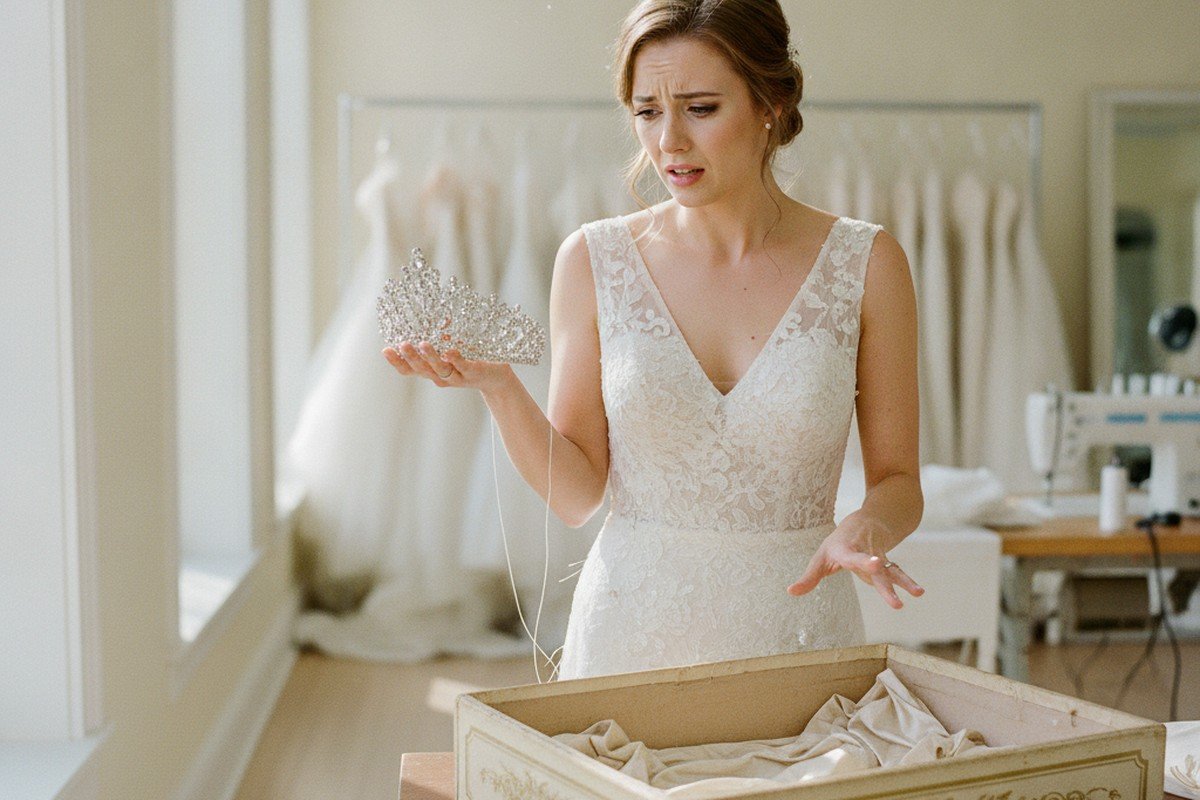
Instead of the antique wooden keepsake chest sitting on the velvet presentation table, there was only a pink cardboard box bearing a commercial costume label.
I asked Madame Laurent if the final pressing of my cathedral lace veil was complete, but she hesitated, wiping her hands nervously on her linen apron.
Madame Laurent explained that on Tuesday morning, my future mother-in-law Beverly had arrived at the salon with an urgent cancellation instruction.
She opened a black leather desk portfolio and handed me a signed alteration cancellation form and a commercial rental receipt.
I looked at the document and reviewed the signature line, which contained Beverly’s dramatic handwriting executed in bright turquoise ink.
The paperwork confirmed that Beverly had instructed the salon to halt all preservation work on my heirloom lace, claiming that the bride had changed her styling direction.
Attached to the cancellation slip was a printed invoice showing that Beverly had rented an oversized rhinestone pageant tiara from a theatrical costume agency for four hundred dollars.
The rental agreement stated that the gaudy metal crown was reserved exclusively for my ceremony, complete with a non-refundable damage deposit.
I opened the pink cardboard box and stared in horror at a towering six-inch tiara encrusted with cheap synthetic crystals that looked like a circus accessory.
“Beverly told me that the antique lace looked yellowed, dingy, and hopelessly outdated for modern photography,” Madame Laurent explained with genuine sorrow.
“She insisted that her son deserved a glamorous modern bride and that this crystal tiara would elevate our social standing in the newspaper society page.”
I felt my pulse pounding in my temples as a wave of cold fury washed over me; my future mother-in-law had taken my family heirloom without permission.
When I asked where my great-grandmother’s vintage veil was located, Madame Laurent revealed that Beverly had taken the wooden box and locked it inside her luxury SUV.
The reason this theft was so catastrophic was that antique Brussels lace is extremely vulnerable to environmental damage, heat, and improper humidity.
Leaving a century-old delicate silk textile in the trunk of a hot vehicle could cause irreparable fiber brittleness, tearing, and permanent discoloration.
I believed that if the heirloom lace suffered irreversible heat degradation, a century of irreplaceable family history would be extinguished forever.
I feared that Beverly’s boundary-shattering arrogance would destroy my wedding day and cast a permanent shadow of resentment over our marriage.
I wanted to protect my grandmother’s legacy and establish an unbreakable standard of respect, so I refused to tolerate Beverly’s intrusion for another second.
The thought of walking down the aisle wearing a rented rhinestone tiara while my family’s heritage languished in a hot car trunk made my blood run cold.
I called Liam immediately, putting him on speakerphone while standing beside Madame Laurent in the alteration suite.
Liam answered from his architectural studio, greeting me with his customary warmth before noticing the sharp distress in my voice.
“Liam, your mother walked into Madame Laurent’s studio yesterday, canceled the preservation on my great-grandmother’s heirloom veil, took the antique box, and replaced it with a rented rhinestone tiara,” I told him.
There was a moment of stunned silence on the other end of the line, followed by an audible intake of breath as Liam grasped the enormity of what his mother had done.
“She did what?” Liam shouted, his voice shaking with disbelief and outrage. “Clara, stay right there at the salon. I am driving directly to my parents’ house right now.”
I told Liam that I was meeting him there immediately, because this violation required a face-to-face confrontation before another hour passed.
As I drove through the autumn afternoon sunlight toward the suburban hills, Liam called me back over the hands-free audio link.
He told me that he had already phoned his father to warn him that Beverly had overstepped a dangerous line and needed to produce the veil immediately.
Liam explained that his mother had spent years using money and social leverage to micromanage his choices, but he would never allow her to disrespect my heritage.
Hearing Liam’s absolute resolve gave me immense strength, confirming that our marriage would be anchored in mutual protection.
I drove across the valley to Beverly’s gated residential enclave, my hands gripping the steering wheel with fierce determination.
Liam pulled into his parents’ circular brick driveway at the exact same moment, slamming his car door and marching toward the grand front entrance.
Beverly answered the heavy mahogany front door wearing a silk lounging robe, holding a cup of herbal tea with an expression of smug condescension.
“Liam, darling! Clara! What an unexpected surprise,” Beverly announced airily. “I assume you saw the stunning crown I selected for the ceremony?”
“Where is Clara’s heirloom veil, Mother?” Liam demanded, his voice dropping into a harsh register I had never heard him use before.
Beverly scoffed dismissively, waving her hand as though batting away a minor inconvenience.
“That faded old rag looked like something fished out of an attic trunk sale,” Beverly scoffed loudly. “Our society friends will be sitting in the front rows, and I refused to let my only son marry a girl wearing dingy antique netting!”
“You stole a century-old family heirloom from a master conservator without my knowledge or consent!” I told Beverly, stepping onto the marble threshold.
Instead of apologizing, Beverly argued that because she was paying for the floral centerpieces at the reception, she possessed the right to dictate my bridal accessories.
That was the moment the argument changed, because Liam looked his mother directly in the eyes and completely withdrew his deference.
“You have zero right to touch Clara’s belongings, Mother, and you have zero authority over our wedding,” Liam said with absolute finality.
“If you do not hand over that wooden box in pristine condition within three minutes, we are canceling your invitation and banning you from the church.”
Then Beverly admitted that she had placed the antique veil in her upstairs closet, hoping that I would be forced to wear the tiara on Saturday morning.
This revelation proved that Beverly had executed a calculated, premeditated scheme to humiliate my family and assert her dominance over our vows.
Worse still, another message arrived on Liam’s phone from Beverly’s private florist, revealing that Beverly had also ordered giant crystal candelabras without our approval.
I discovered that Beverly had spent the entire week attempting to quietly dismantle our chosen wedding arrangements behind our backs.
Until that afternoon, I had always tried to accommodate Beverly’s difficult personality to keep family peace, but her entitlement had crossed an unforgivable line.
Liam walked past his mother into the upstairs hallway and retrieved the embossed wooden keepsake chest from the top shelf of her master closet.
He brought the chest down to the foyer, opened the latch, and reviewed the condition of the antique Brussels lace with meticulous care.
I checked the floral vine borders and delicate silk netting, which confirmed that the century-old fabric was intact and had not suffered fiber damage.
I looked Beverly directly in the face, my voice quiet, icy, and completely uncompromising.
“You will not step foot in my bridal suite on Saturday morning, Beverly,” I said firmly. “You will sit in the designated guest pews as a spectator, and if you make a single critical remark, security will escort you to your vehicle.”
Beverly burst into theatrical tears, attempting to claim that she was being victimized and excluded by an ungrateful future daughter-in-law.
Liam refused to entertain her manipulation; he took the tiara rental receipt from my hand and tossed it onto the entry console table.
“You will pay the return fee for this costume jewelry yourself, Mother,” Liam stated. “And you will offer Clara a formal written apology before you are welcomed into our home.”
We walked out of the house together, carrying the wooden keepsake chest securely between us, leaving Beverly alone in her empty foyer.
Liam’s father Arthur walked into the foyer from the rear garden, looking deeply embarrassed by his wife’s brazen conduct.
Arthur looked at Beverly with stern disappointment, telling her that canceling our preservation order was completely inexcusable.
“Beverly, you took something that belongs to Clara’s family without asking, and you embarrassed all of us,” Arthur said with quiet authority.
Beverly crossed her arms defensively, attempting to argue that she had only intended to surprise me with an expensive pageant crown.
Liam refused to yield an inch, reminding his mother that her vanity was not more important than our autonomy.
We drove immediately back to Madame Laurent’s atelier, where the master conservator inspected every inch of the lace under a specialized magnifying lamp.
Madame Laurent verified that no fibers had been broken or snagged during Beverly’s unauthorized transport.
Over the next forty-eight hours, Madame Laurent completed the final pressing and attached the heirloom lace to the antique mother-of-pearl comb with archival silk thread.
On Thursday evening, Liam called the wedding coordinator and the church venue director to institute a strict guest credential protocol.
The venue coordinator confirmed in writing that Beverly was strictly prohibited from entering the bridal dressing wing or altering any floral installations.
Madame Laurent carefully spread the cathedral lace across a large padded drafting table, examining every scalloped edge with her magnifying glass.
She pointed out the hand-knotted floral vines, showing me how the vintage Belgian thread had remained supple and resilient despite Beverly’s rough handling.
“Your great-grandmother knew master craftsmanship when she bought this,” Madame Laurent whispered with deep admiration.
On Thursday afternoon, Liam and I met with our wedding coordinator at the botanical conservatory to finalize the ceremony timeline.
We reviewed the bridal suite guest manifest, which confirmed that only my mother, my maid of honor, and the bridal attendants were authorized to enter the dressing rooms.
The coordinator agreed to station two professional ushers outside the bridal preparation wing to ensure zero uninvited visitors caused a disturbance.
On Friday morning, Beverly delivered a curt, handwritten note of apology through Liam’s father, realizing that her son was fully prepared to cut off contact if she persisted.
The consequence for Beverly was total loss of influence: she was stripped of every ceremonial role, excluded from all bridal preparations, and relegated to an ordinary guest seat.
The consequence for our marriage was an unbreakable foundation of mutual loyalty, proving that Liam would always prioritize our partnership above parental pressure.
The cost of the confrontation was temporary family tension, but the cost of compliance would have been the permanent surrender of our self-respect.
Because Liam and I stood together decisively, the antique lace was preserved in its authentic glory, and the dignity of our wedding was saved.
On Saturday morning at eleven o’clock, the organ chords resonated through the stone chapel as the oak double doors swung open.
I walked down the aisle with my father, the great-grandmother’s Brussels lace veil trailing eight feet behind me in breathtaking, timeless elegance.
The sunlight streaming through the stained glass windows illuminated every delicate floral stitch, casting soft shadows across the stone floor.
As Liam took my hand at the altar with tears of pride in his eyes, I knew that true love never requires the sacrifice of one’s identity or heritage.
True devotion honors the past, protects the present, and builds a future rooted in mutual courage and unyielding respect.
The heirloom veil now rests safely inside its acid-free cedar preservation box, undamaged, completely unencumbered, and permanently protected for the next generation.
I will forever cherish the memory of our vows, knowing that we began our marriage by proving that love is strongest when guarded by firm boundaries.
And whenever I look at our wedding portraits showing the delicate antique lace glowing in the chapel light, I will remember the Wednesday afternoon we defended what mattered most.
On Sunday morning, the day after the ceremony, Liam and I opened our wedding guest book and reviewed the heartfelt messages from our families.
Beverly had sent a formal bouquet of white lilies with a short note acknowledging that she had learned a vital lesson in respecting our autonomy.
Two weeks later, Madame Laurent returned our antique veil in a sealed archival preservation box designed to prevent light oxidation and dust.
We placed the wooden chest in our cedar armoire, alongside Genevieve’s original travel diary and our wedding album.
Three months later, my younger sister announced her engagement, asking if she could wear Genevieve’s antique Brussels lace for her own ceremony next spring.
Hearing her request filled my heart with warmth, knowing that our courage had preserved this sacred family tradition for generations to come.