On Friday afternoon, I left my university library research office three hours early to make the ninety-minute drive north into the pine foothills.
For seven years, our rustic timber-and-stone cabin on Whispering Creek had served as my sanctuary from academic deadlines, grading marathons, and departmental politics.
The property had belonged to my late aunt Clara, a landscape painter who spent thirty summers documenting the changing alpine foliage before leaving the deed solely to me.
The cabin sat on three secluded wooded acres surrounded by ponderosa pines, featuring a hand-built fieldstone fireplace, a wrap-around cedar porch, and a tranquil brook that ran fifty yards from the rear door.
Every corner of the cabin reflected Clara’s patient craftsmanship, from the hand-planed yellow pine bookshelves to the south-facing studio easel overlooking the creek.
I had spent four months meticulously planning this specific two-week sabbatical to finish the final three chapters of my book manuscript on regional cultural folklore.
My husband Derek, an account executive at a commercial packaging firm, had known about my planned writing retreat since early January.
Derek had claimed that heavy quarterly client presentations would prevent him from joining me for the first ten days, which suited my need for quiet focus perfectly.
Over the previous eight months, Derek’s behavior at home had grown increasingly erratic, secretive, and guarded.
He frequently stayed up past two o’clock in the morning staring at live sports betting lines on his encrypted phone, closed browser tabs whenever I walked into our home office, and made vague excuses about unexpected automotive repair charges.
I trusted my husband and assumed he was under ordinary workplace stress related to annual revenue quotas and corporate restructuring.
Because our household expenses were shared from a common checking pool, I never suspected that Derek was incurring massive private gambling obligations.
As my station wagon crested the gravel rise leading to Whispering Creek at four o’clock, the serene silence I anticipated was shattered by an overwhelming wall of low-frequency bass vibrations.
The ground beneath my tires actually trembled with the rhythmic thud of an amplified kick drum and screaming electric guitar distortion.
I pulled into the gravel clearing and slammed on the brakes in complete astonishment.
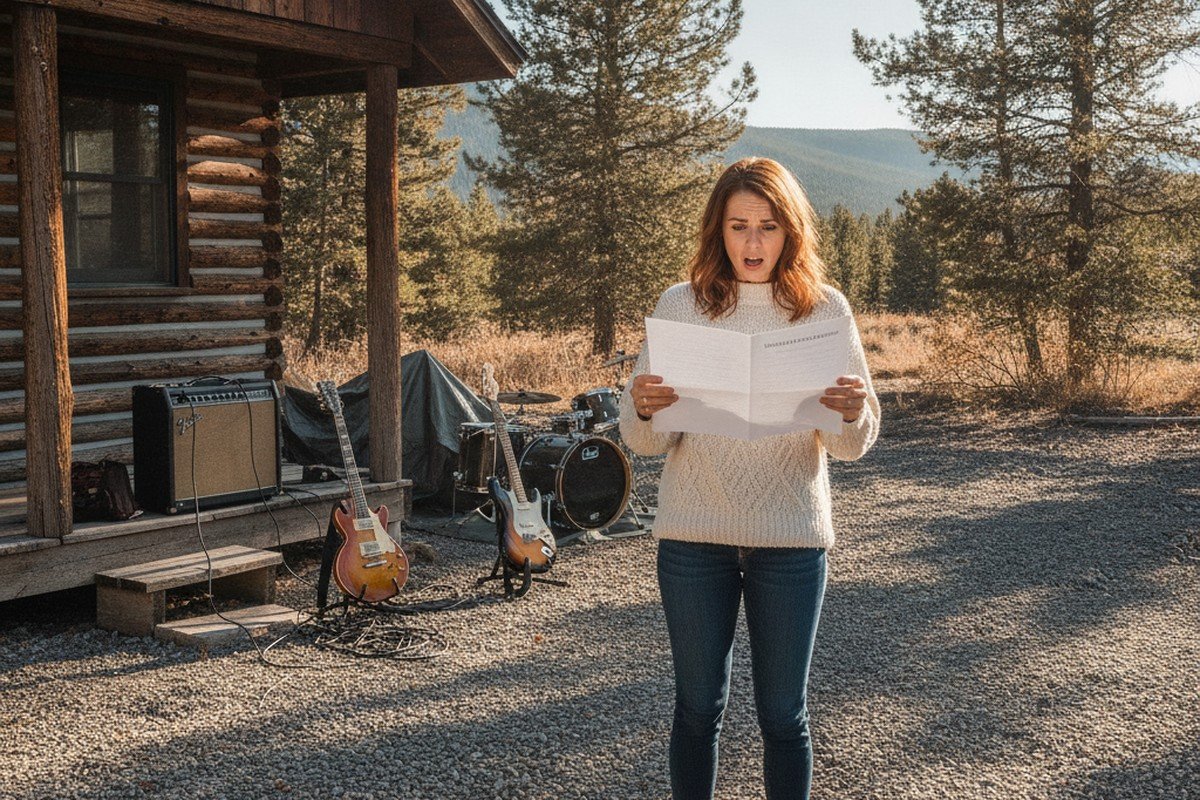
Parked across our pristine grass lawn were two rusted cargo vans, an open flatbed trailer loaded with empty speaker flight cases, and seven customized motorcycles.
The peaceful stone porch where my aunt once set up her easel was covered with crushed energy drink cans, plastic fast-food bags, and an industrial orange electrical cable snaking through an open front window.
Through the cabin’s double front windows, I could see five young men in denim vests and band t-shirts headbanging furiously around a full drum kit erected on our antique wool rug.
I stepped out of my car, the deafening wall of sound hitting my chest like a physical blow, and marched onto the porch with fury surging through my veins.
I pushed open the unlocked front door and shouted over the cacophony until the drummer finally noticed me and ceased his double-bass rhythm.
The room fell into a disorienting, ringing silence, leaving only the hum of oversized tube amplifiers and the smell of stale beer and burnt electrical wiring.
A lanky man with shoulder-length hair who identified himself as Jason stepped forward, wiping sweat with a rag, and demanded to know why I had barged into their rehearsal session.
I told Jason that I was the sole deeded owner of the cabin, that they were trespassing on private property, and that they had ten minutes to clear their equipment before I summoned the county sheriff.
Jason looked at me with genuine confusion, walked over to the wooden kitchen counter, and picked up a laminated plastic document folder.
He handed me a printed residential lease agreement titled “Whispering Creek Creative Retreat Sub-Tenancy Contract.”
I opened the folder and read the terms, my hands trembling with disbelief as my eyes scanned the signature block at the bottom of page four.
The contract explicitly granted Jason’s rock band, The Iron Spire, exclusive residential and rehearsal occupancy of our cabin for sixty consecutive days.
The monthly rent was listed as sixteen hundred dollars, with an upfront non-refundable security deposit of twelve hundred dollars paid in cash.
At the bottom of the document, printed in crisp black ink, was Derek’s unmistakable signature, accompanied by a forged copy of my utility billing statement used to prove property authority.
The contract date was March twelfth, meaning Derek had signed away my private sanctuary three full weeks before my scheduled sabbatical.
“We paid twenty-eight hundred dollars cash upfront to your husband Derek two weeks ago,” Jason insisted defensively, crossing his arms. “He told us the cabin was an unused investment property and that we could rehearse twenty-four hours a day without neighbor complaints.”
The reason this discovery was so catastrophic was that our cabin was located within an environmentally sensitive alpine conservation zone with strict noise and residential zoning ordinances.
Commercial rehearsals and unlicensed subleases carried severe municipal code penalties of up to five hundred dollars per day, and our homeowner insurance strictly excluded unauthorized commercial activity.
Furthermore, our antique pine floorboards were already deeply gouged by heavy iron amplifier stands and steel drum spurs.
I believed that if the neighbors down the creek called county code enforcement, I would face thousands of dollars in administrative environmental fines and risk having our residential water rights suspended.
I feared that the structural integrity of our late aunt’s hand-carved furniture and original interior wood would be ruined forever.
I wanted to protect my home and my family heritage, so I refused to accept their commercial presence for another hour.
The thought that Derek had deliberately exposed my inherited sanctuary to legal forfeiture filled me with cold indignation.
I looked Jason directly in the eye, keeping my voice cold and unwavering despite the panic hammering in my chest.
“Derek does not own this property, his name is not on the county land deed, and he had zero legal authority to execute this contract,” I stated firmly. “You have been defrauded, but this lease is legally void from its inception. If your equipment is not packed into those vans by seven o’clock tonight, the county deputies will impound every piece of gear on this property.”
Jason and his bandmates began shouting objections, pointing to their signed receipt and insisting that they had canceled their suburban warehouse lease based on Derek’s promises.
Instead of backing down, I unfolded our certified property deed from my travel portfolio and showed them the sole title registration under my name.
That was the moment the argument changed, because Jason realized that Derek was not a co-owner but an unauthorized third party who had pocketed their cash illegally.
Then Jason admitted that Derek had instructed them to keep the front gate closed and never answer the door if any female relatives visited.
This revelation proved that Derek had premeditated the entire deception, knowing full well that I would arrive for my sabbatical in early April.
Worse still, another band member showed me a text message from Derek promising that they could expand their rehearsal setup onto the rear lawn for an outdoor festival in June.
I discovered that Derek had collected a second advance installment of eight hundred dollars for utility surcharges just forty-eight hours earlier.
Until that afternoon, I had always believed Derek was simply overwhelmed by executive deadlines, but his calculated betrayal showed total contempt for our home and marriage.
I stepped out onto the porch, dialed Derek’s personal number, and waited for him to pick up.
Derek answered with a casual, cheerful tone, asking if I had arrived safely and whether the mountain air was helping my writing inspiration.
“Derek, I am standing in Clara’s living room looking at five band members, twelve guitar amplifiers, and a sixty-day sublease signed by your hand,” I said, my voice shaking with ice.
The line went dead quiet for five agonizing seconds before Derek began stammering incoherently.
“Cynthia, listen to me, let me explain before you do anything crazy,” Derek whispered frantically, clearly stepping away from his coworkers. “I was in a terrible financial bind. I owed four thousand dollars on an offshore sports betting platform, and they threatened to send commercial collection agents to my corporate office.”
The confession hit me like ice water; my husband had not merely overstepped a boundary, he had concealed a destructive gambling addiction and sacrificed my family heritage to cover his debts.
“You leased my sanctuary to pay off illegal gambling debts?” I whispered, tears of shock stinging my eyes. “You forged my utility bill and invited strangers to wreck my late aunt’s home!”
Derek begged me to let the band stay for just two weeks so he wouldn’t have to refund their deposit, but I refused to listen to another word of his rationalizations.
“You have twenty minutes to transfer twenty-eight hundred dollars back into my account so I can refund these musicians and get them off my land, or I am filing a criminal fraud complaint with the county sheriff right now,” I told him.
Realizing that his career and marriage were hanging by a thread, Derek panicked and transferred the funds from his personal credit reserve within fifteen minutes.
I confirmed the receipt of the wire transfer on my mobile banking portal, which verified that the full refund balance had cleared into my account.
I handed Jason his cash refund directly, took a signed receipt of lease termination, and supervised the band as they loaded their amplifiers, drums, and cables back into their vans.
By half past eight that evening, the gravel clearing was empty, leaving only tire ruts in the grass and the quiet murmur of Whispering Creek.
I spent the entire weekend sweeping pine needles, scrubbing beer stains from the floor, and assessing gouges in the historic woodwork.
I checked the county code enforcement registry online, which confirmed that no municipal noise violations had been filed against our parcel during the band’s forty-eight-hour stay.
That discovery provided tremendous relief, because an active citation would have required a formal hearing before the county zoning board.
On Saturday morning, I walked through every room of the cabin with a digital camera and a yellow legal pad, documenting every scratch, scrape, and electrical overload scorch mark.
The heavy iron amplifier feet had left deep depressions in Clara’s antique hand-scraped yellow pine floorboards near the fieldstone fireplace.
I unfolded the original restoration invoice from five years ago to verify the specific timber sealant Clara had chosen for the living room floor.
I called an independent timber restoration craftsman named Frank Miller, who lived eight miles south down the valley road, and asked him to evaluate the damage.
Frank arrived at noon in his work truck, inspected the gouged planks with a brass depth gauge, and estimated that repairing the timber would cost twelve hundred dollars.
Frank explained that while the grooves were deep, the antique pine was thick enough to withstand a gentle precision sanding without losing its historical hand-planed character.
Hearing Frank’s professional assessment reassured me that Clara’s sanctuary could be completely healed through skilled labor and proper materials.
Later that Saturday afternoon, Derek sent a long email containing screenshots of his offshore betting accounts, attempting to prove that he had permanently self-excluded from every online gaming platform.
I read the electronic statement carefully, noticing that his total wagering losses over the preceding eight months exceeded eleven thousand dollars.
The sheer scale of his reckless gambling proved why our shared household savings had remained mysteriously flat despite his substantial quarterly salary.
I realized that Derek’s promises of reform were completely meaningless unless backed by binding legal safeguards and third-party accountability.
I refused to let emotional sympathy weaken the practical boundaries necessary to secure my life and assets.
On Sunday morning, I drafted an itemized financial separation schedule and sent it to my family law attorney in the county seat.
I stipulated that Derek would assume sole legal responsibility for all personal debts, reimburse the full twelve-hundred-dollar wood repair expense, and sign an irrevocable quitclaim disclaimer verifying that he possessed zero marital equity in the Whispering Creek cabin.
When Monday morning arrived, I drove down to the county clerk’s office and filed a formal certified copy of Clara’s original will and deed to ensure our title remained entirely unclouded.
I met with my attorney, Sarah Jenkins, who confirmed that Derek’s forged utility document constituted civil fraud and gave us overwhelming leverage to secure a strict post-nuptial protection agreement.
Sarah reviewed the band’s signed lease termination receipt, which verified that Jason and his musicians had waived all further tenancy claims against our address.
On Tuesday evening, Derek drove up the gravel road in his sedan, looking pale, haggard, and visibly chastened as he stepped onto the porch.
He carried a formal cashier’s check for twelve hundred dollars to cover the floor restoration and handed it to me without a word of argument.
I handed Derek his packed luggage and the formal post-nuptial separation agreement drafted by my attorney.
“Derek, you will sign this legal document confirming you have zero claim on this property, and you will attend mandatory weekly counseling for your addiction,” I told him calmly.
Derek broke down in tears on the front steps, finally acknowledging the profound damage his deceit had inflicted on our partnership.
“I was so terrified of being exposed as a failure that I almost burned down everything we loved,” Derek whispered, signing the agreement against his leather portfolio.
The consequence for Derek was profound: he was removed from all shared household accounts, required to attend four weekly recovery sessions, and forced to face the humiliation of his actions before our extended families.
The consequence for me was total autonomy over my property and the permanent legal safeguarding of Clara’s artistic sanctuary.
I took the extra precaution of changing every exterior lock, installing automated smart deadbolts with cellular activity logs, and posting formal private property trespass notices at the road gate.
The cost of the repair was significant: I spent twelve hundred dollars to have the antique pine floors professionally sanded and refinished to remove the amplifier gouges.
Because I confronted the situation decisively, the commercial sublease was extinguished before any municipal fines were issued, and the quiet rhythm of the valley was restored.
The following month, Frank completed the floor restoration, leaving the yellow pine glowing with rich amber oil that highlighted every natural ring in the grain.
With the house restored to pristine silence, I spent the remaining days of my sabbatical immersed in my manuscript, completing seventy pages of detailed regional history.
Two months later, I sat on the refinished wrap-around porch in the warm June sun, listening to the creek and reviewing the final published proofs of my book manuscript.
My aunt’s legacy remains safe, the mountain air stays pure, and the firm boundary I established now protects my life permanently.
True partnership is rooted in honesty and mutual respect; it never sacrifices a spouse’s peace to conceal a secret vice.
The cabin stands serene among the ponderosa pines, completely peaceful, entirely protected, and forever guarded against deceit.
I will continue cherishing this mountain haven with the same fierce devotion Clara demonstrated throughout her life.
And whenever I sit beside Whispering Creek watching the sunlight dance across the clear water, I will remember the Friday afternoon I drew the line that kept our heritage unbroken.