On Wednesday morning, the rhythmic hum of our computer-controlled plasma cutter filled the spacious industrial workshop of Ironwood Architectural Fabrication.
As the founder and master artisan of our studio, I had spent twelve grueling years establishing our reputation for bespoke bronze staircases, hand-forged steel architectural screens, and public sculpture commissions.
For years, our enterprise had adhered to rigorous safety protocols, maintaining impeccable compliance with state environmental guidelines and artisan guild standards.
My career was defined by respect for material integrity, structural permanence, and meticulous civic building code adherence.
Our enterprise operated out of a four-thousand-square-foot commercial building in an industrial park, featuring high ceilings, heavy overhead cranes, and a dedicated concrete loading dock.
Inside the main shop floor, five certified metal artisans worked with TIG welders, hydraulic press brakes, and diamond-grit polishing stations.
We took enormous pride in creating architectural landmarks that would endure for generations in civic spaces across the country.
I held a ninety percent controlling equity stake in the corporation, while the remaining ten percent was owned by my estranged cousin Trevor Mercer.
Our team held certified AWS D1.1 structural welding endorsements, allowing us to fabricate critical load-bearing architectural assemblies for major public institutions.
Trevor had received his minority shares seven years earlier in exchange for a modest family seed loan that had long since been repaid with interest.
Trevor operated an independent mobile pressure-washing service, but his chronic gambling debts and reckless business shortcuts kept him on the verge of bankruptcy.
Under our corporate bylaws, Trevor possessed zero operational authority, no check-writing privileges, and no right to bind Ironwood to commercial contracts.
I had maintained strict professional boundaries with Trevor, permitting him only to attend our annual shareholder review and receive his small annual dividend distribution.
Because Trevor had repeatedly demonstrated poor financial judgment, I had explicitly barred him from storing personal equipment or conducting third-party business on our premises.
Trevor had always complained that our metal studio possessed valuable unused floor space and freight capacity that we should monetize through commercial logistics.
I had firmly rejected his proposals, explaining that our facility was permitted strictly for architectural metal fabrication and artistic welding.
I believed that our clear operating agreements and legal corporate structure provided an impenetrable shield against any unauthorized interference.
The reason Trevor targeted Ironwood was that commercial chemical distributors strictly refuse to sell or ship bulk industrial solvents to unverified residential addresses or mobile businesses.
Trevor needed an established commercial industrial facility with an active EPA hazardous waste generator profile, an industrial street address, and an open commercial loading dock.
He wanted desperately to purchase forty barrels of surplus industrial trichloroethylene degreaser at auction prices, planning to repackage the toxic solvent into five-gallon pails for black-market automotive body shops.
I thought our family distance was complete, but Trevor routinely viewed our company as an exploitable resource for his dangerous black-market schemes.
I feared that his total disregard for environmental regulations would eventually cause a catastrophic chemical disaster or trigger fatal industrial workplace accidents.
The thought that my life’s work could be reduced to ashes by toxic negligence filled me with acute protective fury.
The museum staircase project required over eight tons of custom-cast silicon bronze, engineered to withstand rigorous seismic and dynamic pedestrian load ratings.
I wanted to protect my dedicated craftsmen and preserve the pristine architectural heritage of our company.
In the quiet of the morning shift, my lead welder Marcus and I reviewed the precision installation blueprints for our upcoming museum commission.
At nine-thirty in the morning, a massive fifty-three-foot commercial tractor-trailer from Western Freight Express backed up to our concrete loading dock, its air brakes hissing loudly.
I set down my TIG welding torch, slipped off my protective helmet, and walked out onto the dock in my leather work apron to meet the driver.
The freight driver stepped down from the cab holding a digital clipboard and a thick paper manifest envelope.
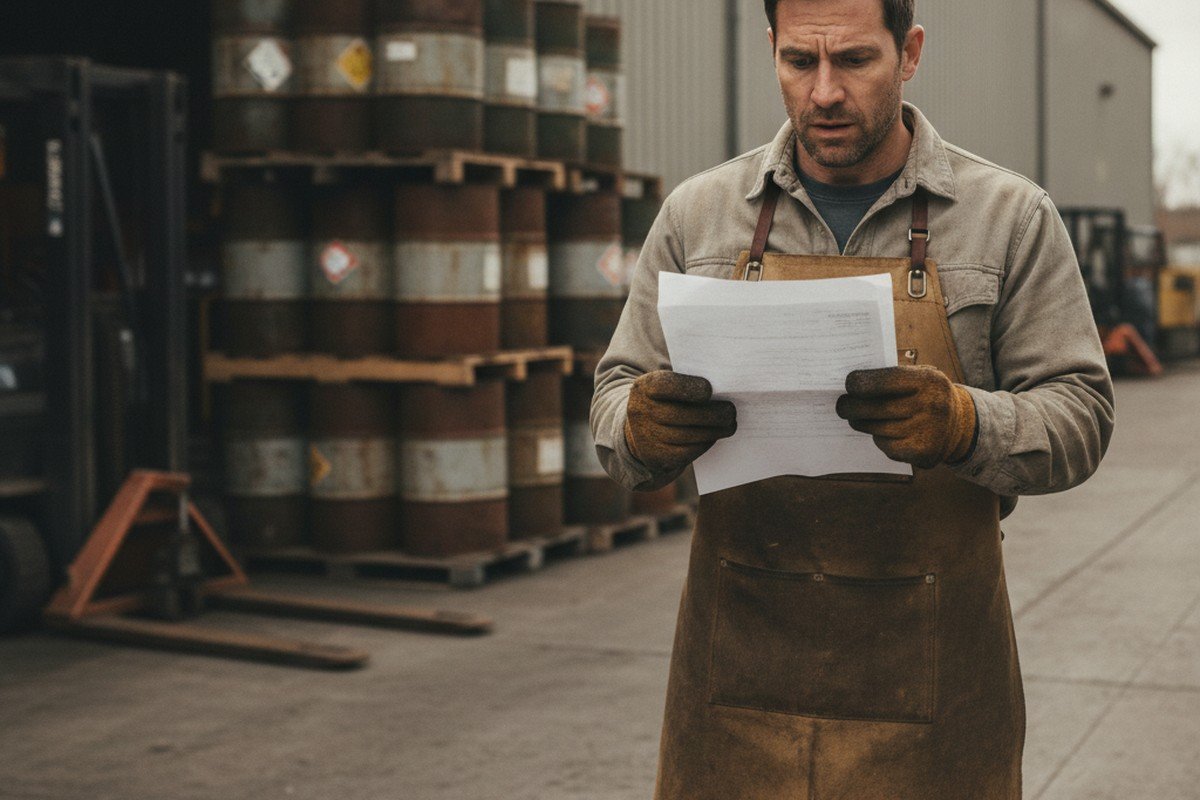
“Delivery for Ironwood Architectural Fabrication: forty 55-gallon drums of industrial degreasing solvent, hazardous Class 3 flammable liquids,” the driver announced briskly.
I stared at the freight driver in utter disbelief, feeling a wave of ice-cold adrenaline surge through my chest.
“I never ordered forty barrels of industrial solvent! This is an architectural metal shop, not a chemical processing facility!” I told him with immediate urgency.
The driver pulled the physical paper bill of lading and hazardous material declaration from the envelope and handed the paperwork to me.
I opened the paper and read the document carefully: the shipping manifest listed customer Ironwood Architectural Fabrication, displaying our corporate account number, federal tax ID, and facility address.
The booking record showed that the shipment had been arranged on Monday afternoon, carrying an expedited freight charge of eighteen hundred dollars billed directly to my commercial credit line.
Worse still, listed in the primary delivery notification box was a secondary contact name and cellular number: Trevor Mercer, Operations Director.
The document confirmed that Trevor had stolen our commercial freight account credentials from an old billing invoice he had photographed while visiting our office last winter.
I examined the hazardous material safety data sheet attached to the freight manifest, noting that trichloroethylene vapors are heavier than air and rapidly displace oxygen in low-lying industrial workspaces.
I examined the United Nations hazardous chemical classification code on the manifest: UN 1710, designating trichloroethylene, a known carcinogenic industrial solvent with extreme vapor volatility.
I pulled out my emergency response handbook and pointed to the mandatory storage specifications requiring hermetically sealed vapor recovery and explosion-proof containment.
My hands tightened on the clipboard with righteous fury as I realized Trevor had forged my commercial credentials to ship over two thousand gallons of highly toxic, explosive industrial solvent to my facility.
The freight driver, witnessing my immediate inspection of the hazardous placards, stepped back from the dock and acknowledged that carrier protocol required immediate refusal upon notice of identity fraud.
This breach of trust meant that our studio was in immediate danger of catastrophic fire code violations, severe environmental contamination, and immediate operational shutdown.
The cost of hazardous material cleanup fees and environmental protection agency penalties would easily exceed fifty thousand dollars, threatening to bankrupt my entire life’s work.
Just as I was examining the fraudulent documents, Trevor’s battered commercial cargo van pulled into our industrial parking lot, parking directly beside the freight trailer.
Trevor hopped out of his van wearing rubber boots and a stained canvas jacket, walking toward the loading dock with a broad, confident grin.
“Hey Aaron! Look at that, the shipment arrived right on schedule!” Trevor called out, waving his hand toward the back of the trailer.
I walked to the edge of the dock, holding the fraudulent bill of lading in my hand, my voice vibrating with icy intensity.
“Trevor, step away from that truck right now,” I said with cold clarity.
“Aaron, come on, help me unload these drums with the shop forklift into bay two,” Trevor replied, starting up the dock ramp.
“You used my corporate shipping account, my federal tax ID, and my facility address to illegally import two thousand gallons of hazardous chemical solvent!” I shouted.
Trevor stopped on the ramp, his grin fading into an uneasy, defensive scowl.
“Aaron, relax for five minutes! This is an incredible commercial opportunity!” Trevor argued, looking around the parking lot.
“I bought these surplus solvent barrels from an aerospace bankruptcy auction for twenty cents on the dollar,” Trevor continued. “We can repackage them into five-gallon pails and make fifteen thousand dollars in cash profit this weekend!”
Trevor’s voice cracked with panic as he realized that the commercial freight carrier would hold the hazardous cargo in regulatory impound at an exorbitant daily demurrage rate.
“I am not an accomplice to illegal hazardous chemical trafficking, Trevor!” I answered, holding my ground.
“Our facility is not permitted to store Class 3 flammable solvents, and storing these drums here violates municipal fire codes, EPA regulations, and my commercial insurance policy!” I told him.
The confrontation escalated when Trevor admitted that he had already rented an unventilated public mini-storage unit across town to hoard the repackaged solvent pails.
He admitted that his unlicensed automotive buyers had agreed to pay him twelve thousand dollars in physical cash upon delivery at an unpermitted rural body shop.
That admission proved that he had planned to create an catastrophic explosion risk in a public storage facility, showing sociopathic indifference to human life.
Trevor also confessed that he had borrowed nine thousand dollars from a predatory private lender to secure the auction lot, leaving him desperate for immediate liquid cash.
Then Trevor revealed that he had forged my signature on the hazardous materials carrier declaration, certifying that our facility possessed secondary containment berms and emergency hazmat response equipment.
That was the moment the argument changed, because I discovered that Trevor had committed federal transportation fraud and commercial forgery using my professional license.
Instead of backing down, Trevor attempted to bribe me, offering to give me seventy percent of the black-market profits if I allowed the driver to offload the forty drums.
I turned directly to the freight driver and said: “Driver, this shipment is officially refused due to commercial fraud and identity theft. Do not offload a single barrel onto this dock.”
The driver looked at the bill of lading, saw my formal written refusal stamped on the manifest, and immediately closed the trailer doors, locking the heavy steel padlock.
“You can’t refuse the load, Aaron! I paid nine thousand dollars for those chemicals at auction! If the freight company returns them to a hazardous holding facility, I will lose everything!” Trevor screamed frantically.
Fire Marshal Ramirez tested the emergency shutoff valves on our shop ventilation systems, noting that Ironwood maintained exemplary safety records that contrasted sharply with Trevor’s hazardous scheme.
“You should have thought about that before committing commercial fraud in my name,” I told him.
I pulled out my smartphone and dialed Western Freight Express corporate fraud division, reporting the unauthorized account compromise and voiding the eighteen-hundred-dollar shipping fee.
Then I called the regional environmental protection authority and the municipal fire marshal, reporting an unauthorized hazardous chemical transit attempt by Trevor Mercer.
Hearing me speak directly to the municipal fire marshal, Trevor panicked, sprinted back to his cargo van, slammed the door, and sped out of the industrial park in a cloud of exhaust.
The freight driver departed immediately, returning the forty hazardous drums to the certified industrial carrier depot under regulatory custody.
At one o’clock in the afternoon, the municipal fire marshal and an environmental compliance officer arrived at my facility to inspect the loading dock and review the paperwork.
In the workshop office, I presented the bills of lading, the surveillance video footage showing Trevor’s arrival, and my formal account fraud dispute documentation.
Fire Marshal Ramirez inspected the concrete apron, verifying that no chemical containers had been unsealed or offloaded onto our property.
Corporate counsel Amanda Vance filed the emergency certificate of cancellation with the Secretary of State, officially updating our corporate filings to reflect my one hundred percent sole ownership.
The fire marshal commended my immediate refusal of the shipment, confirming that storing forty drums of trichloroethylene without vapor recovery systems would have resulted in immediate facility shutdown and criminal prosecution.
The environmental compliance officer issued an official clean site clearance document, certifying that no hazardous leakage or containment breach had occurred on my property.
On Friday morning, I visited our corporate legal counsel, Amanda Vance, to initiate emergency shareholder proceedings.
In her downtown conference room, Amanda reviewed the corporate operating contract, the forged freight declarations, and the regulatory police reports.
Amanda drafted a formal petition to dissolve Trevor’s minority equity stake under the fraud and bad-faith clauses of our corporate shareholder agreement.
The evidence was incontrovertible: Trevor’s forged declarations, the fraudulent freight bookings, and the official regulatory incident reports provided absolute justification for immediate expulsion.
Within ten days, our corporate board executed a mandatory forfeiture of Trevor’s ten percent shares, expelling him permanently from Ironwood Architectural Fabrication.
In the aftermath of the emergency board vote, we reclaimed all corporate shares and secured the legal standing of the studio.
The municipal court’s restraining order also prohibited Trevor from contacting any of our material suppliers, freight carriers, or commercial clients.
The legal consequence for Trevor was swift and devastating: state environmental regulators impounded his mobile pressure-washing van, seizing his equipment and assessing forty-five thousand dollars in environmental violation penalties.
The municipal court also issued a permanent restraining order barring Trevor from coming within five hundred yards of our facility or contacting our staff.
The social consequence for Trevor was complete exile from our extended family, who were horrified to learn that he had risked our lives and businesses for quick black-market cash.
For Ironwood Architectural Fabrication, the consequence was enhanced security, structural integrity, and elevated commercial prestige.
I upgraded our facility security protocols, installing biometric access controls on all bays and implementing dual-signature requirements on all commercial logistics accounts.
Over the following weeks, my fabrication team completed a ninety-thousand-dollar monumental bronze staircase commission for a prestigious regional art museum.
Our workshop hummed with the bright blue glow of welding arcs, the rhythmic precision of laser cutters, and the pride of uncompromised craftsmanship.
During the museum installation, our ironworkers positioned the grand staircase with millimeter precision, bolting the monumental bronze stringers to the structural concrete core.
We spent days meticulously hand-rubbing the bronze balustrades with warm wax and sulfur patinas to achieve a luminous, velvety finish.
Three months later, I stood on the finished museum staircase, running my hand along the hand-rubbed satin bronze balustrade as the museum director praised our immaculate work.
At the grand museum dedication gala, the board of trustees presented our studio with a commemorative bronze plaque honoring our contribution to public architectural heritage.
Now my loading dock stays clean, the industrial air remains safe, and my company’s reputation stands completely untarnished.
The following month, our studio was awarded the regional architectural heritage award for structural excellence and civic safety.
Now our shop remains a beacon of artistic craftsmanship, our team works in total security, and our contracts flourish.
The museum curator highlighted Ironwood’s unwavering commitment to safety and material authenticity in the exhibition catalog distributed to three thousand attendees.
I defended my business and my life’s work through decisive, unwavering integrity, establishing an unbreakable boundary that safeguards my enterprise permanently.
The resolution brought complete closure to a dangerous threat and reinforced our commitment to ethical, uncompromising excellence.
Because true artistry is rooted in structural discipline and uncompromising honesty, I defended my life’s work and secured its future forever.
Standing beneath the towering skylights of our workshop as molten sparks cascaded from a custom forge, I knew that our creative enterprise was invincible.
The strength of our creations reflected the unyielding integrity of the principles that built them.
We forged our future through uncompromising honesty, ensuring that our artistic vision would inspire generations to come.
Looking across the immaculate shop floor at the finished bronze architectural screens ready for dispatch, I felt immense pride in the uncompromising standards that defined our legacy.