On Friday morning, my commercial flight from Seattle touched down three days ahead of schedule after our annual environmental compliance symposium wrapped up earlier than expected.
As a certified environmental data analyst, my career was built around measuring volatile organic compounds, monitoring industrial emissions, and enforcing clean air quality standards.
For six years, I had lived in a peaceful, tree-lined suburban neighborhood where single-family homes sat on spacious quarter-acre parcels with quiet backyards.
My property featured a finished, detached two-car garage at the end of a long asphalt driveway, which I had painstakingly remodeled into a spotless woodworking studio and home fitness space.
Inside that structure, I kept over thirty thousand dollars worth of calibrated digital air sensors, seasoned walnut lumber, and specialized dust-filtration equipment.
Before leaving for my three-week West Coast assignment, I had entrusted a spare brass house key to my younger brother Kevin.
Kevin was twenty-seven years old, working irregular shifts as a tire warehouse technician, and constantly pursuing ill-conceived commercial ventures that ended in debt.
I had asked Kevin to handle two straightforward domestic tasks during my absence: water my indoor orchid collection twice each week and collect the postal mail from my curbside box.
I gave Kevin explicit written instructions that my detached garage was strictly off-limits under all circumstances, explaining the value of my sensitive instrumentation.
Kevin had smiled, pocketed the brass key, and promised that he would respect my property boundaries and visit only to water the plants.
Because Kevin was my brother, I had chosen to trust his word, never imagining that he viewed my quiet residential property as an opportunity for unlawful commercial exploitation.
I believed that Kevin understood the severe legal ramifications of residential zoning restrictions and toxic hazardous chemical handling.
The reason Kevin routinely crossed boundaries was his chronic financial instability and his belief that municipal regulations were merely optional guidelines for other people.
He wanted desperately to launch an independent automotive paint and body business, but his rental apartment lease strictly banned mechanical work and spray painting.
I thought our firm verbal and written agreement was sufficient to protect my home, but Kevin routinely treated family property as disposable personal inventory.
I feared that his reckless disregard for safety would eventually cause catastrophic physical damage or trigger crushing legal liabilities for our family.
The thought that my home could be endangered while I was hundreds of miles away had never crossed my mind during my travels.
I wanted to believe that Kevin was maturing and capable of respecting ordinary adult responsibilities.
At ten o’clock in the morning, a rideshare vehicle dropped me off at the bottom of my driveway beneath clear autumn skies.
The moment I stepped onto the pavement, a sickening stench of industrial polyurethane enamel, acetone, and lacquer thinner caught in my throat, burning my sinuses immediately.
Parked across my manicured front lawn and driveway were four battered, un-muffled fleet sedans with missing bumpers, their rusty chassis resting on hydraulic floor jacks.
A deafening roar from a large diesel air compressor echoed from behind the house, rattling the cedar fence planks and vibrating through the ground.
I sprinted down the paved driveway toward the detached garage, my heart racing with disbelief and rising fury.
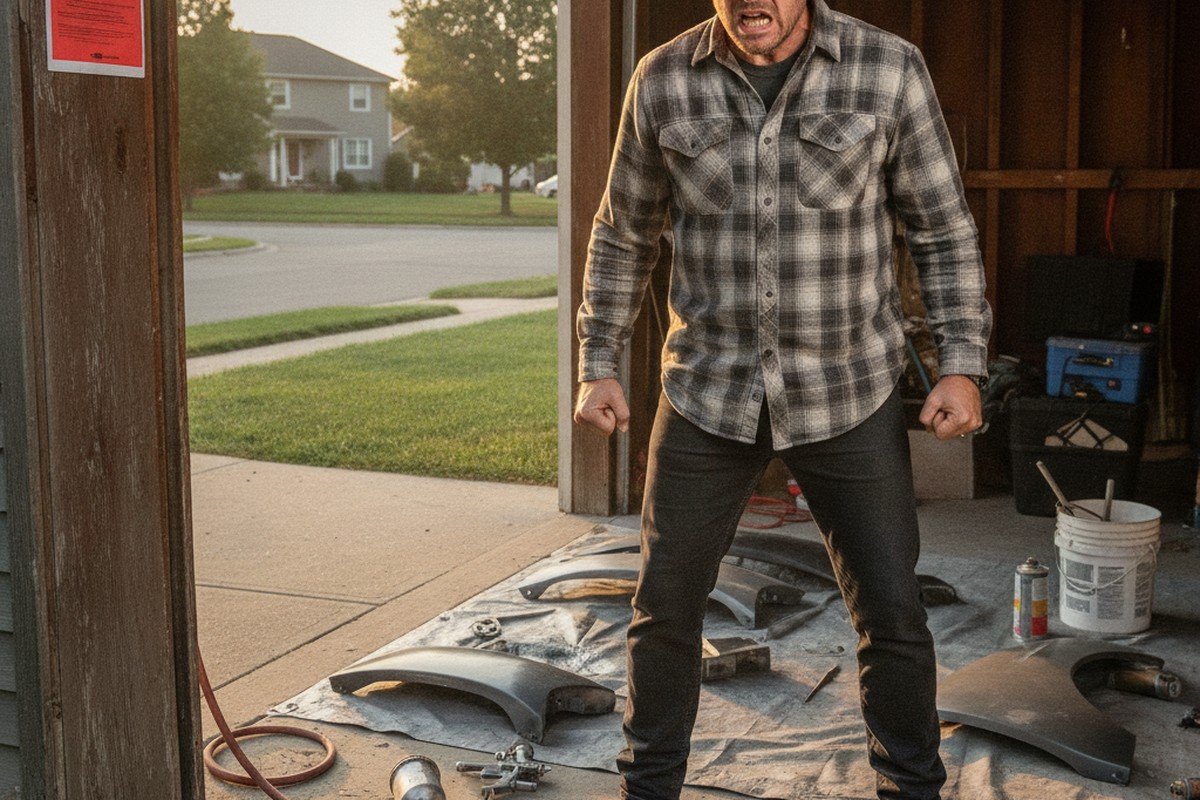
Taped directly across the painted exterior door frame was a bright red paper document: an official municipal code enforcement citation and emergency stop-work order.
I opened the paper and read the document carefully: the citation cited property owner Daniel Miller for unlawful operation of an unpermitted commercial spray-painting business in a residential zone.
The notice carried an immediate municipal fine of one thousand five hundred dollars and warned that failure to abate hazardous chemical discharge within twenty-four hours would result in municipal court prosecution.
I opened the side entry door and stepped into a blinding, suffocating cloud of toxic aerosol mist that hung in the air like a dense chemical fog.
My pristine studio was unrecognizable; heavy industrial plastic sheeting was stapled across my drywall, coated in thick dripping layers of midnight-blue automotive paint.
My calibrated air quality sensors and polished walnut woodworking benches were shoved into a corner, covered in metal grinding dust, grease, and overspray.
Standing in the center of the workshop wearing a paper dust mask was Kevin, holding a pneumatic spray gun and applying clear-coat lacquer to a detached car door.
Beside Kevin sat three open five-gallon buckets of industrial lacquer thinner and piles of solvent-soaked shop rags resting inches from an active electric space heater.
“Kevin! Shut that compressor off right now!” I yelled, coughing violently as the chemical fumes seared my lungs.
Kevin spun around, startled, dropping his spray gun onto a piece of cardboard and pulling down his paper mask with a sheepish grin.
“Daniel? You weren’t supposed to land until Monday afternoon!” Kevin exclaimed, looking nervously around the ruined workshop.
“You turned my private property into an illegal commercial spray shop and racked up a fifteen-hundred-dollar municipal violation!” I shouted, holding up the bright red citation.
Kevin switched off the compressor, and a sudden, tense silence settled over the fume-filled garage.
“Daniel, relax for two minutes and let me explain the situation,” Kevin pleaded, wiping his paint-stained hands on a greasy towel.
“Explain why four unregistered vehicles are tearing up my front lawn and why toxic fumes are pouring into my neighbors’ windows?” I demanded.
“A commercial car dealer paid me thirty-five hundred dollars in cash to prep and paint four fleet cars for an auction this weekend,” Kevin explained.
“You used my home address without my consent to run an unpermitted hazardous business!” I answered, refusing to let him deflect.
“I was going to clean everything up, wash the floor, and air the room out before you returned on Monday,” Kevin insisted.
“These industrial polyurethane paints contain hazardous isocyanates that require explosion-proof ventilation booths and charcoal scrubbing! You could have ignited this entire building!” I countered.
I walked over to the electrical subpanel and discovered that Kevin had spliced an ungrounded commercial cable directly into my 240-volt circuit breaker to power an industrial heat lamp.
This makeshift wiring had already scorched the insulation along the junction box, creating an immediate electrical fire hazard inches from open solvent cans.
The confrontation escalated when Kevin admitted that he had already spent two thousand dollars of the client’s cash deposit on high-performance racing tires for his own pickup truck.
That admission proved that he had zero capital reserves to pay for professional cleanup or reimburse the municipal citation.
Then Kevin revealed that he had forged my name on an equipment rental contract to lease the high-output diesel compressor sitting beside my patio.
That was the moment the argument changed, because I realized Kevin had committed intentional commercial fraud using my personal identity.
Instead of showing remorse, Kevin attempted to bargain, offering to pay me five hundred dollars from the final job payment if I allowed him to finish spraying the remaining vehicles.
“Not another ounce of paint is being sprayed on this property, Kevin. Turn off the heater, pack your personal hand tools, and hand over my brass house key right now,” I said with absolute finality.
Kevin hesitated, his defensive expression souring into resentment, but seeing the cold resolve in my eyes, he unclipped the key and slapped it onto my worktable.
Thirty minutes later, in my kitchen, I poured a glass of cold water and placed an urgent call to the municipal code enforcement division.
I spoke directly with Senior Inspector Rodriguez, explaining that I had been out of town on business and that an unauthorized third party had operated the equipment without my knowledge or consent.
Inspector Rodriguez reviewed the file and agreed to conduct an immediate on-site inspection that afternoon to assess the environmental status.
Next, I dialed the equipment rental company listed on the compressor lease document and informed their dispatch manager that the machine had been rented fraudulently under my name.
The rental manager apologized, canceled the fraudulent account entry, and dispatched an industrial flatbed truck to retrieve the compressor within two hours.
At one o’clock in the afternoon, Inspector Rodriguez pulled up to the driveway in his marked municipal vehicle, accompanied by two code compliance technicians.
I walked Inspector Rodriguez through the property, presenting my airline boarding passes, hotel receipts, and the signed key agreement demonstrating my absence.
Inspector Rodriguez inspected the garage interior, taking air quality readings and photographing the improperly stored solvent buckets and overspray damage.
“Mr Miller, because you reported this breach immediately and took proactive steps to halt operations, the municipality will reassign the primary citation and fifteen-hundred-dollar fine directly to Kevin Miller,” Inspector Rodriguez stated.
Inspector Rodriguez then handed me a formal municipal compliance notice detailing the mandatory remediation protocols required to restore the structure to residential standards.
The document specified that all contaminated materials had to be professionally hauled by a certified hazmat remediation contractor to prevent chemical leaching into the neighborhood watershed.
While we were standing in the driveway, my next-door neighbor, Mrs Henderson, walked across her lawn holding her handkerchief to her face.
Mrs Henderson explained that the chemical fumes had been drifting into her living room since Wednesday, triggering her chronic respiratory asthma.
I apologized sincerely to Mrs Henderson, showing her the city stop-work order and promising that all commercial activity had been permanently terminated.
At two-thirty in the afternoon, a flatbed tow truck arrived to repossess the leased diesel compressor, hauling the noisy machine away from my patio.
Shortly before three o’clock, the owner of the fleet sedans, an aggressive used-car dealer named Vince, pulled into the driveway in an oversized SUV.
Vince stepped out, chewing on a toothpick, and marched toward the garage demanding to know why the painting operation had stopped.
“Where is Kevin? These cars need to be clear-coated and delivered to the auto auction by eight tomorrow morning!” Vince shouted loudly.
I stood at the entrance of my driveway, holding the municipal stop-work order and Inspector Rodriguez’s official business card.
“Kevin does not own this property, and this site is closed under municipal order for hazardous code violations,” I told Vince evenly.
“I gave that kid thirty-five hundred bucks in cash! If these cars aren’t finished, I’m taking the equipment in that garage!” Vince threatened, stepping forward.
“If you take one step onto this private property, I will immediately summon the police for criminal trespass,” I replied calmly. “You have two hours to arrange flatbed towing for these four unlicensed vehicles, or municipal parking enforcement will impound them at your expense.”
Vince glared at me, glanced at the official municipal seal on the citation, and pulled out his phone, cursing loudly as he arranged emergency towing.
By four-thirty in the afternoon, two commercial tow trucks had cleared all four battered sedans from my front lawn and driveway, leaving behind crushed grass and oil stains.
At five o’clock, our parents, Arthur and Martha, arrived at my front porch after receiving an emotional, hysterical phone call from Kevin.
My mother was visibly distressed, while my father wore a stern, exasperated expression as they stepped into my living room.
“Daniel, Kevin says you called the city on him and threw away his chance to start a legitimate career!” my mother cried, clutching her purse.
“Kevin committed commercial fraud, forged my signature on heavy equipment leases, and turned our family property into a toxic fire trap while I was traveling,” I replied firmly.
I opened my laptop on the dining room table and displayed the surveillance footage, the photos of lacquer thinner sitting inches from the open heater, and the municipal citation.
My father leaned over the screen, his jaw clenching as he reviewed the photographic evidence of the hazardous conditions.
“Martha, look at this,” my father said quietly to my mother. “He had open solvents right next to a glowing heating element. The whole garage could have blown up.”
“Kevin told us he was just touching up a bumper for a friend!” my mother whispered, her face going pale as the reality sank in.
“He was spraying industrial polyurethane without permits or ventilation, racking up municipal penalties and jeopardizing my homeowner insurance,” I explained.
“We wanted him to succeed, Daniel, but this was utterly reckless,” my father acknowledged, putting an arm around my mother’s shoulders.
My parents agreed that Kevin needed to face the full legal and financial consequences of his actions without any family bailouts.
On Saturday morning, a certified environmental remediation team arrived at my property with specialized HEPA air scrubbers and solvent extraction gear.
Over the weekend, the technicians stripped away the contaminated plastic, scrubbed the drywall with neutralizing agents, and purified the interior air quality.
The professional cleanup invoice totaled three thousand two hundred dollars, which was submitted directly to the municipal court as part of Kevin’s restitution file.
On Tuesday morning, I attended the municipal administrative hearing alongside Inspector Rodriguez.
The hearing officer reviewed the photographic evidence, the forged lease paperwork, and the inspection reports, issuing a binding restitution order against Kevin for four thousand seven hundred dollars to cover the fine and remediation costs.
The judge also placed Kevin on twelve months of administrative probation, barring him from operating any automotive enterprise without proper commercial licensing.
The financial consequence forced Kevin to take an extra night shift at the tire warehouse and surrender his prized racing tires to satisfy his debts.
The social consequence for Kevin was significant; our extended family realized that his charm hid a pattern of reckless deceit, and they ceased offering him unmonitored access to their assets.
For my property, the consequence was a thorough restoration and the implementation of uncompromising security measures.
I replaced the mechanical locks on the garage with commercial biometric deadbolts linked to a monitored smart-security alarm system.
In the aftermath of the cleanup, I purchased a medical-grade HEPA air filtration unit as a gift for Mrs Henderson to ensure her home remained completely free of lingering odors.
Mrs Henderson thanked me warmly, expressing deep gratitude for handling the neighborhood disturbance with speed and consideration.
Over the following weeks, I replanted my damaged front lawn with fresh fescue sod, repainted the interior garage walls with clean white enamel, and reinstalled my calibrated environmental sensors.
Two months later, I spent a tranquil Saturday morning crafting a custom walnut dining table in my restored workshop, breathing clean, fresh air as sunlight streamed through spotless windows.
Now my garage remains a spotless sanctuary of creative craftsmanship, free from chemical hazards or unwanted intrusions.
My home had returned to a place of safety, order, and peaceful productivity.
I protected my home and my professional reputation through disciplined, uncompromising action, ensuring that my property would never again be exploited.
The lessons learned throughout this ordeal reaffirmed the essential truth that setting firm, unyielding boundaries is the greatest act of self-preservation.
Because true integrity requires confronting betrayal with unflinching clarity, I stood my ground and secured the lasting sanctuary of my home.
Standing in the clean evening light beside my fragrant cedar fence, I felt profound gratitude for the quiet tranquility of my neighborhood.
The clear autumn air carried only the scent of fallen maple leaves and damp earth, a reminder that peace is preserved through decisive vigilance.