On Wednesday morning, I walked out to our curbside mailbox under a canopy of blooming dogwood trees on our quiet residential street.
As a museum graphic archivist, I spent my days preserving delicate nineteenth-century botanical manuscripts and historic photographic prints.
My work demanded extreme precision, working under polarized laboratory lamps with specialized micro-spatulas and reversible wheat starch paste to stabilize fragile historical documents.
I understood the sacred value of preserving delicate artifacts without altering their true texture or compromising their historical integrity.
My seventeen-year-old daughter Maya was a brilliant, hardworking high school senior who had recently achieved her dream of receiving an admission letter to the state university architecture honors program.
Because I had raised Maya as a single mother while maintaining a modest museum salary, paying university tuition required applying for every available need-based grant and academic scholarship.
Two months earlier, Maya had written a deeply personal, confidential personal statement and financial hardship appeal for the university scholarship endowment committee.
In that confidential document, Maya wrote honestly about her past childhood recovery from a severe spinal orthopedic surgery, our family modest finances, and her determination to design accessible public buildings.
The appeal letter contained vulnerable details about our family financial struggles and medical bills that Maya had never shared with anyone outside our immediate household.
She recounted how three grueling years of pediatric physical therapy had taught her to walk with grace and designed universal accessibility ramps into every school architectural sketch she created.
I had printed a single reference copy of the completed appeal packet and placed the document inside a pale blue folder on the desk in our home library.
My mother Evelyn lived six blocks away in a historic brick townhouse and served as the longtime program chairwoman for the Oakridge Women’s Civic and Philanthropic Circle.
Evelyn was a woman who placed immense value on social prestige, regional standing, and being perceived as the benevolent matriarch of our suburban community.
She frequently visited our house during afternoon hours to drop off garden vegetables or borrow reference books on regional history.
I believed that my mother respected the privacy of our household and understood that Maya was an intensely private teenager who hated being made the center of public attention.
The reason Evelyn frequently overstepped was her insatiable appetite for public praise and social admiration from her wealthy club peers.
She often thought that sharing family personal milestones was a legitimate currency for demonstrating her family moral worth to the civic committee.
She wanted everyone in her social circle to believe that she was the indispensable protector and financial benefactor of our household.
I thought that our family boundaries were clearly understood, but Evelyn routinely viewed our private lives as raw material for her public speeches.
I feared that her constant need for attention would eventually compromise Maya’s emotional well-being and independence.
At nine o’clock in the morning, while I was tending our front hydrangeas, our neighbor Brenda stopped along the sidewalk with her golden retriever.
“Hannah, I wanted to tell you how deeply moved everyone was by Evelyn’s presentation at the civic circle yesterday,” Brenda said warmly, resting her hands on the garden gate.
“What presentation are you talking about, Brenda?” I asked, setting down my garden shears with an uneasy feeling tightening in my chest.
“The presentation about Maya’s childhood surgery and your tuition hardship,” Brenda replied with an encouraging smile. “Evelyn read excerpts from Maya’s appeal letter, and the club voted to sponsor a special community benevolence fund for her college books.”
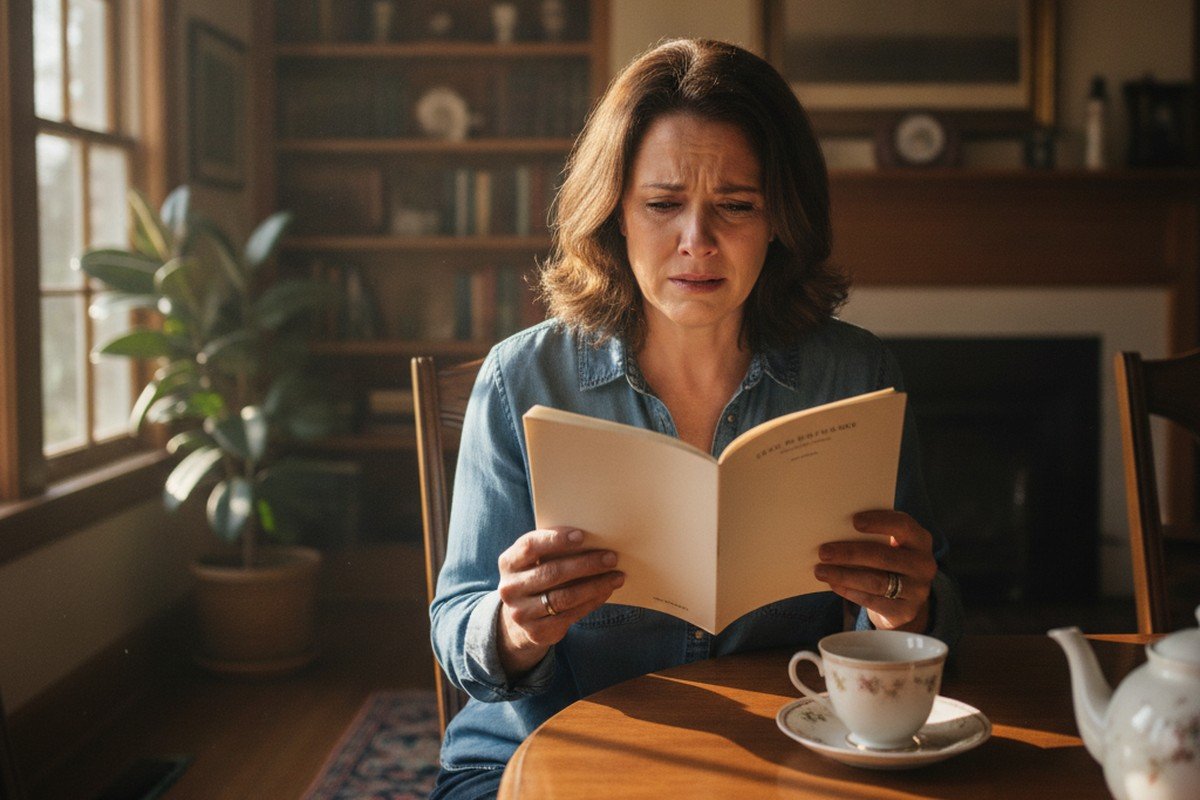
A wave of cold nausea washed over me as Brenda pulled a glossy sixteen-page printed booklet from her canvas tote bag and handed it to me across the fence.
“Here is yesterday’s official luncheon program; Evelyn made sure everyone at the sixty-person banquet received a copy,” Brenda added before walking down the street.
I stood frozen on the front walkway, clutching the printed booklet as my heart pounded in my ears.
The booklet cover announced the annual spring charity luncheon of the Oakridge Women’s Civic Circle, held at the historic country club ballroom on Tuesday afternoon.
I opened the booklet to page six and found a full-page feature titled Overcoming Adversity: A Granddaughter’s Courageous Appeal, authored and presented by Evelyn Vance.
The printed text contained word-for-word paragraphs lifted directly from Maya’s confidential university hardship appeal, including detailed accounts of her orthopedic hospital stays, our private medical debts, and our family financial limitations.
The document ended with a public pledge card inviting club members to contribute to a special benevolent scholarship fund managed by Evelyn herself.
Tucked inside the back flap was a printed announcement stating that Maya would be invited to give an acceptance speech at the June country club banquet to receive the charity donation in front of local press.
My hands shook with righteous anger as I realized that my mother had secretly entered our home library, taken Maya’s private college essay from the blue folder, photocopied the document, and distributed it to sixty prominent local community members.
Maya had not yet returned from her morning high school classes, and the thought of her learning that her most painful childhood memories were being circulated as public gossip made my stomach churn.
This breach of trust meant that my daughter’s private medical trauma was now being discussed over coffee cups across our entire neighborhood.
The cost of this exposure to Maya’s self-esteem and future collegiate independence would be devastating if I did not intervene immediately.
I immediately called my mother’s home telephone, my voice shaking with fury as soon as she picked up.
“Mother, I am holding the civic circle luncheon program from yesterday,” I said without greeting her.
“Hannah, wasn’t it wonderful?” Evelyn replied with bright enthusiasm. “The committee members were in tears, and we already collected over nine hundred dollars in pledges for Maya’s college fund!”
“You stole a confidential college scholarship appeal from my private library desk and printed Maya’s private medical history in a public brochure!” I shouted.
“I did not steal anything, Hannah,” Evelyn answered defensively. “I found the folder on the desk when I brought over zucchini bread on Friday, and I saw an opportunity to secure financial help for my granddaughter.”
“Maya did not ask for your charity, and she explicitly asked that her medical history remain confidential between her and the university bursar!” I replied firmly.
“You are being ungrateful, Hannah,” Evelyn insisted. “These women have substantial philanthropic influence, and I gave Maya an incredible opportunity while demonstrating our family resilience.”
“You exploited my daughter’s vulnerability to make yourself look like a benevolent patron in front of your social circle,” I told her.
“I will be at your house in ten minutes, Mother. Do not leave, because we are resolving this immediately,” I added before ending the call.
I walked into our home library, opened the desk drawer, and confirmed that the pale blue folder was empty; the original printed appeal had been taken and never returned.
I drove five blocks to Evelyn’s townhouse, parked along the curb, and walked up the stone steps with the printed luncheon program gripped tightly in my hand.
Evelyn opened the front door wearing an elegant knit cardigan, her expression already set in a rigid mask of injured pride.
I stepped into her formal foyer, held up the printed brochure, and pointed directly to the printed excerpts.
“You will return Maya’s original paperwork right now, and you will call the civic club president to cancel this benevolence fund today,” I said evenly.
Evelyn crossed her arms and backed into the living room. “I will not humiliate myself by canceling a charitable initiative that I personally announced to the entire board.”
“You humiliated your granddaughter by treating her painful childhood orthopedic recovery as public entertainment for your friends!” I answered.
“Maya will be grateful when she does not have to take out student loans for her textbooks!” Evelyn argued, raising her voice.
“Maya is seventeen years old, and she has the right to decide who knows about her body and our family finances,” I told her.
The confrontation escalated when Evelyn admitted that she had already emailed a digital PDF copy of the luncheon program to the regional civic federation newsletter editor for wider publication.
That admission proved that she was planning to broadcast Maya’s private struggles across the entire county civic network.
Then Evelyn revealed that she had applied for a civic leadership award based partly on her family philanthropy initiative.
That was the moment the argument changed, because I discovered that Maya’s private medical story was being used as an audition piece for a regional civic trophy.
Instead of defending her granddaughter’s future, my mother had reduced our family hardship to a public relations campaign.
Worse still, another club member sent Evelyn a text message during our argument, asking for Maya’s personal contact details to conduct a local radio interview.
I refused to allow my daughter to be turned into a public spectacle for the benefit of a country club committee.
“If you do not call the newsletter editor immediately and revoke that submission, I will attend next week’s general club meeting in person and publicly announce that this fundraiser was conducted without our consent using stolen private documents,” I stated with total clarity.
Evelyn gasped, stepping backward against her antique sideboard. “You would not dare embarrass your own mother in front of the community.”
“Watch me, Mother,” I replied, looking straight into her eyes. “My duty is to protect my daughter’s dignity, not your social standing.”
Realizing that I was fully prepared to expose her breach of trust to the entire civic circle board, Evelyn broke down into angry tears.
She walked over to her writing desk, opened the bottom drawer, and retrieved Maya’s original pale blue folder, handing the document back to me.
Then, sitting at her desk while I watched over her shoulder, Evelyn opened her email account and sent a formal written cancellation to the newsletter editor, retracting the article completely.
Next, she dialed the civic club president on speakerphone, stating that due to university scholarship compliance regulations, the special benevolence fund had to be canceled and all pledge checks returned uncashed.
The club president accepted the explanation without suspicion and agreed to shred all surplus luncheon programs remaining in the club office.
I took the blue folder and the printed programs, walked out to my car, and drove home to prepare for Maya’s return from school.
At twelve o’clock, I contacted the state university scholarship endowment office to ensure that no unauthorized third-party fundraising entity had contacted them regarding Maya’s file.
The scholarship counselor assured me that all financial aid deliberations were strictly sealed and evaluated solely on academic and financial merit without outside community solicitations.
When Maya arrived home at three o’clock, I sat down with her at our dining room table and told her the truth about what had occurred.
I showed her the canceled program and explained how the fundraiser had been dismantled before any pledges were processed or public articles printed.
Maya cried from the initial shock of the betrayal, but she hugged me tightly and thanked me for defending her privacy and shutting down the public spectacle.
“Thank you for protecting me, Mom,” Maya said softly. “I only ever wanted to earn my place on my own merits, not as someone’s charity project.”
On Thursday morning, I received a confirmation email from the state university financial aid office, officially awarding Maya a merit-based architectural design scholarship that covered her entire first-year tuition.
The formal letter proved that Maya had earned her academic standing entirely through her own portfolio and scholastic achievements.
We celebrated the victory together that evening at a quiet neighborhood Italian restaurant, sharing pasta and laughing over Maya’s campus housing plans.
Maya brought her sketchbook to the table, showing me her completed blueprints for a community center with sensory gardens and ground-level universal ramps, her eyes glowing with creative excitement.
The following weekend, Maya and I organized a private exhibition in our living room for her architectural models, inviting two of her high school drafting teachers and her closest friends.
Her teachers were astonished by Maya’s intricate scale model of a community center featuring tactile navigation strips and acoustic dampening panels for visitors with sensory sensitivities.
Watching Maya articulate her architectural philosophy with confidence and poise reaffirmed that her voice was hers to share when she chose, not a commodity for others to exploit.
During the exhibition, Brenda stopped by our porch with a bouquet of fresh garden lilacs, warmly apologizing for having handed me the luncheon brochure without understanding the hurt it caused.
Brenda admitted that many civic club members had felt uneasy about Evelyn’s presentation, realizing afterward that personal family struggles should never be paraded for donor applause.
I thanked Brenda for her honesty and accepted the flowers, glad that our neighborhood understood the difference between true community support and theatrical philanthropy.
The university architectural department sent Maya an official welcome package containing her studio access card and registration details for her first design seminar.
We walked to the university bookstore on Friday afternoon to purchase her precision technical pens, stainless steel rulers, and heavy watercolor paper.
Holding the bookstore receipt stamped with Maya’s student identification number, I felt a surge of gratitude that her path forward was clean and uncompromised.
The consequence for Evelyn was a deep, humbling loss of her self-appointed role as our family public spokesperson.
The consequence for our household was a permanent change in family access: I changed the electronic keypad codes on our house doors and informed Evelyn that she is only welcome to visit when invited.
Later that month, Evelyn stepped down from her position as program chairwoman, realizing that her overstepping had permanently altered her standing with her own daughter.
I spent the following weekend reorganizing our home library, installing a heavy brass deadbolt lock on the archival filing cabinet to ensure that our private family records remain completely secure.
Two months later, Maya graduated with honors at the top of her high school class, surrounded by true friends who respected her for who she was.
Evelyn sent a handwritten note in late August enclosing a modest graduation gift, carefully omitting any mention of civic awards or charity initiatives.
I acknowledged the note with a brief, polite phone call, keeping the conversation focused solely on neutral family greetings.
In August, I helped Maya move into her university dormitory, watching her proudly arrange her drafting tools and sketchbooks on her new desk.
Evelyn attended Maya’s high school graduation ceremony, sitting quietly in the fourth row, having finally learned that family trust cannot be sacrificed for social applause.
Now Maya studies freely without the burden of public pity, our private life remains protected, and our home is once again a place of true peace.
Walking across the sunlit university campus after saying goodbye to my daughter, I felt an enduring sense of maternal pride and inner peace.
I protected my daughter’s privacy and dignity through unwavering courage, and the firm boundary I established now keeps our family safe and respected.