On Friday afternoon, I loaded my station wagon with groceries, carpentry tools, and fly-fishing gear for a planned ten-day solitary vacation at Whispering Pines, my late father’s cedar lake cottage in the Blackwood Mountains.
As a high school physics instructor, the end of the spring academic semester always left me mentally drained and longing for quiet solitude.
My father Donald had spent thirty years building and refining the lakeside timber cottage with his own hands, creating a peaceful sanctuary overlooking the pristine waters of Heron Lake.
He had sourced hand-hewn cedar logs, laid the massive fieldstone hearth, and spent countless summer weekends teaching me the quiet discipline of woodland carpentry.
When my father passed away eleven months earlier, he bequeathed the cottage and its four surrounding wooded acres entirely to me in his recorded estate will.
I had spent the past eight months completing probate proceedings, paying off the modest remaining mortgage balance, and transferring the property deed into my individual name.
My father had also been a lifelong founding member of the regional Blackwood Civic Brotherhood, a local fraternal association dedicated to civic volunteerism and historical preservation.
While my father had generously hosted occasional summer fish fries on the cottage lawn during his lifetime, he had always maintained strict personal ownership and never granted the association any legal claim to the property.
The current brotherhood committee president, an ambitious retired contractor named Harold Finch, believed that all resources owned by senior lodge members belonged collectively to the organization.
Harold had repeatedly approached me during my father’s memorial service, hinting that Donald had surely intended for Whispering Pines to become a permanent mountain retreat center for lodge leadership.
I had politely but firmly clarified to Harold on three separate occasions that the cottage was my private family home and would never be converted into a communal facility.
The reason Harold refused to take no for an answer was his desire to inaugurate an ambitious regional youth leadership program that required an impressive wilderness headquarters to attract state funding.
He wanted the prestige of launching a high-profile mountain camp without having to pay commercial rental rates or leasehold fees.
He believed that because I was an unmarried schoolteacher who spent most of the year in the city, the cottage was sitting empty and available for communal exploitation.
He thought that by creating a fait accompli on a holiday weekend, I would feel too embarrassed to refuse thirty traveling delegates.
I feared that if the lodge established a presence on the property, the quiet natural habitat and timber cottage my father built would be ruined by constant group traffic.
I wanted Harold to understand that my father’s generosity during his lifetime did not transfer ownership of private real estate to an outside club.
I thought that my written email statements had permanently put the matter to rest, never suspecting that the committee would simply bypass my consent entirely.
When I drove up the winding gravel access road and arrived at the cottage at five o’clock on Friday evening, I stopped my car in shock at the edge of the clearing.
Nailed to the rustic timber entrance gate was a large, professionally printed wooden directional sign that read: “Welcome to Blackwood Brotherhood Alpine Leadership Retreat; Registration at Main Lodge.”
I stepped out of my wagon, my heart pounding with disbelief, and walked up the front steps to the cottage porch.
Resting on the cedar porch bench was a weather-resistant plastic storage tote containing thirty printed event orientation packets, laminated meal schedules, and key drop envelopes.
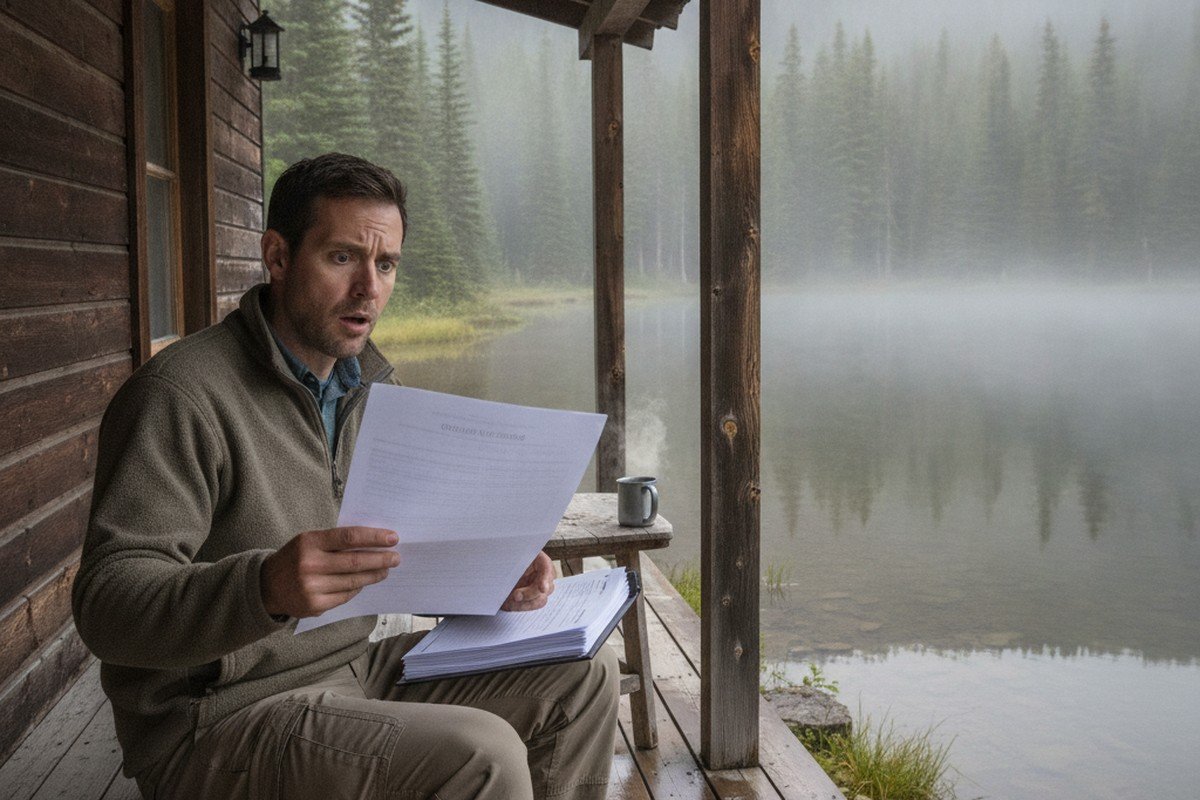
I picked up one of the printed orientation packets, opened the folder, and reviewed the official retreat itinerary document with mounting fury.
The document confirmed that the Blackwood Civic Brotherhood had scheduled a seventy-two-hour intensive leadership conference at my cottage for thirty-two traveling delegates from across three neighboring states.
The printed itinerary detailed that attendees would be sleeping in dormitory cots inside the great room, utilizing the private boat dock for rowing exercises, and staging outdoor campfire banquets on the lawn throughout the weekend.
The document proved that Harold Finch had signed an official facility usage declaration certifying that the venue was fully secured, insured, and provided at zero cost to the association.
Worse still, the document indicated that delegate registration fees of one hundred and fifty dollars per person had already been collected into the brotherhood treasury, totaling forty-eight hundred dollars in unearned revenue.
Then I discovered a secondary envelope containing a master key duplicate that Harold had illicitly obtained from a local hardware store using my father’s old trade account.
Before I could even process the audacity of this intrusion, the deep rumble of a commercial passenger charter bus echoed through the pine trees.
I watched in stunned amazement as a fifty-passenger tour coach navigated the narrow gravel driveway, coming to a halt directly in front of the cottage workshop and releasing its air brakes.
A dozen passengers with oversized duffel bags and hiking gear began disembarking onto my gravel turnaround, looking around the tranquil mountain property with enthusiastic smiles.
Seconds later, Harold Finch’s red pickup truck pulled in behind the bus, kicking up clouds of dust as he stepped out wearing an embroidered brotherhood blazer and a wide smile.
“Julian, my boy! You made it up early to welcome the fellows!” Harold shouted warmly, waving a clipboard as he walked toward the porch.
I stood at the top of the porch steps, holding the printed retreat packet in my hand, my expression cold and unmoving.
“Harold, tell the bus driver to put every bag back in the luggage bay and leave this property immediately,” I stated in a clear, carrying voice.
Harold’s jovial expression froze, replaced by an irritated furrow of his brow as he hurried up the steps, leaning in close to speak quietly.
“Julian, what on earth are you doing?” Harold whispered urgently. “These delegates drove four hours from across the state line. We have the regional district governor arriving in twenty minutes.”
“You have zero legal right to be on this property, Harold,” I replied firmly, pointing at the printed schedule in my hand.
“You forged an unauthorized facility usage agreement and advertised my private home as a public retreat center after I explicitly told you no three times,” I stated.
“Julian, your father Donald was the soul of this brotherhood,” Harold argued defensively, raising his hands in appeal.
“Donald would be turning in his grave if he knew you were turning away his loyal brothers over a bureaucratic misunderstanding,” Harold insisted.
“My father built this cabin with his own hands as a sanctuary for our family, Harold, not as an unpermitted commercial conference hall for your association,” I answered.
The confrontation escalated as Harold insisted that the lodge executive committee had passed a unanimous resolution designating Whispering Pines as an official auxiliary asset.
“Your committee has zero legal authority to pass resolutions regarding private real estate that belongs solely to me,” I told him.
I pulled my leather binder from my travel bag and retrieved a certified copy of the county warranty deed and the recorded probate decree, holding them directly in front of Harold’s face.
“This property is titled in my name alone, Harold. It is not owned by the lodge, it is not zoned for commercial lodging, and my homeowner insurance does not cover thirty-two strangers camping in my living room,” I said.
“If anyone slips on the dock or gets injured on these rocks, I would be personally liable for catastrophic medical damages,” I emphasized.
That was the moment the confrontation changed when Harold admitted that he had promised the state association that the venue was completely free so that the lodge could pocket the registration fees to cover an operational budget deficit.
Worse still, Harold revealed that the lodge treasury had already spent half of the collected registration money on catered barbecue and custom commemorative jackets.
The realization that Harold had deliberately exploited my father’s memory and sacrificed my property rights to bail out his mismanaged organization filled me with cold determination.
I feared that if I conceded even one evening of access, Harold would establish a precedent of adverse possession and continue using the property for annual events.
I wanted Harold to understand that my father’s legacy of kindness was not an open invitation for exploitation.
I believed that defending property rights and private boundaries was the only way to protect my family’s sanctuary.
The reason Donald left Whispering Pines to me was to preserve our family heritage, not to subsidize fraternal budget shortfalls.
“Here is the reality of your situation, Harold,” I told him, looking him squarely in the eyes.
“You have exactly twenty minutes to instruct that bus driver to reload all passengers and clear out of this driveway,” I said.
“If that bus and your truck are not past my entrance gate by five-thirty, I will dial the county sheriff’s department and file formal criminal trespass complaints against you and the association,” I warned.
“Julian, that will cost the brotherhood thousands of dollars to relocate thirty people on a holiday weekend!” Harold yelled, his face turning dark purple with rage.
“Then you should not have collected forty-eight hundred dollars under false pretenses, Harold,” I answered calmly.
Seeing that I had pulled out my smartphone and keyed in the direct dispatch number for the county sheriff, Harold realized that I would not back down under any circumstance.
Swallowing his pride with visible humiliation, Harold walked over to the tour bus driver and the gathered delegates, announcing through gritted teeth that a facility emergency required an immediate venue change.
For thirty minutes, the delegates grumbled in confusion as they reloaded their luggage into the cargo bays.
At ten minutes to six, the tour bus and Harold’s pickup truck rumbled down the access road, disappearing past the tree line and leaving the clearing in utter silence.
The consequence of Harold’s reckless overreach was immediate and severe for the brotherhood treasury.
Harold was forced to negotiate an emergency group reservation at a commercial ski lodge twenty miles away on the mountain pass, depleting thirty-six hundred dollars of lodge reserves to secure thirty hotel rooms at peak weekend rates.
The cost of the emergency relocation wiped out the retreat profits and created an immediate financial shortfall for the lodge.
The following morning, on Saturday, I took a heavy crowbar and removed the wooden brotherhood directional sign from my entrance gate, cutting it into firewood.
At ten in the morning, a county sheriff deputy arrived at my cabin in response to the preliminary dispatch report I had logged.
The deputy examined my deed, inspected the unauthorized retreat brochures, and completed an official incident report documenting Harold’s unlawful commercial trespass attempt.
“If any vehicle from that organization enters your road again, Mr Donald, we will impound the transport and arrest the driver on sight,” the deputy assured me.
I spent the afternoon on the timber dock, replacing two weathered cedar deck planks and breathing in the crisp mountain air as gentle ripples lapped against the pilings.
On Sunday morning, I took my father’s handmade bamboo fly rod out onto the lake at dawn, catching two rainbow trout in the misty cove beneath the pine bluffs.
The regional district governor also sent a personal letter expressing deep regret for the misunderstanding and commending my firm defense of my father’s property.
My sister and her two children came up for a week in late July, filling the cabin with genuine laughter and joy as we swam off the dock.
We baked fresh berry cobbler in Donald’s cast-iron skillet, remembering his warmth without the shadow of outside interference.
Now, whenever I drive up the winding gravel road, I know that my home is truly secure.
I drove into the county seat on Monday morning, where I met with a local security contractor to install a heavy steel security gate with a digital keypad and cellular trail cameras along the driveway.
I also consulted my real estate attorney, who drafted a formal cease-and-desist letter delivered via certified mail to every member of the Blackwood Civic Brotherhood executive board.
The letter put the association on formal legal notice that any future entry onto Whispering Pines without my written authorization would trigger immediate civil trespass litigation and punitive damages.
Two weeks later, the brotherhood executive council held an emergency meeting, voting unanimously to censure Harold Finch and remove him from the committee presidency for ethical misconduct.
The council sent me a formal written apology signed by all seven trustees, permanently disclaiming any interest or claim to my father’s estate.
The mountain air remains crisp and unpolluted, a living testament to the values my father cherished throughout his life.
The lakefront woods now stand protected against outside overreach, preserving our family heritage for generations to come.
Three months later, as autumn foliage turned crimson and gold over Heron Lake, I sat on the cottage porch in the peaceful mountain silence, watching bald eagles soar over the open water.
Taking decisive action had protected the sanctuary my father spent three decades creating with his bare hands.
The firm boundary I established ensured that Whispering Pines will remain what it was always intended to be: a quiet family refuge anchored in peace, respect, and enduring independence.