# My Mother-in-Law Crossed Out My Name on the Bakery Order
The first thing my mother-in-law changed about my wedding was not the flowers, the music, or the seating chart. It was my name.
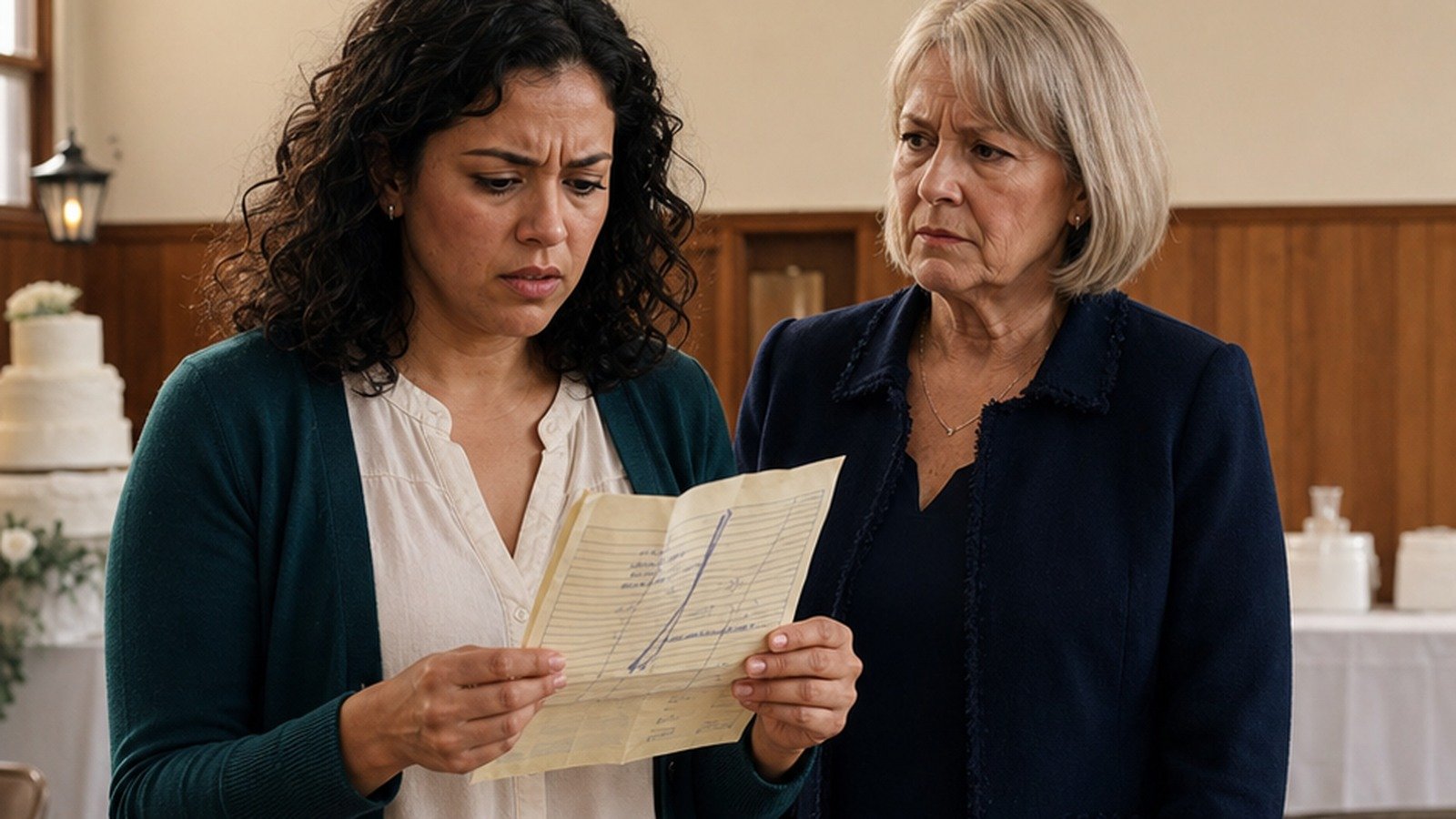
I found the carbon-copy bakery order on a folding table at the union hall three days before the ceremony. CAMILLE ORTIZ had been crossed out in blue ink. Under it, someone had written RUTH MERCER, followed by a new phone number and the words CANCEL GROOM'S CAKE.
Ruth was standing twenty feet away, directing my fiancé, Ben, and two cousins as they carried boxes of glass candleholders. She had the calm, capable expression she wore whenever she entered a room and silently decided everyone else was doing things inefficiently.
I held up the order. “Did you cancel my brother's cake?”
Every box stopped moving.
Ruth looked at the paper, then at me. “I changed the contact person.”
“That is not what I asked.”
My older brother, Mateo, owned the bakery supplying both our wedding cakes. The shop had been part of our family rhythm since I was in college. I had iced cupcakes there during holiday rushes, and Mateo had quietly covered our mother's grocery bill in lean months. Ben knew that history. Ruth knew only that Mateo was a vendor who answered messages late and treated every change as a favor. I had kept those two versions of him separate because bringing relatives into a contract already felt risky.
Ruth had her own reason for watching wedding costs. After Ben's father died, she found invoices he had handled with handshakes and half-finished notes. More than once, a bill arrived that she could neither confirm nor disprove. Ben had told me that story as an explanation for her folders, duplicate receipts, and habit of asking for every price in writing. Until I saw my name crossed out, those habits had seemed fussy rather than threatening. Mine was lemon with white frosting. Ben's was a chocolate sheet cake decorated like the old baseball field where we met. Mateo had offered us a family rate, and I had defended him when Ruth suggested getting a second estimate.
Now the words CANCEL GROOM'S CAKE sat between us in blue ink.
Ruth asked if we could speak in the hall office. I said no. It was not my proudest decision. I was tired, embarrassed, and suddenly certain that privacy was the tool she used to get her way. I wanted witnesses.
“You do not get to remove my brother from my wedding,” I said. “And you do not get to put your name over mine.”
Ben stepped toward me, but I raised the order before he could touch my arm. Ruth's face went pale, then still. “The lemon cake is still coming,” she said. “The other order is not.”
“Why?”
“Because Mateo changed the price yesterday.”
That sounded impossible. The total was printed at the bottom of my copy. I had paid the deposit myself. Ruth reached into her tote bag and removed another order form. Same date. Same cake descriptions. Different total.
Mateo's second invoice added an eight-hundred-dollar “priority delivery adjustment” and required payment before the rehearsal. On the back, in Mateo's handwriting, was a note: Delivery held until old balance is resolved.
I knew about no old balance.
Ruth said Mateo had called Ben that morning. Four years earlier, when Ben's father was still alive, he had ordered food for a retirement dinner and disputed the final bill. Ruth believed it had been settled. Mateo said the Mercer family still owed him money and that he would not deliver either wedding cake unless the new charge was paid.
My first reaction was to defend my brother. Mateo had kept his bakery open through long weeks and thin margins. He would not invent a debt. My second reaction was worse: I wondered whether Ruth had tried to use our wedding to avoid paying him.
“Show me the original bill,” I said.
“I cannot,” Ruth answered. “I do not have it.”
That answer gave my anger somewhere easy to go. I told her she had no proof, no right to change the order, and no business making a family decision behind my back. Then Ben said, quietly, “I asked her to handle it.”
The hall seemed to tilt.
Ben had taken Mateo's call while I was meeting the florist. He worried that telling me would put me between my brother and his mother on the week of our wedding. So he gave Ruth permission to pay for the disputed retirement dinner if Mateo would remove the new fee. Ruth called Mateo. He refused. She canceled only the groom's cake and ordered a plain replacement from the grocery bakery.
They had protected me by turning me into the last person who knew what was happening at my own wedding.
I asked Ben what he thought would happen when the replacement cake arrived. He admitted he planned to tell me after the rehearsal, when guests were present and changing course would be difficult. Ruth objected that she had wanted to tell me sooner. Ben turned toward her and asked why, then, she had not called me before writing her name on the order. For the first time they were not a united front. Their attempt to contain Mateo had depended on each believing the other would eventually explain it.
The cousins carried the candleholders into the next room. The three of us remained beside the folding table, surrounded by boxes labeled with decisions I had actually made. Ben said, "I thought one problem I solved without you would be kinder than ten problems I handed you."
"But you did hand it to me," I said. "You just waited until it was on fire."
I put both invoices on the table. “Call Mateo.”
Ben offered to do it. I told him the call would be on speaker and all three of us would be present. Ruth started to object, then stopped herself.
Mateo answered from the bakery kitchen. Mixers thumped behind him. When I asked about the old balance, he said Ben's father had refused to pay for thirty meals added on the night of the retirement party. He had carried the loss for years. When he learned which family I was marrying, he decided the wedding was his only chance to collect.
“You told me the price was final,” I said.
“It was final for your cake.”
“You threatened to hold both cakes.”
He went silent.
Ruth opened her mouth, but I held up one hand. I was not going to let her win the argument for me. I asked Mateo to send every record he had. Ten minutes later, photographs arrived: the original estimate, a handwritten change count, and a final invoice. The extra meals were real. So was a credit entered two weeks later for returned equipment. The amount still disputed was two hundred sixty dollars, not eight hundred.
Then Ruth admitted the part she had kept from Ben. His father had complained about the bill, but Ruth had mailed Mateo a check for the remaining amount after the retirement dinner. Her bank no longer showed the old image. She had no receipt because Mateo had told her on the phone that the matter was closed.
Mateo said he never received it.
There was no clean villain in the room, which was inconvenient because I badly wanted one.
My brother had used my wedding as leverage. My fiancé had hidden a crisis to spare me stress. Ruth had changed my vendor paperwork and placed her name over mine. Each person could explain the fear behind the decision. None of those explanations made the decision acceptable.
I told Mateo to deliver only the lemon cake at the original contracted price. I would pay the remaining balance when it arrived, and after the wedding he could pursue the old dispute through records rather than threats. If he refused, he could keep the deposit and stay home.
He accused me of choosing my new family over him.
“No,” I said. “I am choosing not to let either family purchase control of this day.”
He hung up.
The silence after the call was different from the one before it. We no longer had a disputed invoice in the abstract; we had Mateo's threat, Ruth's undocumented payment, and Ben's plan to delay telling me. I wrote the known amounts and unanswered questions on the back of the seating chart. Ruth wanted to call her bank again. Ben wanted to drive to Mateo's shop. I stopped both ideas. The ceremony was three days away, and urgency had already given everyone permission to act alone.
We made a narrower plan. Ruth would search her tax records for the check number. Ben would confirm the grocery order without changing it. I would put the lemon-cake agreement in writing to Mateo and copy both of them. No one would settle the four-year-old debt before the wedding. It was not a satisfying resolution, but it prevented the next secret action while leaving room for evidence.
I turned to Ben. He apologized first. Not for failing to solve the problem, but for deciding I was too fragile to face it. That distinction mattered. We agreed that no one would change a vendor, payment, guest, or schedule without both our names on the decision.
Ruth looked at the crossed-out order. “I thought if my name was on it, Mateo would direct his anger at me.”
“He did,” I said. “But you also erased me.”
She took that without defending herself. Then she wrote a short note beneath her correction: Contact changed without bride's approval. Reversed. She signed it and passed me the pen.
The lemon cake arrived on our wedding morning. Mateo did not. He sent our youngest cousin with the delivery and a sealed envelope containing my deposit receipt, the disputed records, and a two-line apology. I did not read it before the ceremony.
The grocery bakery delivered Ben's chocolate sheet cake in a plain white box. It had no baseball field, no piped stadium lights, and no clever decoration. Ben and I added one little plastic scoreboard from his childhood desk. It looked homemade because, by then, honesty felt more useful than polish.
At the reception, Ruth did not explain the family conflict or ask to be praised for trying to protect us. She simply introduced me to the bakery manager as the person authorized to approve the delivery. Then she stepped back.
Mateo and I met two weeks later at his shop. He had placed the old retirement file beside two cups of coffee and, for once, closed the kitchen door before we talked. Ruth had found a check number, but the bank could confirm only that the check had expired, not that Mateo had deposited it. Mateo showed me how the extra thirty meals changed his staffing and food costs. I showed him the wedding message in which he had called eight hundred dollars a delivery adjustment rather than an old claim.
He said he had chosen that wording because he knew I would reject a family debt added to my contract. Hearing him state the calculation plainly mattered more than another general apology. I told him that if he wanted me to trust his business, he had to allow me to say no before the consequences arrived at the venue. He agreed to send Ruth a clean two-hundred-sixty-dollar claim with supporting records and accept whatever the records could prove. We did not settle every old grievance over coffee. We did compare copies, separate the retirement dispute from my wedding contract, and agree that family discounts would never again come with invisible obligations.
The carbon-copy order now sits in a folder with our marriage certificate and vendor receipts. The blue line through my name is still visible. So is Ruth's signed correction beneath it.
I kept both because a boundary is not proven by never being crossed. Sometimes it is proven by what everyone does after the crossing becomes impossible to ignore.