On Tuesday morning, I was sitting at the breakfast nook with my hot coffee when the loud hydraulic hiss of an eighteen-wheeler air brake echoed from our quiet suburban street.
The neighborhood was usually completely silent at seven in the morning, save for chirping robins and the distant rumble of school buses heading toward the county elementary school.
I looked out the front window and saw a heavy flatbed commercial freight truck attempting to back into our narrow residential driveway on Birch Lane.
The truck’s yellow hazard lights flashed rhythmically across our living room ceiling as the driver maneuvered the massive rig between our mailbox and the maple tree.
The driver climbed down from the cab carrying a metal clipboard and began unstrapping four large wooden shipping crates wrapped in heavy industrial protective plastic.
I walked outside into the cool morning air and asked the driver who had ordered the shipment to our quiet residential address.
The driver checked his manifest and handed me a commercial delivery receipt stamped with the name of an industrial machinery supplier in Ohio.
“The delivery receipt is signed by Mark Henderson for delivery to this garage location,” the driver explained, pointing to my husband’s signature at the bottom of the invoice.
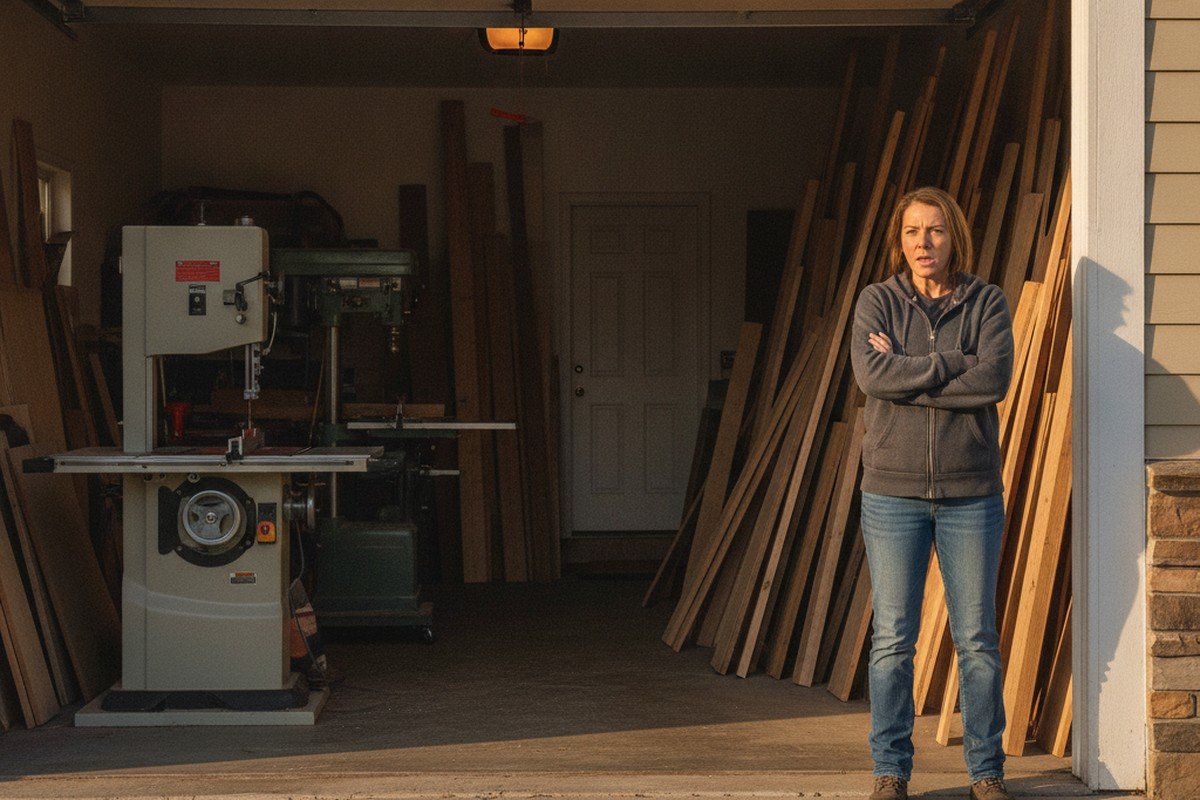
I reviewed the invoice carefully and discovered that the crates contained a heavy three-horsepower cabinet table saw, an industrial dust extractor, and twenty sheets of commercial marine plywood.
The document proved that over four thousand dollars of commercial workshop machinery was being unloaded directly onto our residential property.
When I asked the driver why commercial machinery was being delivered to a private home, he showed me the delivery instructions: “Unload into two-car detached garage; tenant will begin commercial fabrication next week.”
I felt an immediate surge of disbelief because my husband Mark had never mentioned any delivery, let alone turning our two-car garage into a commercial production site.
The thought of our quiet home being converted into an industrial workshop made my stomach churn with apprehension.
I thought about our suburban neighbors who valued the peaceful atmosphere of our cul-de-sac and would certainly object to high-pitched table saws running all day.
I called Mark at his accounting office immediately, but his phone went straight to voicemail after two rings.
“Mark, there is an eighteen-wheeler in our driveway right now unloading industrial machinery into our garage,” I said firmly into the voicemail. “You need to call me back immediately because this is completely unacceptable.”
Fifteen minutes later, my phone rang and Mark’s voice came through the line, sounding tense, rushed, and defensive.
“Rachel, please do not make a scene with the delivery driver,” Mark said quietly. “It is for my cousin Trevor. He lost the lease on his downtown cabinet workshop, and he just needed a temporary place to stage his equipment for a few weeks.”
“You did not just stage equipment, Mark; the delivery invoice specifically says our garage is being used as a commercial fabrication workshop,” I answered.
“We will talk about the details when I get home tonight,” Mark insisted, trying to end the phone call before I could ask further questions.
“No, we are talking about this now, because the driver is asking me to sign the final bill of lading,” I told him.
Mark hesitated before admitting that he had signed a formal six-month space agreement with Trevor three weeks ago without telling me.
The argument escalated rapidly as I stood in our driveway, watching the driver lower the first thousand-pound crate onto our asphalt.
“Our suburban property is zoned strictly residential R-1, Mark,” I reminded him. “Operating a commercial woodworking business here violates our township zoning bylaws and our homeowner insurance policy.”
“Trevor is family, Rachel, and he would have gone completely bankrupt if I did not help him keep his custom furniture contracts alive,” Mark argued defensively.
I refused to accept his excuse, telling him that putting our home insurance and zoning compliance at risk was an egregious breach of trust between partners.
That was the moment I discovered that Mark had already contracted an electrician to upgrade our garage subpanel to two hundred amps of commercial three-phase power.
He admitted that he had scheduled the electrician for Thursday morning to install high-voltage wiring for the industrial saw and heavy dust extraction unit.
The electrical modification contract carried an estimated cost of eighteen hundred dollars, which Mark had planned to pay out of our joint household maintenance fund.
“You committed our garage space, our legal liability, and eighteen hundred dollars of our household money without once asking my opinion,” I told him.
Mark answered that as co-owner of the property, he believed he had the right to make emergency accommodations for his immediate family members.
“Co-ownership means neither of us makes unilateral decisions that alter our home’s legal standing or financial security,” I replied.
“Why did you think you could conceal a four-thousand-dollar machine installation from your own wife?” I asked him.
I feared that if an electrical fire occurred in an unpermitted commercial garage, our homeowner insurance would refuse coverage and leave us financially ruined.
I wanted our marriage to be an honest partnership, but this secret contract proved that Mark was willing to jeopardize our safety behind my back.
The reason he hid it was obvious: he knew I would point out the legal risks and refuse to host an unlicensed factory in our backyard.
I instructed the delivery driver that the crates could sit on the concrete apron temporarily for forty-eight hours, but could not be unboxed or wired into the garage structure.
The driver nodded, had me sign a conditional drop slip, and drove away, leaving our driveway completely blocked by the massive wooden crates.
I stood alone in the driveway staring at the towering crates, feeling a profound sense of isolation because my partner had chosen secrecy over basic partnership.
I thought about how hard we had worked to buy this home four years ago, carefully budgeting every paycheck to build a stable suburban sanctuary.
Before work that afternoon, I drove down to the township municipal building to review our local zoning regulations and commercial enterprise restrictions.
The municipal zoning officer reviewed our parcel map and confirmed that commercial manufacturing, daily freight deliveries, and industrial power equipment were strictly prohibited in our neighborhood.
The officer explained that if neighbors complained about commercial noise or sawdust exhaust, the township would issue a formal violation notice carrying daily fines of two hundred and fifty dollars.
She handed me an official copy of the municipal code chapter on home occupations, which clearly prohibited customer traffic and heavy machine fabrication.
I also called our homeowner insurance agent, who confirmed that operating an unlicensed woodworking shop on residential property would immediately invalidate our fire and liability coverage.
“If an industrial dust fire occurred in an unpermitted commercial garage, the insurer would deny the entire claim,” the agent warned me solemnly.
Armed with the municipal code and our insurance policy warnings, I returned home to prepare for the confrontation that had to happen.
I laid out our mortgage documents, the township zoning ordinance, and the property tax assessment across our dining room table, creating an undeniable record of our legal obligations.
At six o’clock that evening, Mark arrived home and found me sitting at the kitchen table with the municipal zoning code, our insurance policy, and his signed delivery receipts laid out in plain view.
Trevor was standing right behind him in the doorway, holding a heavy toolbox and looking sheepish as he avoided making eye contact with me.
“Rachel, Trevor is here so we can all sit down and work out a reasonable schedule that works for everyone,” Mark began, attempting to sound diplomatic.
“There is no schedule to work out, Mark,” I said, looking at both of them. “This garage will not be operated as a commercial manufacturing workshop under any circumstances.”
Trevor spoke up, trying to plead his case with an apologetic smile. “Rachel, I promise I will only run the heavy table saw between ten in the morning and three in the afternoon, so the neighbors will hardly notice.”
“The township zoning officer confirmed this afternoon that running a commercial furniture business here will trigger daily fines of two hundred and fifty dollars,” I told Trevor, pointing to the code printout.
“Furthermore, our homeowner insurance agent confirmed that operating an unlicensed commercial workshop voids our property liability coverage entirely in the event of a fire,” I added.
The argument changed when Mark admitted that he had already accepted three months of advance workshop rent from Trevor to pay for the upcoming electrical upgrade.
That was the moment I discovered Mark had treated our home as a commercial rental property while deliberately concealing the transaction from me.
“You took cash rent from your cousin and planned to hide it while altering our home’s electrical system?” I asked Mark, my voice trembling with controlled anger.
Mark looked down at the table, unable to find an answer that sounded defensible.
“Why did you think you could keep a financial arrangement like this secret from your own wife?” I asked him.
“I feared you would say no immediately, and Trevor was facing eviction from his commercial space within forty-eight hours,” Mark answered quietly.
“The reason you hide things from a partner is that you already know the action is wrong and violates their trust,” I told him.
“You need to refund Trevor’s rent money immediately, Mark,” I said firmly. “And Trevor, these four crates need to be removed from our driveway by Thursday afternoon.”
Trevor looked at Mark with visible frustration. “Mark, you told me two weeks ago that Rachel was completely on board with this arrangement.”
The revelation that Mark had lied directly to his cousin to smooth over his unilateral decision made the betrayal even more stark and painful.
“Mark lied to you, Trevor,” I told him plainly. “I was never consulted, and I would never have agreed to put our home and financial stability at risk.”
Trevor sighed heavily, shook his head, and apologized to me for the intrusion before stepping back outside to his truck.
Once we were alone in the kitchen, Mark attempted to defend himself by claiming he had only wanted to be a supportive family member in a crisis.
“You cannot be generous to someone else by stealing safety and transparency from your own marriage,” I told him.
“I wanted to help Trevor get through his rough patch, and I thought you would understand once the project was already underway,” Mark said quietly.
“Presenting your partner with an accomplished fact is not seeking understanding; it is manipulation,” I answered.
I explained that trust was not an abstract concept, but a daily practice of consulting each other before taking actions that affected both our lives.
I told him that concealing financial transactions and inviting commercial liability into our home had shaken the foundation of our marriage.
Later that night, Mark went out to the driveway and spent an hour measuring the crates before coming back inside to sleep in the guest bedroom.
I spent the evening reviewing our joint bank statements, changing online passwords, and separating our discretionary savings accounts.
I sat up until two in the morning drafting a clear set of household guidelines governing shared property, emergency assistance, and financial transparency.
On Wednesday morning, Mark called the electrical contractor and formally canceled the eighteen hundred dollar subpanel upgrade, forfeiting a seventy-five dollar cancellation administrative fee.
He then wrote a personal check to Trevor refunding the full advance rent amount that he had accepted without my knowledge.
Mark also spent two hours calling local industrial commercial brokers to help Trevor locate an affordable shared space in the neighboring county.
The consequence was a significant loss of personal time and stress, but Mark took full responsibility for undoing the logistical knot he had created.
By Thursday afternoon, a local moving company arrived with a flatbed truck, loaded the four heavy machinery crates, and transported them to a shared commercial maker space in the industrial park.
The garage apron was swept clean, and I parked my car back inside our two-car garage for the first time in three days.
Standing inside the clean, quiet garage with the afternoon sun slanting across the concrete floor, I felt a deep sense of relief that our boundary had held.
In the aftermath of the crisis, Mark and I agreed to establish strict new financial and property boundaries to restore trust in our marriage.
We instituted a mandatory joint approval rule requiring written agreement before either of us could commit household space, invite extended guests, or authorize any expenditure exceeding two hundred dollars.
We also scheduled three months of sessions with a licensed marriage counselor to work through the patterns of conflict avoidance that had led to his secret decision.
The consequence of the ordeal was a difficult six-week period of marital tension, but having clear, enforceable boundaries prevented an even greater legal and financial catastrophe.
Two months later, Trevor successfully opened his workshop in the industrial park, and he recently thanked me for holding the line before he invested thousands into an illegal residential setup.
Now, our garage remains a quiet residential space for our cars and bicycles, and our home remains protected from unauthorized enterprise.
The boundary between our marriage and outside family demands remains firm and enduring: neither of us makes major commitments without the other’s informed and explicit consent.
True partnership requires honesty and mutual respect, and protecting our home from reckless obligations was the best decision we could have made for our shared future.
In the months that followed, our communication grew stronger as Mark learned that real security in a family begins with complete transparency at home.
We continue to maintain our household guidelines, confident that honoring each other’s boundaries is the only foundation that can withstand life’s unexpected pressures.
When I look at our quiet garage today, I feel gratitude for the courage it took to stand firm against secrecy and protect the sanctuary we worked so hard to build.
Marriage is an ongoing commitment to shared truth, and refusing to allow outside pressure to erode our home’s foundation was the most loving act of preservation possible.